

Tuesday, October 27, 2009
Mountain yam wrapped in bacon 長いものベーコン巻き


Monday, October 26, 2009
Deep-fried pork and onion skewer 豚肉とタマネギの串揚げ
Deep-fried pork and onion skewer 豚肉とタマネギの串揚げ (Mark's book p60)
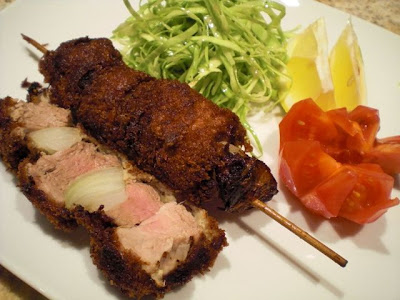 This is also a very popular item either in Izakayas or restaurants specialized in "kushiage" 串揚げ. Kushiage ("kushi" means a skewer and "age" means to deep fry) is skewered small pieces of meat, fish, or vegetables, breaded and then deep dried. My wife and I are getting too old to have an entire meal of deep dried food either kushiage or tempura. But we enjoy few deep fried items in Izakayas. This combination of pork and onion is very common and very good. We mentioned "Muroran"-style yakitori with this exact combination. Onion and pork cooked together impart some synergetic enhancements of each flavor.

Here, I used pieces of pork tenderloin and onion skewered alternately on bamboo skewers. Some commercial establishments (not good Izakayas) may use a batter (water and flour) to coat the skewers before breading but this will usually make a very thick and oily crust. I use a more traditional method of dredging the skewered meat and onions in flour (AP flour), dipping it in an egg wash, and finally coating it in Japanese Panko crumbs (as described in the recipe in Mark's book). I deep fry using a low-meidum temperature since it will take some time to cook the pork through (15 minutes or more depending on the size of the pork). I sliced along the skewer to show the pork onion layering as it was done in the Mark's book illustration but, of course, you should just serve the skewers without cutting it. Serve this with a Japanese hot mustard and "tonkatsu sauce". The usual accompaniment is a thinly shredded cabbage but I lightly dressed the cabbage with my version of honey-musdard dressing as per my wife's request (she said she can not face a mound of a raw shredded cabbage). This dish can go with sake, beer, or red wine. We had this dish with a nice California Cabernet Sauvignon Flora Springs 2005.
Saturday, October 24, 2009
Stewed Japanese pumpkin かぼちゃの煮物
Stewed Japanse pumpkin カボチャの煮物
 Although this vegetable is called Japanese pumpkin, "Kabocha" カボチャ, it is a type of winter squash. This dish is the most common way to serve kabocha. Again, like many Japanese dishes most of the work for this dish is in the preparation of the squash. It appears that kabocha is grown in North America especially in California and Florida and, reportedly, many are exported to Japan. You can sometimes get kabocha even in regular grocery stores. The quality of the kabocha can vary a lot and success of this dish depends on the quality of the kabocha.
 I make Kabocha pottage from the scraps when I make the above kabocha dish. The recipe is very standard for any type of pottages. I mince one medium onion and saute in melted butter in a deep pan until soft and semi-transparent, season with salt and pepper. Peel and cut up one small potato into small cubes. Add to the pan with the kabocha scraps, saute briefly and add chicken stock to cover (I used a commercial, 1/3 less salt, non-fat variety from Swanson which comes in a carton). Add two bay leaves and simmer for 15-20 minutes or until all the ingredients are soft. Take off the pan from the burner and make sure to remove the bay leaves. Using an immersion blender (or food processor), process until smooth consistency is achieved and no solids remain (you may add more chicken stock to adjust the consistency). Add 1/3 cup (or whatever amount you prefer) of cream, mix and put the pan back on the burner, adjust the seasoning. I often add a small amount of white miso as a "hidden taste" 隠し味 for some Japanese touch but it is optional. I often serve this with the leftover stewed kabocha as seen above. Here, I garnished it with minced parsley.

Cut the kabocha in half using a heavy chef's knife or cleaver and remove the seeds and "guts". I cut the halves into 8th or to a large bite size pieces. I "shave off" the skin just leaving a hint of green behind (meaning the remaining layer of skin is extremely thin). I do this by securely placing the piece of kabocha on the cutting board and using a heavy chef's knife or vegetable cleaver "nakiri" 菜切り包丁. I use a paring knife and bevel all the sharp edges 面取り and soft parts (near where the seeds were). This is to prevent the kabocha from crumbling while cooking. Do not discard these scraps. I always use them to make a wonderful kabocha pottage (see below).
In a saute pan large enough, put all the kabocha pieces in a single layer with skin side down. Add "dashi" broth so the kabocha pieces are half submerged. Sprinkle sugar over the kabocha pieces (for the amount of kabocha which will fit in a 12 inch saute pan, I use about 2-3 tbs of sugar but but you can use more), and 2 tbs each of soy sauce (if you do not want the kabocha to color too dark, you could use "usukuchi" or light colored soy sauce) and sake. Cover and simmer for 10 minutes until kabocha is cooked through. Remove the lid and turn up the flame, gently shake the pan and reduce the liquid until it just coats the bottom of the pan and glazes the kobocha. Let it cool down in the pan and serve at room temperature.
Kabocha Pottage カボチャのポタージュ

Chicken tender with wasabi 鶏のささみのとりわさ

When chicken tenders are prepared as Yakitori, the are often grilled only on the surface with the center still raw. As long as you eat this type of dish in a reputable establishment in Japan, salmonella appears not to be a problem. Unfortunately, it is too dangerous to do this using store bought chicken in the U.S. Instead of using the traditional technique described above, I have to poach the chicken tenders gently in salted water with a dash of sake (to remove any smell it may have) for 5-6 minutes or until the chicken meat is completely opaque. I then let it cool down, slice it on the bias and eat it with wasabi and soy sauce. It does not taste or look as good as real "tori-wasa" but it has to do.
Here is an image borrowed from the web for "tri-wasa". f.hatena.ne.jp/paraiso/20090615192014
 Mmmmmm..this one looks good.

P.S. (2-27-10) I came across an article (in Japanese) which indicates a higher incidence of food poisoning among people who eat raw or under cooked chicken and other meat. Campylobacter and E. coli (O-157) are two major causes. They mention that among the population that eat raw chicken, there is 77 times more risk of food poisoning. So, even in Japan, eating raw chicken like this dish may not be wise.
Friday, October 23, 2009
Deep-fried tofu in tempura sauce 揚げ出し豆腐
Deep-fried tofu in tempura sauce 揚げ出し豆腐 (Mark's book p21)

This is a favorite Izakaya "teiban" 定番 or regular dish. It's called "agedashi-dofu" 揚げ出し豆腐 ("a-ge" means "deep fried", "dashi" means "broth"). Our good friends told us that they had this dish in a small Japanese restaurant located in a remote mountain town in the Western Canadian Rockies last summer (a very unexpected place to find good Japanese food). They liked it very much. So much so, they tried to make it at home. They said that the broth came out OK but the crunchy surface of the tofu was missing from their version. They said they coated the tofu with corn starch and pan fried it, instead of deep frying it. I have not made this dish for some time since we can have it at our Izakaya substitute in the U.S., "Tako Grill", which we frequent. They make a very good agedashi-dofu.
There are many versions of the recipe for this dish but the most important factor for its success appears to be the quality of tofu followed by the kind of flour used to coat it. I have traditionally used "potato starch" 片栗粉. That is also used in the the recipe in Mark's book. Potato starch is available in our Japanese grocery store. Other recipes suggest the use of regular AP (all purpose) flour or coating the tofu first with a beaten egg before dredging it in the flour. Most of the recipes call for deep frying the tofu but some home recipes suggest pan frying.

The broth is the usual mixture of dashi, soy sauce, and mirin but I took a short cut, and used a good quality bottled concentrated broth which I just diluted with hot water (to your desired taste). I added a small amount of soy sauce because it was a bit too sweet. For this dish, I make the broth stronger than I would if I were using the broth for a warm noodle dish. I just garnished it with grated ginger and chopped chives or scallions but you could also add any combination of julienned nori sheet, bonito flakes, graded daikon, prepared mushrooms, or even thicken the broth with potato starch (then, the dish is called "agedoufu no ankake" 揚げ豆腐の餡かけ, which is similar to "Deep-fried tofu with Mushroom sauce", Mark's book p120).

This is a favorite Izakaya "teiban" 定番 or regular dish. It's called "agedashi-dofu" 揚げ出し豆腐 ("a-ge" means "deep fried", "dashi" means "broth"). Our good friends told us that they had this dish in a small Japanese restaurant located in a remote mountain town in the Western Canadian Rockies last summer (a very unexpected place to find good Japanese food). They liked it very much. So much so, they tried to make it at home. They said that the broth came out OK but the crunchy surface of the tofu was missing from their version. They said they coated the tofu with corn starch and pan fried it, instead of deep frying it. I have not made this dish for some time since we can have it at our Izakaya substitute in the U.S., "Tako Grill", which we frequent. They make a very good agedashi-dofu.
There are many versions of the recipe for this dish but the most important factor for its success appears to be the quality of tofu followed by the kind of flour used to coat it. I have traditionally used "potato starch" 片栗粉. That is also used in the the recipe in Mark's book. Potato starch is available in our Japanese grocery store. Other recipes suggest the use of regular AP (all purpose) flour or coating the tofu first with a beaten egg before dredging it in the flour. Most of the recipes call for deep frying the tofu but some home recipes suggest pan frying.
I decided to do a small experiment. After draining and removing the excess water (as described before) from a firm or "momen-goshi" tofu, I cut the tofu into 8 equal sized rectangles and remove any surface moisture using paper towels. Four rectangles were coated with potato flour. Two each were coated with corn starch or AP flour. I usually deep fry these but our friends appeared to want to avoid deep frying. I do not think pan frying can give a nice crunchy surface to all sides of the tofu. So, I decided to use a "shallow frying" technique. The amount of oil I used is somewhat more than pan frying but much less than deep frying. The depth of the oil came to just half the thickness of the tofu as you can see below. Probably, I can further experiment to see how much more I can reduce the amount of oil while still maintaing the crunchy crust.


I used a frying pan large enough that the tofu pieces do not touch each other (otherwise they will stick together especially if you coat them with potato starch). They were cooked together in the same pan for the same amount of time. (Actually, I did two runs. The potato starch coated tofu was included in each run as a reference). I turned over the tofu once half way through the cooking (4-5 minutes each side or until the bubbles become small).
In the picture below on the left, the ones in the front were coated with potato starch, the ones in the back with AP flour (all are same size but the ones in the back look smaller because of the perspective of the camera lens). In the picture on the right, the lighter one (left) is coated with potato starch and the darker one (right) is coated with corn starch. The results were very clear; the potato starch does not burn and forms a nice crunchy surface crust with a very unique inner layer of somewhat gelatinous texture.

The corn starch is the second best. It does result in a darker color surface than does the potato starch but the crust in nicely crunchy. My wife also noticed that the corns starch imparts a subtle corn flavor to the tofu. The tofu coated in AP flour burned easily and did not form a good crust. So, my conclusion is that potato starch is the best and corn starch is OK but AP flour does not work. So for this dish 1) use potato starch but corn starch can also be used, 2) use either "deep" or "shallow" frying.

The corn starch is the second best. It does result in a darker color surface than does the potato starch but the crust in nicely crunchy. My wife also noticed that the corns starch imparts a subtle corn flavor to the tofu. The tofu coated in AP flour burned easily and did not form a good crust. So, my conclusion is that potato starch is the best and corn starch is OK but AP flour does not work. So for this dish 1) use potato starch but corn starch can also be used, 2) use either "deep" or "shallow" frying.
The broth is the usual mixture of dashi, soy sauce, and mirin but I took a short cut, and used a good quality bottled concentrated broth which I just diluted with hot water (to your desired taste). I added a small amount of soy sauce because it was a bit too sweet. For this dish, I make the broth stronger than I would if I were using the broth for a warm noodle dish. I just garnished it with grated ginger and chopped chives or scallions but you could also add any combination of julienned nori sheet, bonito flakes, graded daikon, prepared mushrooms, or even thicken the broth with potato starch (then, the dish is called "agedoufu no ankake" 揚げ豆腐の餡かけ, which is similar to "Deep-fried tofu with Mushroom sauce", Mark's book p120).
Subscribe to:
Posts (Atom)