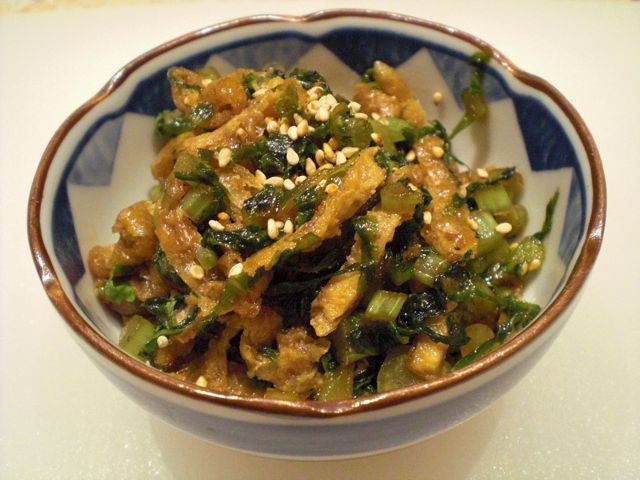
I used one large frozen tofu pouch "abura-age" or "aburage" 油揚 for all the daikon greens from one medium sized daikon. I placed the aburage in a colander and ran hot water over it to thaw as well as to remove excess oil. I squeezed out the moisture and cut it into small strips (approximately 1x1/4 inch) and set aside. Meanwhile, I chopped the daikon greens from one medium (about 10 inch long) daikon including stems into small pieces. In a frying pan, I added 1 tbs of peanut oil and a dash of dark sesame oil. Add the daikon greens and sauté until wilted, add the strips of abrage and keep sautéing for another minute. Add 2tbs of sake and 2tsp of mirin and 1tbs of soy sauce. Keep sautéing until almost all the liquid is gone. As a rice condiment, you may want to add more soy sauce to make it a bit saltier. If you like it a bit sweeter add more mirin. Remove from heat and sprinkle white sesame. You could use cabbage or other green vegetables instead of daikon greens. This is a perfect "tuskidashi" 突き出し or "otoshi" お通し dish.
Friday, December 4, 2009
Daikon green and tofu pouch stir fry 大根葉と油揚の炒め物
Daikon 大根 is a popular Japanse root vegetable and widely available in the U.S. but I usually am not able to get daikon greens becase they are often removed before the daikon is sold. It is similar to how most carrots are sold here. But, recently, I happened to find a whole daikon with its greens attached in a near-by Japanese grocery store. Rather than discarding the greens, I made this dish based on a childhood memory. It is a kind of "collard greens with bacon" type dish in the Japanese style. Certainly, this one can be served as a condiment for rice or as is with your sake.
Thursday, December 3, 2009
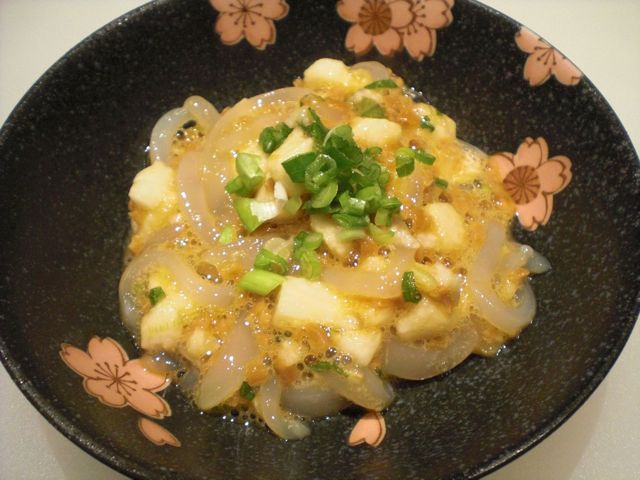
Squid sashimi with mountain potato and fermented soy beans 長芋のイカ納豆
Japanese appear to like slimy food. Often, Japanese recipes call for not just one but a multiple of slimy ingredients in one dish. This dish called for squid sashimi, mountain yam or "naga-imo" 長芋, and fermented soybean "natto" 納豆. All have a rather slimy texture. This dish probably qualifies to appear on the "Bizarre food" TV show. In any case, I saw this recipe on line. I happened to have all the ingredients and decided to make this dish.
It was indeed very slimy but the natto did not have a strong smell. I sort of liked it and even my wife finished the dish and she said she did not dislike it (delicately put). Since all the ingredients are slimy, it sort of worked. The only drink that goes with this dish appears to be sake.
Tuesday, December 1, 2009
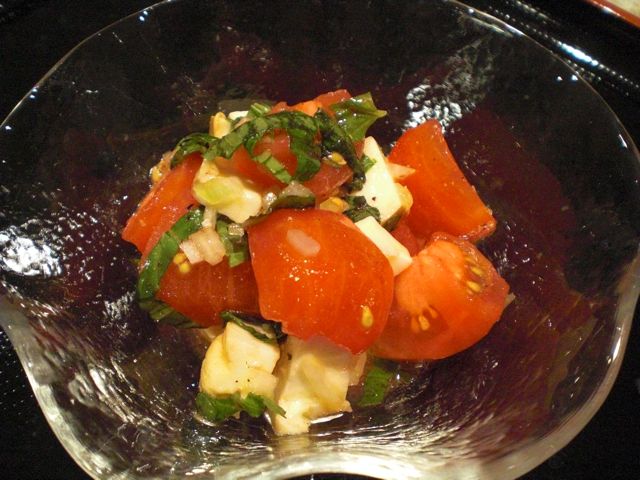
Tomato and Mozzarella cheese salad トマトとマッツレラチーズのサラダ
This is a variation of a more common layered salad of tomatoes, basil, and Mozzarella cheese, "Insalata Caprese". In this version, I finely chop onion or shallot and mix in a good quality olive oil, salt, black pepper and dash of balsamic vinegar and dress cubes of mozzarella cheese and quarters of tomatoes (skin removed, either by peeling the skin with a knife as I did here or blanching very briefly) and garnish with chiffonade of fresh basil. Key to this dish is good quality ingredients including the olive oil and balsamic vinegar.
Monday, November 30, 2009
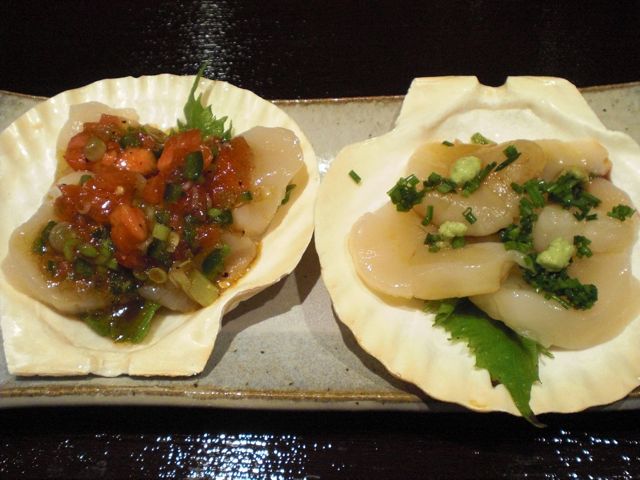
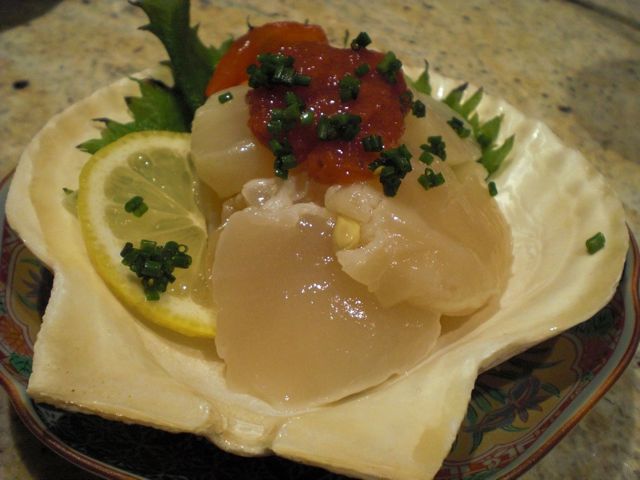
Scallop sashimi three ways ホタテ貝の刺身
We can not easily get "sashimi" grade scallops. I make a scallop sashimi-like dish from regular frozen and thawed scallops from a nearby gourmet market by poaching the scallops in a dashi broth and sake mixture gently for 5 minutes until the scallops just become opaque throughout. I chill the scallops and serve with a pickled plum "bainiku" 梅肉 sauce like sashimi. This is not bad but does not have the texture and sweetness of the real thing. Fortunately, we got sashimi-grade sea scallops from Catalina Offshore Products along with other goodies. The only problem was that we had to eat them fairly quickly. Since we had guests who appreciate scallop sashimi, I made three different scallop sashimis.
I washed the scallops and patted them dry. I removed the small hard muscle attached to the side of the scallops. I sliced one large scallop into 4-5 thin rounds. I salted them very lightly and squeezed lemon over them. The verions shown in the picture are: 1. Straight forward sashimi (upper right) with real grated wasabi (see below) and soy sauce, 2. scallops with salsa sauce (upper left), and 3. Scallops with pickled plum sauce ("bainiku" 梅肉) (below). Garnishes are lemon sclices, chopped chives and perilla leaves.
For the salsa sauce: Chop tomatoes, shallots, Jalapeno peper (seeded and de-veined) finely and add olive oil, lemon or lime juice, salt and pepper. Pour over the scallop. Sometimes I also use balsamic vinegar and soy sauce (no lemon juice in that case).
Regrading "wasabi" 山葵; I mentioned a bit about this in the previous post. There are two companies which sell "real" wasabi"; one is called "Real Wasabi" another is called "Pacific Farm". You could buy; 1. wasabi daikon 山葵大根 or rhizomes, 2. frozen grated real wasabi in a tube, or 3. wasabi powders made from real wasabi not from western horseradish. Last time we tried rhizomes from Real Wasabi. This time I tried "the grated frozen real wasabi in a tube from Pacific Farm" (left image). I think this is very good and probably more cost effective than buying a wasabi rhizome, although it has some additives like artificial coloring. The other problem is packaging. Initially, the water and wasabi appeared to seperate and then it becomes difficult to squeeze out from the tube but the flavor and heat are very similar to the freshly grated wasabi. It is probably best to smear a small dab on the sashimi itself before dipping in soy sauce but this may be bit too strong for some. In that case, dissolve wasabi in soy sauce. It will keep a long time frozen and, reportedly, for 30 days after opening the tube. In my experience, however, at 3 weeks after opening, the remaining wasabi (about 1/8 of the tube) became almost impossible to squeeze out. By cutting open the tube, I found that the wasabi became bit dry and chalky in texture. The flavor was still there, though. Some of sushi bars in Washington, DC started offering "real" wasabi with an extra charge but I think it is worth it.
For the bainiku sauce: Remove the meat from "umeboshi: chop it finely and mix in a small amount of mirin and rice vinegar. Pour over the scallop.
Friday, November 27, 2009
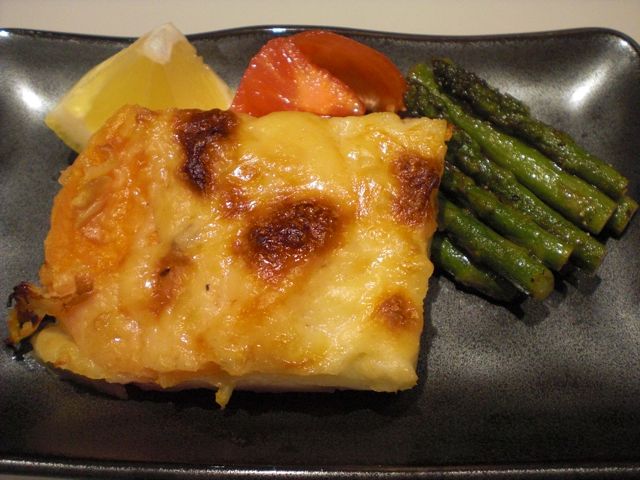
Potatoe gratiné square with asparagus ポテトグラタン、アスパラ添え
My wife made this potato gratin dish (I helped with cutting potatoes and making the Béchamel sauce) as a side when we made a roasted pork tenderloin with mustard, ginger, and garlic marinade. The original recipe for the potato dish is from "Cooking light" but I do not think this is quite "light" cooking. I just used the leftover potato gratin as a part of Izakaya course menu item.
For the potato gratin, peel and slice both potatoes and sweet potatoes (2 medium, each) in 1/4 inch in thickness. Boil 4-5 minutes in salted water until just cooked. For Béchamel sauce, saute one strip of bacon finely cut until the fat is rendered and the bacon gets crispy. Take out the bacon and set aside. Add 1 tbs of butter and saute chopped onion (one medium) for 1-2 minutes (do not brown) and add 1/3 cup of all purpose flour. Keep sauteing so that all the onion pieces are coated with flour (using finely chopped onion is the secret of making Béchamel with a small amount of fat since each piece of onion holds flour on its surface and prevents the flour from clumping). Add 2 cups of low-fat (I used 1%) milk at once and stir on medium low heat. Add back the bacon. As the liquid heats up, it thickens. Add more milk if it is too thick. Stir in 1/2 cup of grated Parmigiano-Reggiano cheese and adjust the seasoning (salt and pepper). The final product should be rather loose (if needed, add more milk). Grease a rectangular (9x13 inch) pyrex baking dish with light olive oil. Make alterate layers of the cooked potatoes and sweet potatoes slices and pour the Béchamel cheese (Mornay) sauce over the potatoes to cover. Bake at 370F for 45 minutes.
For this serving, cut small squares of the leftover potato gratin and put it in toaster oven at 400F for 5 minutes or until throughly heated. Saute green asparagus (pre boiled) in browned melted butter and season (salt and pepper). We used this as a part of the Izakaya course for our guests. Although this is not Japanese dish it went very well with the rest of the Japanese dishes we served. Such a comfort food.
Subscribe to:
Comments (Atom)