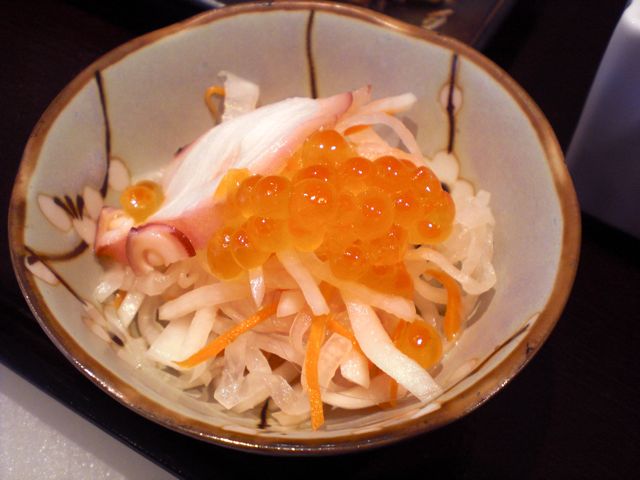
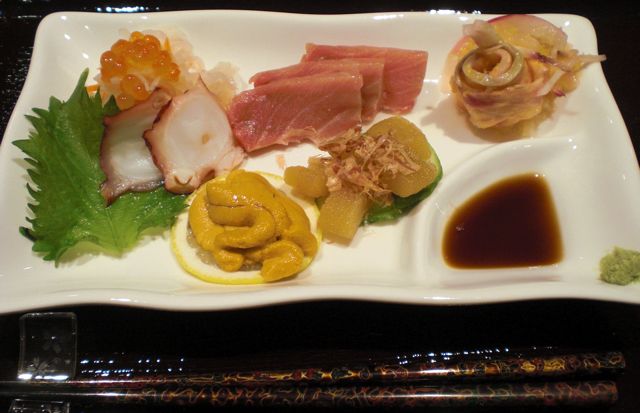
Instead of usual sashimi accompaniment 刺し身のけん, I used vinegared "Namasu" diakon 大根なます garnished with ikura salmon roe and octopus. Herring roe 数の子 and marinated salmon were also added. Ankimo was served in a separate plate with orange marmalade-soy sauce.
It was a nice start for New Year's Izakaya feast.
Tuesday, January 5, 2010
New Year's day sashimi assortment 元旦の刺身盛り合わせ
Monday, January 4, 2010
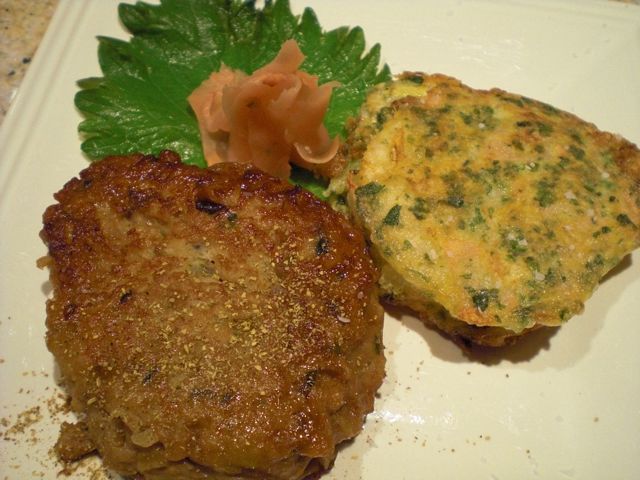
"Tsukune" Chicken patty and mountain yam fritter 鶏のつくねと長芋のフリット
"Stukune" つくね is ground meat (chicken is most common) with binder and seasoning made into a ball or patty. It is one of the most popular "Yakitori" 焼き鳥 item but it can be deep fried, pan fried or boiled. Here I made another popular version of chicken "stukune". As an accompaniment, I also made a "mountain" yam fritter.
The recipe is rather simple. I used pre-ground chicken (1/2 lb), added sauteed finely chopped onion and shiitake mushroom mixture (2-3 tbs), "Yuzu-kosho" 柚子胡椒 (1/2 tsp, commercial kind in a tube) and 1 tsp of potato starch. I made oval flat patties (about 2x4 inch). In a frying pan, add 1-2 tsp of peanut oil and cook each side for 3-4 minutes. I added sake (1tbs), mirin (2 tbs) and soy sauce (2 tbs) and put a lid on. I cooked on low heat for 3-4 minutes, then removed the lid and increased the heat until the liquid became thick and coated the patties. I sprinkled them with Japanese "sanshou" or Sichuan pepper powder.
For mountain yam or "nagaimo" 長芋 fritter (I am not sure what is the right name for this dish, "fritter" is not quite right but piccata is also not right), peel and slice the yam in 1/2 inch thick rounds (I made 4 rounds). Beat one egg and mix in 2 tbs of finely chopped vinegared ginger root (called "Gari", the type you have at the sushi bar) and dried "aonori" powder (1 tsp). Dust each round with popato starch and then coat with egg mixtures. Pan fry in a frying pan with a small amount of vegetable oil (I used light olive oil) for 2-3 minuts on each side until crusts are formed. Eat with salt or soy sauce (I used salt).
I am not sure that the addition of a "Yuzu-kosho" to "tsukune" was a success. It does not have enough fresh "yuzu" flavor to make a big difference. But as far as "tsukune" goes it was more than OK. The mountain yam fritter has a very nice crunchy texture inside and nice eggy crust with ginger and aonori flavors. Very nice texture and flavor contrasts.
For mountain yam or "nagaimo" 長芋 fritter (I am not sure what is the right name for this dish, "fritter" is not quite right but piccata is also not right), peel and slice the yam in 1/2 inch thick rounds (I made 4 rounds). Beat one egg and mix in 2 tbs of finely chopped vinegared ginger root (called "Gari", the type you have at the sushi bar) and dried "aonori" powder (1 tsp). Dust each round with popato starch and then coat with egg mixtures. Pan fry in a frying pan with a small amount of vegetable oil (I used light olive oil) for 2-3 minuts on each side until crusts are formed. Eat with salt or soy sauce (I used salt).
I am not sure that the addition of a "Yuzu-kosho" to "tsukune" was a success. It does not have enough fresh "yuzu" flavor to make a big difference. But as far as "tsukune" goes it was more than OK. The mountain yam fritter has a very nice crunchy texture inside and nice eggy crust with ginger and aonori flavors. Very nice texture and flavor contrasts.
Friday, January 1, 2010
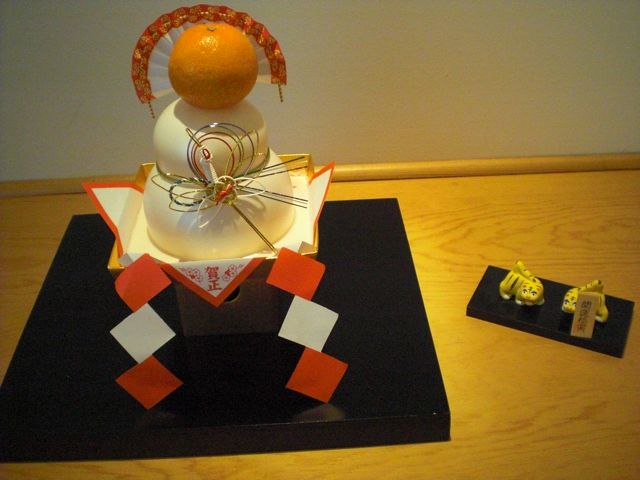
A Happy New Year 2010 謹賀新年
I had to work until 12/31/09. So I did not have time to put together the usual New Year's boxes お節の重箱 but managed to make or buy the usual good luck new year dishes.
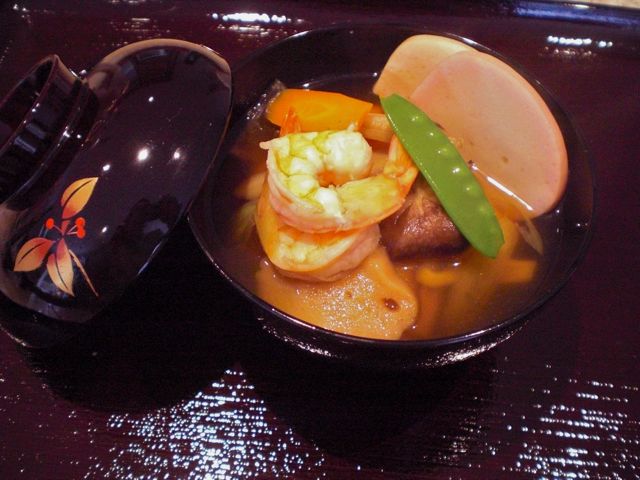
New Year Soup お雑煮
Only unusual thing I do is to put "mochi" 餅 or rice cake in " fried tofu pouch "aburage" 油揚 as per my wife's request. So that the sticky mochi will not dissolve or attached to your teeth and the bowl. In addition to keeping the mochi under control, the combination tastes pretty good.
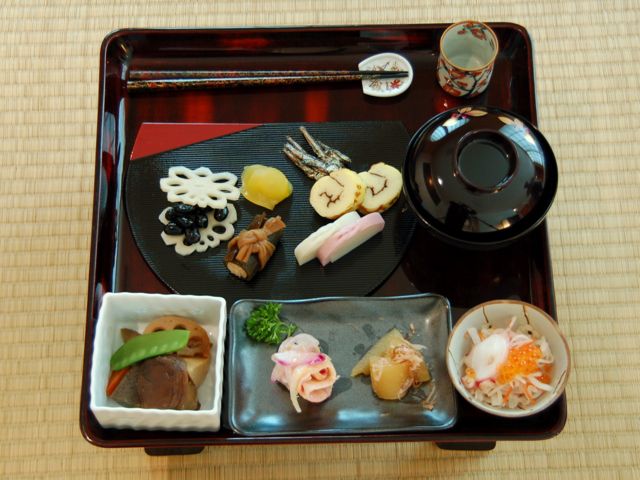
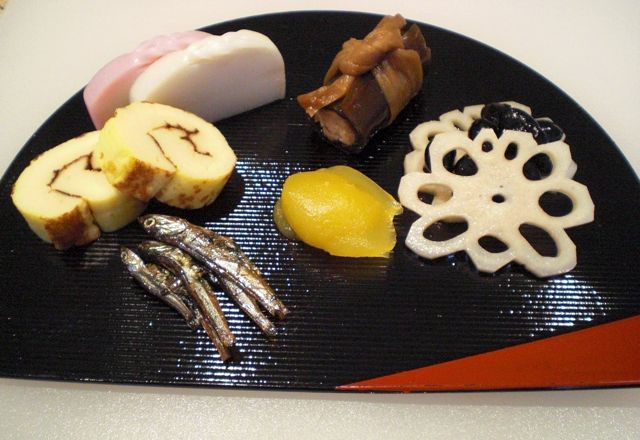
Assorted appetizers "Kuchitori" お口取り
Small fish ごまめ, red and white fish cakes 紅白かまぼこ, sweet chestnut 栗きんとん and black beans 黒豆 are bought ready made. The rest were home made. Rolled omelet 伊達巻きwas made from eggs and commercial "hanpen" はんぺん a type of white fish cake, lotus root or renkon レンコン was bought already cleaned and boiled but then I made this "flower" cut and vinegared it. For the first time, I also made kelp roll with salmon 鮭の昆布巻き, which, if I say so myself and my wife (who is impartial) also agrees that this was much much better than the commercial product.
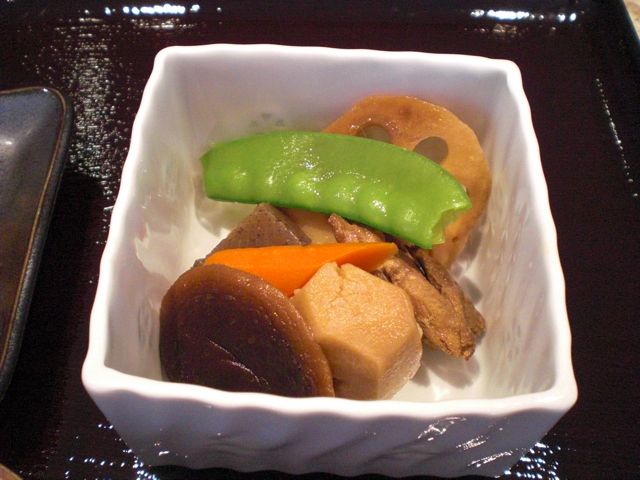
Vegetable and chicken stew 筑前煮
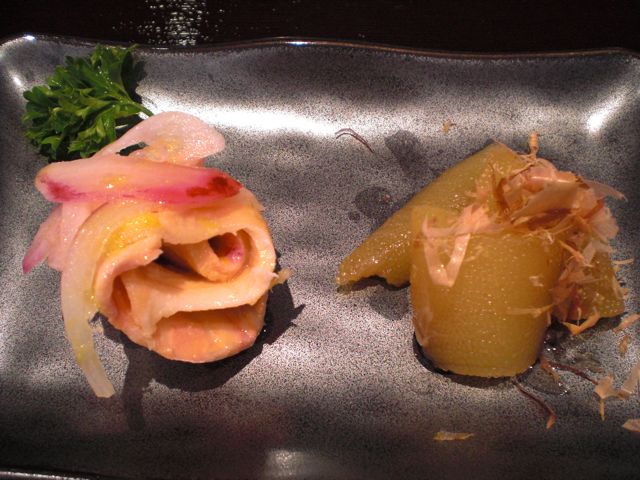
Marinated salmon 鮭のロシア漬け、Herring roe 数の子
This salmon dish is my mother's recipe. She does not remember where she got it. Thinly sliced salmon was layered with onion, lemon slices and marinated in a mixture of sake, rice vinegar and olive oil for at least 3 days. The herring roe was first soaked in weak salt water to remove salt (they are sold preserved by heavily salting) and then marinated in dashi, mirin, and soy sauce mixture for a few days.
Julienned Daikon "Namasu" in sweet vinegar 大根なます, vinegard octopus 酢蛸,
Salmon roe いくら
For "Namasu", as per my mother's recipe, I do not add water or dashi and we like more assertive vinegar taste. The octopus was bought boiled and frozen and then sliced and vinegared before serving.
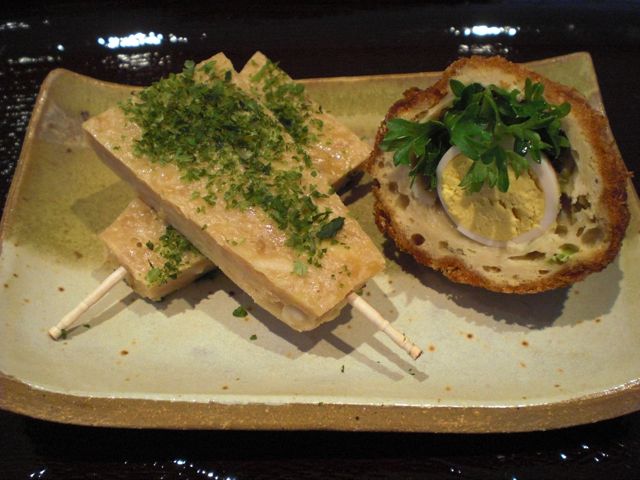
Chicken patty with pine nuts and miso 鶏肉野松風焼き, Scotch egg スコッチエッグ
I used boiled quail eggs rather than hens eggs for my Scotch eggs.
Only unusual thing I do is to put "mochi" 餅 or rice cake in " fried tofu pouch "aburage" 油揚 as per my wife's request. So that the sticky mochi will not dissolve or attached to your teeth and the bowl. In addition to keeping the mochi under control, the combination tastes pretty good.
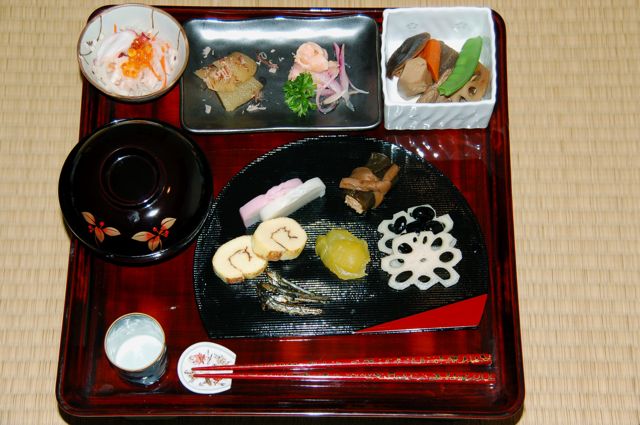
Assorted appetizers "Kuchitori" お口取り
Small fish ごまめ, red and white fish cakes 紅白かまぼこ, sweet chestnut 栗きんとん and black beans 黒豆 are bought ready made. The rest were home made. Rolled omelet 伊達巻きwas made from eggs and commercial "hanpen" はんぺん a type of white fish cake, lotus root or renkon レンコン was bought already cleaned and boiled but then I made this "flower" cut and vinegared it. For the first time, I also made kelp roll with salmon 鮭の昆布巻き, which, if I say so myself and my wife (who is impartial) also agrees that this was much much better than the commercial product.
Vegetable and chicken stew 筑前煮
Marinated salmon 鮭のロシア漬け、Herring roe 数の子
This salmon dish is my mother's recipe. She does not remember where she got it. Thinly sliced salmon was layered with onion, lemon slices and marinated in a mixture of sake, rice vinegar and olive oil for at least 3 days. The herring roe was first soaked in weak salt water to remove salt (they are sold preserved by heavily salting) and then marinated in dashi, mirin, and soy sauce mixture for a few days.
Julienned Daikon "Namasu" in sweet vinegar 大根なます, vinegard octopus 酢蛸,
Salmon roe いくら
For "Namasu", as per my mother's recipe, I do not add water or dashi and we like more assertive vinegar taste. The octopus was bought boiled and frozen and then sliced and vinegared before serving.
Chicken patty with pine nuts and miso 鶏肉野松風焼き, Scotch egg スコッチエッグ
I used boiled quail eggs rather than hens eggs for my Scotch eggs.
Wednesday, December 30, 2009
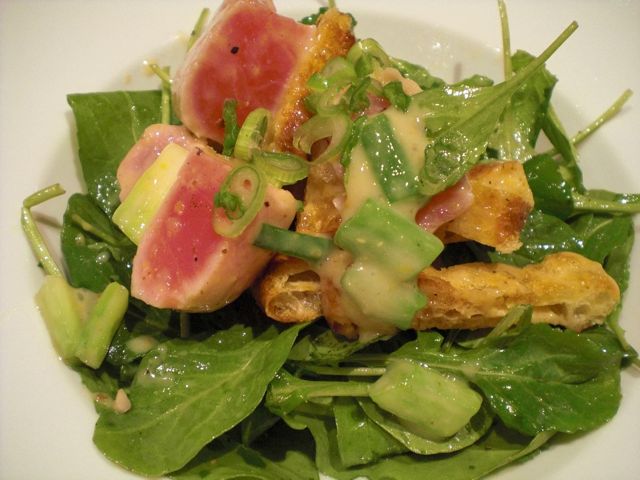
Seared Tuna salad 炙り鮪のぬたサラダ
Again, this is a continuation of how to enjoy tuna sashimi in different ways. Mark's book (p80) has a similar more traditional recipe, "Tuna 'Nuta' with Miso Mustard dressing". I make this dish slightly differently. "Nuta" ぬた is a traditional Japanese dish in which raw fish, sea weed, and "wakegi" わけぎ (which is very similar or identical to scallions -green or spring onions- we get in the U.S.) are dressed in sweet miso mustard sauce "karashi sumiso" からし酢みそ. I made some modifications to this traditional recipe and made it into a salad. I used the "tataki" technique for tuna and cooked the scallions over direct gas flame. This way, the tuna attains a nice firm texture and the scallions become very sweet. You could just boil the scallions as suggested in Mark's book. For added texture, I used grilled "abura-age" 油揚げ or deep fried tofu pouch and everything was set on the top of dressed greens (I used baby arugula here but any leafy greens will do). Of course, if you omit the greens, that will also be just fine with sake.
I used 1/3 "saku" 冊 or block of tuna sashimi (previously frozen) for two servings. After thawing, remove any moisture from the surface and salt both sides. To sear the surface, you could use a frying pan with a bit of oil but I used the traditional Japanese method of a direct gas fire (or charcoal fire). I put two metal skewer, fanned out, through the tuna and held it over the flames until all surfaces were white with small light brown patches but the center was still raw. I plunged the tuna into ice water to cool. I then dried with paper towels and cut into bite size pieces.
I selected thick scallions (3-4) rather than thin ones. Holding the green part, I charred the white part of the scallion over the direct flame until the outer skin blackened. I set them aside until they were cool enough to handle (1-2 minutes). I then removed the root end and outer most blackened layer and cut the white and contiguous green parts into 1/2 inch long segments.
I put one abura-age in a toaster oven and toasted it like I would a slice of bread until surface was brown and crispy (I could have used direct flames as well). I cut it into 1/3 inch strips.
To make "nuta" or "sumiso" sauce (I posted this before); this time I used regular white miso (2 tbs), sugar (2 tbs) and mixed in enough rice vinegar to make a saucy consistency. If the sauce is vinegary enough but still too thick, you could add a bit of 'dashi" or sake. I also added 1/3 tsp of prepared hot Japanese mustard. In Mark's book, this sauce was made with the addition of mirin without sugar (mirin is sweet) and less vinegar which makes the sauce less vinegary but I like a more assertive vinegary taste. Dress all the above ingredients except for the greens with this sauce.
For the baby arugula, I simply dressed with a splash of rice vinegar and good quality olive oil, salt and black pepper.
Just place the greens on the bottom of the plate and make a mound of "nuta" on the top. My wife usually does not like scallions in big pieces but this time because of the method of cooking them they were very soft and sweet and she liked it. Abura-age added a nice crunch and everything came together with the smooth miso sauce. Arugula has nice peppery taste which also added to the overall flavor.
To make "nuta" or "sumiso" sauce (I posted this before); this time I used regular white miso (2 tbs), sugar (2 tbs) and mixed in enough rice vinegar to make a saucy consistency. If the sauce is vinegary enough but still too thick, you could add a bit of 'dashi" or sake. I also added 1/3 tsp of prepared hot Japanese mustard. In Mark's book, this sauce was made with the addition of mirin without sugar (mirin is sweet) and less vinegar which makes the sauce less vinegary but I like a more assertive vinegary taste. Dress all the above ingredients except for the greens with this sauce.
For the baby arugula, I simply dressed with a splash of rice vinegar and good quality olive oil, salt and black pepper.
Just place the greens on the bottom of the plate and make a mound of "nuta" on the top. My wife usually does not like scallions in big pieces but this time because of the method of cooking them they were very soft and sweet and she liked it. Abura-age added a nice crunch and everything came together with the smooth miso sauce. Arugula has nice peppery taste which also added to the overall flavor.
Monday, December 28, 2009
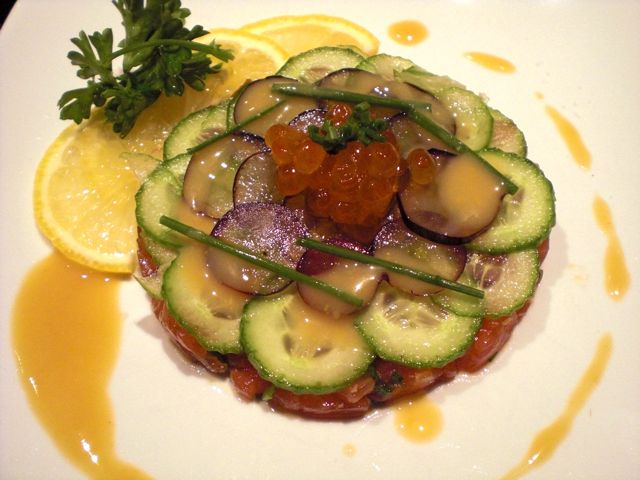
Tuna tartar with cucumber and grape 鮪のタルタル
If tuna sashimi is in good quality, it is best to eat it simply with wasabi and soy sauce. If you like to have tuna sashimi in different ways or the quality of tuna sashimi is not really good (often in my case), you could make something different. I already posted a few variations on this theme.
This particular night, I made tuna tartar, which is a fairly common Western adaptation of tuna sashimi. Again, this is not a recipe per se, you could make many variations on this theme to your liking. I just chop tuna sashimi in small cubes, mix in finely chopped chives, soy say sauce with wasabi dissolved, a dash of good quality olive oil to your taste. If you like, you could use, chopped perilla and/or scallion, tabasco, sesame oil etc for variations.
To make the taste a bit more interesting, I made a sweet vinegar miso sauce with Japanese mustard "karashi sumiso" からし酢みそ in addition. I used "saikyo" miso 西京味噌, which is sweet to begin with. I used 1 tbs of saikyo miso, 1/3 tsp of prepared hot Japanese mustard (in a tube), 1/2 tsp sugar, and added rice vinegar until a nice smooth saucy consistency is reached. I did this in a Japanese mortar "suribachi" すり鉢 and pestle すりこぎ but you could use a small bowl attachment using a food processor or you could just buy a premade "sumiso" sauce. Taste and adjust the degree of sweetness by adding more sugar.
Subscribe to:
Comments (Atom)