
Saturday, January 30, 2010
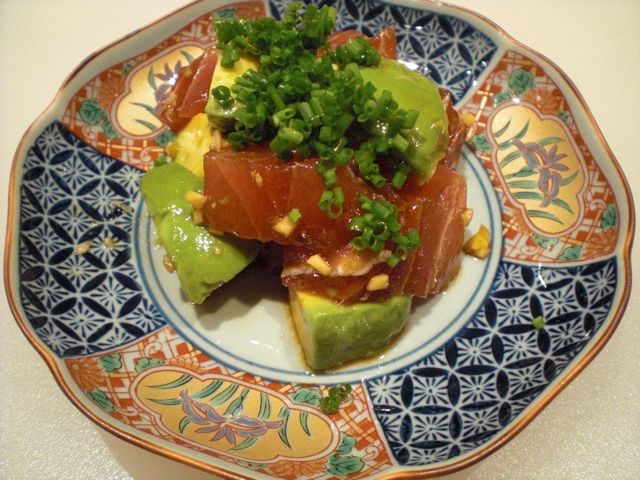
Tuna and Avocado cubes 鮪とアボカドの角切り
This is the dish shown on the front jacket cover of Mark's book. I meant to make this for some time but somehow I could not synchronize having tuna sashimi and ripe avocado at the same time. The taste and texture of avocado are quite a good match for tuna sashimi. The most significant and successful sushi invention in the U.S. must be California roll. California rolls use crab meat and avocado, which is also a good combination. We often have slices of avocado like sashimi along with other sashimi items served with soy sauce and wasabi. That is also good.
As long as you have the ingredients, making this dish is simple and quick. I followed the recipe in Mark's book in the back jacket flap verbatim. I cut avocado into 1/2 inch cubes and dressed with lemon juice to prevent discoloration. I then cut sashimi tuna into 1/2 inch cubes. The dressing is made of minced garlic (I used one fat clove), 2 tbs of soy sauce and 1 tsp each of sake and dark roasted sesame oil. I tossed the tuna and avocado cubes and served them with chopped chives. This is excellent! Quite different from the usual tuna sashimi. The dressing is rather assertive but surprisingly good. The above is a serving for one person and the amount is perfect. You do not want to eat too much of this dish. This dish definitely made it to the "teiban" 定番 list of our home Izakaya dishes.


Thursday, January 28, 2010
Rare tastes 珍味
A Japanese word "chinmi" 珍味 is often used to describe food items which are rare and/or limited to certain regions of Japan. You can assemble these rare tastes more easily nowadays by mail order and because of many special sales featuring these rare and regional food items (usually held in department stores in Japan). Even in the U.S., more and more of these "chinmi" items are becoming available, albeit much more limited compared to Japan. Tonight, we had an assortment of these rare tastes with sake.
Dried "Shishamo" fish 寒干しししゃも
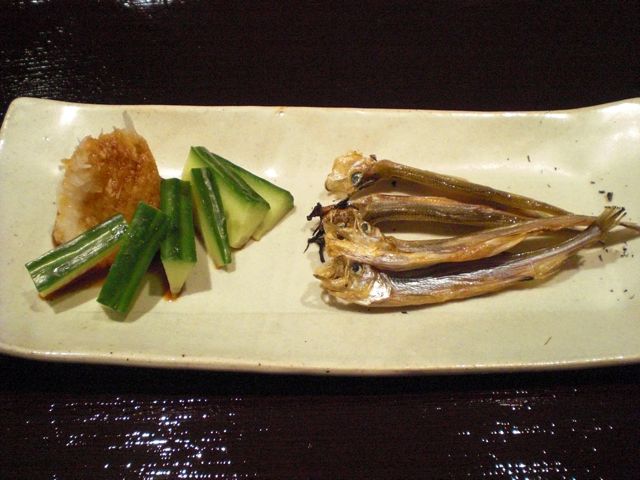
This small fish called "Shishamo" ししゃも or 柳葉魚、Spirinchus lanceolatus, is harvested only on the southern pacific coast of Hokkaido. I grew up with this fish and they are very popular drinking snack items especially in Hokkaido. These are usually semi-dried and we get them frozen in the United States. My mother sent these to us. They were (supposedly) "fully dried" in the cold northwind of Hokkaido. They can be eaten as is but I grilled them briefly over the gas fire and served them with grated daikon 大根おろし and soy sauce. They are a bit chewier than semi-dried (which has to be more thoroughly grilled) but they are very flavorful. To my surprise, even my wife liked them.
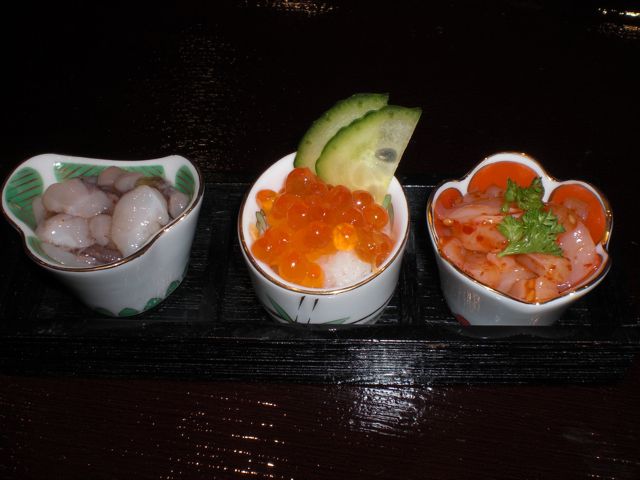
Raw Octopus marinated in wasabi sauce たこぶっかけ (lt)、Salmon roe with grated daikon いくら甘酢大根おろし (ctr)、Raw Squid mariated in hot red peper sauce イカぶっかけ (rt)
My wife and I love "squid and guts" or squid "shiokara" いかの塩辛. This is definitely an acquired taste but most people who love sake will love this as well because both go together so well. Shiokara is made from fresh squid which is salted and slightly fermented with squid innards (mostly liver). The homemade variety made with a light amount of salt (this kind does not last long) is the best. Many commercial ones are too salty but more recently, we can get a less salty kind in a small plastic pouch in the frozen case of the Japanses grocery store. Last time we were in Hakodate we had commercial but local "shiokara" which was excellent. Another similar preparation is called "okizuke" 沖漬け. "oki" in Japanese means "far-away from the shore". Supposedly, fishermen start marinading the freshly caught squid (sometimes other fish or shell fish) while in their boat and by the time they come back to shore (overnight or one day), the dish is done. Once in a blue moon, Chef Kudo at Tako Grill makes squid okizuke which is exquisite. Last time we were in Kanazawa, a small fluorescent squid called "hotaruika" 蛍イカ or firefly squid was in season. We really enjoyed "okizuke" of this small squid. Unfortunately, it is next to impossible to get a fresh squid suitable for making these dishes in the U.S. What we have here is the closest substitute.
In the above image, from left to right are raw octopus with wasabi sauce たこぶっかけ、salmon roe with grated daikon いくら大根おろし (grated diakon is seasoned with sweet vinegar which is only item I prepared)、and raw squid with hot sauce イカぶっかけ. These squid and octopus dishes are variations of "shiokara" and "okizuke" and are called "bukkake" ぶっかけ in which small pieces of raw octopus or squid are marinated in a spicy sauce. Here, the octopus is marinated in "wasabi" sauce and squid in red pepper sauce. Both come in a small plastic pouch and bought frozen. These are perfect accompaniment for sipping sake.
Cheese stuffed squid チーズいか
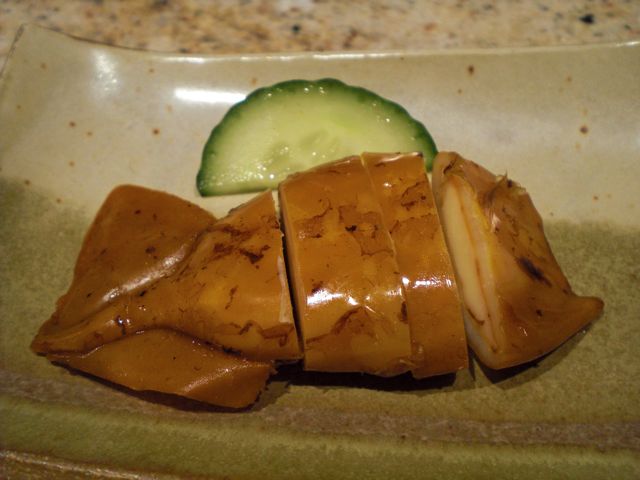
This is another item, my mother sent us. A Japanese word "Ikomi" 射込み means to "insert" or to "stuff" and this one is a type of "ikomi" squid. This is a commercial product in which a small squid was stuffed with cheese and cooked. This is eaten as is. Interesting combination of tastes. I served one for each of us but my wife went back and got another one. She must have liked it.
Smoked scallop 帆立ての薫製
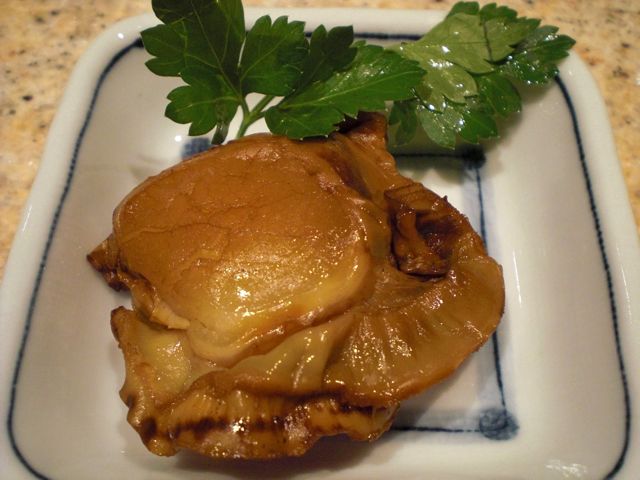
This is a smoked whole scallop from Lake Saroma 佐呂間湖 in Hokkaido. To us, it is a bit too smoky and chewy.
Dried "Shishamo" fish 寒干しししゃも
This small fish called "Shishamo" ししゃも or 柳葉魚、Spirinchus lanceolatus, is harvested only on the southern pacific coast of Hokkaido. I grew up with this fish and they are very popular drinking snack items especially in Hokkaido. These are usually semi-dried and we get them frozen in the United States. My mother sent these to us. They were (supposedly) "fully dried" in the cold northwind of Hokkaido. They can be eaten as is but I grilled them briefly over the gas fire and served them with grated daikon 大根おろし and soy sauce. They are a bit chewier than semi-dried (which has to be more thoroughly grilled) but they are very flavorful. To my surprise, even my wife liked them.
Raw Octopus marinated in wasabi sauce たこぶっかけ (lt)、Salmon roe with grated daikon いくら甘酢大根おろし (ctr)、Raw Squid mariated in hot red peper sauce イカぶっかけ (rt)
In the above image, from left to right are raw octopus with wasabi sauce たこぶっかけ、salmon roe with grated daikon いくら大根おろし (grated diakon is seasoned with sweet vinegar which is only item I prepared)、and raw squid with hot sauce イカぶっかけ. These squid and octopus dishes are variations of "shiokara" and "okizuke" and are called "bukkake" ぶっかけ in which small pieces of raw octopus or squid are marinated in a spicy sauce. Here, the octopus is marinated in "wasabi" sauce and squid in red pepper sauce. Both come in a small plastic pouch and bought frozen. These are perfect accompaniment for sipping sake.
Cheese stuffed squid チーズいか
Smoked scallop 帆立ての薫製
Wednesday, January 27, 2010
Cornmeal Parmesan Chicken tender with crispy skin 鶏の笹身のパルメザンコーンミール焼きとカリカリ鶏皮
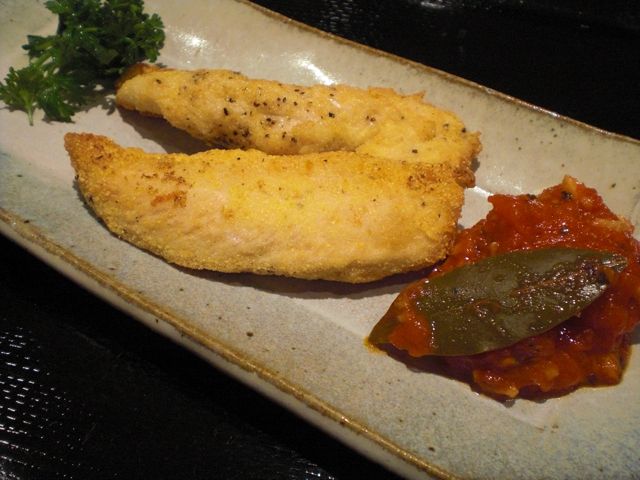
We love a crispy skin, either chicken, fish or pork. To make chicken skin very crispy, I parboil the chicken skin in water with salt and sake for 10 minutes until the fat was rendered. Then, I patted them dry and placed them (no oil needed) in a frying pan and put another identical frying pan on the top to press down. Cook it for 5-8 minutes on low heat and turn over and cook another 5 minutes until the skin is very crispy. You may still have to remove some excess fat from the pan using a paper towel during the cooking. Sprinkle on a bit of salt while it is hot.
For dipping sauce, I made a mixture of Dijon mustard and honey (about equal amount or less honey depending on your taste). Honey will melt easily and changes the consistency and color of the mustard. This one goes well with any drink.
Monday, January 25, 2010
Simmered "kiriboshi" daikon 切り干し大根の煮物
"Kiriboshi" daikon is an old fashioned preserved vegetable in which daikon is cut into thin, long strands and dried. I bought a package some time ago in the Japanese grocery store. Obviously I had forgotten about it but found it while I was going through my Japanese food items in the pantry. I decided to make some dishes using this. It is rather odd looking and it doesn't smell particularly pleasant (all cruciferous vegetables appear to have similar smell but drying makes it stronger). The drying, however, does add more sweetness. To use this, wash briefly in cold running water and rehydrate in enough water for 20-30 minutes.
Simmered "kiriboshi" daicon 切り干し大根の煮物
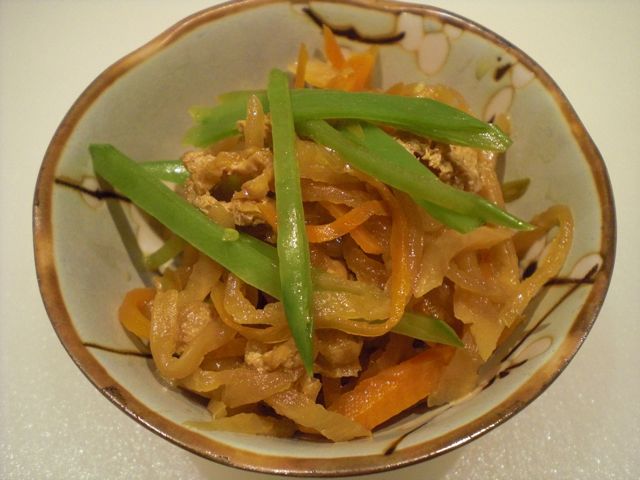
This is a very typical way of using "kiriboshi" daikon. After re-hydration, I squeeze water from it and set aside. I thinly slice carrot and julienne. I also julienne abura-age 油揚げ or deep dried tofu pouch. The amounts are totally arbitrary. You could also add shiitake mushroom (dried and re-hydrated shiitake is the best for this but I did not have enough time to re-hydrate dried shiitake this time). In a pan, I add a small amount of vegetable oil and a dash of dark roasted sesame oil and add few flakes of dried red pepper. I then sauté daikon and carrot. When the oil has coated the each vegetable pieces, add abura-age and enough "dashi" stock to cover (In my case, I used about 200ml). I place an "otoshi buta" and simmer for 10-15 minutes. "Otoshi buta" 落とし蓋 or "drop lid" is frequently called for in Japanese simmered "nimono" 煮物 recipes. It is a lid (often wood) that is smaller in diameter than that of the pan used. This way, the ingredients will cook evenly while allowing evaporation of the simmering broth. Instead, you could use a kitchen parchment paper cut slightly smaller than the opening of the pan (called "kami buta" or paper lid). You do not need a special wooden lid (I have one but it was too big for this pan). A plate or a regular metal lid smaller in diameter than the pan's opening will do as shown here.
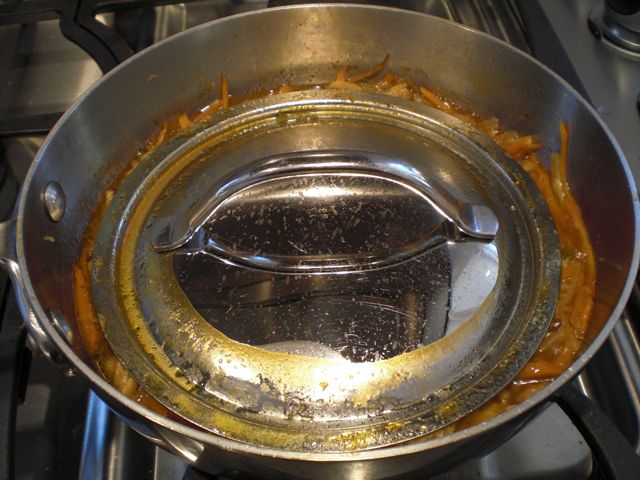
After coming to a boil, simmer for 10-15 minutes. For seasoning, I add 3 tbs of mirin and 2-3 tbs of soy sauce (for 200ml of dashi). I add soy sauce in two increments, tasting each time, to adjust the seasoning. Addition of soy sauce just before completing cooking gives fresh soy sauce flavor as well. If you are having this dish with sake, I use less soy sauce and for rice condiments, I use more soy sauce. Simmer for another 10-15 minutes and cut the flame and let it cool in the broth. I garnished with snow peas blanched, shocked in cold water and then julienned.
"Kiriboshi" daikon and celery in vinegar dressing 切り干し大根のハリハリ
Simmered "kiriboshi" daicon 切り干し大根の煮物
After coming to a boil, simmer for 10-15 minutes. For seasoning, I add 3 tbs of mirin and 2-3 tbs of soy sauce (for 200ml of dashi). I add soy sauce in two increments, tasting each time, to adjust the seasoning. Addition of soy sauce just before completing cooking gives fresh soy sauce flavor as well. If you are having this dish with sake, I use less soy sauce and for rice condiments, I use more soy sauce. Simmer for another 10-15 minutes and cut the flame and let it cool in the broth. I garnished with snow peas blanched, shocked in cold water and then julienned.
"Kiriboshi" daikon and celery in vinegar dressing 切り干し大根のハリハリ
This is another classic way of using this ingredients. "Harihari" is a Japanese word to indicate "crunchy". Beside dried daikon, this dish usually calls for julienned cucumber. While I was making this, all the mini-cucumbers I had (although I bought them just few days ago) had brownish discoloration around the seeds and did not taste right (This appears not to be the usual brand I get. It said "seed-less" but it definitely had seeds). So after cutting all 5 cucumbers, I had to discard all of them. Without cucumbers, I rummaged in the refrigerator and found celery.
After re-hydration, I squeezed out the excess water and put the "kiriboshi daikon" in the bowl. I sliced a celery stalk diagonally and thinly. I mixed a small amount of Chinese red pepper paste "Toubanjan" 豆板醤 (1/5 tsp), sushi vinegar (3 parts) and mirin (1 part) and dressed.
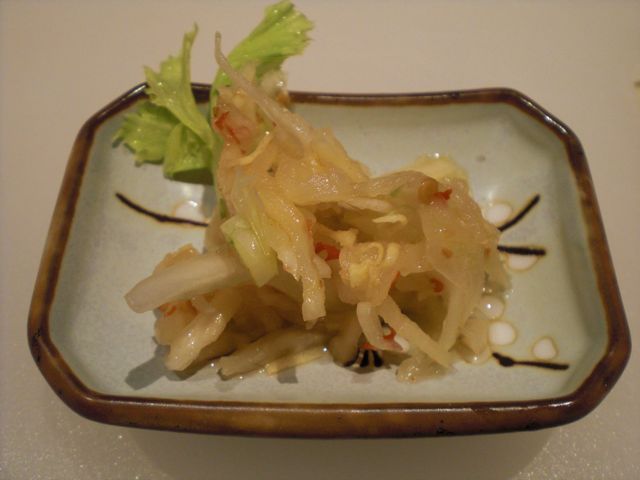
After re-hydration, I squeezed out the excess water and put the "kiriboshi daikon" in the bowl. I sliced a celery stalk diagonally and thinly. I mixed a small amount of Chinese red pepper paste "Toubanjan" 豆板醤 (1/5 tsp), sushi vinegar (3 parts) and mirin (1 part) and dressed.
The kiribishi daikon definitely has a crunch as name "harihari" indicates. It is a very simple (especially if you have a cucumber) and refreshing dish. Even with substituting with celery, it was not so bad.
Saturday, January 23, 2010
Fried Oyster カキのフライ
Fried oyster is by no means a traditional Japanese dish but Japanese appear to like it very much. This item appears on Izakaya menus as well as family style Japanese restaurants called "taishu shokudo" 大衆食堂 or similar low-key restaurants. the Japanese modification must be the use of Japanese "panko" パン粉 for breading. Thinly cut raw cabbage キャベツ is served as an accompaniment as well as "tonkatsu" sauce (often).
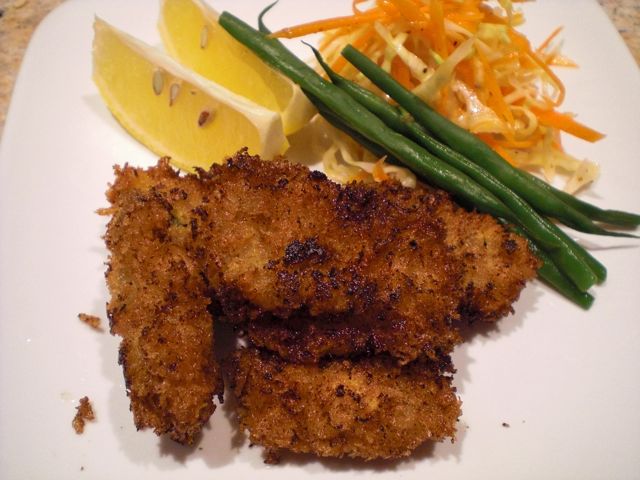
Classically, this is perfect with cold beer but we do not drink beer anymore so we had this with cold sake.
Subscribe to:
Posts (Atom)