

Saturday, July 24, 2010
Home grown tomatoes 家庭菜園トマト


Friday, July 23, 2010
Cold asparagus soup 冷製アズパラガス スープ
It has been extremely hot especially in recent days. By my wife's request, I made cold asparagus soup. She says it is the essence of everything good about asparagus. It is a perfect starter dish for hot summer days.
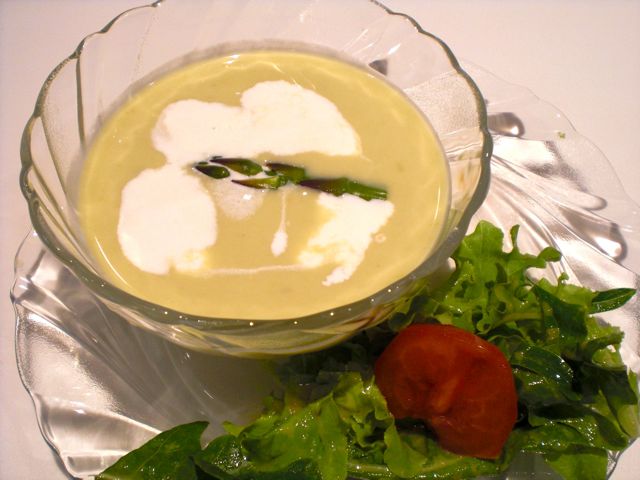
For about 4 servings, I used asparagus (10, thick ones, not the pencil kind), white potato (one medium), onion (one, small), bay leaves (3), chicken broth (16 oz) and cream (1/4 cup). First I cut off the tips of the asparagus (about 1 inch from the top) and blanched them for 1 minute. Then I shocked it in cold water. I set them aside as a garnish. I then cut off the very bottoms which are woody and discard them. I slice the remaining stems on the bias in 1/3 inch thick. I skinned and diced the potato (small dice). I sauteed finely diced onion in olive oil (1 tbs) for 2-3 minutes or until it becomes semitransparent. I then added the sliced asparagus, diced potato and saute for another minute. I added the chicken broth and three bay leaves. Once it come to the boil, I turn down the flame to low and put the lid on. I let it simmer for 15-20 minutes or until all the ingredients are soft and cooked. I remove all three bay leaves (I count them very carefully) and, using an immersion blender, homogenize the soup. Toward the end, I add 1/4 of a cup of cream. I taste it and season with freshly ground white pepper and salt. I season a bit more severely than I would for hot soups since the taste will be somewhat muted when the soup is served cold. I did not strain the soup but you could strain it to make it perfectly smooth. Cool it down to the room temperature and then chill it in a refrigerator for, at least, several hours. I add a bit more cream when I serve it and garnish with the asparagus tips. Perfect cold soup to start hot summer days.
Wednesday, July 21, 2010
Grits and poached egg グリッツとポーチドエッグ
This could be a "shime" 締 ending dish or, more traditionally, a breakfast. It is a variation of "Okayu" お粥 or porridge but in a US Southern style. It is a very comforting and nice starch dish. This one is prepared by my wife and I only help by chopping up the chives and making the poached eggs.
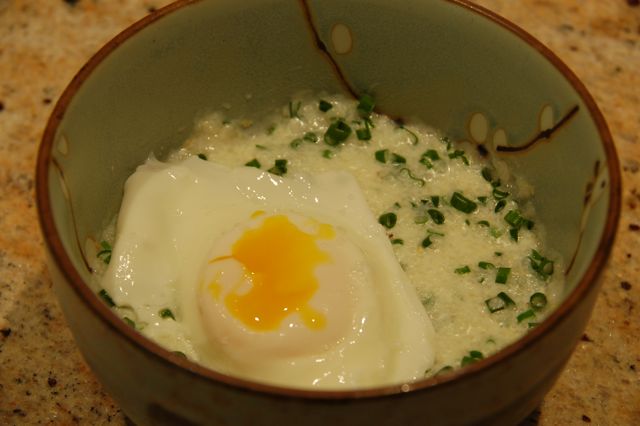
Grits is a very Southern food and my wife is not even from the South but we adapted this dish for some reason. Instead of the more traditional grits which is eaten as a breakfast with additions of cheese, butter or maple syrup (a Northern addition to a Southern dish...don't ask why), we make it savory. We cook the grits in milk instead of water. Just in case you are not familiar with grits, it is coarsely ground alkaline-treated hard kernel corn. Alkaline treated corn prevents the development of a niacin deficiency (Pellagra) especially if your main diet consists of corn. I do not know who first figured this out but certainly American Indians ("hominy" from which grits is made) and Mexicans ("masa harina" for corn tortilla is also made from alkaline treated corn) must be among the first. This treatment also created another flavor different from regular corn meal. Grits and polenta are similar yet distinctive in their taste. The description below is how my wife makes grits.
 Grits: She prefers to use "Quick" grits (Quaker brand) rather than "Instant" grits. Quick grits, which has been pre-steamed and then dried, requires about 5 minutes cook time but it is more "authentic" in flavor and consistency than the "instant" variety. True old fashioned stone-ground grits will take way too long to cook.
Grits: She prefers to use "Quick" grits (Quaker brand) rather than "Instant" grits. Quick grits, which has been pre-steamed and then dried, requires about 5 minutes cook time but it is more "authentic" in flavor and consistency than the "instant" variety. True old fashioned stone-ground grits will take way too long to cook.
For two small serving, in a small but deep pan, add milk (one cup, we use 1%) and just when it starts boiling, add salt (1/4 tsp) and grits (3 tbs) while stirring with a whisk, turn down the flame and cook covered for 5 minutes until all the milk gets absorbed. Add chopped fresh chives (3-4 tbs). She adds 1 pat of butter (1/2 tbs) but no cheese.
Poached eggs: I poach eggs very simply without any vinegar and without any special techniques or gadgets but works all the time. I used a 8 inch frying pan with non-stick surface and with a high side wall so that it can have enough depth of water to completely submerge the eggs. After the water comes to a gentle boil, I adjust the heat so no or only few bubbles form in the water (many bubbles result in egg-drop soup). I then add 1 tsp of salt (just for seasoning). I crack the egg into a small ramekin or bowl and gently slide the egg into the water. Repeat the process. After the white is set and the egg yolk becomes opaque on the surface (4-5 minutes), using the perforated spoon or silicon spatula gently pry the bottom of the eggs from the surface of the pan; take care not to break the yolk. The eggs should come loose without a problem because of the non-stick surface. Pick up the egg using a perforated spoon and drain on a paper towel-lined plate.
Place the grits in a bowl and put the poached egg on top. Sprinkle with salt and serve. For breakfast my wife serves this with her home-made buttermilk biscuit (another Southern specialty) but for the "shime" dish serve as is. Break the egg yolk and mix it with the grits. Even if you are not from the South, you will like this dish.
Monday, July 19, 2010
Pasteurized eggs and homemade mayonnaise 滅菌卵と自家製マヨネーズ
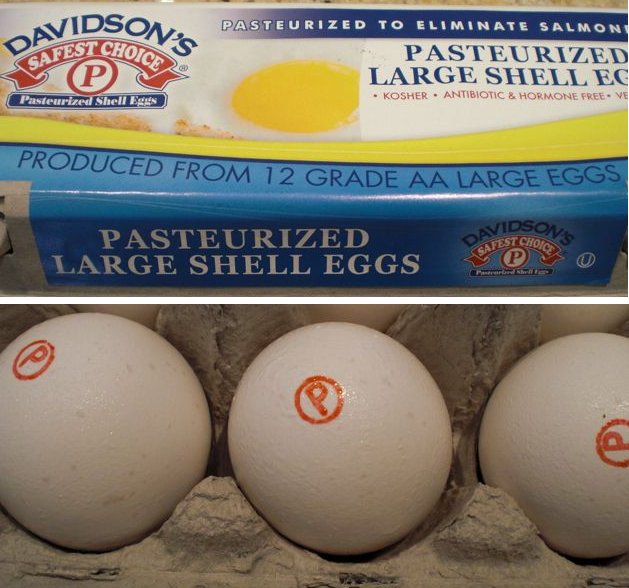
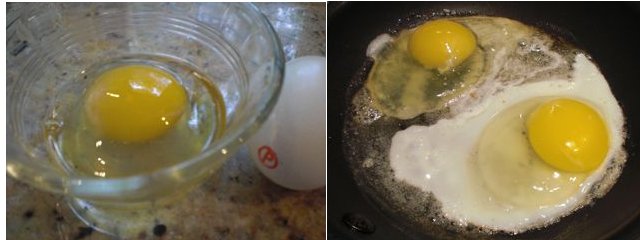
When I made cold ramen noodle, I discussed the risk of Salmonella food poisoning when eating raw or undercooked eggs. Since we like runny egg yolks and many Japanese cuisines call for raw or undercooked eggs, we have been using "free ranging and organic" eggs for these purposes, which are reportedly safer than regular mass produced eggs. Now we found we could get pasteurized eggs. The price appears to be about the same or even slightly cheaper than free ranging organic eggs. As you can see, eggs have red "P" in a circle stamped on them indicating it is "P"asturized.
In the mixing cup of an immersion blender, I put two egg yolks, lemon juice and rice vinegar (1 tbs each), salt (1/2 tbs), Dijon mustard (1 tbs, smooth kind), a pinch of sugar and vegetable oil (1 cup) plus olive oil (1/2 cup, extra-virgin olive oil). I put the immersion blender to the bottom of the mixing cup and pulsed it several times as emulsion develops in the bottom. As more emulsified material appears, I continuously blend and also raised the tip of the blender off the bottom to mix everything. In 30 seconds, nice mayonnaise is made.
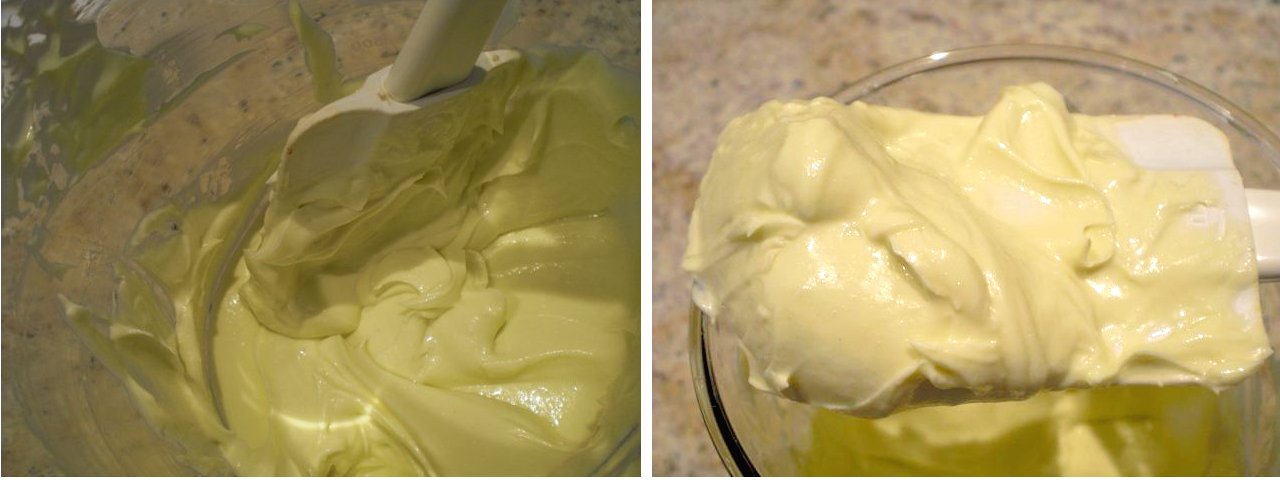
It tastes good. Because of the extra-virgin olive oil I used, it looks slightly greenish and you can taste both olive oil and egg yolk with nice acidity. Yolks from the pasteurized eggs work exactly same as yolks from regular eggs. Sunny-side-ups also look and taste identical to regular eggs, although the egg white looks slightly firmer than one in a regular egg.
Saturday, July 17, 2010
Braised Shirataki with Tarako roe 鱈子と白滝の炒り煮
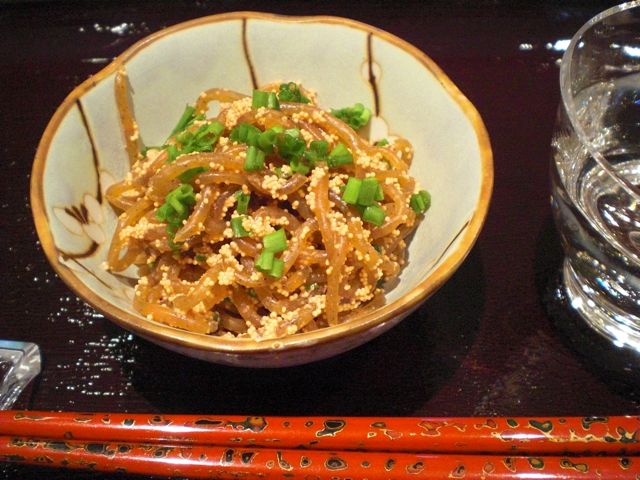
I decided to make this dish because I found frozen tarako in our freezer which appears not to be high in quality (I must have bought it frozen sometime ago). Shirataki, which means "white cascade" in Japanese, is Konnyaku or Konjac made into thin noodles by extrusion and is often used in Sukiyaki. It does not have many calories and, for that matter, not much taste but can absorb any flavor you add to it.
Tarako mixture: First, remove the tarako roe by slicing the membrane and, using a back of the knife, scrape off the roe from the membrane and put it in a small bowl. For the one package of shirataki, I used two small sacs of tarako but the amount is totally arbitrary. I add 1-2 tbs of sake and a dash of Tabasco (optional) and mix so that it will have nice thick saucy consistency.
Shirataki: I drain and wash one package of shirataki and cut into three portions to make the noodles more manageable and cook it in a boiling water for 1 to 2 minutes (mostly to remove the peculiar smell konnyaku and shirataki always have) and drain. Put the shirataki noodle in a dry non-stick frying pan on a medium flame. Stir to let the excess moisture evaporate (so that it can absorb more liquid seasoning). I add sake and soy sauce (1 tbs each) and stir until the liquid is almost all gone. You could add mirin here to make this dish a bit sweet.
Add the tarako mixture and keep stirring until the color of the tarako become white and cooked through. Since tarako is salty you may adjust the amount of soy sauce accordingly. I mix in chopped chives (or scallion). I garnish with chopped chives when serving.
This dish has an interesting texture contrast of cooked roe and shirataki noodle. The addition of Tabasco adds a very slight and slow acting pleasant heat to the dish. Sake is definitely called for.
Subscribe to:
Posts (Atom)