

Sunday, December 19, 2010
Flat iron steak with wasabi butter sauce 和風ステーキのわさびバターソース


Saturday, December 18, 2010
Izakaya cookbooks
I added a short description of the Izakaya cookbooks that I find useful. You can access the description using the tab third from the left located above. Unfortunately only one of the cookbooks is in English. Other Japanese cookbooks written in English also contain some dishes appropriate for Izakaya and I may be able to list them in the future.
Friday, December 17, 2010
Egg miso 卵味噌
Flavored Miso is perfect to "nibble/lick" as you sip sake. It also works well as a condiment for hot rice. This one is based on a condiment for rice I ate as breakfast when I was a kid. This is also a perfect Izakaya food. My mother made this using a large scallop shell as the pan. She told us that this was the way her father used to cook this dish. The miso and egg were well cooked, even a bit burned at the periphery but loose in the middle. I recall that I enjoyed the different tastes, textures and degrees of doneness of this dish. I do not have any idea what the recipe was except that it was made from egg and miso. Since the scallop shells I have are too small to use as the cooking vessel, I made this in a small frying pan. As a result the end product may not be that similar to what I had as a child. Without a specific recipe I made it according to my whim.
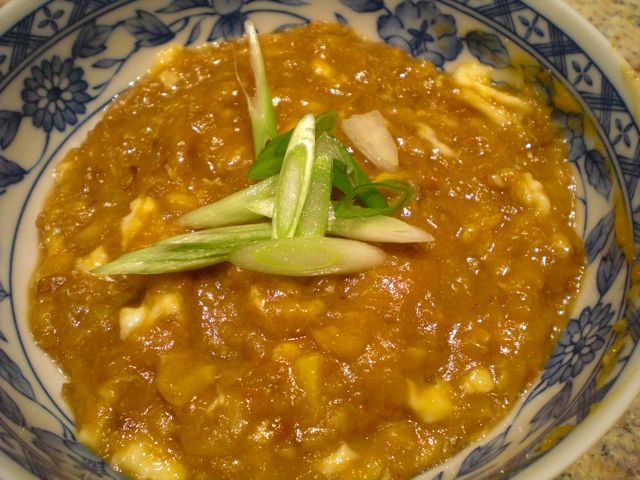
I first finely chopped garlic, ginger, and shallot (I am sure scallion or onion will also do but I happened to have a half of a large shallot). I added a small amount of light olive oil and a dash of dark sesame oil to a small frying pan and sauteed the garlic, ginger and shallot mixture until fragrant and the shallot was soft (2-3 minutes). I added miso, mirin and sake and mixed well on a low flame (amounts are all arbitrary). After everything was combined, I kept stirring until the mixture became somewhat thick (not to the original miso consistency but softer). I then added one beaten egg and mixed until the egg was just cooked.
This was not too bad but it wasn't like the one I remembered. Maybe I should have added more eggs and I will have to be on the look-out for a really big scallop in the shell. It went well with cold sake, however. As a shime 締め or finishing dish, we used this as a condiment when we had leftover and microwaved chestnut rice. That was also quite good. The only problem is that this dish is rather salty. As a result over indulgence in sake may occur. I may have to experiment a bit more to make this dish better.
Wednesday, December 15, 2010
Oyster and tofu "nabe" in miso broth 牡蛎の味噌鍋
It is getting cold especially in the morning and evening here in DC. We even had snow. We are definitely getting into "Nabe" 鍋 season. When I posted "Nabemono" 鍋物, I mentioned "Dotenabe" 土手鍋, which is famous in the Hiroshima 広島 region. It uses miso smeared (or "schmeared" in NY and NJ) around the rim of a pot (resembling a "bank" made of soil, "dote" 土手 in Japanese, along the river) with dashi broth poured in the center of the pot. You dissolve the miso into the broth as you cook. Oysters, for which Hiroshima is famous, among other ingredients, have to be included, in this nabe dish. I found a variation of this dish in the 1st volume of "Otsumami Yokocho" おつまみ横町 P149, I decided to make this nabe dish. When I was choosing which vessel I was going to use for this dish, I found this one (below). I completely forgot that we had it. It is a miniature (about 7-8 inches), imitation cast iron (I guess it is made of cast aluminum with anonized surface) "nabe" with a wooden lid. It is a perfect vessel for this dish.
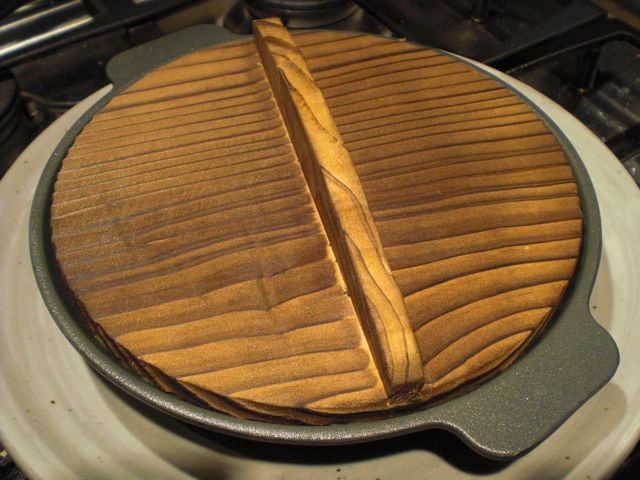
Here it is when the lid was lifted and the oysters were revealed. When I read the recipe, I immediately thought I had to modify this. The seasoning broth, as instructed, would be too salty and way too sweet for our taste. Besides, I needed some green.
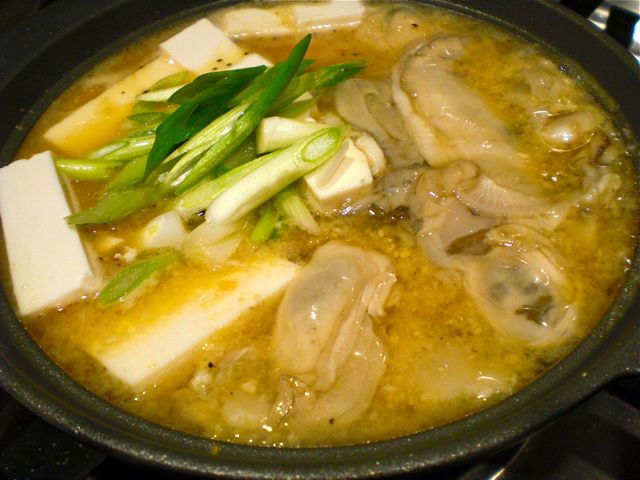
Oyster: The oysters we got were not the best. I bought some already shucked and in a plastic container (I am no sure if they had been pasteurized, probably not). There were a total of 10-12 medium to small oysters. I washed them in salted water, drained and put them on layers of paper towels.
Tofu: I used 3/4 leftover tofu from when I made other dish. I cut it into cubes as seen above.
Tofu: I used 3/4 leftover tofu from when I made other dish. I cut it into cubes as seen above.
Miso broth: This is where I deviated from the recipe. I mixed sake (1/2 cup), miso (1.5 tbs or a bit more), and sugar (0.5 tbs). The original calls for sake (1/4 cup), miso (3 tbs) and sugar (1 tbs). In addition, imitating the traditional "dotenabe" flavor, I char the surface of the miso lightly using a small kitchen blow torch (every home cook should have one) to enhance the fragrant flavor of miso before dissolving it in sake.
After the miso broth came to a simmer, I added the tofu and when it was warmed through, I added the oysters and scallions and cooked for a few minutes or until the oysters are just cooked. Although this may not be enough even for one (you big eaters out there), we shared this. I served this in small individual bowls and, before eating, we sprinkled "sansho" 山椒 powder. You have to have sake with this. The broth was surprisingly good. Even though I reduced the amount of sugar, the broth was slightly sweet but also very delicate and excellent. Although this dish was wonderful and we enjoyed it, we could have had better quality oysters. Especially when you use oysters which can be eaten raw, slightly undercooking oysters is the best way to enjoy this nabe.
Monday, December 13, 2010
Chicken tender Picatta with aonori 鶏の笹身の青のりピカタ
Whenever I use chicken breasts, I usually separate the tenders from the rest of the breast to make separate small dishes, which I have posted before. This is one such variation. I am not sure "Picatta" is the correct name for this dish especially since there is no lemon caper sauce. The ultimate-and-always-correct reference, Wikipedia, has two different versions for "Picatta" depending on ja.wikipedia or en.wikipedia, although both show an identical picture of the dish. It.wikipedia appears not to have an entry for "Piccata". In any case, since this dish is Izakaya-style, I call this dish "Picatta" as per the Japanese definition.
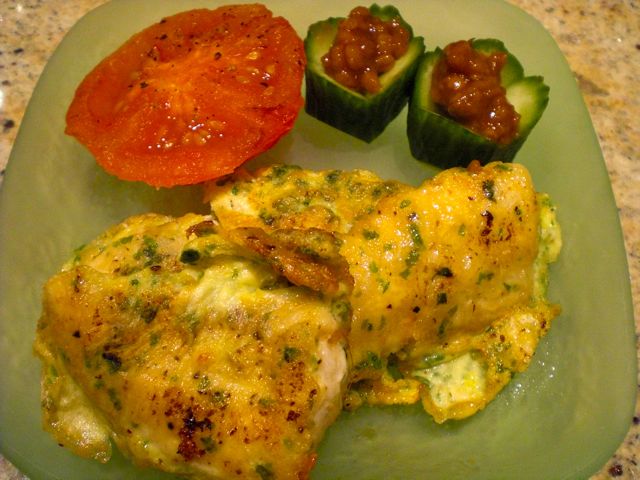
I had three chicken tenders which were marinated in sake for several days in the refrigerator (I almost forgot I had it). I use the sake, not particularly for seasoning, but to prevent the meat from going bad (American chicken goes bad very quickly).
I pat dry the tenders and lightly salt and pepper them. I cut each tender in half crosswise to make even numbers (6 pieces) for 2 small servings. I dredge the meat with flour (I used potato starch just because it was easier to get to than the regular flour in our pantry).
For the egg coating; One large egg beaten, add dried aonori 青海苔, salt and pepper. I coated each piece with the egg mixture and cooked it in a non-stick frying pan with a small amount of olive oil on a medium low flame. Once the bottom cooked, I poured the remaining egg over the meat and turned it over, so that the meat pieces were completely encased. I turned the heat to low and cooked it for 5 minutes more or longer until the center of the thickest part is done.
I served this with a pan fried tomato half, seasoned with salt and pepper, and American mini-cucumber with moromi miso. I could have made a sweet and sour Chinese style sauce but I did not.
This is a really good dish. The egg crust seals in the moisture and chicken tender comes out very tender and moist. The egg crust add a nice eggy taste with an oceanic flavor of aonori. The garnish also went very well especially the pan-fried tomato.
Subscribe to:
Posts (Atom)