Saturday, July 30, 2011

Stewed fish head 兜煮もどき

When I grilled the whole large red snapper in a semi-Japanese style, we were left with this head (below). No self respecting person of the Japanese persuasion could bear to just cut it off and throw it out. We could have eaten the meat from the head the night we cooked the fish but we had plenty of meat from the other parts. So I decided to make something else from this.

Authentic Japanse stewed fish head or "kabutoni" 兜煮 traditionally starts with an uncooked fish head which is split in half (called "nashiwari" 梨割り) before stewing. Since we needed the head to properly display the whole grilled red fish, this fish head was already grilled (and even hot smoked). In addition, the head was really big with its thick skull and sturdy cervical vertebrae preventing me from cutting it in half short of using a reciprocal saw.
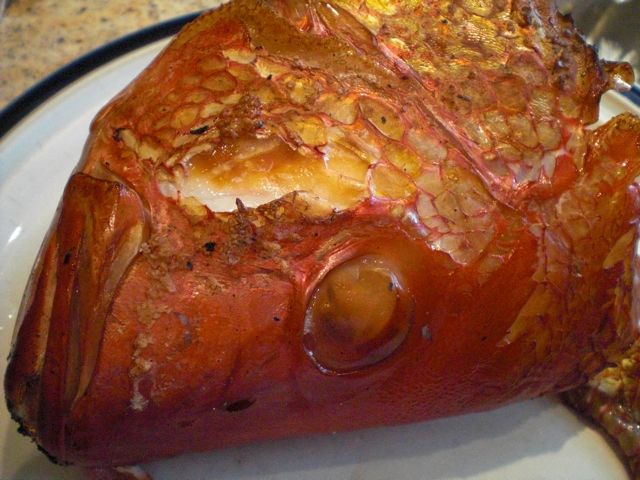
So, by no means, this was "kabuto-ni" but "kabutonioid" 兜煮もどき. Besides getting a fish head, one of the problems of "kabutoni" is the presentation. This one is particularly not good. It almost looks like a mummified fish head (below) dug up from one of the Egyptian pyramids. In any case, I just simmered the grilled (hot smoked) head with dashi, mirin and soy sauce with slices of ginger. The traditional way is to place the burdock root or "gobou" 牛蒡 in the bottom of the pan and then place the fish head on top but I did not have gobou. I just placed the fish head in the pot and added daikon instead.
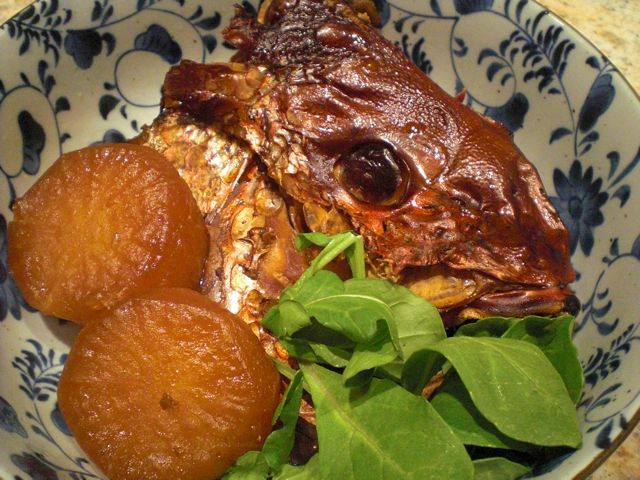
With an "otoshi buta" 落とし蓋, I simmered it for 40 minutes or so and let it cool down. I actually served this the next day after it spent the night in the refrigerator and warmed it up the next evening.

The result? Obviously not as good and real kabutoni but it had lots of meat which is a bit on the dry side but not too bad. The skin was not edible (like leather)(but neither was the skin on the rest of the fish edible). The gelatinous stuff behind the eyeballs, which connoisseurs of fish head including myself love, was not as gelatinous but was quite good (my wife graciously offered her share of the eyeballs to me). Next time, we will get a smaller red snapper and may try different dishes from the fillets and maybe a more authentic "kabutoni".

Thursday, July 28, 2011

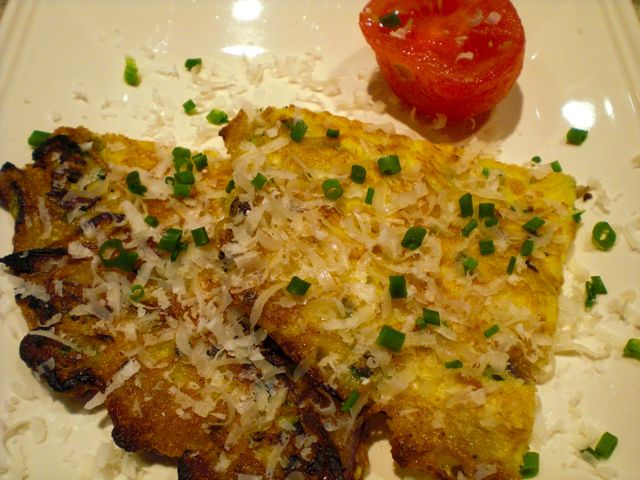
Angel hair pasta pancake with Parmesan cheese エンジェルヘアパスタとパルメザンチーズのパンケーキ

This was made mostly for leftover control but it is a nice satisfying dish. The ingredients I had to work with were: leftover cooked angel hair pasta, one egg (while making poached eggs earlier I broke one of the yolks when I cracked it into a small dish before submerging the egg into the poaching water. Luckily I could save the egg for later use) and a small piece of red onion (less than 1/4). So this is the dish I came up with.


This is variation of the one I already posted. I first sauteed the red onion (thinly sliced) in a light olive oil on a medium flame. Meanwhile I mixed an appropriate amount of pasta, egg, and good amount of grated Parmigiano Reggiano (all precise measurement). I added the sauteed onion and spread the mixture in a small flying pan (the same one I used for the onion) and cooked it for 2-3 minutes on low flame. When the bottom is set and brown, I flipped it (a successful flip is all in the wrist!) and browned the other side for 2-3 more minutes until cooked and the edge was brown and crispy. I grated more Parmigiano on the top and garnished it with chopped chives. I had one last drunken tomato which I served one half per person.

Tuesday, July 26, 2011

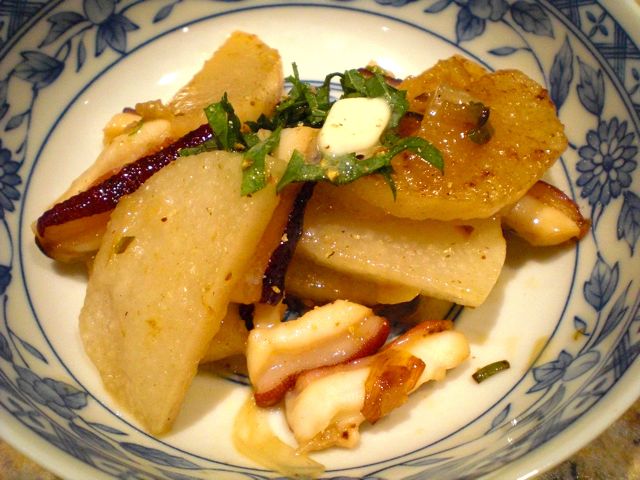
Octopus and Nagaimo stir fly with garlic 長芋とタコの塩バターソテー

I made this dish from what was left of boiled small octopus after making sumiso-ae.  I adapted this from e-recipe. I would have used soy sauce instead of just salt but I followed the recipe.

Octpus: I used boiled small octopus head (body). I sliced the octopus in to thin (1/2 to 1/4 inch) strips.
Nagaimo: I used nagaimo (2 inch segment), peeled, sliced (1/4 inch) and cut in half rounds.

I put a pat of butter (1 tsp) in a frying pan on medium low flame. When the butter melted, I added garlic (1 small glove, finely chopped). When the garlic became fragrant (1 minute), I added the nagaimo rounds and fried both sides (1-2 minutes each). I then put in the octopus and sauteed for another 1 minute. I added salt (1/3 tsp) melted in warm water (2 tbs) and  mirin (2 tbs). I braised it until the liquid is almost all evaporated. I garnished with a very small pat of butter, perilla and freshly cracked white pepper (my additions).

This is an interesting dish. The nagaimo is still a bit slimy and may not be suitable for those with slimonphobia out there but is nicely crunchy with a buttery flavor. The octopus is rather tender (relative to other cooked octopi) and nice garlic taste. Perfect drinking snack for sake.

Sunday, July 24, 2011

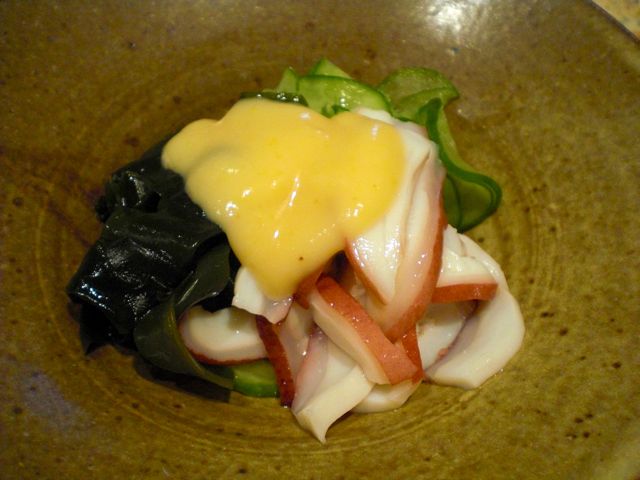
Small "Iidako" octopus and wakame dressed in vinegar-miso いいだこと塩蔵ワカメの酢みそ和え

When I visit the only Japanese grocery store left in our area, what I find is sort of hit-or-miss. On one such visit, I found boiled small octopus (only head or body portion but not the legs or tentacles) in the refrigerated case. I only saw boiled octopus legs before in this store but this was new, so I bought it.

This is probably "Iidako" 飯蛸. If I am correct, this is a small species of octopus but not a juvenile or baby of a larger octopus such as "true" octopus or 真蛸. I pondered a bit but I decided to make a classic vinegar-miso dressing with cucumber and wakame seaweed. Despite the fact I posted a few very similar dishes before, this is such a classic combination and I could not resist making this dish.

I just sliced the octopus thinly. Wakame was the salt preserved variety which was washed, hydrated and cut into a bite sized pieces (this was the last of the salt preserved wakame that we had). Cucumber was my usual American mini-cucumber, thinly sliced, salted and excess moisture squeezed out. 

"Karashi sumiso" is my usual with Saikyo miso 西京味噌 and rice vinegar and Japanese hot mustard.

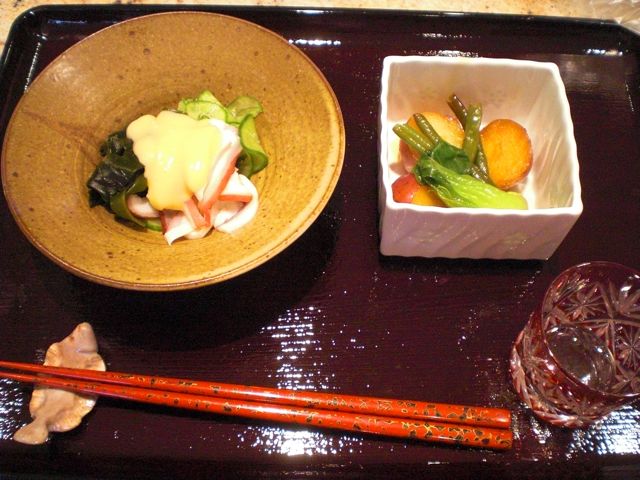
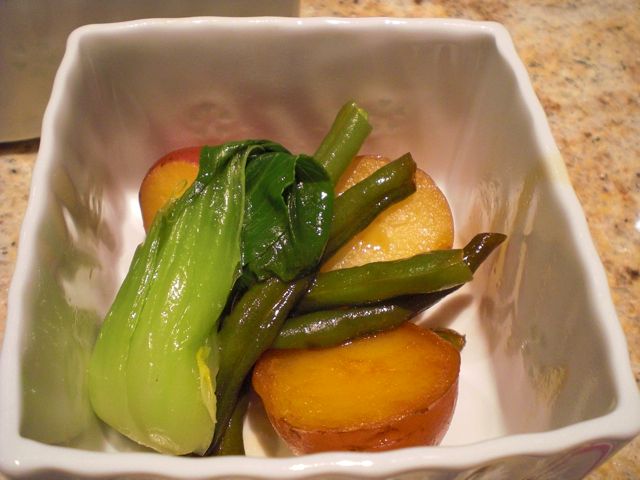
The octopus is a bit firm but very nice. It has different textures as compared to the tentacles of larger octopus. I made sumiso sauce a tad too vinegary this time. I served this with braised potato and green beans (right in the image below) as opening dishes.

We tasted a new batch of G-Sake "joy" (I suppose "G" is for "Genshu" 原酒). We think this is a new brew since the shape of the bottle is slightly different (No "BY" or "Brew Year" is listed on the bottle). The taste is about the same as before with a "umami" predominant taste profile. It has a slightly viscous but pleasant mouth feel. As compared to the old batch, my wife felt it was slightly more yeasty but I did not. If this sake had a bit more fruity and crisp upfront taste which leads to the "umami"-laden finish, which this one already posses, this sake would be formidable. But the taste of this sake is a true undiluted or "genshu" style of sake. The assertive vinegary taste of my miso dressing actually went very well with this sake.

Friday, July 22, 2011

Braised new potatoes and green beans ジャガイモとインゲンの炒め煮

This is a very homey dish of potato and green beans. I grew up eating this dish and this is how my mother made it as far as I can remember. When my niece visited us many years ago, I made this dish and she immediately recognized it as her grandmother's recipe.

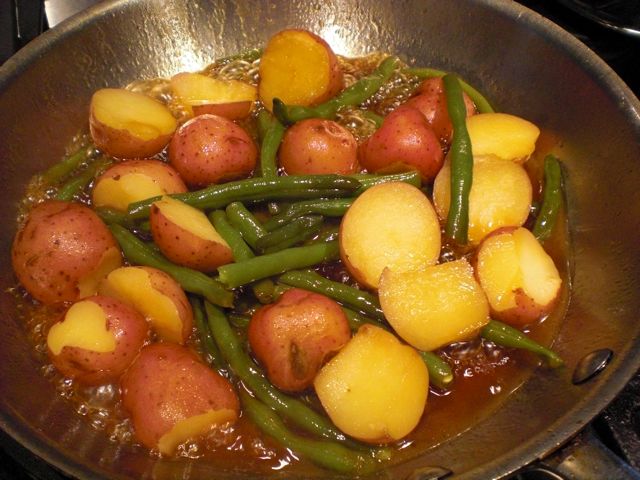
The amount of potato and green beans are arbitrary. The below picture shows the amount of potatoes and green beans I prepared. I used small red new potatoes (about 10, small one as is and larger ones cut in half after removing any blemish). Green beans, I trimmed off both ends after washing.

I put light olive oil (or vegetable oil, 2 tbs) with a splash of dark roasted sesame oil in a frying pan on medium heat. I sauteed both green beans and potatoes so that they were coated with oil. I added dashi (about 100ml). It immediately and vigorously started boiling. I put the tight fitting lid back on and let it cook for 5 minutes. I then added mirin (2-3tbs) and soy sauce (2-3 tbs). I put the lid back on and cooked another 7-10 minutes. I pierced  the potato and when the knife slid in easily it was done. I remove the lid and just let the liquid reduce until only a small amount of liquid remained (another 5 minutes). If the potato is not cooked but the liquid is almost gone, add water or dashi and cook a bit longer.

I added quartered baby bok choy on the top of the potato and green beans for the last 5 minutes of cooking and served this as a small drinking snack.

This is a classic home cooked dish. The green beans will lose color and it is not a fancy or pretty dish but is a very confronting dish. We went for sake with this.