Saturday, November 19, 2011

Baked pork tenderloin salad オーブン焼き豚ヒレ肉のサラダ

Am I having too many padding posts?  I usually have two cooked meats readily available in our refrigerator--oven roasted pork tenderloin and microwaved chicken breast. This time it was the left-over pork that I used. I made this pork tenderloin several days ago using a dry rub I recently came up with (a mixture of ground smoked paprika, cumin, clove, cinnamon, black pepper and salt). Without searing the surface of the pork I put it in a 350F oven for 30 minutes or until temperature of the thickest part registers 145F.  The pork came out very tender and flavorful and it is surprisingly easy to make.

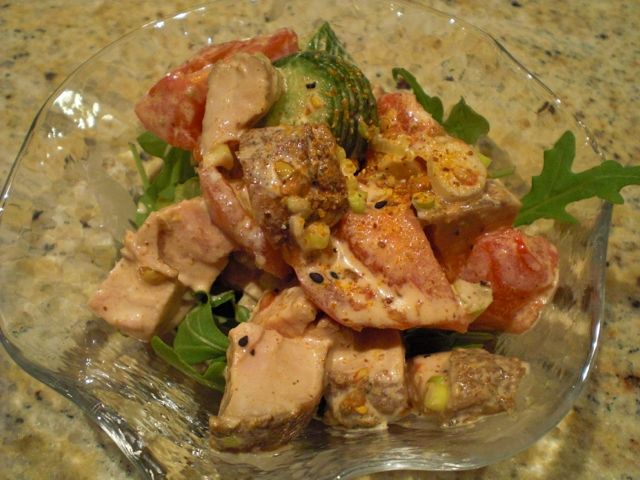
Using this tender and moist pork, I made this quick salad as a starter. I used all the usual suspects; small cubes of cooked pork tenderloin, snake-belly cut American mimicucumber, skined and quartered Campari tomato, finely chopped scallion and baby arugula. The cucumber was first dressed in sushi vinegar and then the excess liquid was squeezed out before comabining with the rest.

The dressing is simple store bought (real) mayonnaise, Dijon mustard, soy sauce and Japanese 7 favored red pepper powder 7味唐辛子. For good measure, I sprinkled 7 flavored pepper on the top.

We had this with a highly extracted Napa Cab loaded with fruits and full body, Hall Cabernet Sauvignon 2008. RP gave 95. With this price point, this is a good buy.

Thursday, November 17, 2011

Otokomae tofu 男前豆腐

The kind of Japanese dishes I can make in the U.S. is really driven by what ingredients are available.  I may have lamented the fact that the tofu we could get here was not really good especially the kind found in the supermarket. One of the Kyoto tofu makers called "Kyozen-an" 京禅庵 built a factory in New Jersey some years ago and their tofu was pretty good but after the incidence of salmonella contamination in their bean sprout products and failing FDA inspection, their tofu is no longer available in our near-by Japanese grocery store. Last weekend, when I was there, however, I found another Kyoto tofu called "Otokomae tofu" 男前豆腐. Sometime ago, I read about this tofu maker in Kyoto foodie. 

So, without hesitation, I bought one. It came in a very un-traditional shaped container (shaped like a surf board) and the printing on the front said something like "Blowing in the wind tofu maker, Johnny". "Johnny" is supposedly the nick name of the president of the company, Shingo Ito. I also noticed that the bar code on the lower right is shaped like a wave (tune 90 degree anti-clock wise) with a surfer on it (You will find a close up image at Kyoto foodie). It also states that it contains Hokkaido daizu 大豆 soy bean and natural coagulant (nigari にがり) from Okinawan sea water.

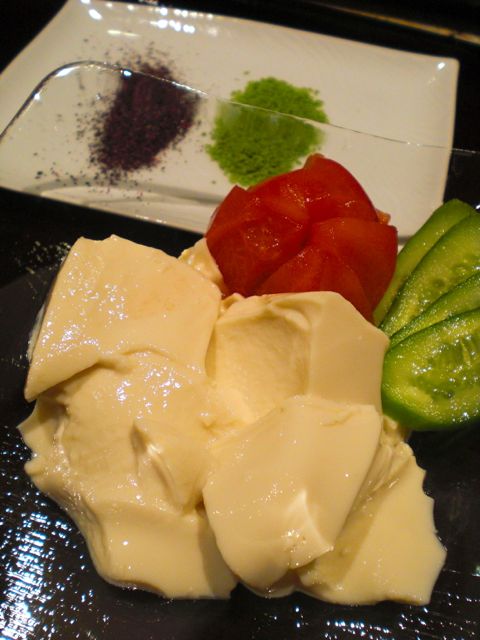
In any case, I figured that this could not be bad. I also thought that  this type of tofu was best eaten as is. I scooped up the tofu into glass bowls. Instead of my usual condiments for cold tofu, I decided to go with the simplest way to really enjoy the flavor of tofu.

As you can see below image, I served this tofu with green tea salt-obviously, the green one on the right and "Yukari" ゆかり salt - red one on the left - which is dried red perilla and salt, by-products of making picked plum or "umeboshi" 梅干し.

Most Westerners think tofu does not have any taste. Actually many supermarket varieties even have some unpleasent smell and taste. This tofu has a real nice flavor of soy beans and unctious creamy texture. We just sprinkled either green or red salt and really enjoyed this tofu. Hope I can get this next time I go to this Japanese grocery store (the only such store left in the neighbourhood).

Tuesday, November 15, 2011

Sautéed scallops two ways; with nori and egg yolk 帆立貝の黄金焼き、海苔焼き

Hokkaido is famous for scallops among other sea food and I am partial to it but, come to think of it, I have not cooked scallops that often. So, I decided to make this dish one weekend.

I thought I would make a standard scallop dish called a "Golden grilled" scallop. This dish uses only an egg yolk which leaves the egg white behind. So I also made "nori coated scallop" or "Seashore grill" 磯辺焼き using the egg white.

I got medium sized "dry" sea scallops. In an ideal situation, you would like to get fresh ones with roes (liver) and membrane ("himo" 紐 in Japanese) attached but the ones I got were just the muscle. I removed the hard small bundle of muscle from the main muscle. I washed and patted dry. I salted the scallops but did not use any marinade this time.

I separated a pasteurized egg into the yolk and white. I mixed a small amount of mirin (less than 1 tsp) and salt into the egg yolk.

I tore the nori into small pieces. I dipped half of the scallops into the egg white and then rolled them in the nori to coat. The remaining scallops and the nori coated scallops were then sautéed in melted butter on medium high heat until both side were nicely brown turing once for 1 minutes or so depending on the thickness of the scallops. (Do not over cook). I took out the ones I was using for golden scallops before they were completely cooked. I left the nori coated ones for another 30 seconds to complete cooking.

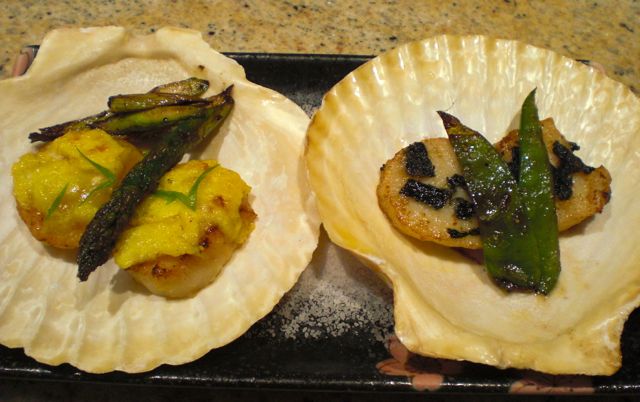
For the golden scallops, I placed the sautéed scallops on a metal tray in a toaster oven on grill mode. I brushed the egg yolk mixture over the grilling scallops several times until a golden crust formed (2-3 additional minutes).

In the same sauté pan I used to cook the scallops, I added green asparagus (skin peeled and the bottom portion cut into several pieces on a slant) and snow peas. I cooked them for a few minutes in the remaining melted and browned butter seasoned with salt and pepper.

I placed scallop shells on the plate covered with a layer of Kosher salt to make the shells stable. I garnished the golden scallops with the green part of a scallion cut in a decorative shape and served with a side of asparagus. For the nori-coated scallops, I added a garnish of snow peas.

This is a perfect drinking snack. Both recipes have some variations. For golden scallops, you could add miso and sugar to the egg yolk. For Isobe scallops, you could marinade the scallops in a mixture of mirin and soy sauce before grilling or sautéing and instead of small pieces of nori, you could use a larger rectangle of nori to wrap the cooked scallops.
Sunday, November 13, 2011

Sake steamed chicken and avocado 酒蒸し鶏肉とアボカドのピリ辛和え

This is another padding post but is a quick and nice drinking snack in the true spirit of Izakaya food as long as you have a cooked chicken and ripe avocado. As I mentioned in another post, roast pork tenderloin and microwaved sake steamed chicken are regulars in our refrigerator.

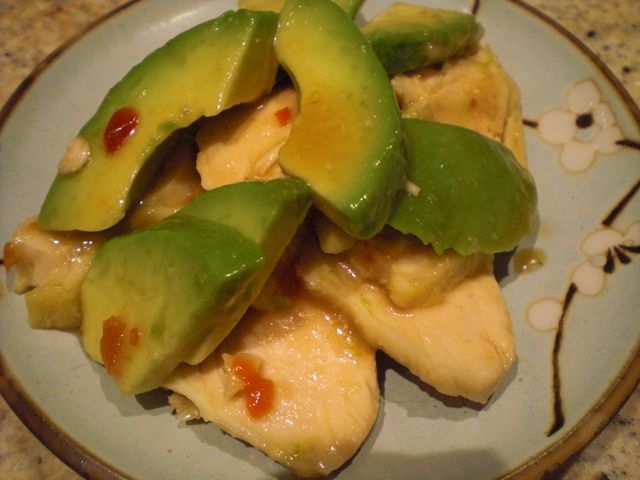
The idea for this dish came from tuna and avocado cubes.  I just sliced the cooked chicken breast with skin attached and quartered the avocado slicing it into pieces on the slant. 

For sauce, I mixed grated garlic (1 small clove), garlic chile paste (1/4 tsp), sesame oil (1/2 tsp), ponzu shouyu (1 tsp) and semi congealed liquid from the container where the chicken breast was kept (1 tbs).

I am really fond of microwave sake steamed chicken breast. It is so easy to make and is a nice thing to have in the refrigerator which can be used many different ways. The sauce really makes this dish come alive. The spiciness combined with the tender texture of the chicken juxtaposed to the texture and taste of the avocado makes this dish much more than the sum of its parts.

This dish will go well with any drink but we were having cold sake with this.

Friday, November 11, 2011

Nagaimo pancake トロロ焼き

Since we do not have easy access to an Izakaya, I check Izakaya blogs to get vicarious enjoyment out of their reports. I saw this dish called "tororo-yaki" in one such Izakaya blog that the author found when drinking in an "Okonomiyaki" place. ("Tororo" is the name for grated yamaimo or nagaimo). Japanese pancake or "okonomiyaki" お好み焼き is not one of our favorites. For us, it tends to be too heavy and with so many ingredients all mixed together the taste is muddy--like the color you get when you mix all the colors in the paint box together. But, this one looked very interesting and I decided to try it. While the aforementioned blog, described the dish and included pictures of the final product including each step showing how to cook it, the blog did not include the recipe per se. So if I wanted to taste the dish I just had to come up with the recipe--as I imagined it must have been made.


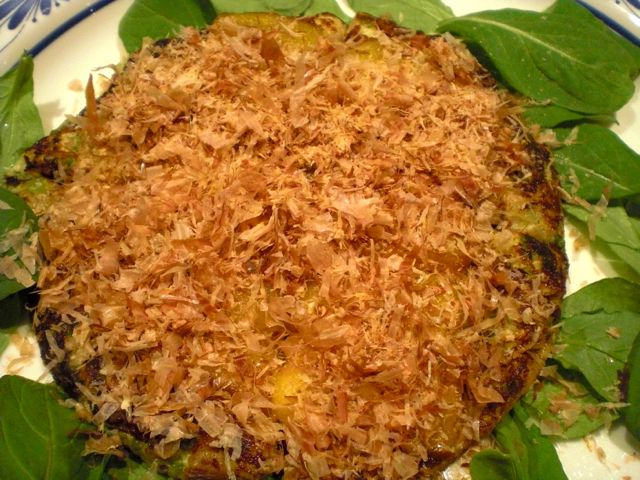
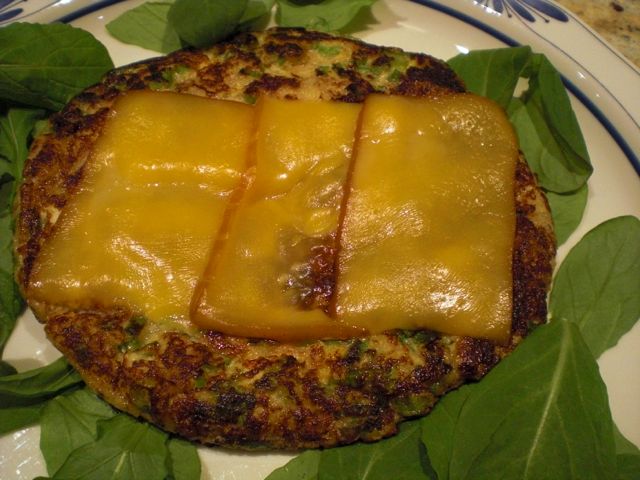
The first pictures above shows the final product. I topped it with cheese (picture directly above) and added dried bonito shavings or "katsuobushi" 鰹節 (top picture). I served it cut into 4 pieces using a pizza cutter and with a little of soy sauce.

I surmised the original recipe may have used "mountain yam" 山芋 but I only had the domesticated version called "Nagaimo" 長芋. Since nagaimo is not as sticky as yamaimo and a bit more watery, I decided to mix in an egg.

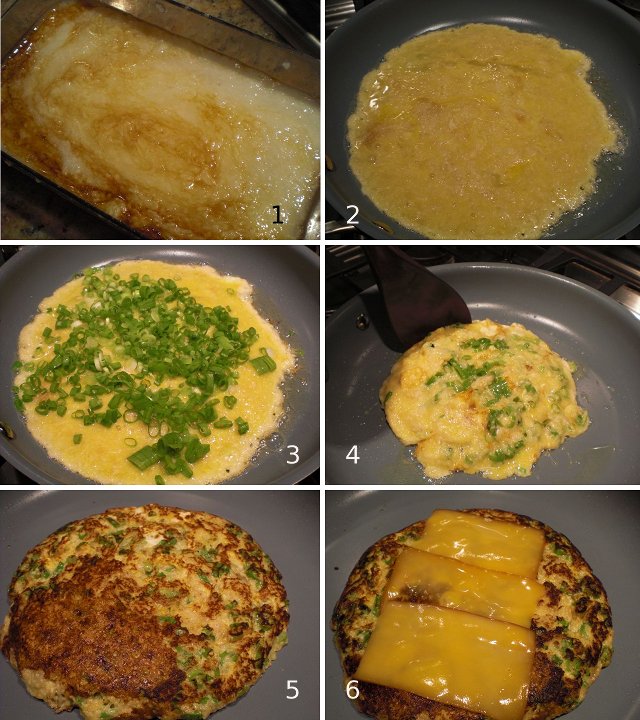
I grated the nagaimo (about 1 cup) and mixed in soy sauce (1 tsp) (#1). I then added one beaten egg and poured it in a non-stick frying pan with a small amount of vegetable oil (1 tbs) on a medium flame (#2). When the bottom was set, I spread finely chopped scallion on top (3 stalks) (#3). Using a spatula, I started folding the edges toward the center all around (#4). After several minutes, I flipped the pancake until both sides were brown (#5). I placed three slices of smoked aged cheddar cheese on top (my wife's choice) and put the lid on for another 1-2 minutes until the cheese melted (#6).

I placed the pancake on the bed of baby arugula and spread shaved bonito flakes with a bit of soy sauce.

This is a very interesting dish--in a good way. The center was still soft and the scallion flavor was well integrated. It had the mouth feel of the most tender-delicate french omelet you've ever tasted and yet it was very clearly not an omelet.  My wife's choice of smoked cheddar added depth of flavor and almost a sense of barbecue that went surprisingly well with the bonito. We really liked this dish and cold sake was the perfect choice.