Wednesday, December 7, 2011

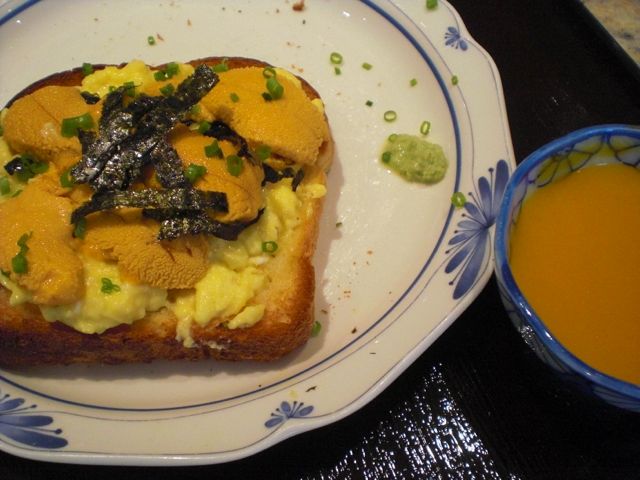
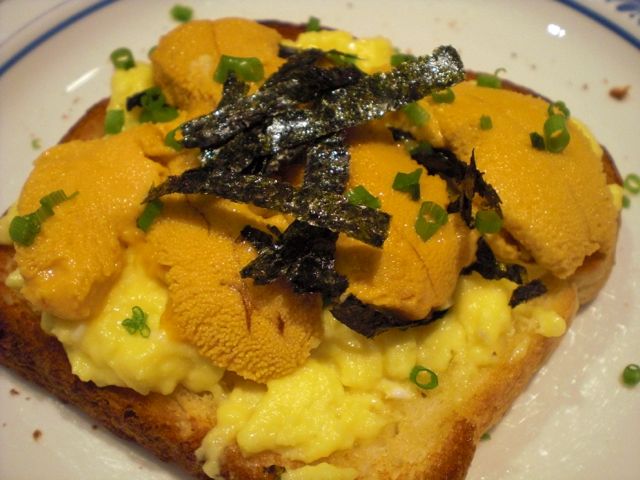
Sea urchin, creamy scrambled egg on toast 雲丹とクリーミィ炒り卵のせトースト

Uni for breakfast--this may be too much of a good thing. I have to preface this by saying it was all my wife's idea. I, for one, would not have considered eating uni for breakfast. However, we were in a bind. I had ordered 4 trays of luscious golden California uni from Catalina (along with some other items) expecting to feast on them over the Friday to Sunday dinners of the weekend when my wife reminded me that one of those days we had a dinner engagement. So there we were; too much uni and not enough intervening dinners before it went bad--hence breakfast uni. We have tried the combination of soft scrambled eggs and uni before and it was really good so this was just another step along the continuum
Scrambled eggs: I made creamy scrambled eggs using a Bain Marie or a double boiler to make it extra creamy. I used pasteurized eggs (two) with the addition of cream (light cream 2 tbs), salt (1/4 tsp) and freshly cracked white pepper. After beating the eggs well, I added a thin pat of butter in the upper pan of a double boiler. When butter melted, I added the egg mixture and stirred with a silicon spatula. I kept stirring until the eggs became soft scrambled eggs (4-5 minutes). I erred on the side of slightly under cooking (this is a reason I used pasteurized eggs).

Toast: My wife had baked a loaf of white bread previously which was sliced and frozen. She toasted and then buttered it.

Assembly: I layered the creamy scramble eggs, chopped chives and then sea urchin (for two servings, I used a whole tray, 80 grams). I garnished it with strips of nori (I added more after taking picture) and a side of real wasabi. I sprinkled Kosher salt and white pepper and more chopped chives as well.
We served this with a very small bowl of kabocha and sweet potato potage (I used sweet potato instead of my usual regular potato) on the side. We smeared a little of the wasabi on the uni before eating. This is rich! You can't go wrong with this combination no matter what time of the day it is eaten. It was amazingly good as a breakfast. We had Cappuccino with this but if this had been in the evening, sake wold have been our choice of libation.

Monday, December 5, 2011

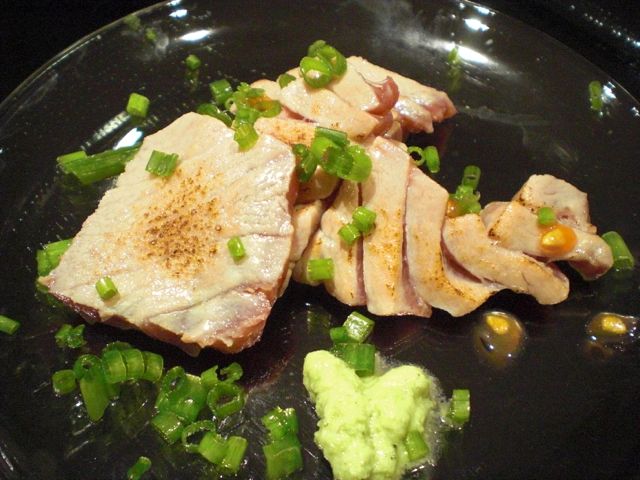
Seared or "aburi" fatty tuna トロの炙り

This is part of the tuna feast. Sometimes the fattiest part of tuna can be just a bit overwhelmingly too much fat for some (not for us). One of the ways to make the fattiness more agreeable is to use a technique called "aburi" 炙り. In the old days, charcoal fire was used but, nowadays, a kitchen torch is the most commonly used tool to accomplish this task. For this dish, I chose the fattiest portion of the tuna we had.
I placed the tuna slice on a plate and using a kitchen torch, I seared the sides of the tuna slices. I just served this with a garnish of chopped chives, fresh wasabi and soy sauce.

Searing does add a different dimension to tuna sashimi. We rather enjoyed this dish (a lot), which led to consuming more sake.

Saturday, December 3, 2011

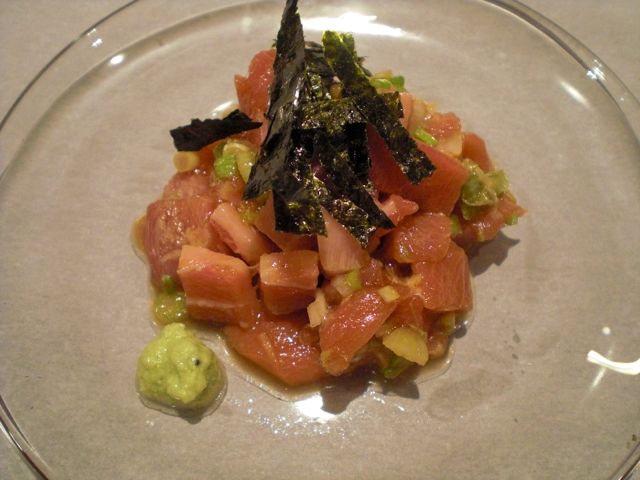
Fatty tuna and scallion ネギトロ

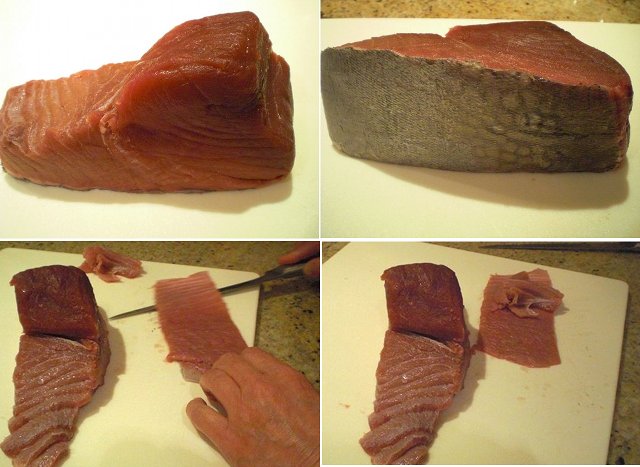
Catalina offshore products did not have fresh tuna sashimi blocks for quite some time but, recently, it was back in stock. I ordered one pound along with other items. This is blue-fin tuna with "akami" and mostly "chu-toro" block which most likely came from a portion toward the tail.
The one pound block looks like you see below with the skin still attached. Top triangular part is mostly red meat or "akami" 赤身 and underneath is mostly moderately fatty or "chu-toro" 中トロ and only small amount of fatty part or "toro" トロ. We got a much better block of tuna from them in the past but given the long hiatus in availability, I am not complaining.

After I removed the skin and then the meat attached to the skin which was quite fatty (image above lower right). I decided to make "negitro" ネギトロ ("negi" means scallion and "toro" means fatty tuna) from this and other trimming or "scrap" parts. I then cut the akami by slicing horzontally (getting a triagular shaped akami block. I then divided the remaining rectangular blocks into slightly fatty ("ko-toro" and moderately fatty ("chutoro"). I wrapped each part in parchment paper, then paper towels and placed them in a Ziploc bag. I stored it in the meat drawer of the refrigerator, where it will keep up to 3 days if it is going to be used as sashimi. Any  longer and it has to be cooked.

I am not sure where "negitoro" originally came from but I believe it was popularized by low-end shushi bars such as "Kaiten sushi" 回転寿司 place serving their customers utilizing scraps or low-quality tuna sashimi either as a roll or battle ship sushi or "gunkan maki" 軍艦巻き. Certainly, I did  not have this while I lived in Japan. In any case, since I had thin but rather fatty meat (image above lower right) just off the skin, I made "negitoro".  Since the portion was not totally scrap or scrapings from the skin or bone, I cut it into small dices rather than making it almost like paste which is usually the consistency of negitoro.

I just mixed in finely chopped scallion and dressed it with a mixture of "real" wasabi (just defrosted) and soy sauce and garnished it with nori strips. This was our starter for the tuna feast evening. The only problem with this type of dish is that you tend to over indulge with sake.

Thursday, December 1, 2011

Fried lotus root sandwich 蓮根のはさみ揚げ

Lotus root or "renkon" 蓮根 is a floating stalk of the lotus plant but is not really a root. It has air channels which makes it float on the water. Japanese (and Chinese) are fond of renkon which has a nice firm texture and is rather starchy. In the past, I could occasionally get fresh renkon in the Japanese grocery store but now only ones I can get are pre-boiled in a vacuum pack. That's  just fine with me since it is always difficult to clean the insides of the air channels. The vacuum packed variety has a nice firm texture and can substitute for fresh ones for any dish which calls for renkon.
Pork: We had a whole pork loin which I made into three different kinds of roasts (Sino-Japanese pot roast, brined and non-brined pork roast cooked in the Weber with hot smoking) for Thanksgiving (we gave up on Turkey some years ago). I had some trimmings which I chopped by hand and made into ground meat. I decided to make this dish as a drinking snack. I am not sure about the amount but it was not a lot (may be less than 1/2 pound), just enough to make 7 sets of renkon sandwiches as see below.
Other ingredients for meat stuffing: I mixed in scallions (finely chopped, 3 stalks), grated ginger (1/2 tsp) and garlic (1/2 tsp), soy sauce (1/2 tsp) and mirin (1/4 tsp) and back pepper. I just kneaded the mixture together by hand until it became rather sticky. If it had too much moisture, I could add potato starch. I sliced the renkon into thin rounds (1/4 inch thick). I took a small amount of the meat mixture and made miniature hamburger patties the same size as the renkon rounds to form a sandwich (left in the image above).

Batter: I made a relatively thick tempura batter; a mixture of cake flour and potato starch (3:1) and ice cold water.

I coated the renkon sandwiches with the batter and deep fried in 340F peanut oil for 2-3 minutes turning once or until the meat was done.

I served this with green tea salt. The renkon retains a nice crunchy texture which combined with the juicy meat stuffing is very nice. This dish will go with any drink including cold beer. Other variations could use chicken or shrimp for the stuffing. Of course, you can serve more than just one per person.

Tuesday, November 29, 2011

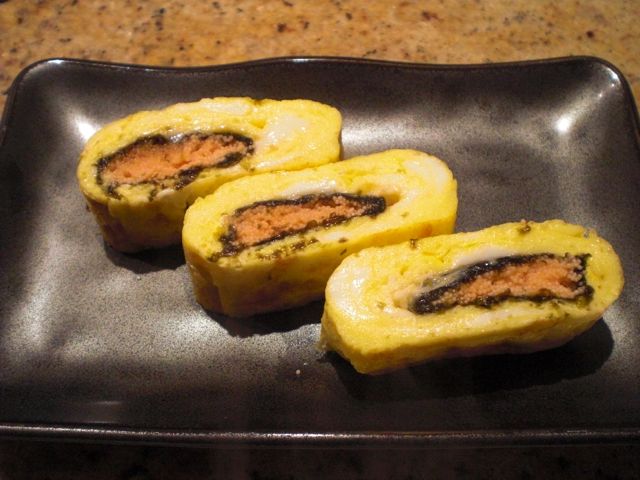
Japanese omelet with Cod roe wrapped in nori 鱈子と海苔いりだし巻き

This is a dish I made from the cod roe left over after I made nagaimo dressed with cod roe. I posted a similar dish before but this time I wrapped the cod roe with a nori sheet before making it to a Japanese style rolled omelet. Again, I could have done a better job of centering the nori/cod roe.

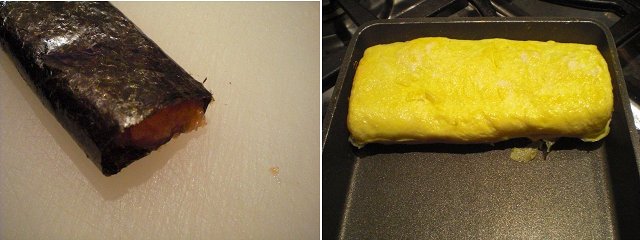
The cod roe is about a half a sack mixed with sake and Tabasco. I just cut the nori sheet to the width of the square frying pan I used to make the Japanese omelet. I put the cod roe in the center of the nori sheet and rolled it to make a rather flat roll (image below left).

I just mixed two beaten eggs with dashi broth (2 tbs) and added sugar (2 tsp) and salt (a pinch). On medium heat, I put a small amount of vegetable oil (1 tsp) and poured in 1/4 of the egg mixture. When the bottom is set, I placed the cod roe/nori roll on the far side of the pan and started rolling using a spatula, Japanese cooking chop sticks and by tilting the pan to help with the rolling. I poured another 1/4 of the egg mixture into the open area of the pan, lifting the existing omelet so that the egg mixture flows under it. I rolled again and repeated the process until all the egg mixture was used resulting in a rectangular omelet (image below right).

I cut it into 6 pieces (3 for one serving). The cod roe was just barely cooked and was lovely and moist. The addition of nori makes the rolling easier as well as adding a nice oceanic flavor to this dish. The tabasco gave it a slight zing. Of course, the egg part is slightly sweet and dashi adds nice soft texture and delicate flavor. There is no need for soy sauce since cod roe gives enough saltiness. The winning combination! We, of course, had cold sake with this.