Wednesday, January 18, 2012

Steamed potato and pork tenderloin with pickled plum sauce ジャガイモと豚肉の梅が香蒸し

Whenever we cook pork tenderloin, we have trimmings left. From the trimmings, I make many other dishes such as gyoza, pork scallopini etc. I then saw this recipe in Asahi shinbun on line and decide to try it. This is potato and pork tenderloin in a pickled plum (or umeboshi 梅干) sauce which is steamed. This is in a category similar to our steamed lemon chicken with shiitake mushrooms. This is a rather healthy dish and it turned out to be very nice. This dish definitely will join in our teiban 定番 or regular dishes.
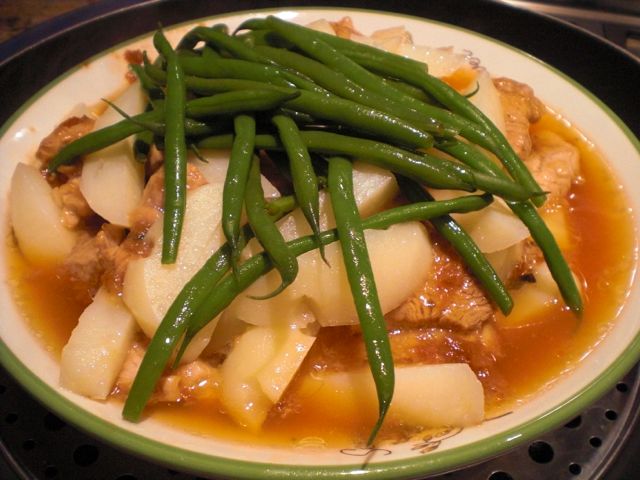
I made some modifications to the dish but they were not intentional; they just happened. Otherwise, I followed the recipe. The above is the final product and this will probably serve 4.

Pork tenderloin: These were the trimmings from 2 pork tenderloins. I did not weigh them but I estimate it was about 4-500 grams (about 1 lb). I sliced them into 1/3 inch medallions.

Potato: We used white potatoes (4 medium). Peeled and cut it in 1/3 inch wide batons like for French fries.  I soaked them in cold water to remove the excess starch on the surface and then dried them using a paper towel. I seasoned them with salt and coated with olive oil (2 tbs).

Plum sauce: I removed the meat from umeboshi or pickled plum (2) and minced it to make a paste. I mixed in soy sauce (2 tbs), mirin (1tbs), sake (1 tbs), sugar (2 tsp), dark sesame oil (2 tbs) and potato starch (2 tbs). I also added grated ginger (1/4 tsp) and grated garlic (1/2 tsp). The grated garlic was my addition, I thought I had grabbed a tube of ginger but discovered after I had put it in that it was garlic. Turns out that it added a very interesting dimension that really added to the dish. 

I placed the pork tenderloin from above and mixed and marinated it in the sauce for few minutes.

Assembly: I used a deep pasta dish and made alternate layers of the potato and the pork with potato layers on the bottom and top with two pork layers. 

I steamed it on medium high flame for about 30 minutes. At the last few minutes, I added haricot verts (we happened to have ones already steamed from the other night). I think any greens will do here.
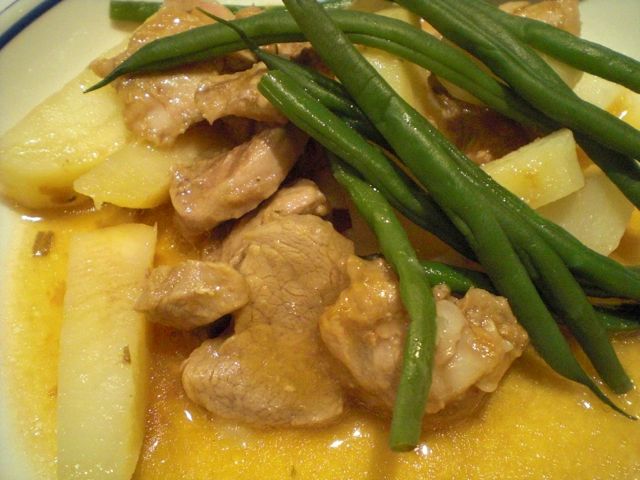
We served portions as shown in the picture. This is a very good dish that could quickly enter the "comfort food" category. The pork is very tender and potato and the sauce which forms during the steaming goes so well together. The sauce has a subtle sourness from the pickled plum. My (inadvertent) addition of garlic was also good. The only problem we had was that the potato cooked a bit unevenly.

Monday, January 16, 2012

Tuna bowl 鉄火丼

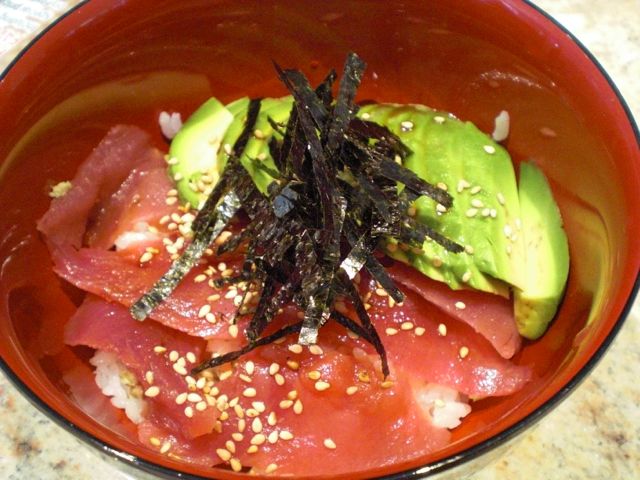
"Tekka" 鉄火 in Japanese literally means "iron fire" describing red hot iron. When the red meat of tuna sashimi is used in a "maki" roll or "donburi" rice bowl dish, they are called "tekkamaki" 鉄火巻き and "tekkadon" 鉄火丼, respectively. Here, the red tuna sashimi is equated with red hot iron. One weekend, I made this as a lunch.
Again, this is not a recipe per se but just a description of how I assembled the dish. 

Tuna: From a pound block of tuna sashimi, I sliced red meat or 赤身 in relatively thin slices like one would use to make nigiri sushi. I smeared on a small amount of real wasabi exactly like I would do to make nigiri sushi.

Sushi rice: Since this was a lunch, I did not make fresh rice. I microwaved frozen rice in a silicon container and added sushi vinegar (from the bottle). After mixing, I put the lid back on the container and let it steep for a few minutes so that the sushi vinegar was nicely absorbed.

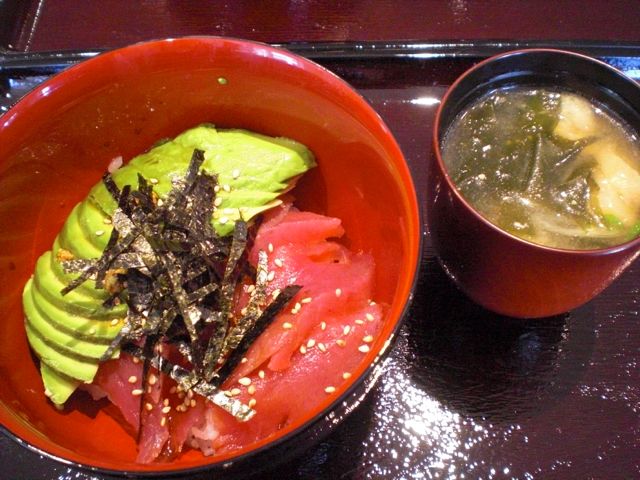
I placed the sushi rice in the bowls and placed the tuna sashimi (with wasabi smeared side down). Since I had a nicely ripe avocado, I sliced it and placed next to the tuna. I sprinkled soy sauce on the top and garnished with roasted white sesame and nori strips.
I also made miso soup with wakame, deep fried tofu pouch or abura-age 油揚げ, and scallions. This is a simplest form of this type of dish but very satisfying. A good lunch for any day.

Saturday, January 14, 2012

Tuna "chiai" cake 鮪の血合いバーガー

The block of sashimi-grade tuna we got from Catalina Offshore products contained a dark red portion called "chiai" 血合い or blood line. This very dark meat is the least desirable part of the entire tuna. It has a strong gamy taste. Many sushi bars throw out this portion (or I imagine they may serve it to the employees) but, I have made two similar dishes using chiai, which were not bad. This time, I decide to make something totally different.
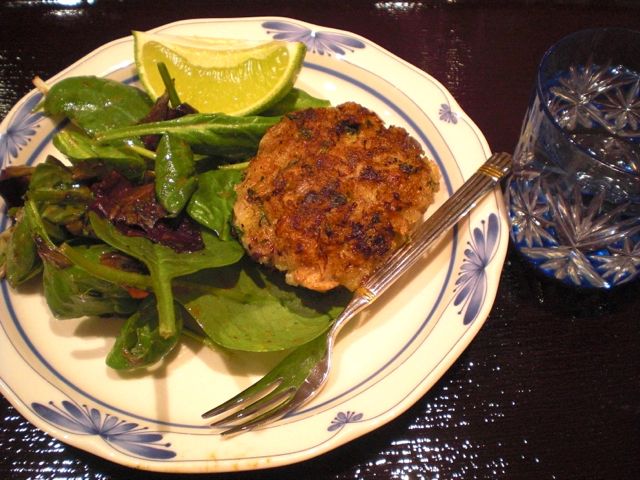
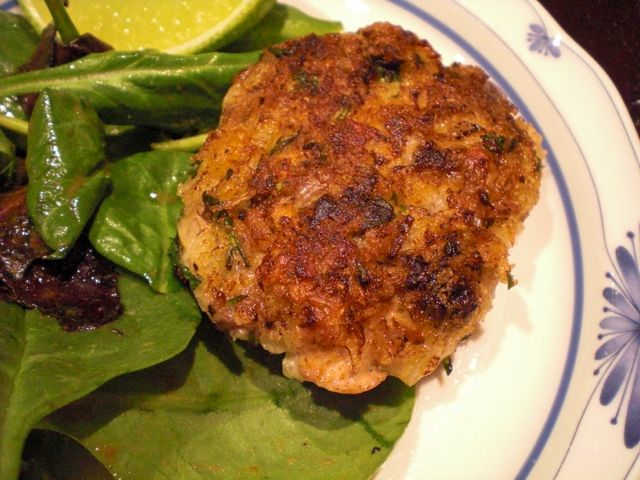
This was a starter dish. The amount of chiai from the one pound tuna block this time was not much. I could only make two small tuna patties or cakes.

Tuna chiai: I just chopped into small cubes.

I sautéed a shallot (one small, finely chopped) in light olive oil for few minutes. I placed it in a metal bowl to cool before I added the other ingredients which included finely chopped parsley (3 springs, finely chopped), ginger and garlic (grated 1/2 tsp each), store-bought mayonnaise (1 tbs) and panko bread crumbs (1 tbs).  I seasoned it with salt and pepper. I could have added more items such as lemon zest, hot pepper (either Tabasco or finely chopped jalapeño), but I restrained myself.

I made two equal sized patties and fried them in olive oil 2-3 minutes on both sides. I served it with mixed green and my salad dressing which is balsamic vinegar, mustard, olive oil and rice vinegar.

I was afraid that chiai may be too strong for this dish but the addition of a good amount of ginger and garlic really helped. This was a perfectly good use of scrap meat from the tuna block which would have been discarded in most circumstances. 

Thursday, January 12, 2012

Sea urchin pasta パスタのうにクリームソース

This was a dish I've been wanting to make for some time but it felt like a bit of a sacrilege to use  good uni this way, so I did not make it until now. Catalina Offshore products sells four different kinds of uni; two kinds of live uni in a shell, California "premium" uni and "gold" uni with the gold uni being the best. I usually get the gold uni but this time, the only uni available was "premium". The difference between the "gold" and "premium" is the color and texture; the gold uni has a nice golden color with a firm texture and the premium is yellower with a softer consistency. Both taste pretty similar to us but there is about a 100% difference in price. They also sell frozen "vana" uni which appears suitable to use for a sauce but we have not tried this.
In any case, because the premium uni has a softer consistency, I thought this was best for this pasta dish. Since this is still an excellent uni, I made sure not to cook the uni in order to preserve its fresh oceanic flavor.

Uni: I used the entire 80 gram tray for two small portions of pasta (We were going decadent here). Leaving a few pieces for garnish, I put the rest in a metal bowl and stirred to break it up and added cream (about 2 tbs) and mixed them well but did not use a bender. Because of this, it still had some small bits and was not totally homogenized but that was OK by me.

Pasta: I used Angel-hair pasta which was cooked as per instruction on the box.

While the pasta was draining, I melted butter (1 tbs) in a frying pan on medium flame. When the butter melted I added the drained pasta to coat. After I cut the fire, I added the mixture of uni and cream and coated the pasta.

I garnished it with chopped chives and nori strips and more uni on the top. I served soy sauce on the side. This is a very rich and creamy pasta. Excellent! Next time, I may mix in soy sauce before serving. Although this is a pasta dish, we stuck to cold sake which went so well with the uni.

Tuesday, January 10, 2012

Julienne of Nagaimo with sea urchin 千切り長芋と雲丹

I just realized that my fellow Izakaya affectionado, Tobias at Izakaya Sanpo, has one recent post on October 2011 which I missed. It is about the Izakaya in Setagaya ward 世田谷区 called "Akaoni' 赤, which is an imaginary red demon in Japanese folklore. One of the dishes he had and posted included this dish. Since I happened to have all the ingredients, I decided to make it.
I should have arranged everything more neatly but this is an Izakaya dish after all and I suppose rustic or not perfectly neat presentation is OK. The description of this dish and picture were enough to assemble this simple dish.

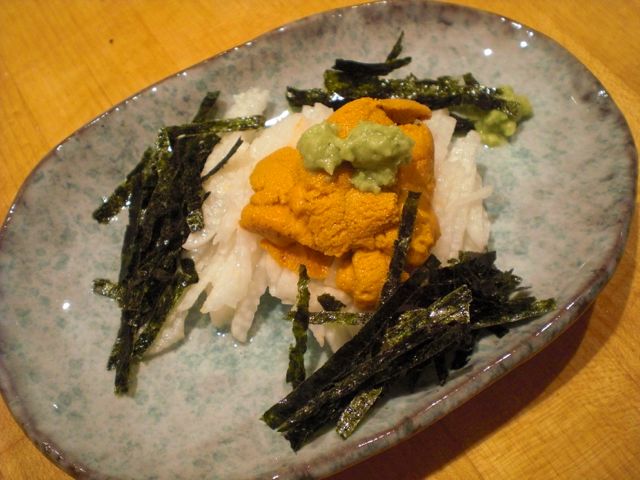
I just sliced and cut nagaimo 長芋 into small match sticks. I dressed with a small amount of sushi vinegar (from the bottle) and placed in the middle of the dish. I placed California gold uni with a small dab of real wasabi. On the three corners, I paced nori strips.

Before eating, we poured a small amount of soy sauce and mixed. This is certainly a good small dish. A perfect Izakaya affair which goes well with cold sake even with Daiginjou 大吟醸.