Monday, August 17, 2015

Otoshi 3 kinds お通し三種類

These are another example of my otoshi appetizer threesome. Again these were made quickly from mostly leftovers.


The first  one is sort of Italian style octopus, a leftover part toward the tip of the tentacles after using thick portion for sashimi; Cucumber cut into small cubes, black and green olives, dressed in olive oil seasoned with smoked paprika.


The second one is my usual braised burdock root or "Kinpira gobo" 金平牛蒡, which I made the prior weekend.


The last one is leftover cooked salmon (broken into small pieces) dressed in mayo (mixed with Japanese one flavor pepper flakes 一味唐辛子 and light colored soy sauce 薄口醤油 garnished with ikura salmon roe.


Except for the Ikura, all these appetizers will go with either sake or wine. Instead of just one appetizer, having three is more enjoyable.

Friday, August 14, 2015

PA Dutch Wet Bread stuffing

This is another one of my wife's PA dutch dishes triggered by our recent trip to rural Pennsylvania. It is essentially, a hybrid of mashed potato and bread stuffing but it tastes more like mashed potatoes than bread stuffing. When my wife was growing up, she used to eat something called wet bread stuffing served in the school cafeteria as a side dish for lunch. She remembers it as a loaf cut into slices and heated with a gelatinous texture.  Not one of her favorites as a child (it was that gelatinous texture) but as an adult she was curious to try it again. After some searching she found this recipe and though this may be it.


Ingredients (for 8 servings):
2 1⁄4 lbs potatoes, peeled and chopped
4 slices white bread, torn into pieces (My wife used Pepperidge Farm flavored bread stuffing about 2 cups). Several of the recipes go into great detail on how to handled the bread such as toasting it, frying it, and other methods to dry it out.
1⁄2 cup diced onion
1⁄2 cup diced celery
Salt and pepper

Directions:
  1. Saute the onions and celery until the onions are just translucent and soft
  2. Bring a large pot of salted water to a boil.
  3. Add potatoes and cook until tender but still firm, about 15 minutes.
  4. Drain, mash, salt and pepper to taste. Add enough milk and butter to give the mashed potatoes a very creamy texture. They should be a bit more liquid than usual for mashed potatoes because the dried bread soaks up the extra liquid. At this point just the potatoes themselves are good. 
  5. Preheat oven to 350 degrees.
  6. Lightly grease a 2 quart casserole dish.
  7. In a large bowl, mix together the potatoes, white bread (or flavored stuffing), onion, celery, salt and pepper. (First picture below)
  8. Pour into prepared casserole dish, dot with pads of butter (second picture below) and bake for 1 hour. (Final picture below).
(Mix the seasoned bread stuffing with the mashed potato).


(Fill casserole and dot the surface with butter).


(Bake for one hour at 350F).


This was not exactly the dish she remembered from her childhood. For one thing, there was no gelatinous texture and it was very good. The bread stuffing completely amalgamated with the potatoes. The flavored stuffing really made the dish savory. It was like mashed potatoes but different. It must have been a great way for PA Dutch cooks to use stale bread and leftover mashed potatoes. The first day, it didn't hold together and we spooned it onto the plate as shown in the picture above but a few days later it could be sliced. My wife is still curious about the concoction she ate as a kid but from her descriptions of it, I'm glad this was not it.

Tuesday, August 11, 2015

PA Dutch Crumb Cake クラムケーキ

Recently we visited rural Pennsylvania where my wife grew up. The trip was very nostalgic for her. One of the highlights was stopping at two regional grocery stores; Henning's and Landis. When she was a girl they were just small country stores which have grown a lot larger. (Henning's boasts 57,000 square feet). She was beside herself standing in front of the deli department stocked with all the Pennsylvania Dutch goodies such as beet pickled eggs, chow chows of all types, multiple types of scrapple. I had to remind her that  there was only so much room in the car. The real piece de resistance was the stop at Landis. Every Christmas she mail orders shoofly pie and funny cake from them. There, she stood confronted with shelf after shelf of shoofly pie, funny cake, apple sauce cake, apies pie, hard tac cake and others.  They even offered free samples with a small cup of coffee!! She couldn't resist and loaded up. Despite the mother load she brought back with her, she was inspired to make some PA Dutch dishes. This is one of them called "Crumb cake". It is not too sweet, and is very moist with interesting rough texture. I really like this cake. (Like many Pa Dutch baked goods although it is a cake it is made in a pie pan).


The name "Crumb" comes from the fact the whole cake; both top and bottom are made from "Crumbs".


Ingredients

3 cups flour
1 teaspoon baking powder
1 1/2 cups brown sugar
2/3 cup butter
3 large eggs
1 teaspoon baking soda
1 cup buttermilk
2 teaspoons vanilla extract
1 teaspoon almond extract

Directions

Sift together flour, baking power, salt, sugar and soda.
Using a pastry cutter, cut in the butter until the mixture has the consistency of course meal or small peas. (These are the crumbs for which the cake is named. )
Reserve about 1 1/2 cups of this mixture and set aside.
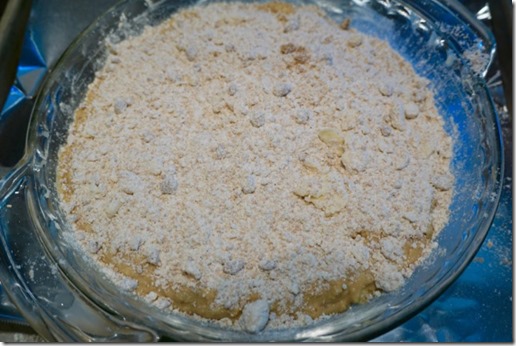
Combine the eggs, milk and extracts and stir into the remainder of the dry ingredients and blend. (First picture below)
Pour into 2 well-buttered 10-inch pie pans.
Brush the top of the dough w/ butter and sprinkle with the reserved crumb mixture. (Middle picture below)
Bake at 350° for 25-30 minutes or until cake is done. (Last picture).

(Pie pan filled with wet and  dry "Crumbs" mixture).


(After reserved dry "Crumbs" were put on).


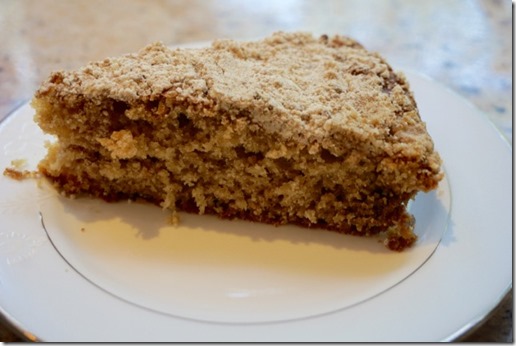
(After baked at 350F for 30 minutes).


The cake is mildly sweet with a lovely moist texture. The combined flavors of the brown sugar, vanilla and almond is very distinctive but delightfully mild. The cake went so well with our espresso. The cake is so easy to make. We'll be seeing this one again.

Saturday, August 8, 2015

G Sake on the rocks G 酒 オンザロック

When we were at Izakaya Kurakura 蔵倉 in Kyoto recently, we had "Icebreaker" summer sake on the rocks which gave us the idea to taste G sake on the rocks. We posted G sake Joy and G sake Fifty in 2013. While they were good, we were not wild about these sakes (we liked the original G sake) and thought they were a bit too assertive/savory in taste with cloying sweetness (this tendency was more pronounced in "Fifty"). As a result several bottles of G sake have stayed in the refrigerator untouched. Since they were a rather assertive undiluted genshu with higher alcohol content (18% alcohol), we thought they may taste better on the rocks like Icebreaker sake.

We first tried G sake (2013 version) on the rocks.


The glass came from Kitaichi glass 北市グラス in Otaru 小樽. While we were in Japan, we noticed some of the Japanese tumblers were made of incredibly thin glass. We learned that since incandescent light bulbs are becoming a thing of the past in Japan, the same technology used to make light bulbs is being used to make very thin-walled glass tumblers. The ones we bought have little dimples on the sides making them easier to grasp. We tasted G sake "Joy" on the rocks in these tumblers accompanied with deep fried small sweet fish or "ayu".


A few days later, we tried G sake "Fifty" (2013 version) on the rocks. The major difference between "Joy" and "Fifty" is the degree to which the rice has been polished; 40 and 50% (of outer kernel removed), respectively.


This time we had octopus sashimi and raw ocutopus in wasabi yuzu dressing (in the square container,  from a frozen package). I also served matchsticks of nagaimo in vinegar dressing garnished with dried "aonori".


We liked G sake "Joy" on the rocks. The cloying sweetness was much less and the slight dilution and icy temperature made the G sake taste crisp and better.  G sake "Fifty" got much better than tasting it straight but the cloying sweetness broke through even on the rocks. Certainly, we can drink it much more easily on the rocks than straight. In conclusion, it is a good idea to have G sake on the rocks in hot summer. The assertive tastes of G sakes are actually perfect for on the rocks. We much prefer G sake "joy" over "fifty". We have not tried the most recent brews, however.

Wednesday, August 5, 2015

Octopus 2 ways たこのお通し2種類

Again these two appetizers using boiled octopus leg are not new. But these were what we had one evening.

The first one is sort of octopus carpaccio (Carpaccio de pulpo). I posted a similar item in the past. I first made zigzag lines of good fruity olive oil on the plate and then criss-crossed with lines of syrupy aged balsamic vinegar. I scattered Kosher salt and freshly ground black pepper.  Since I had a leftover fennel bulb which was used for making chicken paillard, I first thinly sliced fennel using a Japanese mandolin Benriner and placed them as a base. I thinly sliced  boiled octopus leg and placed in one layer on the  top. I added a few slices of fennel, thin slices of cucumber and scattered oil cured back olives (after removing the stone). I finished with lines of olive oil and balsamic vinegar, Kosher salt and black pepper. Fennel added anis-like  flavor and oil cured olive gave a burst of saltiness. This combination was quite good.


Using the tips of the octopus leg, I also made a small Japanese style salad with karashi-su-miso 芥子酢味噌 dressing. I just cut the tips into small bite size chunks. I sliced cucumber, salted it and squeezed out the moisture. I then took salt preserved (not dry) Wakame sea weed, washed it to remove the salt and soaked in water for a few minutes then cut into small pieces. The dressing is a mixture of white (sweet "Saikyo" 西京味噌) miso, rice vinegar, Japanese mustard and sugar.


Because of the acidity in the dishes, sake was the best choice although the first Carpaccio dish could go with wine. These were good starters with cold sake.