Wednesday, January 15, 2020

Tippsy sake; Best sake website

Buying Japanese sake has not been easy in the U.S., that was, however, until recently. Surely any wine/liquor store, either brick-and-mortar or on-line, carries some sake but if you are looking for a certain sake, you will not find it most of the time. Since turnover is usually low in regular liquor or wine  stores, your chances of getting old sake is high. Our Japanese grocery store carries a better collection of sake which is still limited and the prices tend to be on the high side. I regularly get cooking sake (Ozeki brewed in California) at a near-by liquor store but that is about it. Our house sake has been "Mu" daiginjo sake ”無” 大吟醸. To get a case of "Mu" on line or from brick-and-mortar stores required some efforts and wait time.  When we added  "Tengumai" daiginjo 天狗舞 大吟醸 to our house sake, it was more difficult still.

This was all solved when I came across the "Tippsy sake"  website last March (disclaimer: I am not associated with or getting any benefits from them except that I can now buy the sake I want on line). I guess when you get "tipsy", your finger hits "p" twice. I have bought 5-6 cases by now and I am happy to tell you that I am very satisfied with their selections, services and prices.

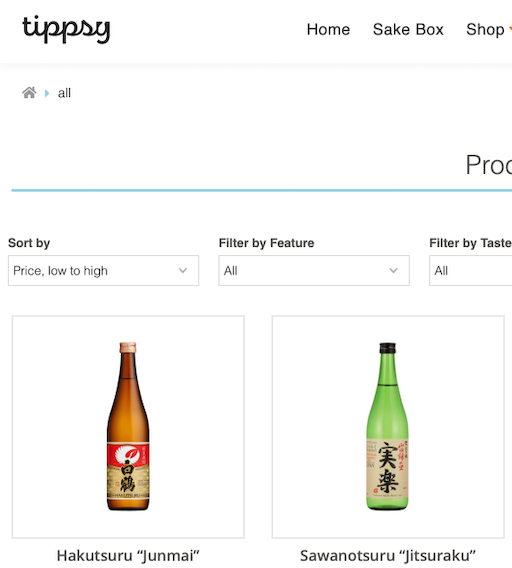
The below is the "sake shop" page. It has excellent collections of sake although some "cult" breweries are missing (which is not a negative by any means especially since these almost never get out of Japan and if they did probably would not be worth the price). You can search and filter the results in many ways. The below is "junmai" sake listed from low to high price.  The lowest price sake happens to be my go-to sake when we want warm sake; "Hakutsuru" junmai 白鶴純米.


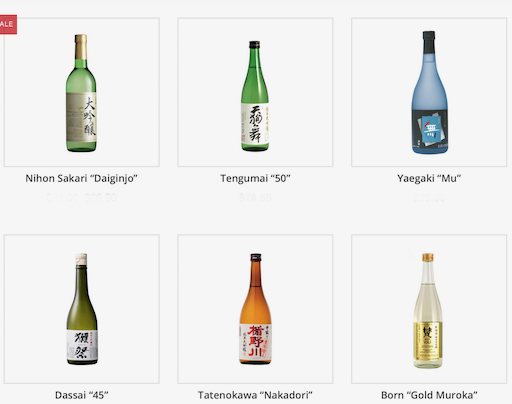
The below is daiginjo listed from low to high price. I think the frist three are good ones with high CP (cost/performance) ratio. Tengumai "50" and Yaegaki "Mu" are, as I mentioned, our house cold sakes. Actually Nihon Sakari 日本盛 大吟醸,  which is the lowest priced daigiinjo, is not bad at all. Mu and Nihon Sakari are similar; very  clean, fruity but a bit on the  simple side, Tengumai has more complex flavor. Of course, Dassai "45" 獺祭45 is a classic very fruity and popular daiginjo.

When choosing a particular sake,  one advantage of the web site is the detailed information concerning the sake that is available, such as the information shown below. I think this is for "Tengumai 50". Beside the flavor profile, you get more technical information like %alcohol, RPR (Rice  polishing ratio or "seimai-do" 精米度, for example daiginjo has to be more than 50%), SMV (Sake Meter value or "Nihonshu-do" 日本酒度 , +3 is neutral, the larger the number drier) etc. Appropriate serving temperatures and food pairing are also listed.


I am also impressed with their service. The sake is shipped from California, and took more than one week in the beginning but their processing has been getting better and takes 5-6 days to the East coast. During the summer months, they are careful to make sure the sake is handled appropriately and does not undergo a "hot soak" in the summer heat while being shipped cross country.  They ship it in a refrigerated truck/train to somewhere in NJ and then ship it to the customer using FedEx ground which is same as over-night shipping. This adds a few more days and the FedEx notification gets a bit screwed up but once the sake arrives in NJ, the notification is accurate. With all this service, shipping is free if you buy half a case or more. One time, the package was damage during shipping on the day it was supposedly to be delivered. I got a notification from FedEx that they were shipping it back to the sender. I contacted (emailed)  "Tippsy" and the customer service was wonderful  and re-shipped the order.

For me, this is the best place to buy sake. I recommend this site for anybody interested in buying sake. They also has the "sake box" subscription which I have not tried. Hope they will continued to be successful.

Sunday, January 12, 2020

January 2 evening with osechi 正月2日の夕

This was January 2nd. We finished the lovely soba noodle from Sushi Taro as a lunch  and in the evening, we hit the Sushi Taro osechi box in a big way. This plate is the collection what goes well with sake. All except for two items came from the osechi box.


This is a lot of food and also encourages sipping sake.
1. Red and white fish cake, 2. Steamed Uni sea urchin, 3. Vinegar cured flounder kelp roll, 4. Smoked oyster and persimmon, 5. Salt-broth soaked sugar snap (my contribution), 6. Miso marinated herring roe, 7. Caramelized crispy baby shrimp, 8. "Karasumi" cured sun-dried mullet roe, 7. Braised "ayu"  sweet fish with roe in sweet soy sauce, 10. Koji pickled  herring with daikon or could be turnip, 11. Salmon kelp roll (my contribution), 12. Squid ink coated mustard stuffed burdock root, 13. Monkfish liver terrine, 14. Russian marinated salmon with ikura salmon roe (my contribution), 15. Grilled sweet miso marinated Spanish Mackerel, 16. Slow cooked miso marinated Wagyu beef tongue.


Everything was fabulous. Several items are highlighted below. This is persimmon and smoked oyster which is new and great.


More daikon (or could be turnip) than herring but marinated in malted "koji" rice is also good. This is the first time I used these miniature square plates we got in Kyoto last time we were in Japan.


I warmed the mackerel and beef tongue in the toaster oven but I got distracted and they got a bit overcooked/warmed it but they were still great.


After cold sake and these 16 different delicacies, we switched to red wine and several dishes I made: chicken liver simmered in red wine, pork belly "kaku-ni", and two variations of chicken squares (one with pine nuts and miso flavor and the other with blue-cheese and dried fig). This was more than enough for us for the evening. We indulged adequately for the January 2nd feasting.

Thursday, January 9, 2020

New Year Soba お正月蕎麦

Chef Kitayama of Sushi Taro is passionate about making hand-cut "teuchi" soba 手打ちそば. This year, "Toshikoshi soba" 年越し蕎麦 was an option with  the Osechi box and we got one order (for two people). It also included "Soba dare" 蕎麦だれ in a plastic botttle. We knew we could not eat the soba on New Year eve as "toshikoshi soba" since we would be too full. As in other years, we enjoyed it as "New Year soba" (if such a word exists, お正月蕎麦). We had this as a lunch on the second day of the New Year.


I asked my wife if she wanted the soba cold or warm. She chose warm. So I made "Kakesoba" かけそば.  I topped it with all "osechi" items to make it "New Year soba". Some came from the Sushi Taro osechi box some are what I made.


We used one portion in a plastic wrap for two of us.


How to cook "raw" 生そば or "teuchi" soba 手打ちそば:
Since most of us including me usually have commercially made dried soba, it may be worthwhile to mention how "teuchi soba" should be cooked (mostly for my own reminder).

1, Large amount of rapidly boiling water.
2. Add soba by separating and distributing in the water.
3. Gently move the soba in slow circular motion with a pair of long cooking chopsticks to prevent the soba from sticking to each other but not to break the soba. I cooked about 1 minute and half.
4. Scoop up the soba using a wire-meshed ladle, if you want "Sobayu" 蕎麦湯 (which is the water in which soba was cooked) to dilute the dipping sauce for drinking (applicable to cold soba).  Otherwise, just drain it in a colander and gently wash it in running cold water (this process is important to remove the cooked flour on the surface of the noodles (if left on, the flour would make it a bit slimy) and to cool down the soba to make it firm.
5. For warm soba, either you could warm it up again by dipping it in hot water or briefly warming it in the soup broth. Since my wife has a "cat's tongue" (her own words) she does not like very hot soup so I chose to just to put the cooled and washed noodles in the bowl directly (see below).


These are the toppings I used for the New Year soba. The sake-steamed shrimp, ume-fu (flower or more specifically plum blossom-shaped gluten cake), and white and red fish cakes are from the osechi box. Chopped chives (I could have used "Mitsu-ba" since I had it but I forgot), sugar snaps in salted broth, and the datemaki are what I prepared. I prepared bonito and kelp broth using a dashi pack and added Chef Kitayama's tare sauce to taste (not quite 1:1) and kept warm on a low flame.


I warmed these toppings (except for the chives) briefly in the simmering broth and assembled the final bowls (see the first and second pictures). I then poured in the hot soup. This was quite good. I could have gone with a "volcanic" hot soup but my wife was happy with this since it was safer to eat without burning your mouth. I do not know if soba eaten in the 2nd day of New Year will bring any luck and  longevity but we enjoyed it nonetheless.

Monday, January 6, 2020

Shushi Taro Osechi 2020 寿司太郎のおせち重箱 2020

Since we did not finish the bluefin tuna sashimi and boiled octopus which we got frozen from Catalina offshore products and ate on New Year's eve, we started the evening of January 1st or "Gantan" 元旦 with the remaining tuna sashimi 本マグロ赤身, and octopus leg 茹で蛸の足. I also added some other items I prepared. For the first time, we got  frozen salted herring roe 数の子 from a company in Alaska called Great-Alaska-Seafood. Although, after I prepared it, it tasted the same as the Japanese sourced herring roe we have had in the past, it tended to be a bit soft and crumbly and the lobes were not uniform in size. I also made a part of the tuna sashimi block from Catalina into "marinated zuke tuna" 鮪の漬け which I served as "Yamakake" やまかけ.  I did not take pictures of this first round of the Gantan feast.

After this first round prelude, we finally opened the Sushi Taro Osechi Jubako 寿司太郎のおせち重箱. Although we have done this every new year since 2012, it is still always a thrill to open the osechi box. The picture below shows the first layer.  We immediately notice our favorites "karasumi" 唐墨 and steamed sea urchin 蒸しうに. A new item we noticed (there may be more) is in a bamboo container on the right upper portion called "lobster in shuto egg sauce" ロブスターの酒盗和え (see the comments on our tasting of this item, below).


Here is the close-up of karasumi or Japanese Bottarga. They make their own at Sushi Taro and as far as we can tell, it is the best.


This is the second layer. In this layer one of our favorites is in the left upper corner which is "Monkfish liver terrine" or あん肝豆腐.


Since we already had sashimi and yamakake, we ate only a little from the box. We made a small collection of our favorites shown below.


1. Karasumi, 2. Steamed sea urchin, 3. lobster in Shuto egg sauce*, 4. Caramelized baby shrimp, 5. Fish cake with matsutake mushroom, 6. Cod roe rolled in kelp, 7. Steamed kumquats in syrup, 8. Monkfish liver terrine and 9. Glazed duck.


*Lobster in Shuto egg sauce is new this year and we liked it very much. The sauce is creamy and I am wondering if it is like "kimi-su" 黄身酢 which was also seasoned with "Shutou" 酒盗 but that is my guess.

In any case, this was the excellent first evening feast of 2020.

Friday, January 3, 2020

New Year's eve sashimi and Black label "Mu" sake 大晦日の夕、大吟醸 黒乃無

On New Year's eve, we feasted on bluefin tuna sashimi and boiled octopus (with daikon namasu 大根なます, not in the picture) which we got frozen from Catalina offshore products and thawed for the celebration. I also served marinated "zuke" tuna 鮪の漬け (it's the darker tuna on the right upper corner of the plate)  along with "datemaki" 伊達巻 New Year's Japanese omelet and "salmon" Russian marinade 鮭のロシア漬けtopped with ikura all of which I made (except for the Ikura).


We opened a sake we haven't had before called "Kuro-no Mu" or "Black Label Mu" daiginjo 黒乃無 純米大吟醸 which is supposedly a step up from our house sake "Mu" daiginjo. Black Label Mu is made from sake rice with an RPR (rice polishing rate) of 40% meaning 60% of the rice's outer shell has been polished away. This compares to Mu which has a RPR of 50%; the minimum amount of polishing to be classified as daiginjo. Since less of the sake rice remains after polishing Black Label Mu is obviously more expensive than Mu.


So, our expectations for this sake were high--maybe somewhat over inflated because somehow this was not what we expected. To us it tasted much sweeter than the regular "Mu" and had a more sherry-like characteristic. What our taste-buds experienced is apparently confirmed by sake metrics shown below (cited from "Tippsy Sake" website which will be the subject for a separate blog in the near future). The SMV (Sake Meter Value or 日本酒度) for Black Label is +1.0 which is on the "slightly sweet" side (neutral is +3.0). Acidity also determines perceived "sweetness". With the acidity of 1.5 and  SMV of + 3, shown as the red dot on the taste metric graph below, the Black Label is still classified "light and dry (but on the border).  (Similar metrics were not available for a regular Mu). Black Label is good for sipping but we prefer regular Mu as an accompaniment with food.


We had a few more food items and ended by making tonkatsu (I breaded it earlier and just fried it).  We had hand made/cut soba noodles from Sushi Taro but as usual, we did not eat it on New Year's eve because we were too full. I fell asleep but my wife stayed awake and woke me up just before midnight. We saw the ball drop at Times Square on TV and welcomed the entrance of 2020.