I wanted to see how the marinade changed after I used it for both the diakon and the cucumber. I did this by weighing it. I weighed the marinade both before and after the daikon and cucumbers were done. Before I put in the diakon, the marinade weighed 170 grams. After the diakon had been in the marinade for 2-3 weeks I removed it and weighed the marinade. It was 343 grams; meaning that 173 grams of liquid were extracted from the daikon and replaced in the diakon by the salt and flavoring of the marinade. In essence the moisture extracted from the diakon doubled the total volume of the liquid. I then added 4 American mini-cucumbers to the 343 grams of marinade and after 1week I removed the cucumber and weighed the marinade. It had increased to 398 grams. (An additional 55 grams of liquid from the cucumbers were added to the marinade). I am not sure how many times I can reuse the marinade like this but it is good to know that I can use it for at least one batch of cucumbers after marinating the diakon and the cucumbers come out nicely.
Tuesday, February 27, 2024
Pickled Cucumber キュウリの漬物
We really like the pickled daikon which I posted before. I am making it regularly. As I mentioned in the previous post, the marinade contains a good amount of sugar and when I placed the daikon in the marinade, the marinade was basically a slurry i.e. not liquid. It weighed a total of 170 grams (120g sugar 25 gram vinegar, 12 gram sake, 15 gram salt, and 10 gram sake). But after 1-2 days, the moisture extracted from the daikon made the slurry into a liquid. Previously I discarded the marinade after the pickled daikon was finished. But this time I decided to experiment and added several whole American mini-cucumbers into the leftover marinade to see what would happen. After two days, the cucumber looked wrinkled. Nonetheless the result was surprisingly good. The cucumber tasted fresh and had some crunch left but was not raw. Initially I thought it was too sweet but the next day, the sweetness dissipated and just complemented the fresh taste of the cucumber.
I wanted to see how the marinade changed after I used it for both the diakon and the cucumber. I did this by weighing it. I weighed the marinade both before and after the daikon and cucumbers were done. Before I put in the diakon, the marinade weighed 170 grams. After the diakon had been in the marinade for 2-3 weeks I removed it and weighed the marinade. It was 343 grams; meaning that 173 grams of liquid were extracted from the daikon and replaced in the diakon by the salt and flavoring of the marinade. In essence the moisture extracted from the diakon doubled the total volume of the liquid. I then added 4 American mini-cucumbers to the 343 grams of marinade and after 1week I removed the cucumber and weighed the marinade. It had increased to 398 grams. (An additional 55 grams of liquid from the cucumbers were added to the marinade). I am not sure how many times I can reuse the marinade like this but it is good to know that I can use it for at least one batch of cucumbers after marinating the diakon and the cucumbers come out nicely.
Saturday, February 24, 2024
Shad Roe Pasta シャドロウパスタ
This was the second dish we made using shad roe. Since we like “tarako” pasta たらこパスタ (using Japanese udon うどんnoodle), we decide to try “shad roe” pasta. Our version of tarako pasta starts with caramelizing onion and instead of spaghetti, we use thin udon noodles (“ito-udon” 糸うどん). This time we had a small amount of leftover shimeji mushroom, so we added it. It is amazing that this dish tasted exactly like one with tarako cod roe. Definitly this is a good dish to make with shad roe. We topped this with thin strips of nori seaweed (“kizami nori”) (picture #1).
Picture #2 is before we added the nori. you can see the roe and shimeji mushroom and caramelized onion.
Half sac of shad roe, scraped off from the membrane
Two servings of cooked thin udon noodles
1 onion, cut into thin slices
shimeji mushroom, optional
1 tbs vegetable oil and 1 tsp sesame oil
1 tbs lemon juice
Marinade for shad roe
1 tbs sake
1 tbs x4 concentrated Japanese noodle sauce (or soy sauce)
Directions:
Add the shad roe to the marinade and let it marinate at least 30 minutes or overnight in the refrigerator (#1 in the composite)
Add the oil to a frying pan on low heat, add the onion and caramelize (10-15 minutes)
Add the mushroom and cook for 1-2 minutes and add the cooked noodle (#2 in the composite)
Add the shad roe with the marinade (#3 in the composite)
Mix and cook for 1-2 minutes, taste and if needed add salt (#4)
Off the heat, add the lemon juice and mix
Serve with a garnish of nori strips (picture #1)
This is a good dish and we really like it. Only problem (?) is that we cannot tell the difference between tarako pasta and this dish except the grain of the roe is larger in the shad roe. Both taste good but the difference is negligible.
Wednesday, February 21, 2024
Simmered Shad Roe with Vegetables シャッドロウの煮付け
I usually make this from “tarako” cod roe たらこの煮付け. Since we got some shad roe, I figured the same recipe should work and tried it. I also added daikon and carrot and garnished with salt broth soaked sugar snap スナップ豌豆の塩びたし. I served this as a small appetizer dish. It is good but tasted very similar to the tarako version. The vegetables are good as they soaked up the flavor of the broth.
Ingredients:
Half sac of shad roe, roe sac (membrane) cut lengthwise only on one side and then cut across to bite size.
1 tsp ginger root, peeled and julienned
Precooked daikon and carrot (optional)
Cooking liquid
1/2 cup Japanese dashi broth (from dash packs, bonito and kelp)
1 tbs mirin
1-2 tbs x4 Japanese noodle sauce or soy sauce
Directions:
Add the ginger to the cooking liquid and heat up to simmer
Add the roe and gently simmer for 10-15 minutes (roe will “blossom” since one side is still connected to the roe sac membrane)
I also added precooked (boiled) daikon and carrot to the simmering broth
This is a good appetizer dish.
Ingredients:
Half sac of shad roe, roe sac (membrane) cut lengthwise only on one side and then cut across to bite size.
1 tsp ginger root, peeled and julienned
Precooked daikon and carrot (optional)
Cooking liquid
1/2 cup Japanese dashi broth (from dash packs, bonito and kelp)
1 tbs mirin
1-2 tbs x4 Japanese noodle sauce or soy sauce
Directions:
Add the ginger to the cooking liquid and heat up to simmer
Add the roe and gently simmer for 10-15 minutes (roe will “blossom” since one side is still connected to the roe sac membrane)
I also added precooked (boiled) daikon and carrot to the simmering broth
This is a good appetizer dish.
Sunday, February 18, 2024
Cranberry Camembert cheese bites クランベリーソース、カマンベールチーズ バイツ
We, especially my wife, like small appetizers or bites. She came across this recipe on-line and decide to make it. We had leftover “figgy cranberry sauce” which I had made for Thanksgiving. The original recipe called for brie cheese but she used camembert instead. These small bits are good but the cheese did not melt much and did not impart much flavor. This can be improved upon but has potential to be a very good appetizer. She tried two versions; one with the cranberry sauce on the top (picture #1) and one with the cranberry on the bottom (#2). Both tasted the same but the cranberry sauce on the top looked better to us.
The original “Cranberry Brie Bites” recipe came from “All Recipes”.
Ingredients
1 (8 ounce) round Camembert cheese
1 sheet frozen puff pastry, thawed (suggest pie crust or wonton skin could be used too)
1⁄2 cup cranberry sauce (we used figgy cranberry sauce)
1⁄2 cup finely chopped walnuts sea salt to taste
Directions
Remove and discard rind from Camembert cheese. (Place cheese in the freezer for 20 minutes to make it easier to cut).
Meanwhile, oil a 24-cup mini muffin pan with butter.
Roll puff pastry sheet out into a 10x14-inch rectangle. Cut sheet lengthwise into 4 even strips and then crosswise into 6 even strips, making 24 squares. Separate squares and gently press each one into a prepared muffin cup (#3). (Following these instructions resulted in rectangular squares which did not fit well into the muffin cup. We found the pieces had to be either square or round to fit properly.)
Remove chilled Camembert from the freezer; cut into 24 pieces, approximately 3/4-inch in size.
Add 1 teaspoon cranberry sauce to each pastry-lined muffin cup, then press in a piece of Brie and top with 1 teaspoon chopped walnuts. Season each bite with a pinch of sea salt. Transfer muffin pan to the refrigerator and chill for at least 30 minutes, or cover and chill for up to 3 days. When ready to bake, preheat the oven to 400 degrees F (200 degrees C).
Bake bites in the preheated oven until golden brown, 18 to 20 minutes (#4)
The most difficult part of the recipe is making the pastry cups. My wife said, she saw little point in using puff pastry since there was little room for it to expand in this preparation. She said next time she may use either commercial pie crust or wonton skin. The combination of the cranberry sauce and walnuts worked very well together. The cheese contributed little flavor but a slightly chewy texture. Next time we’ll try a nice savory cheddar.
P.S. Recently we were expecting 3-6 inches accumulation of snow overnight. Fortunately, the temperature was not low enough for that to happen and the accumulation was much less than expected. In addition most of the snow melted from the pavement. The grassy areas and trees, however, were covered with snow including the Japanese plum tree in our back yard that was in full bloom. This has happened several times in the past. It is one of the remarkable characteristics of this type of plum tree. It blooms early in the year; late January to early March. Yet the tree and blossoms survive even when hit with the snowy cold weather characteristic of that time of year. Also, the blossoms exude a lovely fragrance which gently wafts across the yard when it is in bloom. It is a remarkable experience to breathe in that lovely smell while looking at blossoms completely covered in snow such as the ones shown here.
The original “Cranberry Brie Bites” recipe came from “All Recipes”.
Ingredients
1 (8 ounce) round Camembert cheese
1 sheet frozen puff pastry, thawed (suggest pie crust or wonton skin could be used too)
1⁄2 cup cranberry sauce (we used figgy cranberry sauce)
1⁄2 cup finely chopped walnuts sea salt to taste
Directions
Remove and discard rind from Camembert cheese. (Place cheese in the freezer for 20 minutes to make it easier to cut).
Meanwhile, oil a 24-cup mini muffin pan with butter.
Roll puff pastry sheet out into a 10x14-inch rectangle. Cut sheet lengthwise into 4 even strips and then crosswise into 6 even strips, making 24 squares. Separate squares and gently press each one into a prepared muffin cup (#3). (Following these instructions resulted in rectangular squares which did not fit well into the muffin cup. We found the pieces had to be either square or round to fit properly.)
Remove chilled Camembert from the freezer; cut into 24 pieces, approximately 3/4-inch in size.
Add 1 teaspoon cranberry sauce to each pastry-lined muffin cup, then press in a piece of Brie and top with 1 teaspoon chopped walnuts. Season each bite with a pinch of sea salt. Transfer muffin pan to the refrigerator and chill for at least 30 minutes, or cover and chill for up to 3 days. When ready to bake, preheat the oven to 400 degrees F (200 degrees C).
Bake bites in the preheated oven until golden brown, 18 to 20 minutes (#4)
The most difficult part of the recipe is making the pastry cups. My wife said, she saw little point in using puff pastry since there was little room for it to expand in this preparation. She said next time she may use either commercial pie crust or wonton skin. The combination of the cranberry sauce and walnuts worked very well together. The cheese contributed little flavor but a slightly chewy texture. Next time we’ll try a nice savory cheddar.
P.S. Recently we were expecting 3-6 inches accumulation of snow overnight. Fortunately, the temperature was not low enough for that to happen and the accumulation was much less than expected. In addition most of the snow melted from the pavement. The grassy areas and trees, however, were covered with snow including the Japanese plum tree in our back yard that was in full bloom. This has happened several times in the past. It is one of the remarkable characteristics of this type of plum tree. It blooms early in the year; late January to early March. Yet the tree and blossoms survive even when hit with the snowy cold weather characteristic of that time of year. Also, the blossoms exude a lovely fragrance which gently wafts across the yard when it is in bloom. It is a remarkable experience to breathe in that lovely smell while looking at blossoms completely covered in snow such as the ones shown here.
Thursday, February 15, 2024
Shad Roe from South Carolina 南キャロライナからのシャド魚卵
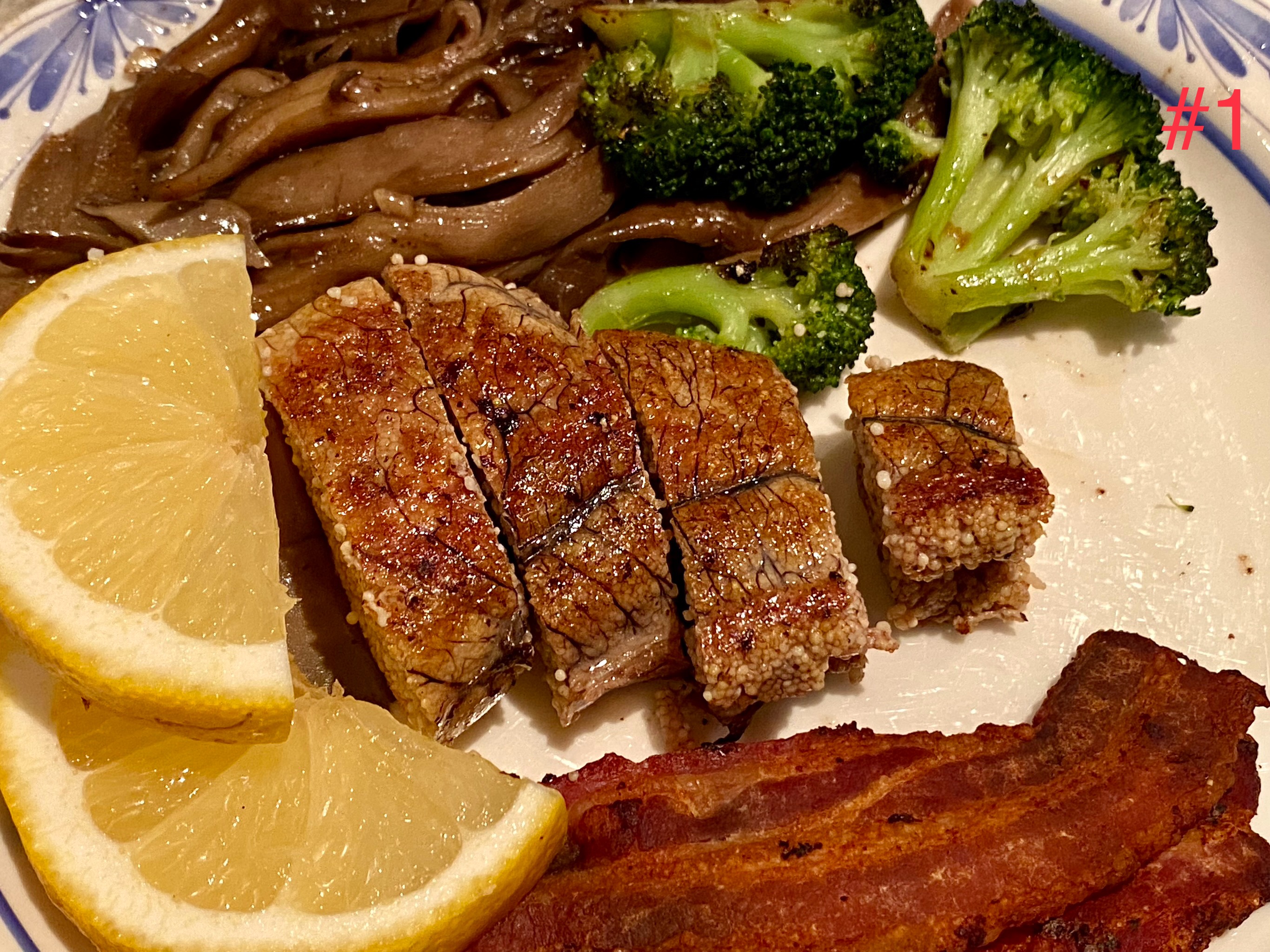
Although fish roe are very popular in Japan, it is not common in U.S.. Few exceptions are, of course caviar, bottargo, and shad roe. We posted a shad roe dish in 2012 but since then we have not had it until now. Turns out my wife’s sister loves shad roe. (According to my wife when she was a kid shad was considered a “trash” fish but the roe were considered a delicacy. Her grandfather particularly liked shad roe and shad roe season was an eagerly anticipated event. He particularly like the roe sautéed with bacon and served with eggs for breakfast. Due to her grandfather’s enthusiasm my wife ate a fair amount of shad roe in her childhood.) My wife’s sister apparently inherited Grandad’s appreciation for shad roe and had an arrangement with a company called “Charleston Sea Food” in South Carolina. They call her every year to let her know when the season opened and she would immediately sign up for a delivery. Although she would relay the information to my wife, my wife had not inherited Grandad’s level of appreciation and previously never pursued purchasing some. But this year we decided to try it. We got 4 sets meaning 4 pairs of egg sacs (minimum you could buy). It comes fresh vacuum packed and can be easily frozen for later use. It arrived in ice packs (picture #3). As before, we cooked in the very traditional way; pan fried in bacon drippings (#1). I fried blanched broccoli in the same frying pan as well as sage brown butter maitake 舞茸 “hen of woods” mushroom (subject to a separate post) as sides.
You can see the grain of the roe on the cut surface (picture #2). This is much coarser than “tarako” たらこ cod roe or “kazunoko” 数の子 herring roe. The texture and flavor are difficult to describe but we like it. To me this reminded me of the roe of a Japanese fish called “Hatahata” ハタハタ but the Japanese fish has a different texture (a bit slippery texture).
We cooked exactly the same as before (in the previous post) but I did not finish it in the oven. I repeat this again for my convenience.
Ingredients: (small servings for two of us, this will be one serving for most)
One sac (half of one set, picture #3 g one set, came fresh and vacuum packed ) of shad roe, removing attached vessels etc but keep membrane intact
2 strips of bacon
6 florets of blanched broccoli (optional)
Salt and pepper
Directions:
Fry the bacon until crispy and fat rendered, remove the bacon and set aside on paper towel lined plate leaving the bacon drippings in the pan.
Add the shad roe and adjust the flame to medium.
After one side is browned (5 minutes) turn it over cook for another 5 minutes (picture #4). Place the lid and cook 5-10 minutes until fully cooked (no pink inside)
Add the broccoli 5 minutes before the roe is finished and season with salt and pepper
Season it with salt and pepper
I cut into short segments and served.
This was not bad at all. I served it with sides of the broccoli and hen of woods mushrooms which went well. I will try cooking it Japanese style to see how that works. I have to say shad roe fits seamlessly into my Japanese fish roe palette…also, I have to appreciate that my wife’s Grandad was a man of fine taste.
You can see the grain of the roe on the cut surface (picture #2). This is much coarser than “tarako” たらこ cod roe or “kazunoko” 数の子 herring roe. The texture and flavor are difficult to describe but we like it. To me this reminded me of the roe of a Japanese fish called “Hatahata” ハタハタ but the Japanese fish has a different texture (a bit slippery texture).
We cooked exactly the same as before (in the previous post) but I did not finish it in the oven. I repeat this again for my convenience.
Ingredients: (small servings for two of us, this will be one serving for most)
One sac (half of one set, picture #3 g one set, came fresh and vacuum packed ) of shad roe, removing attached vessels etc but keep membrane intact
2 strips of bacon
6 florets of blanched broccoli (optional)
Salt and pepper
Directions:
Fry the bacon until crispy and fat rendered, remove the bacon and set aside on paper towel lined plate leaving the bacon drippings in the pan.
Add the shad roe and adjust the flame to medium.
After one side is browned (5 minutes) turn it over cook for another 5 minutes (picture #4). Place the lid and cook 5-10 minutes until fully cooked (no pink inside)
Add the broccoli 5 minutes before the roe is finished and season with salt and pepper
Season it with salt and pepper
I cut into short segments and served.
This was not bad at all. I served it with sides of the broccoli and hen of woods mushrooms which went well. I will try cooking it Japanese style to see how that works. I have to say shad roe fits seamlessly into my Japanese fish roe palette…also, I have to appreciate that my wife’s Grandad was a man of fine taste.
Subscribe to:
Comments (Atom)