Monday, November 7, 2011

Soba Salad そばサラダ

This is not really a "dish" but nice small drinking snack or even a small "shime" 締め ending dish. This also was leftover control. There is no recipe but this is how I put it together,
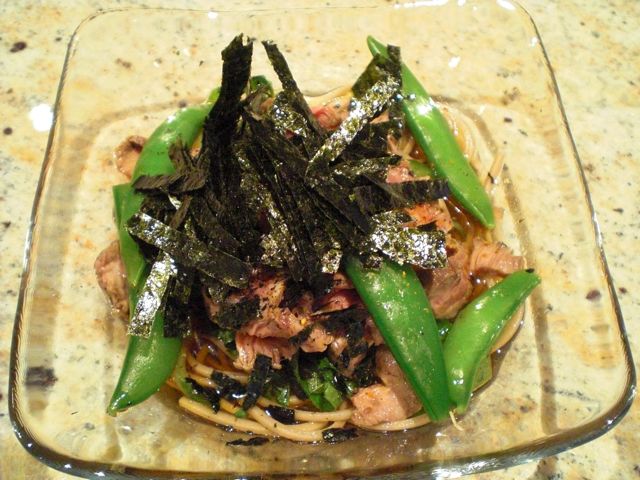
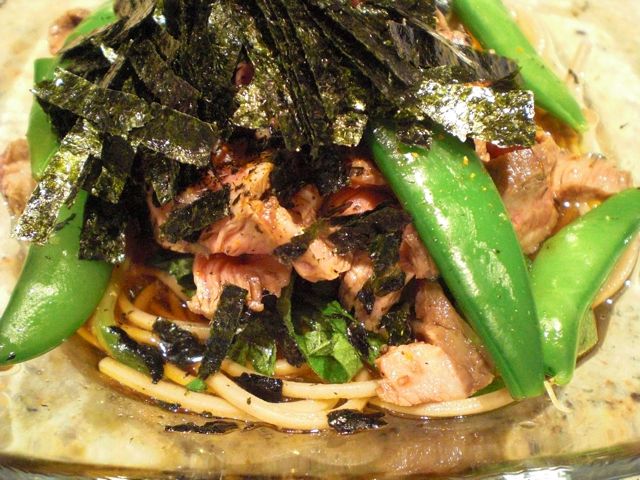

The amount is for two small servings. I had leftover flat iron steak which I used for several other dishes. I thinly sliced across that grain (4-5 slices per serving). I then marinated it with a small amount of concentrated (x2) bottled Japanese noodle sauce called "mentsuyu" 麺つゆ from the bottle without diluting. Of course, you could make your own.


I cooked half a serving of dried soba noodles. The one I had was called "yamaimo-iri" meaning containing mountain yam as a binder. This soba was nicely firm after cooking as per package instruction. I threw in sugar snaps (hand full, may be 10) toward the end of cooking the soba. I had to fish them out and put them in cold water before the soba finished cooking. If you time it correctly, you could drain the sugar snaps together with the soba. I washed the soba in cold running water.

I placed the soba noodle in the bottom of a small bowl, placed the steak slices, sprinkled Japanese 7 flavored red pepper flakes 七味唐辛子 on the top, and garnished with sugar snaps, chiffonade of perilla, and nori. Other garnish choices may include scallion and dried bonito flakes.

For sauce, I simply diluted "mentsuyu" and poured it over from around the sides (not too much).

This is a very decent dish. We really liked this type of soba noodle. It has nice firm texture but not too brittle. For my usual instant preparation, this is indeed in keeping with the spirit of Izakaya food.

Saturday, November 5, 2011

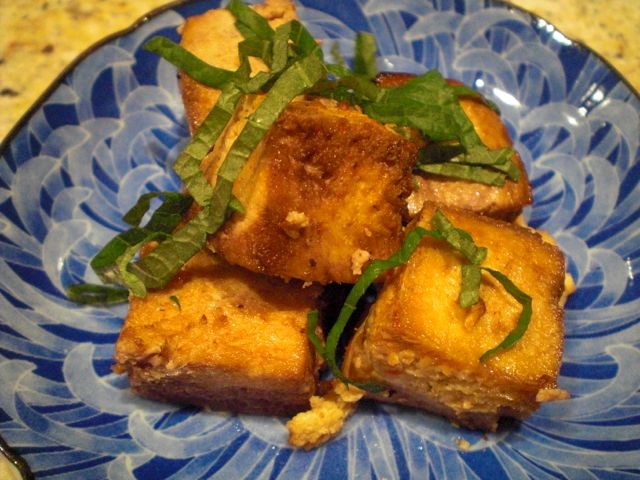
Baked marinated tofu redux ピリ辛豆腐のオーブン焼き 第2弾

When I posted baked marinated tofu, I promised I would try it with frozen and thawed tofu. Here is the dish.

Tofu: I used firm tofu and froze it 24 hours in a freezer without taking it out of the package. The next day, I moved the frozen tofu to the refrigerator. It took two days to completely thaw. After that, I drained any excess moisture as I did with a regular tofu.


The result? I do not like the very dry and spongy texture that results from this method. The texture is different from more authentic freeze dried tofu called "shimidoufu" 凍み豆腐 or "kouyadoufu" 高野豆腐. My wife liked this version more than I did. Certainly I do not think this is worth the effort.

Thursday, November 3, 2011

Japanese Insalata Caprese 日本風カプレーゼサラダ

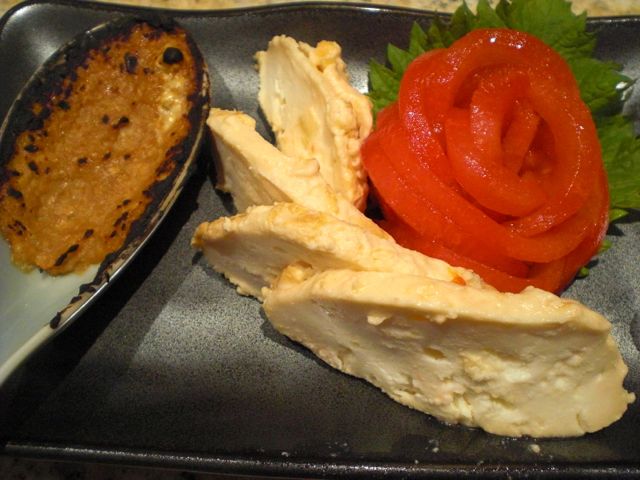
The title is a bit of stretch. This is a combination of miso marinated fresh mozzarella cheese, thin slices of tomato, perilla leaves and grilled miso.

The mozzarella cheese was marinated for a week (we just forgot we had this) in the mixture of miso and mirin as described before. I scraped off the miso marinade and sliced it.

I used a sharp knife to remove the tomato skin (but I could have blanched it first). To make it more attractive, I made it to a "rose". If you are interested in making a tomato rose or flower, here is the instruction with pictures (in Japanese).

Grilled miso: I simply smeared the miso marinade in a thin layer in a porcelain spoon and held it over the gas fire for few minutes until the surface became brown and the miso was fragrant.

We smeared a bit of the grilled miso on the slice of cheese and layered it with a small piece of perilla and a slice of tomato like insalat caprese. We really liked this combination of flavors. My wife really liked the miso and even ate a portion of miso I did not eat. That night, however, she was very very thirsty.

Tuesday, November 1, 2011

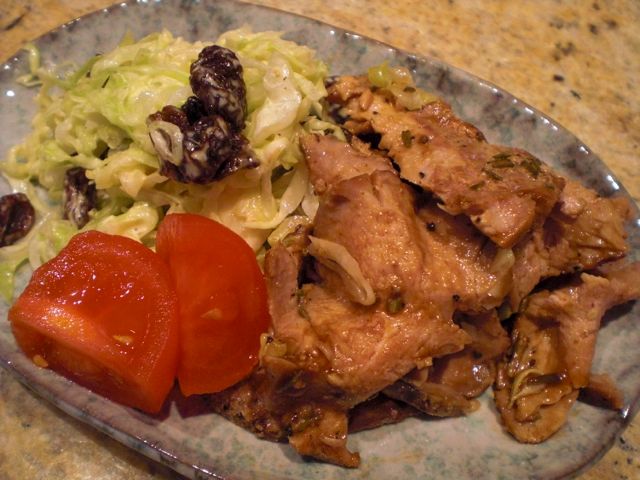
Japanese style coleslaw with hot-smoked pork tenderloin 日本風コールスローと豚ヒレ肉の薫製焼き

Since my wife does not particularly like raw shredded cabbage, I usually end up making variations of coleslaw when I'm in the mood to eat some cabbage. I am not sure where I got the idea of adding raisins to coleslaw but I must have eaten coleslaw made that way in Japan. In any case, this is another quick snack made from whatever was available to go with a drink. The previous weekend, we barbecued (hot smoked) pork tenderloin (seasoned with chopped rosemary, black pepper and salt) which I have been using for sandwiches etc. This is the last of this pork. It has a spicy taste from both the smoke and black pepper.

Coleslaw: As a side, I quickly made this Japanese (I am not sure it is a Japanese or whatever) style coleslaw. I julienned cabbage after removing the thick veins. I then salted, mixed, and let it stand for 10 minutes and squeezed out the excess moisture. Meanwhile I plumped some raisins in a mixture of white vermouth and hot water (about a one to one ratio) for 5-10 minutes. I added mayonnaise and Dijon mustard to the cabbage. I tasted and added freshly cracked black pepper but no more salt (it was salty enough). I removed the excess liquid from the raisins and mixed them into the cabbage.

Pork: After I thinly sliced it, I dressed it with semi-thick "tonkatsu" sauce and Japanese hot mustard mixture.

As usual, I also added a drunken tomato. This is again nothing dish but rather spicy taste of pork went well with this coleslaw. The raisins added a nice sweet taste.

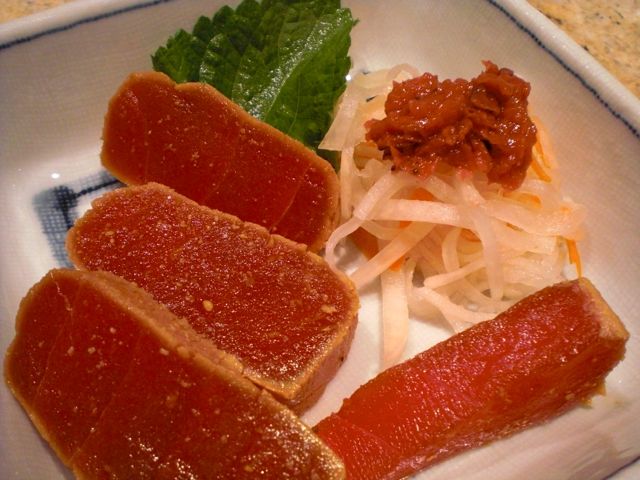
This was followed by marinated tuna "sashimi". Instead of the usual side of daikon garnish, I made an instant "diakon" namasu, dressed in a mixture of mirin and sushi vinegar, and served it with the fine chopped meat of umeboshi or "bainiku" 梅肉 on the top.

Again, we had cold sake. This time we tasted "junmai" sake from Kyoto, Kizakura 黄桜 Touzai Living Jewel. This is from a large sake brewery but made from Yamada nishiki. It is a light but nicely fruity and rather easy-to-drink sake, perfect for hot summer days, best chilled ice cold.

Sunday, October 30, 2011

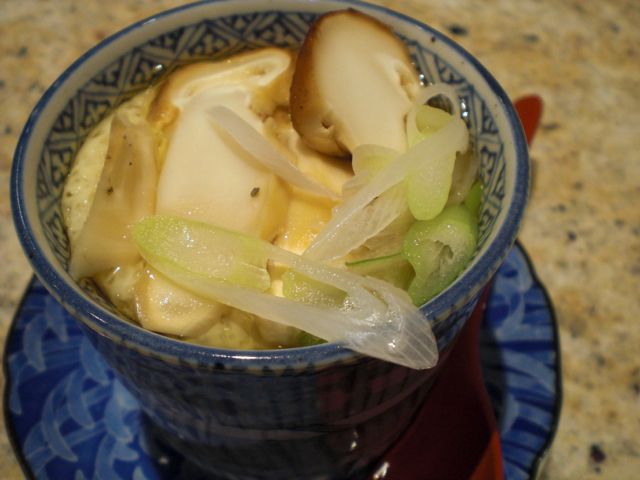
Matsutake "chawanmushi" savory egg custard 松茸の茶碗蒸し

I have posted "chawanmushi"  茶碗蒸し or Japanese savory egg custard before. "Chawan" means "bowl" (more literally "tea bowl" but this word is usually used to just mean a generic bowl) and "mushi" means to steam. Although this is a very popular dish in Japan, only rarely do you see it served in Japanese restaurants in the U.S. Since I got fresh matsutake from Oregon mushroom and I posted most of the ways I can think of to serve matsutake before, I decided to make chawanmush with matsutake.

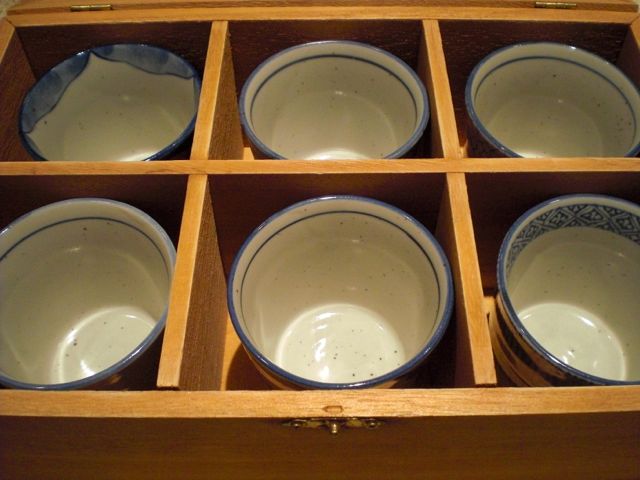
Although I have traditional lidded containers specifically designed for chawanmush, I have been using a set of 6 small bowls for chawanmush for sometime (picture below). I am not sure where I got this one but probably by mail order. This must have been for export, since the traditional Japanese set is either 5 or 10. In any case, three eggs make the perfect amount for these 6 small bowls. The two important tips to make good chawanmushi is the ratio between the eggs and the broth and how to steam it.
Matsutake: I had two relatively large matsutake left. After I cleaned it, I sliced it. 

Eggs: I used 3 large eggs. Since the size of eggs is not uniform,  I measured the amount after lightly beating the eggs (this time, it was 150ml).

Broth: I made dashi broth using a dashi pack (kelp and bonito kind). The amount of liquid should be 3 times of the eggs. (In my case, the final broth should be 150ml x 3 =450 ml). I first measured about 400ml of the broth and I added light colored soy sauce or "usukuchi shouuyu" 薄口醤油 (1 tbs) and mirin (1tbs).  (Taste and if the saltiness is not enough, add salt instead of soy sauce to prevent further darkening the color of the custard. I did not need it this time). I added more broth to make it exactly 3 times of the eggs (in this case, 450 ml).

Egg mixture: I mixed the broth and the eggs trying not to make too many bubbles on the surface. It is important to strain the egg mixture through a fine sieve. If not strained, Chalaza and other chunks of egg white will congeal in chawanmushi producing a very unpleasant white hard spot.

Other ingredients: Since the main feature of this chawanmushi was matsutake, I only used a few other items in this dish; ginko nuts (prepared, in a can, 5-6 in each bowl) and thinly sliced chicken tenderloin (2). After I placed the ginko nuts and the chicken meat in each bowl, I poured in the strained egg mixture. If I had it, I would have used mitsuba 三つ葉 for granish but instead, I had to settle for thinly sliced (on a slant) scallion.

Steaming: I used an electric wok. I started on medium high heat with continuos steam for 2 minutes or so and turned it down to low intermittent steam. After 5 minutes when the surface became lighter yellow and congealed, I placed sliced matsutake and scallion on the top and continued steaming for another 15-20 minutes until a clear liquid started coming or from the custard.

I have to admit the difference between using fresh shiitake mushroom (my usual) and mastutake is subtle but there is a sublime subtle aroma and flavor of matsutake. This dish is so delicate only cold sake could be our choice of libation. Over the next few days I served the remaining chawanmush cold (I could have made cold broth which can be poured over it but I did not). Even cold, it is very good.