Thursday, October 20, 2022

Blueberry puree and pecan muffin ブルーベリーピュレー、ピーカンマフィン

This is another variation on the theme of blueberry muffins. When we got less than perfect (in terms of the shape/consistency and sourness) blueberries, my wife slowly cooked and then pureed them using the immersion blender. You could add sugar and the puree worked well when added to our morning yogurt.  My wife tried using blueberry puree in muffins and found that it really added a blueberry flavor in conjunction with the whole blueberries

At one point she found the whole blueberries were gone but she had more puree than she could use in the morning yogurt. She didn’t want the puree to go bad so she decided to made a blueberry muffin “sans” the whole blueberry but just using the leftover puree as the liquid in the batter. She made this blueberry muffin with the puree as the blueberry “representative” and the addition of pecans to see how it works.  As you can see below, the entire muffin turned sort-of purple.


Ingredients
1 cup toasted pecans).
2 ½ cups all-purpose flour
2 ½ teaspoons baking powder
1 teaspoon kosher salt
1 cup granulated sugar
2 eggs room temperature
4 tablespoons unsalted butter melted and cooled slightly
¼ cup vegetable oil
1 cup combination of buttermilk and blueberry puree (i.e. however much puree is available combined with buttermilk to make 1 cup) room temperature
1 ½ teaspoons vanilla extract
(Optional) finely grated zest of 1 lemon. We did not use this.

Directions:
To make the blueberry puree, bring 1 cup of blueberries to a very low simmer in a small saucepan. Cook until the berries have broken down. Puree using an immersion blended. Cool to room temperature.

Whisk the dry ingredients (flour through salt) in a large bowl. Whisk 1 cup sugar and eggs in medium bowl until thick and homogeneous. Slowly whisk in the butter and oil until combined. Whisk in buttermilk/blueberry puree, lemon zest (if using) and vanilla until combined. Fold wet mixture into flour mixture until just moistened (lumpy is fine). If the batter seems loose, let it mellow for 5 minutes, and it will thicken up (picture below).


Divide among 12 greased muffin cups (batter should completely fill cups) (picture below).


Bake at 425F until tops are golden and just firm, 17 to 19 minutes (picture below).  Cool in muffin tins for 5 minutes, then transfer to a wire rack and cool 5 minutes before serving.


This is not bad but blueberry flavor was not very strong. The amount of the puree you put in may be something to do with it but in it’s own right, this is a good muffin.


Monday, October 17, 2022

Octopus leg dressed in salted plum sauce タコの梅肉あえ

I have posted many dishes using octopus which we got from different sources. We like octopus legs (boiled and frozen) from D’artagnan and Great Alaska Seafood. Interestingly, both are “Spanish octopus legs”.  The offer we recently purchased from Great Alaska Seafood included quite a large amount of octopus legs so I have the luxury of using it fairly regularly. The last time I used it, after thawing, I reserved about 2 inches of the octopus leg to eat as “sashimi*” 刺身 and I made the remainder into tender simmered octopus タコの柔らか煮 using an Instant pot. We usually eat octopus sashimi with wasabi and soy sauce or sumiso but this time, I tried a different dressing using salted plum or “Umeboshi” 梅干し (I used some umeboshi we received quite a few years ago from my mother the last time she made it. We kept it in a sealed container in the refrigerator. It looked and tasted good). I also served two small appetizer dishes.

*Most common “sashimi” of octopus is previously boiled legs because raw octopus is extremely perishable. Real “raw” octopus can be had in Japan. The first time we had “raw” octopus sashimi was in Kobe 神戸 many years ago. Because of the location of Kobe, very fresh octopus from the Japanese inland sea 瀬戸内海 was available. Now, because of the advancement in the logistics of transporting fresh seafood in Japan, it is more readily available throughout Japan. As a matter of fact, we had raw octopus sashimi at Tako Grill in Kuroishi 黒石, Aomori prefecture 青森県 in Japan.


The upper left picture above shows the Octopus slices with salted plum sauce: タコの刺身梅肉和え.

Ingredients and directions: (two small serving)
2 inches of boiled octopus leg, sliced thinly into 8 -10 slices

For Umeboshi 梅干し “bainiku” sauce 梅肉ソース
1 “umeboshi” salted plum, meat removed and finely chopped until creamy.
1 tsp mirin, mixed in

For garnish
1 perilla leaf, finely julienned 
1 nyouga, thinly slices
Cucumber slices


I also served tender simmered octopus leg タコの柔らか煮.


Since we had a small portion of filet mignon left over from the day before, I thinly sliced it and dressed it in ponzu sauce ポン酢醤油 with grated ginger. The green is blanched sugar snaps in dashi broth スナップ豌豆の塩びたし.
 

These small appetizers were great to start the evening.


Friday, October 14, 2022

Mackerel hand-shaped sushi 鯖の棒鮨

Shime-saba しめ鯖 is vinegar pickled mackerel and a very popular item in Japan. The best is fresh local “branded” mackerel (such as “Seki-saba” 関鯖) prepared in-house but, nowadays, the risk of Anisakis is rising possibly due to warming of the sea water. (The fresher the mackerel the higher the Anisakis’ risk. In addition, curing the fish in salt and vinegar does not kill the Anisakis but freezing does). We can easily get shime-saba in the U.S. packaged and frozen. Although there are so many varieties of  mackerel, most frozen packages coming from Japan to the U.S. use mackerel from Norway as I understand it. I have posted molded sushi made of shime saba which is called “baterra” バッテラ or “oshizushi” 押し寿司. This type of sushi is famous in the Kansai region 関西. In that post, I said that the classic preparation requires a thinly shaven sheet of kelp called “Shiroita konbu” 白板昆布 placed on top of the fillet of fish. Such a preparation is next to impossible to get here in US. Some days ago, however, I found a package of frozen mackerel with a sheet of kelp already on it in Tako Grill’s frozen case and got it. This must be a new product which became available recently since I saw the identical item at the Japanese grocery store as well as at Catalina Offshore products

Instead of using a mold to shape the sushi, I made it freehand which is called “Bou-zushi” 棒鮨 (“bou” means a rod or stick). The picture below shows the “saba-no-bouzushi” 鯖の棒鮨 I served as the ending shime dish one evening. As you can see, the surface of the fish is covered with a layer of thinly shaven kelp.


Ingredients:
One package of frozen vinegar cured mackerel as described above, thawed, tail portion cut and tucked in to make an even width.
Sushi rice (my wife made fresh rice for this).


Directions:
Instead of using oshizushi mold, I formed a log of the sushi rice about the same length and width as the mackerel by hand (you need to wet your hand).
Using a silicon sushi rolling mat (relatively recent acquisition, you could use a regular bamboo mat covered with plastic wrap or wet tea towel), place the mackerel skin or kelp side down.
Place the log of the rice onto the mackerel.
Press the rice lightly against the mackerel and roll the silicon mat (top image in the picture below)
Tighten the mat and also press on both sides of the rice to make the rice and the mackerel form a slightly flattened cylinder and unroll (bottom image in the picture below).


Wet the knife and slice about half inch thick (below).
In this cut surface, you could see bottom rice layer and top mackerel layer and surface kelp layer.


This was a very satisfying dish. The layer of mackerel was very thick, but very tender and well seasoned. My wife really like this and said the ratio of sushi rice to fish was perfect. With the addition of kelp layer, it is authentic and tastes better (I think). Since I did not have to find and soak the mold ahead of time, this method was a bit easier to make.

Tuesday, October 11, 2022

Cold cucumber soup and aspic addendum 冷製胡瓜スープと胡瓜ゼリー

 Because we got 4 large American cucumbers instead of the 4 mini cucumbers we ordered for our recent groceries delivery, we decided to use them to make cold cucumber soup and cucumber aspic. We served the aspic with dill sauce. Although both dishes were very good and we ate each one individually for several lunches, my wife came up with the idea of combining the two. She placed the aspic in a bowl, poured in some of the soup and topped it with the sauce.


The result was an example of “the whole being greater than the sum of its parts”. The soup combined with the dill topping acted like a sauce which perfectly complemented the aspic. Cucumber was the predominant flavor but subtle differences in the flavors of the various ingredients that went into the soup versus the aspic added a pleasing complexity. In the future, we think this would be the preferred way to serve these two dishes so we decided to write this addendum to make that point. This cucumber combination also worked very well especially with the chicken curry we had with it for lunch. 

Saturday, October 8, 2022

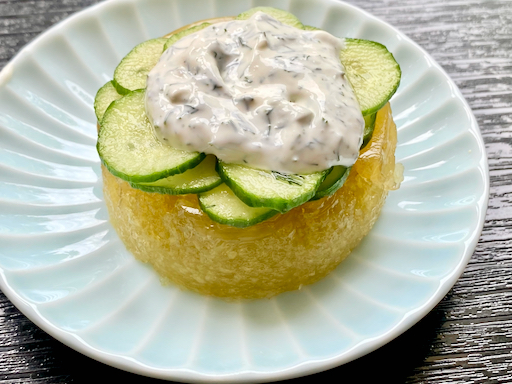
Cucumber aspic 胡瓜のゼリー

This is the second dish we made using the large American cucumbers we got through grocery home delivery by mistake. Since my wife is into anything “aspic”, this was “the dish” for her. It turned out to be remarkably good. For the picture I added slices of Japanese cucumber as a topping garnish and made an instant dill sauce. My wife later made a different sauce for this dish which is based on dressing for cucumber salad. and it worked well. The cucumber flavor of the aspic was very subtle. Most of the cucumber flavor seems to have come from the garnish of Japanese cucumbers but the aspic had a nice texture and fairly complex flavors.


This is based on the recipe on cooks.com.

Ingredients:
2 large American cucumbers, peeled and seeded, grated (I used a Japanese grater to get a fine grated texture)
1/2 c. cold water (We felt that plain water brings nothing to the “show” so we used lightly sweetened cold mint/black tea that my wife makes for the summer months because it was available. Chicken stock would probably work too).
1/2 c. boiling water
2 tbsp. Knox gelatin
1 tsp. grated onion (we used Vidalia onion)
2 1/2 tsp. salt
1 tsp. sugar
2 tbsp. vinegar (we used sushi vinegar)
2 tbsp. lemon juice
Dash of Tabasco sauce (we used Sriracha)

For sauce
Version 1
1tbs Greek yogurt
1tbs sour cream
1 tsp lemon juice
1tbs chopped dill

Version 21/4 cup sour cream
1/4 cup Greek yogurt
1/4 cup Mayonnaise
2 Tbs. sushi vinegar
1 Tbs. Worcestershire sauce
1/4 tsp. sugar
1/2 tsp. salt
1tbs chopped dill

Directions:
Bloom the gelatin by soaking it in the cold water for 5 minutes. Then add the boiling water, stir until thoroughly dissolved, then add all the other ingredients. Put into molds and set in refrigerator to congeal. Yield 6 servings.

This was a very light refreshing dish perfect for a hot summer day. Although the cucumber taste was very subtle the entire refridgerator smelled of cucumber as the aspic was solidifying (which was a very pleasant smell). The flavors were subtle but complex. No single one stood out. For example there was a slight hint of the mint from the tea and a slight hint of the onion. We could have used a bit more hot sauce. The texture was very smooth and pleasing. The sour cream based sauce with the dill really finished the whole dish nicely. Maybe getting the wrong cucumbers wasn’t such a bad mistake after all.