Wednesday, December 23, 2009

Pork meat ball Hot Pot 豚ミートボール小鍋仕立て


Hot pot dish called "nabe" 鍋 (which means a "pot") or "nabemono" 鍋物 is a family style homey dish in which a large (usually earthen) pot was placed in the middle of a table on a portable gas or electric cooker. One large pot is shared by the diners and the ingredients are cooked on the table as you eat. This type of communal pot dish is not usual in Izakaya (unless it is a small drinking party held in Izakaya) but a small individual or 2-person nabe is served in Izakaya. Types of nabe are numerous depending on the type of broth and main items you put in it. If the broth is not seasoned, it is usually eaten with a dipping sauce such as "ponzu shoyu" sauce and if the broth is seasoned with either miso or soy sauce, it is eaten as is or with some garnish. After most of the ingredients are consumed a well seasoned savory both is left in a pot. Cooked (leftover) rice or noodles can be added to the broth to make the last starch dish of the meal. It is the best dish to be had in a cold windy night.
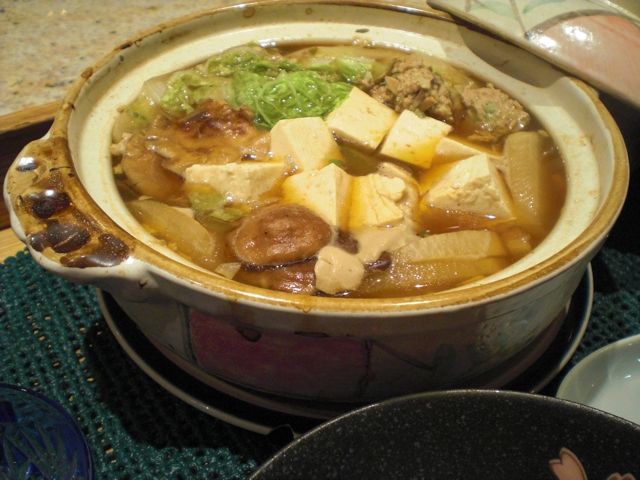
We had our first snow of the season in the DC area few days ago and it has been rather cold which prompted me to make this spur-of-the-moment nabe dish using whatever was available. I happened to have extra kelp broth from the night I made the "warm tofu with pork miso sauce". Also, I had stuffing for pork gyoza which I made the night before. So I used these leftovers and made this nabe dish. Instead of a large nabe, I used a small nabe pot usually used to make "nabeyaki Udon" 鍋焼きうどん- a Japanese noodle dish which is cooked and served in a individual pot. I am sure I can post that recipe in near future. The amount is perfect for my wife and I.

For broth, I used kelp broth and seasoned it with sake, mirin, and soy sauce (sorry, all eye-balled and then tasted for further adjustment, no precise amount here). When the broth was hot I used a small ice cream scoop and dropped small balls of the pork mixture for gyoza into the broth. Other ingredients I used were nappa cabbage 白菜 (cut into 2 inch wide pieces), firm tofu 豆腐, daikon 大根 (cut in 1/3 inch-thick, half moon shaped; put diakon in first while the broth is being heated), fresh Shiitake mushrooms 椎茸, and scallion 葱 (cut into 1 inch pieces). I cooked this in the kitchen rather than on the table. This was served in a small bowl with a sprinkling of  Japanese 7 flavored pepper powder 七味唐辛子.

After we finished this dish, I took the nabe back to the kitchen and added cooked rice (as usual frozen one, you could defrost first), added thinly cut napa cabbage (soft green part which I reserved). I added a bit more water since the broth has reduced a bit. Cooked 10 minutes in low heat until the rice was cooked and a "porridge' consistency was achieved. I adjusted the seasoning by adding salt or soy sauce (I used salt). I beat one egg and mixed it into the porridge. I put the lid back on and took the pot off the flame. I waited 5 minutes and then served the porridge.

Monday, December 21, 2009

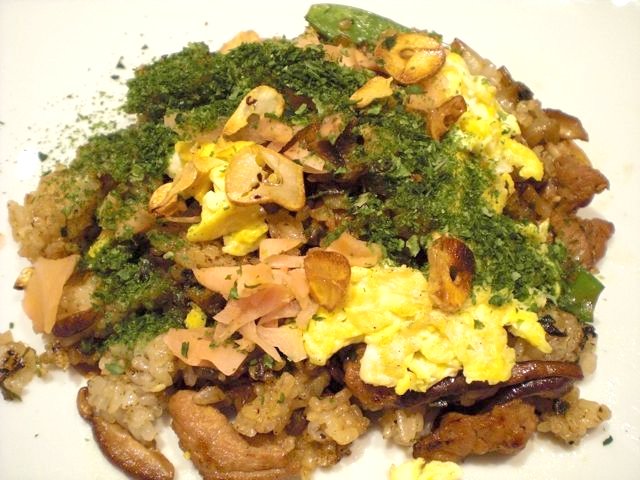
Fried rice 炒飯

This is another popular Sino-Japanese dish and perfect for ending your Izakaya feast. Like fried noodle "yakisoba"焼きそば, I make this dish with leftovers such as frozen rice and whatever vegetables and/or proteins are available. There is no real recipes per-se and there are as many variations as numbers of people who cook this dish. We are not fried rice aficionados, but, I know that some people are really into this dish and many "secrets" have been discussed. Some people appear to like having the rice grains separated and suggest mixing a beaten egg into cold cooked rice before frying. I tried this method but I do not particularly like the end result. I only make sure that the rice does not get too greasy (through judicial use of oil and cooking on very hot wok or frying pan) and is well seasoned (I add a small amount of soy sauce along the perimeter of the hot pan at the end).
The night I made this dish, as a protein, I used thinly sliced pork spare ribs which were briefly (10 minutes) marinated in 2 parts soy sauce, 1 part sake and 1 part mirin with 1/4 tsp of grated ginger root. The vegetables I used were fresh shiitake mushrooms (4-5 medium, sliced), snow peas (10-15 pods), finely chopped onion (1/2 medium), and thinly sliced garlic (1 fat clove). I put 2 tsp of peanut oil in a non-stick frying pan and fried the garlic slices on low-medium heat until the garlic slices  brown slightly (do not burn, it will get bitter). Take them out leaving garlic infused oil in the pan and set aside the garlic chips (I use them later as a garnish). I increased the heat, added onion, meat (strained of the marinade) and stir fried until the meat was cooked. I added shiitake mushrooms and snow peas, sauted until they were cooked (about 2 minutes). Season with salt and pepper and remove from the pan and set aside.

 Clean the pan and add a tsp of peanut oil with a dash of dark sesame oil on high heat. When the oil is almost smoking add about one cup of thawed frozen rice (leftover rice works much better since the grains separate easily) and stir until the rice is coated with oil and the grains are separated (2-3 minutes). Lightly (be aware of an additive effect of seasoning) season with salt and pepper. Add the meat/vegetable mixture back into the pan and keep stirring and flipping until well mixed. At the end, pour a small amount (about 1 tsp) of soy sauce on the inner edge of the hot frying pan so that the soy sauce gets fragrant before reaching the rice, stir or flip to mix well, and plate the fried rice. I prefer to make scrambled eggs separately. Garnish the fried rice with scrambled eggs, thinly sliced vinegared ginger root, "aonori" sea weed, and the garlic chips.

Saturday, December 19, 2009

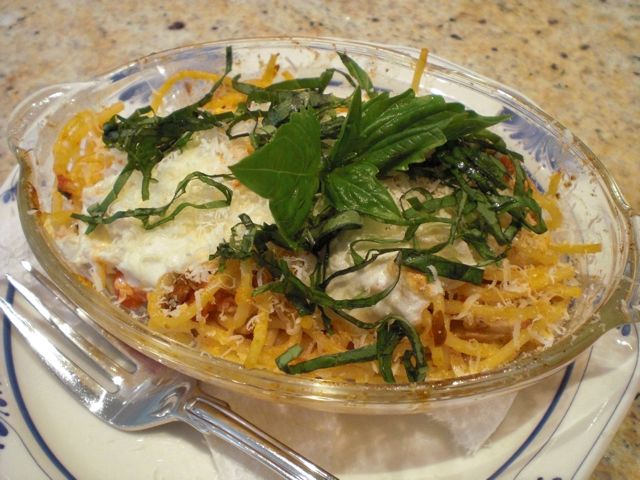
Spaghetti casserole with goat cheese スパゲッティキャセロール

Sometimes, you have to make something using whatever ingredients are available.  We had cooked spaghetti leftover from serving our vegetarian guests two night ago (which was also a moment of "have to make something vegetarian" for them), leftover marinara sauce I made the other day for my pizza. As you may recall, my wife is not particularly wild about spaghetti pasta. I needed to make something for a bottle of red wine we just opened (Mollydooker 2008 The Maitre D', Cabernet Sauvignon"). I had fresh goat cheese, fresh mozzarella cheese and fresh basel (all leftover from the pizza night). So I came up with this starter dish (with helpful suggestions from my wife).

I cut the spaghetti into short pieces so that it was easier to eat and mixed with the marinara sauce. I mixed in crumbled goat cheese. On the bottom of a ramekin or small gratin dish, I added a small amount of olive oil to coat the bottom. I added the spaghetti mixture, placed two to three slices of fresh mozzarella cheese on the top and baked in a 450 degree F toaster oven for 10 minutes. I grated Parmigiano-Reggiano cheese, sprinkled with salt and cracked black pepper, drizzled a good quality EVOO (extra-virgin olive oil), garnished with of fresh basel. With Mollydooker cab, this was not bad. Although my wife still said, "I am not crazy about the spaghetti pasta". Oh, well.

Thursday, December 17, 2009

Warm Tofu with Pork-Miso sauce 肉味噌豆腐

Sweet miso sauce with added meat is rather common Japanese sauce. Mark's book has a recipe of simmered daikon ("Furofuki" daikon ふろふき大根) with pork miso sauce (p20), althouhg more traditional "furofuki" daikon (which I posted before) is with just citrus-miso sauce. This time I had a good silken tofu from Kyou-zen-an 京禅庵, I decided make this tofu dish.

First, to warm up the tofu, I made a kelp broth (1x2 rectangle of dried kelp in 3 cups of cold water, when it comes to a simmer, I added 2-3 tbs of sake, 1 tsp of salt and just a drop of soy sauce not to color the broth. Although the kelp is necessary, you do not need any seasoning.  (This is just to warm tofu). Place cubes (about 2x2 inches) of tofu in the broth and simmer to warm (5-10 minutes). Do not boil.

To make the pork-miso sauce, first saute finely chopped scallion (2 tbs), ginger (1/2 tsp),  garlic (one small clove) in 1-2 tsp of vegetable oil. When these are soft and fragrant, add ground or hand-chopped pork (about 4 tbs), stir until the pork is cooked. Add 2 tsp of red miso, 2 tbs of mirin (I did not use sugar). Stir until nice saucy consistency is reached. If it is too thick, add the kelp broth to loosen the sauce. If you prefer the sauce to be bit sweeter add sugar.

Place warm tofu in a bowl, pour over the pork-miso sauce. Garnish with lime zests (I used a micrograter) and a wedge of lime. Squeeze lime juice and enjoy (for silken tofu, even if you are a chopstick jedi, you definitely need a spoon).

Monday, December 14, 2009

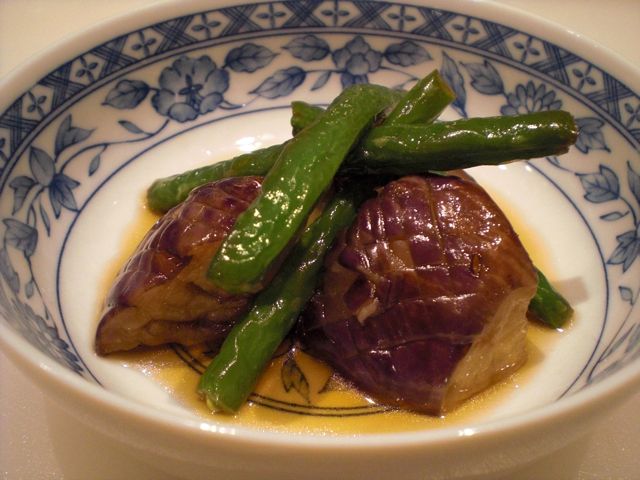
Deep fried egg plant in broth なすの揚げ浸し

Deep fried eggplant in Dashi Marinade  なすの揚げ浸し
(Based on the recipe in Mark's book p64)


This is one of the classic Japanese dishes--"Age-bitashi" 揚げ浸し meaning "fried and soaked". It is a very common Japanese cooking technique in which the ingredient is first deep fried and, while it is hot, soaked in a seasoned broth (aside from the usual soy sauce flavor, sometimes with added vinegar and/or hot pepper). Mark's book has this dish (p64), I only substituted green beans for the small Japanese green peppers "shishito" since I did not have "shishito". In the U.S., the types of eggplant "nasubi" 茄子 available are quite different from those in Japan. So called American eggplant "bei-nasu" 米茄子 is good for baked dishes such as eggplant parmesan or moussaka but not for this dish. I use a smaller eggplant with a thiner skin. Chinese or Japanese (elongated light or dark purple), or small Italian eggplants work best.

Here I used a medium-sized light purple striped eggplant called "graffiti" eggplant. In any case, I cut the eggplant into 1x1 inch size pieces and then made shallow criss-crossing scores on the skin (hatch marks). This makes the skin more palatable and allows the broth to soak in better. I sprinkled the pieces with a small amount of salt and placed them in a colander for 15 minute. I then wiped the surface with paper towels to remove the salt and moisture. Meanwhile, I trimmed both ends of the green beans (10-15 or whatever amount) and wiped the surface dry with a paper towel.

I made the broth from a commercial concentrated noodle broth in a bottle but, of course, you could make this from scratch according to the recipe in Mark's book. I diluted the concentrate to taste (slightly stronger than that for broth for noodles, i.e., for the x2 concentrate, I diluted to x1.5) with cold water and then warmed it up and set aside in a flat sealable container.

I heated the peanut oil in a pan to about 340F (170C). I made sure both green beans and eggplant were dry (using paper towels) to prevent spattering when they were put into the hot oil. I fried the green beans first for 1 minute and put them on a paper towel to drain and the put them in the broth. Next, I fried the eggplant. Skin side down first then turned them over several times for 4-5 minutes until the meat of the eggplant becomes slightly brown and cooked through. I drained the eggplant on a paper towel and placed them in a colander. I poured hot water over them to remove excess oil. Then, I put the eggplant in the broth with the green beans. I let it cool down to room temperature and then put  into the refrigerator. It is best to leave it for at least 30 minutes or overnight before serving.

This dish has subtle flavors but the eggplant is very rich and has a nice soft texture. This is a very nice dish with sake.