Tuesday, January 12, 2010

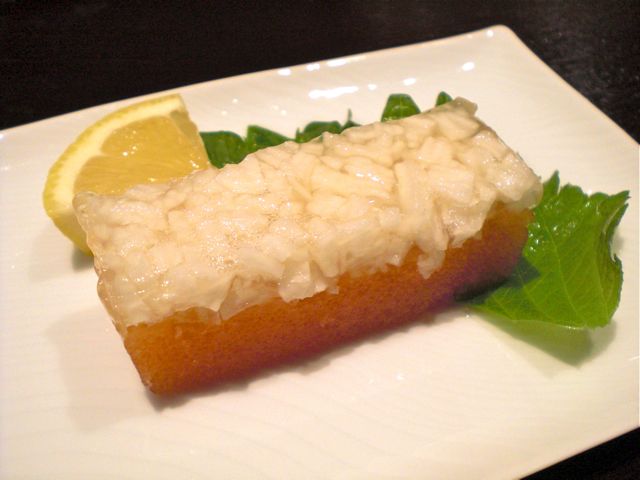
Cod roe and mountain potato gelée 鱈子と長いものジェル寄せ

This is one of our favorite small dishes, which goes excellently with a cold sake. The original recipe was from a Japanese cookbook called something like "Secret drinking dishes of the head chefs". Many of the recipes in the book are too difficult to make but I have adapted a few. One of them is this dish. I have made (as usual) my modifications over the years.  The original may have used a spicy Chinese sesame oil or "ra-yu"  辣油 but I use tabasco and sesame oil. (If I buy "ra-yu", I do not use it often enough and I always find the remaining amount has gone rancid.) The original recipe just topped the tarako gelée with finely diced mountain yam or "nagaimo" 長芋 but I also jell this layer.

I first make a classic "ichiban dashi" 一番だし broth" using kelp and dried bonito flakes. For a large sac of cod roe or "tarako" たらこ, I used about 1/2 cup of hot (temperature) broth and dissolve 3/4 one oz package of unflavored gelatin powder (Knox powdered gelatin). If gelatin does not completely dissolve, you may want to microwave it for few seconds. Then I divide the gelatin-dashi solution into two 1/4 cup portions. One is used for the tarako (a) and the other for the yam (b).

(a) For the tarako, I add a few drops of tabasco, dark sesami oil and soy sauce in the gelatin-dashi solution  Let it cool down to the room temperature before adding to the cod roe. Remove the roe from the sac using the back of a knife and add the gelatin solution to the roe just so that the mixture becomes loose (I do not use all the gelatin solution). If you add too much gelatin solution, the upper layer will be only flavored gelatin when it sets. I lined a small square loaf pan (disposable aluminum kind) and lined it with plastic wrap. Pour the tarako-gelatin mixture into the pan (It will be about 1/2 inch thick) and place it in the refrigerator for 5 minutes until it jells.

(b) For the yam, I add 1 tsp of seasoned sushi vinegar to the gelatin-dashi solution. Cut the yam to  small dices (I use about the half to 1/3 volume of the tarako). Pour in the gelatin solution (room temperature) just enough to coat every pieces of the yam. Gently mix, paying attention not to make too many bubbles since they do not look good in the final dish. Make sure the bottom layers of tarako is set. I layer the yam-gelatin solution on the top. Place it in the refrigerator for 5-10 minutes until set.

It is easy to unmold since it is lined with a plastic wrap. I cut into a small rectangle as seen in the picture. We like to squeeze a lemon over it and eat it with a bit of perilla (sometimes I put a chiffonade of perilla on the top.) The contrast of texture between tarako and yam and flavors of sesame oil, tabasco, all works wonderfully. This has to be enjoyed with sake, nothing else goes well.

Sunday, January 10, 2010

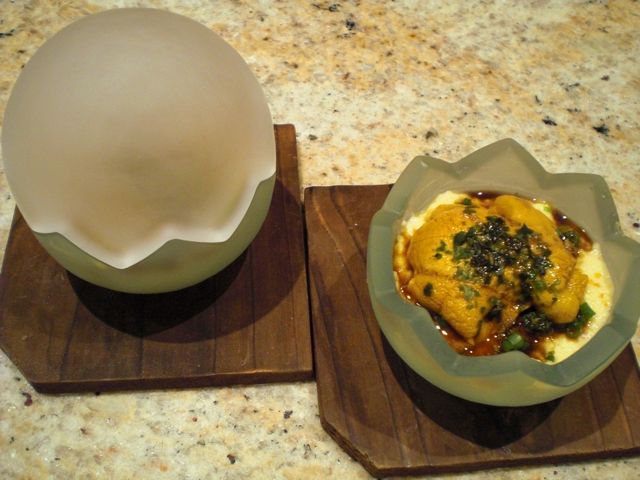
Sea urchin with preserved sea urchin flavored scrambled egg 雲丹と粒雲丹スクランブルドエッグ

This is a variation on Mark's book p148. I have not yet made the lobster sauce according to the original recipe but I am, again, modifying the original recipe. My mother sent us "preserved" sea urchin called "tsubu uni" 粒雲丹. I do not know the details but they are salted and alcohol is added (and other things I am sure). This type of uni can be preserved for rather a long time. It has quite a different taste (rather salty) and texture from fresh sea urchin but it has its own interesting flavor and texture. You could enjoy this by just "licking" it as you drink sake. Since we got fresh sea urchin, I came up with this dish which is a modification of the recipe in Mark's book p148. The idea is to flavor scrambled eggs with the "preserved" sea urchin and place fresh sea urchin on the top.

I put 1 tbs of cream and a half tsp of the "preserved" sea urchin in a small bowl food processor and mixed them well. Beat one large egg and add to this cream mixture. On low heat, put 1tsp of butter in a none-stick frying pan. Add the egg mixture and using a silicon spatula, scramble rapidly to make a creamy soft scrambled egg. Add cracked pepper (the preserved sea urchin is salty so I omitted salt). Place the scrambled egg in the bottom of a small serving bowl (in my case, the egg shaped bowls), top it with fresh sea urchin. I garnished the egg with chopped chives and the fresh sea urchin with "aonori" powder and drizzled soy sauce with wasabi dissolved in it.

The texture of the egg is very nice. The preserved sea urchin has a rather unique flavor. This is a very interesting and good dish.

Friday, January 8, 2010

Salmon marinated in sweet miso 鮭の西京味噌焼き

For us, crispy skin, either fish or chicken, is the best part. One of the great American sushi creations is called "salmon skin roll" using grilled or toasted crispy salmon skin in a small roll. The only way to make skin crispy without over cooking the fish is to cook the skin and fish separately. Here I removed the skin from a salmon fillet and cooked it separately with a good result.

The fish part was marinated in a sweet miso "saikyo miso" 西京味噌 (same amount of miso and mirin, heat to make marinade and cool to room temperature). This is a very similar marinade in Mark's book "Sweet miso marinated fish 魚の西京漬け" (p61). I marinated for 30 minutes but you could go longer. The longer you marinate the more intense the miso flavor will become. You have to dicide how long is to your liking.  I will marinate longer when using white meat fish without its own strong flavors such a cod. After 30 minutes, I remove the miso marinade, wash and pat dry. Then put the fish on a metal grate with a pan undereath and place them in a 350F oven from 10-15 minutes or until done (or you could also grill it).

Meanwhile, I salt the salmon skin and place on a non-stick frying pan (no oil needed) and put an identical sized frying pan nested on top (I cover the bottom of the top pan with aluminum foil so that I do not have to clean both pans).  I suppose you could use a brick wrapped with aluminum foil but I have not tried it. On low-medium heat, cook 5-7 minutes and then turn the skin over for another 5 minutes or until the skin is very stiff and crispy.

I served this with simply boiled small green beans. We loved the skin more than the fish itself.

Wednesday, January 6, 2010

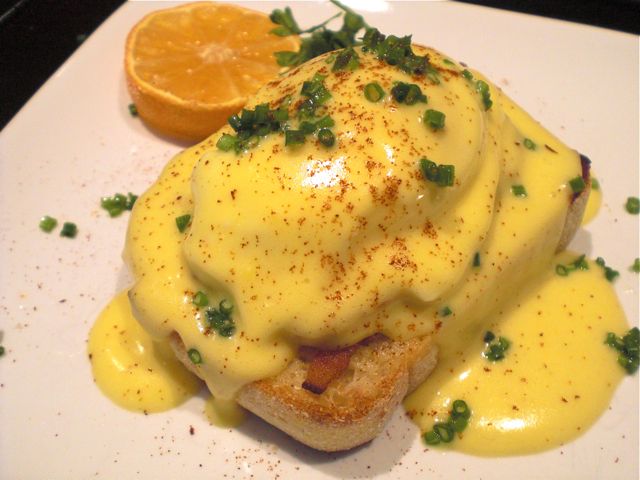
Eggs Benedict エッグスベネデクト


This is certainly not an Izakaya food but I decided to post it anyway. Sometimes eating breakfast for dinner is a wonderful thing and this dish only goes with good sparkling wines (Champagne, Cava or Prosecco). So it could be possible to have this for a late night snack or something for celebration (we do not think we can eat this late at night). Obviously, this is not "low" fat or low calory and we eat this only on very special occasions. We need four components to make this dish; 1. bread, 2. Canadian bacon, 3. poached egg, and 4. Hollandaise sauce.

1. Bread: The bread is transitionally an English muffin which I used to make but, recently my wife started making "English muffin loaf bread" which has a same texture and taste of English muffin and it is bit easier to make (for one thing, you need not to struggle to put the sticky dough into individual rings, but most importantly, I do not have to make it!). My wife recipe may be different but here is one I found on line.

2. Bacon: This time, I did not have Canadian bacon so I used chicken breast and half  a strip of bacon to add bacon flavor. I cut half a strip of bacon into small pieces and made them crispy by rendering the bacon fat in a small frying pan. I removed the bacon bits from the pan and added slices of pre-cooked chicken (one I made few days ago) breast and saute for 30 seconds on each side to add bacon flavor and to warm.

3. Poached eggs: We poach eggs very simply using a small (8 inch) non-stick frying pan. Use one with a high side (not for a French omelet kind) so that enough water can be added allowing the egg yolk to be totally submerged. Add 1/2 tsp of salt (I do not add vinegar since we do not need it and do not like the vinegar flavor in our eggs). When it comes to simmer, break eggs in small cups and gently slide them in the hot water. The egg white around the yolk will stay together without any special techniques. After the surface of the yolk is just set but the yolk is still runny (4-5 minutes), using a slotted spoon, gently remove the eggs on a paper towel lined plate (the eggs may stick to the bottom of the pan but since it has a non-stick surface, they will come off.  If not, you could use a silicon spatula to persuade, but be careful not to break the yolk on the bottom).

4. Hollandaise sauce (for two servings of one egg each): Once you get hang of it, this is not as difficult as you may think. If you are an expert chef you could use a small sauce pan directly on fire but I use a double boiler so that I do not make scrambled eggs instead. Add lemon juice from half a lemon (1-2 tbs) in the double boiler on simmer. Add a pinch of cayenne pepper and one egg yolk, whisk until frothy. Drizzle in 1-2 tbs of melted butter and keep whisking until thick and saucy consistency is reached (2-3 minutes). I usually add a small amount of water to loosen up the sauce to a nice flowing consistency.

5. Assembly:  Toast and butter a slice of  English muffin loaf (if you are so inclined you could use a ring mold to cut a circle or use an English muffin) on the bottom, place a slice of the chicken breast with bacon bits, then, a poached egg, and cover them with Hollandaise sauce. Sprinkle paprika and chopped chives (to make it Chrismasy since this was Christmas morning). By the way, we did not have any drink with this (we had cappuccinos instead) since it was breakfast but we could have Champagne or Mimosa.

The French know how to make it decadent and also artery clogging but this is a wonderful combination of tastes and textures.

Tuesday, January 5, 2010

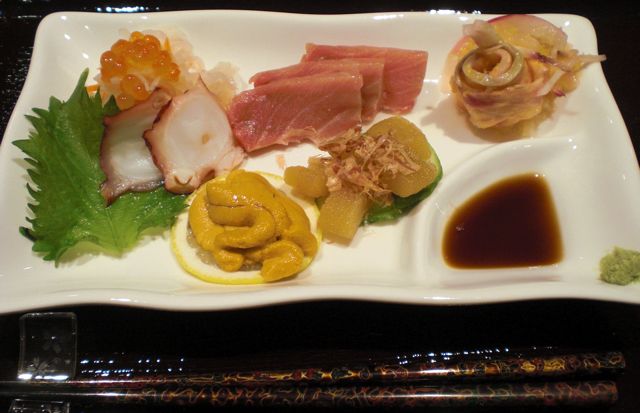
New Year's day sashimi assortment 元旦の刺身盛り合わせ


We were lucky this year that we received uni 雲丹, fatty "ootro" tuna 鮪の大トロ, and Monk fish liver "ankimo" 鮟肝 on December 31 from Catalina Offshore Products after we got email from them stating that uni might not be available since the ocean was rought etc.

Instead of usual sashimi accompaniment 刺し身のけん, I used vinegared "Namasu" diakon 大根なます garnished with ikura salmon roe and octopus. Herring roe 数の子 and marinated salmon were also added. Ankimo was served in a separate plate with orange marmalade-soy sauce.

It was a nice start for New Year's Izakaya feast.