Saturday, January 16, 2010

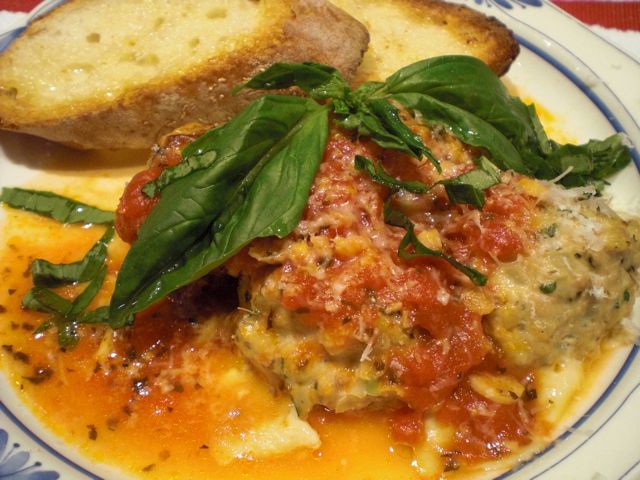
Chicken meatball with marinara sauce チキンミートボール


This may not be strictly Izakaya food but it goes perfectly well with a glass of red wine. This is rather low fat version of Italian meat balls with a marinara sauce but it has very light texture and tastes pretty good. I am not sure where I came up with this particular recipe but I may have seen it in one of the Food Channel shows at some time and modified it.

It starts with ground chicken. I used low fat (less than 1% fat) but you could use raw Italian sausage or ground pork if you are so inclined. For one package of ground chicken (1 lb or about 500 grams), I add 1 medium onion and 4-5 fresh shiitake mushrooms chopped and sauteed in olive oil and cooled, 1/2 tsp or more of freshly ground nutmeg (this is the most important seasoning, freshly ground nutmeg has much better flavor than the pre-ground), 1 tsp of salt and 1/2 tsp of freshly ground black pepper, and 1/2 cup of Japanses "panko" bread crumbs, and 2 beaten eggs. You could also add ground cayenne pepper to taste (optional). Mixed them all up using your hand until the mixture comes together. You may want to reserve a portion of the beaten eggs first and adding the rest depending on the consistency but I like it rather soft with 2 eggs. Using a small ice cream scoop to make small equal sized meat balls and I place them on a cookie sheet. Put them in a 350F oven for 15 minutes or until done. You could sauté or deep fry the meat ball but baking works best for us.

For the marinara sauce, I just use 1/3 cup of light olive oil, two 8 oz cans of whole plum tomatoes (crushed by hand), and chopped garlic (3-4 gloves), 2 bay leaves, salt, black pepper, 1/2 tsp of dried oregano or marjoram, and 1/2 of dried basel, 1/2 to 1 tbs of sugar (to cut acidity). Again you could add red pepper flakes with garlic if you so prefer.

I add chiffonade of fresh basel and grated Parmigiano-Reggiano cheese when serving with an accompaniment of toasted baguette.

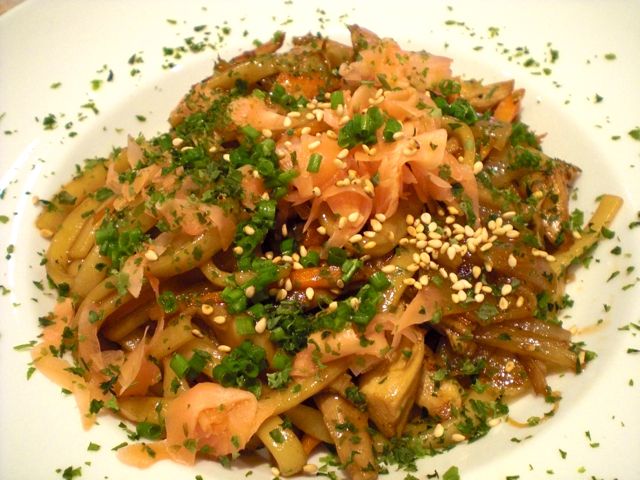
Stir fried udon noodle 焼うどん

This is another "teiban" shime dish. At home, I make this usually from leftovers. The night before, I made "Tarako spaghetti" using a Japanese "Udon" noodles and I had leftover udon. I also had the last small portion of the leftover barbecued chicken (thigh meat). This is a variation of "Yakisoba" 焼きそば.

For two small servings, I sliced onion (1, small), julienned carrot (1, small) and fresh shiitake mushrooms (4, medium). I sautéed these vegetables in olive oil (1 tbs) with a dash of dark sesame oil for 2-3 minutes and added crushed, finely chopped garlic (1 clove). Seasoned with salt and pepper. I then added hand shredded cooked chicken thigh (one thigh) and the noodles. It is important to add some kind of liquid during the cooking of this kind of dish. I added chicken broth (3 tbs) and stirred until the liquid was almost all gone. You could use a bottled "yakisoba" sauce, but I just seasoned it with mirin (2 tbs), soy sauce (1 tbs) and Worcestershire sauce (2 tsp), salt and pepper. You can experiment with any combination of sauces. I stir-fried until the liquid was almost gone and the sauce became somewhat thick and clingy. For garnish, I had thinly sliced pickled ginger root (pink stuff you get at Sushi bars), chopped chives, dried "aonori"  and roasted white sesame seeds. Very familiar dish and good.

Thursday, January 14, 2010

Crab cake クラブケーキ

Along the Chesapeake bay, blue crabs are famous. These are rather small crabs but the meat is very sweet. One of the ways to enjoy this crab is to go to the bay and get one bushel of boiled or steamed blue crabs. Then, sit on the dock, crack the shells and eat. Throw carcasses back into the Bay as you eat and see lots of fish come up to feed on whatever meat we missed. If you or your friend have a boat on the Chesapeake bay, this is the preferred way of enjoying Maryland blue crabs. You can also go to one of crab houses in the area. They will give you a bib, a wooded mallet and a special fork. A mound of freshly boiled crabs is dumped on the news-paper covered table, and everybody has at it with hands and mallet. It is customary, especially in Maryland, that crabs are cooked with "Old Bay" seasoning. McCormick used to have a factory in downtown Baltimore where they made this seasoning. For me, this is good but too much work and the Old Bay seasoning is too strong. Beside just eating steamed or boiled crabs, two most famous crab dishes in this area must be crab cake and deep fried soft shell crab (especially as a sandwich). Although it was a weekday night, I made crab cakes. We also love soft shell crab (particularly as tempura) and hope I can post that dish sometime later.


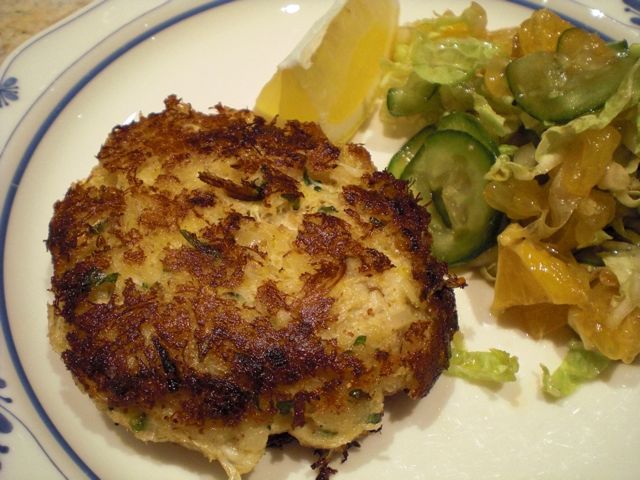
Crab cakes look somewhat like "crab croquette" (Mark's book p.57), but it is composed of mostly crab meat and only a small amount of binders and fillers are used. It is best to use lump or jumbo lump crab meat. I used 8oz of cooked crab meat (not canned) to yield 4 crab cakes. It comes in a sealed plastic container and is readily available in grocery stores in our areas. I finely chopped one small onion, fresh shiitake mushrooms (3-4 medium), parsley (3-4 sprigs), lemon zest from 1 lemon (as usual I used a micro-grater). Using a small amount of light olive oil (1tbs), sauteed onion first and then the chopped shiitake mushroom for 3-4 minutes, season with salt and black pepper, place it in a metal mixing bowl to cool. (If I have jalapeño pepers, I often add finely chopped, seeded and deveined jalapeno pepper as well.) When, the onion mixture is cool, add chopped parsley, lemon zest, a splash or two of Worcestershire sauce and Tabasco, 1 tbs of mayonnaise, 1 tsp of Dijon mustard, and 3-4 tbs of Japanese "panko" bread crumbs and gently fold the crab meat in. You could add a whole egg or egg yolk as a binder but I prefer not to add eggs. Make whatever size round or oval flat patties (I made four about 3 inch diameter and 1/2 thick patties). They are rather delicate and barely hold together. Melt 1-2 tbs of butter or olive oil (or combination) in a non-stick frying pan, and cook the crab cakes (3-4 minutes per side). Be careful when you turn them over, they are mostly crab meat and it is very easy to crumble.

For the accompaniment, I made a simple cucumber, nappa (Chinese) cabbage (only soft and green part), mandarin orange (peel outer and inner skins. Halve and slice) with a simple olive oil, balsamic vinegar dressing. You could serve crab cakes with a tartar sauce but we like to eat simply with a lemon.

Speaking of crabs, we really like Japanese specialized crab "kani" 蟹 restaurants (especially in Sapporo). They serve crabs in so many different ways but you do not have to work to get the crab meat. If you visit Japan especially Sapporo, try these specialized crab restaurants and their course menu.

Tuesday, January 12, 2010

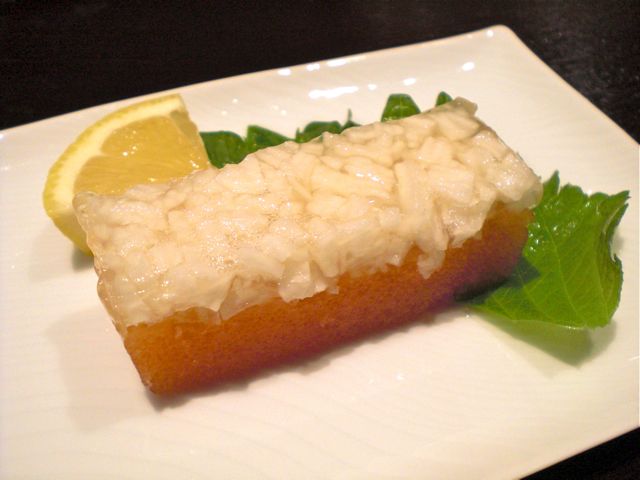
Cod roe and mountain potato gelée 鱈子と長いものジェル寄せ

This is one of our favorite small dishes, which goes excellently with a cold sake. The original recipe was from a Japanese cookbook called something like "Secret drinking dishes of the head chefs". Many of the recipes in the book are too difficult to make but I have adapted a few. One of them is this dish. I have made (as usual) my modifications over the years.  The original may have used a spicy Chinese sesame oil or "ra-yu"  辣油 but I use tabasco and sesame oil. (If I buy "ra-yu", I do not use it often enough and I always find the remaining amount has gone rancid.) The original recipe just topped the tarako gelée with finely diced mountain yam or "nagaimo" 長芋 but I also jell this layer.

I first make a classic "ichiban dashi" 一番だし broth" using kelp and dried bonito flakes. For a large sac of cod roe or "tarako" たらこ, I used about 1/2 cup of hot (temperature) broth and dissolve 3/4 one oz package of unflavored gelatin powder (Knox powdered gelatin). If gelatin does not completely dissolve, you may want to microwave it for few seconds. Then I divide the gelatin-dashi solution into two 1/4 cup portions. One is used for the tarako (a) and the other for the yam (b).

(a) For the tarako, I add a few drops of tabasco, dark sesami oil and soy sauce in the gelatin-dashi solution  Let it cool down to the room temperature before adding to the cod roe. Remove the roe from the sac using the back of a knife and add the gelatin solution to the roe just so that the mixture becomes loose (I do not use all the gelatin solution). If you add too much gelatin solution, the upper layer will be only flavored gelatin when it sets. I lined a small square loaf pan (disposable aluminum kind) and lined it with plastic wrap. Pour the tarako-gelatin mixture into the pan (It will be about 1/2 inch thick) and place it in the refrigerator for 5 minutes until it jells.

(b) For the yam, I add 1 tsp of seasoned sushi vinegar to the gelatin-dashi solution. Cut the yam to  small dices (I use about the half to 1/3 volume of the tarako). Pour in the gelatin solution (room temperature) just enough to coat every pieces of the yam. Gently mix, paying attention not to make too many bubbles since they do not look good in the final dish. Make sure the bottom layers of tarako is set. I layer the yam-gelatin solution on the top. Place it in the refrigerator for 5-10 minutes until set.

It is easy to unmold since it is lined with a plastic wrap. I cut into a small rectangle as seen in the picture. We like to squeeze a lemon over it and eat it with a bit of perilla (sometimes I put a chiffonade of perilla on the top.) The contrast of texture between tarako and yam and flavors of sesame oil, tabasco, all works wonderfully. This has to be enjoyed with sake, nothing else goes well.

Sunday, January 10, 2010

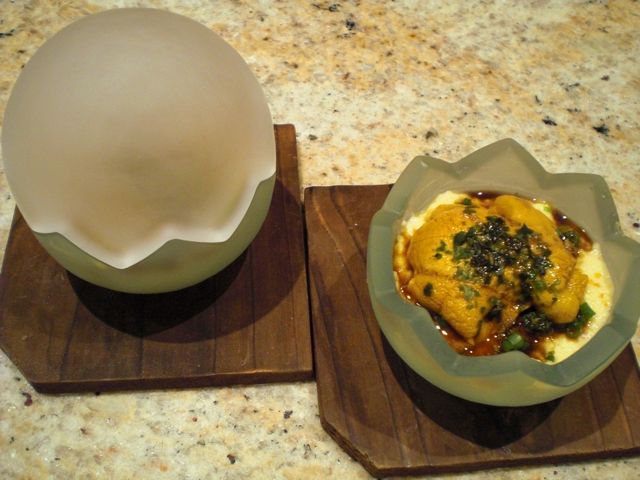
Sea urchin with preserved sea urchin flavored scrambled egg 雲丹と粒雲丹スクランブルドエッグ

This is a variation on Mark's book p148. I have not yet made the lobster sauce according to the original recipe but I am, again, modifying the original recipe. My mother sent us "preserved" sea urchin called "tsubu uni" 粒雲丹. I do not know the details but they are salted and alcohol is added (and other things I am sure). This type of uni can be preserved for rather a long time. It has quite a different taste (rather salty) and texture from fresh sea urchin but it has its own interesting flavor and texture. You could enjoy this by just "licking" it as you drink sake. Since we got fresh sea urchin, I came up with this dish which is a modification of the recipe in Mark's book p148. The idea is to flavor scrambled eggs with the "preserved" sea urchin and place fresh sea urchin on the top.

I put 1 tbs of cream and a half tsp of the "preserved" sea urchin in a small bowl food processor and mixed them well. Beat one large egg and add to this cream mixture. On low heat, put 1tsp of butter in a none-stick frying pan. Add the egg mixture and using a silicon spatula, scramble rapidly to make a creamy soft scrambled egg. Add cracked pepper (the preserved sea urchin is salty so I omitted salt). Place the scrambled egg in the bottom of a small serving bowl (in my case, the egg shaped bowls), top it with fresh sea urchin. I garnished the egg with chopped chives and the fresh sea urchin with "aonori" powder and drizzled soy sauce with wasabi dissolved in it.

The texture of the egg is very nice. The preserved sea urchin has a rather unique flavor. This is a very interesting and good dish.