Tuesday, January 19, 2010

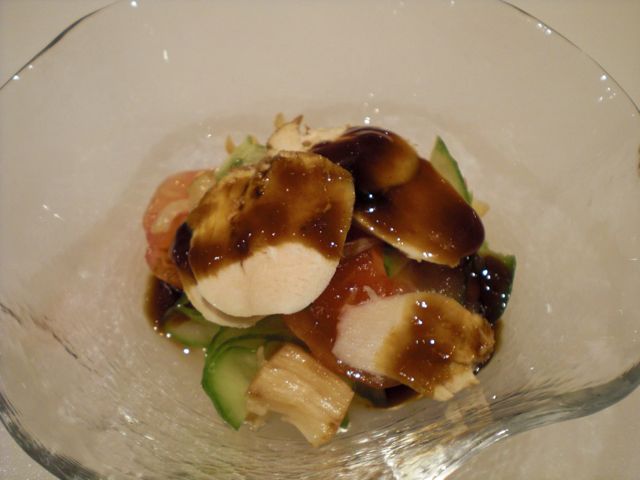
Cucumber salad with smoked scallop and poached chicken breast with black vinegar sauce きゅうり、貝柱、鶏肉のサラダの黒酢ソース和え


This is another small dish you make from whatever you have at hand. Since at our Home Izakaya, I usually make one dish, eat that dish with some sake and then make another, sometimes, making a small dish quickly from nothing is very necessary. In any case, this night, I found leftover poached chicken breast in black vinegar sauce, fresh American mini-cucumber and the New Year care package we just received from my mother which included semi-dried lightly smoked Hokkaido scallops 貝柱の薫油漬. Of course, you could omit the scallops or substitute with finely chopped smoked ham or salami.

For two small servings, thinly slice one mini-cucumber and salt lightly, mixing well or "knead" lightly and let it stand for 5 minutes on the cutting board. Then, squeeze out excess moisture. I also skinned and cut 2 Campari tomatoes into quarters. I crumbled one semi-dry scallop into small pieces and mixed the pieces into the cucumber and tomatoes then dressed with sushi vinegar. I sliced the chicken breast paper thin, placed the slices on top of the cucumbers and drizzled the black vinegar sauce over everything.

It is interesting that the black vinegar sauce congealed to a thicker gelatinous consistency since it contains protein/collagen from the chicken skin. When I was growing up in Sapporo, even inside our old house, it got very cold in winter especially at night without any source of heat. When my mother made a simmered fish dish in soy sauce flavored broth or "nizakana" 煮魚 and the leftover was kept in a kitchen cabinet, the sauce congealed in the bottom of the plate into jello next morning. This is called "nikogori" 煮凝り. It is a natural equivalent of making a fashionable "gelée" sauce by adding gelatin into a sauce. In any case, as a child, I really liked this "nikogori" on hot rice (it melted quickly). The reduced black vinegar sauce indeed attained a similar consistency (in the refrigerator not in the room, though). This dish is definitely best with sake, since it has a vinegary taste.

Monday, January 18, 2010

Potato salad with cod roe, black olive and Cornichons タラモサラダ

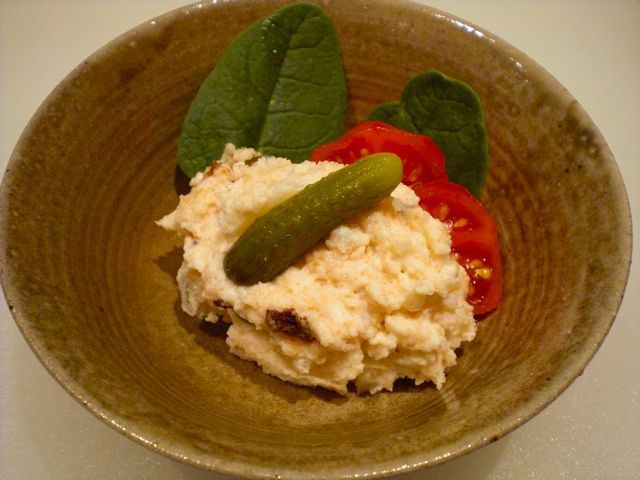
Potato salad is not really Japanese or Izakaya food, yet, it is definitely very common home cooked food in Japan. Last time we were in one of our favarite Izakayas in Kyoto, "Akagakiya" 赤垣屋, the first appetizer or "Otoshi" おとうし was potato salad which was excellent. There is always something different from usual American-style potato salad in Japanese versions. Mark's book has a rather sophisticated version of potato salad (p81).  One of more common Japanese variations is called "taramo" which is a made-up word from "tara-ko" (cod roe) and "imo" (potato). I made my variation of "taramo" salad since I had "tarako" I did not use after making other dishes. I added black olive, finely sliced French Cornichons (tiny cucumbers, gherkins, pickled in a tangy marinade), and instead of using just mayonnaise, I used an equal mixture of plain yogurt and mayonnaise, which is bit better fat-wise and also add a slighly sour tangy flavor to the dish. An addition of yogurt, however, makes the salad a bit watery, so it is important to use white potatoes and cook them whole and remove the skin before mashing to make sure the potato is rather dry to begin with.

I used two large white potatoes which were boiled in salted water whole (you could microwave, also) until a skewer goes through easily. Remove skin using a towel and mash with 1 tbs of butter and a pinch of salt (be light on salt since "tarako" is also salty) and let it cool to a room temperature. Meanwhile I remove the pits from 7-8 black oil cured olives (I am not sure which kind we got here from a local gourmet grocery store) and coarsely chop. I usually use thinly sliced fresh cucumbers (salted and then vinegared) but the mini-cucumbers we got this time did not taste particularly good, so I used pickled French Cornichons finely sliced (4-5). Add 2 tbs each of mayonnaise and plain yogurt and one large sac of tarako (which was removed from the sac and mixed with 1 tsp of lemon juice and 1/2 tsp of sake). Taste and adjust the seasoning (salt and pepper). This "taramo" salad tastes better after leaving it overnight in the refrigerator (especially the textures improves).

Please note that the size of Cornichons I used for a garnish is only 1 inch in length and the tomato is cherry tomato in the above picture. I served this as an "otoshi" for our Home Izakaya à la "Akagaki-ya". Although sake will be a safe choice, It went surprisingly well with an inexpensive everyday Australian Shiraz "Red Dust" 2007.

Saturday, January 16, 2010

Chicken meatball with marinara sauce チキンミートボール


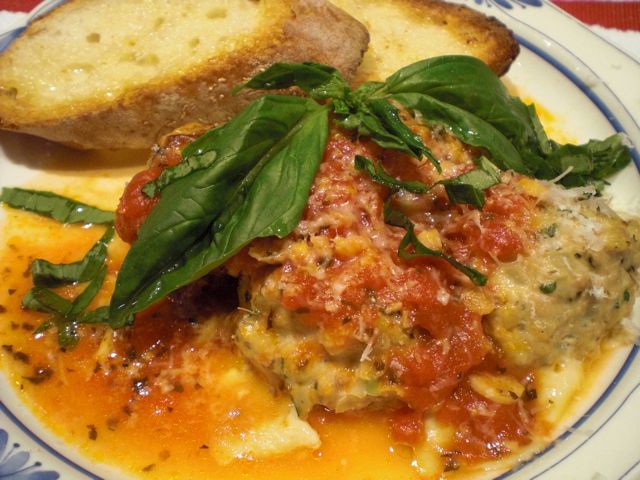
This may not be strictly Izakaya food but it goes perfectly well with a glass of red wine. This is rather low fat version of Italian meat balls with a marinara sauce but it has very light texture and tastes pretty good. I am not sure where I came up with this particular recipe but I may have seen it in one of the Food Channel shows at some time and modified it.

It starts with ground chicken. I used low fat (less than 1% fat) but you could use raw Italian sausage or ground pork if you are so inclined. For one package of ground chicken (1 lb or about 500 grams), I add 1 medium onion and 4-5 fresh shiitake mushrooms chopped and sauteed in olive oil and cooled, 1/2 tsp or more of freshly ground nutmeg (this is the most important seasoning, freshly ground nutmeg has much better flavor than the pre-ground), 1 tsp of salt and 1/2 tsp of freshly ground black pepper, and 1/2 cup of Japanses "panko" bread crumbs, and 2 beaten eggs. You could also add ground cayenne pepper to taste (optional). Mixed them all up using your hand until the mixture comes together. You may want to reserve a portion of the beaten eggs first and adding the rest depending on the consistency but I like it rather soft with 2 eggs. Using a small ice cream scoop to make small equal sized meat balls and I place them on a cookie sheet. Put them in a 350F oven for 15 minutes or until done. You could sauté or deep fry the meat ball but baking works best for us.

For the marinara sauce, I just use 1/3 cup of light olive oil, two 8 oz cans of whole plum tomatoes (crushed by hand), and chopped garlic (3-4 gloves), 2 bay leaves, salt, black pepper, 1/2 tsp of dried oregano or marjoram, and 1/2 of dried basel, 1/2 to 1 tbs of sugar (to cut acidity). Again you could add red pepper flakes with garlic if you so prefer.

I add chiffonade of fresh basel and grated Parmigiano-Reggiano cheese when serving with an accompaniment of toasted baguette.

Stir fried udon noodle 焼うどん

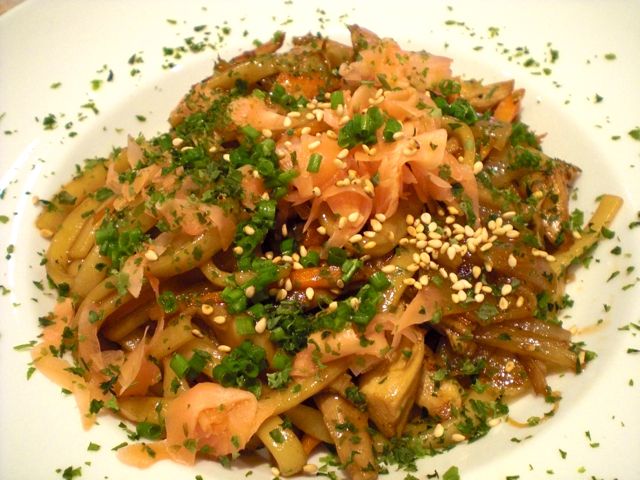
This is another "teiban" shime dish. At home, I make this usually from leftovers. The night before, I made "Tarako spaghetti" using a Japanese "Udon" noodles and I had leftover udon. I also had the last small portion of the leftover barbecued chicken (thigh meat). This is a variation of "Yakisoba" 焼きそば.

For two small servings, I sliced onion (1, small), julienned carrot (1, small) and fresh shiitake mushrooms (4, medium). I sautéed these vegetables in olive oil (1 tbs) with a dash of dark sesame oil for 2-3 minutes and added crushed, finely chopped garlic (1 clove). Seasoned with salt and pepper. I then added hand shredded cooked chicken thigh (one thigh) and the noodles. It is important to add some kind of liquid during the cooking of this kind of dish. I added chicken broth (3 tbs) and stirred until the liquid was almost all gone. You could use a bottled "yakisoba" sauce, but I just seasoned it with mirin (2 tbs), soy sauce (1 tbs) and Worcestershire sauce (2 tsp), salt and pepper. You can experiment with any combination of sauces. I stir-fried until the liquid was almost gone and the sauce became somewhat thick and clingy. For garnish, I had thinly sliced pickled ginger root (pink stuff you get at Sushi bars), chopped chives, dried "aonori"  and roasted white sesame seeds. Very familiar dish and good.

Thursday, January 14, 2010

Crab cake クラブケーキ

Along the Chesapeake bay, blue crabs are famous. These are rather small crabs but the meat is very sweet. One of the ways to enjoy this crab is to go to the bay and get one bushel of boiled or steamed blue crabs. Then, sit on the dock, crack the shells and eat. Throw carcasses back into the Bay as you eat and see lots of fish come up to feed on whatever meat we missed. If you or your friend have a boat on the Chesapeake bay, this is the preferred way of enjoying Maryland blue crabs. You can also go to one of crab houses in the area. They will give you a bib, a wooded mallet and a special fork. A mound of freshly boiled crabs is dumped on the news-paper covered table, and everybody has at it with hands and mallet. It is customary, especially in Maryland, that crabs are cooked with "Old Bay" seasoning. McCormick used to have a factory in downtown Baltimore where they made this seasoning. For me, this is good but too much work and the Old Bay seasoning is too strong. Beside just eating steamed or boiled crabs, two most famous crab dishes in this area must be crab cake and deep fried soft shell crab (especially as a sandwich). Although it was a weekday night, I made crab cakes. We also love soft shell crab (particularly as tempura) and hope I can post that dish sometime later.


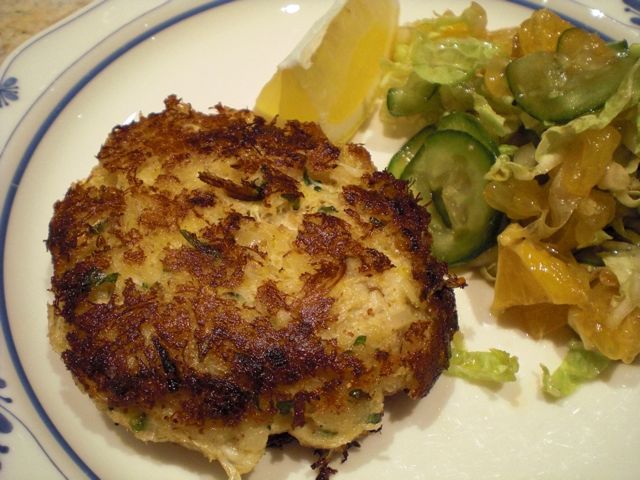
Crab cakes look somewhat like "crab croquette" (Mark's book p.57), but it is composed of mostly crab meat and only a small amount of binders and fillers are used. It is best to use lump or jumbo lump crab meat. I used 8oz of cooked crab meat (not canned) to yield 4 crab cakes. It comes in a sealed plastic container and is readily available in grocery stores in our areas. I finely chopped one small onion, fresh shiitake mushrooms (3-4 medium), parsley (3-4 sprigs), lemon zest from 1 lemon (as usual I used a micro-grater). Using a small amount of light olive oil (1tbs), sauteed onion first and then the chopped shiitake mushroom for 3-4 minutes, season with salt and black pepper, place it in a metal mixing bowl to cool. (If I have jalapeño pepers, I often add finely chopped, seeded and deveined jalapeno pepper as well.) When, the onion mixture is cool, add chopped parsley, lemon zest, a splash or two of Worcestershire sauce and Tabasco, 1 tbs of mayonnaise, 1 tsp of Dijon mustard, and 3-4 tbs of Japanese "panko" bread crumbs and gently fold the crab meat in. You could add a whole egg or egg yolk as a binder but I prefer not to add eggs. Make whatever size round or oval flat patties (I made four about 3 inch diameter and 1/2 thick patties). They are rather delicate and barely hold together. Melt 1-2 tbs of butter or olive oil (or combination) in a non-stick frying pan, and cook the crab cakes (3-4 minutes per side). Be careful when you turn them over, they are mostly crab meat and it is very easy to crumble.

For the accompaniment, I made a simple cucumber, nappa (Chinese) cabbage (only soft and green part), mandarin orange (peel outer and inner skins. Halve and slice) with a simple olive oil, balsamic vinegar dressing. You could serve crab cakes with a tartar sauce but we like to eat simply with a lemon.

Speaking of crabs, we really like Japanese specialized crab "kani" 蟹 restaurants (especially in Sapporo). They serve crabs in so many different ways but you do not have to work to get the crab meat. If you visit Japan especially Sapporo, try these specialized crab restaurants and their course menu.