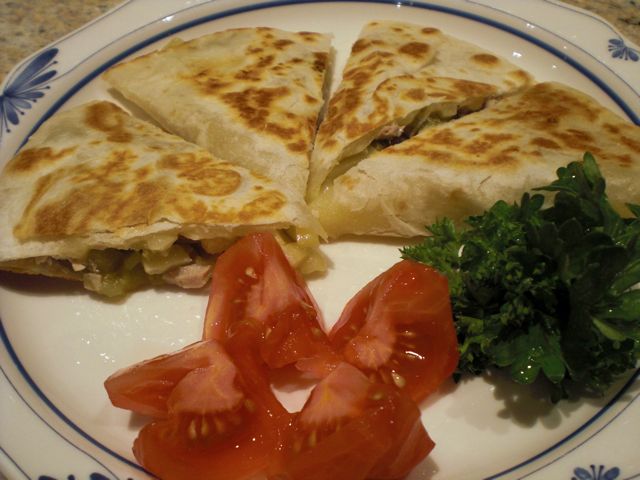
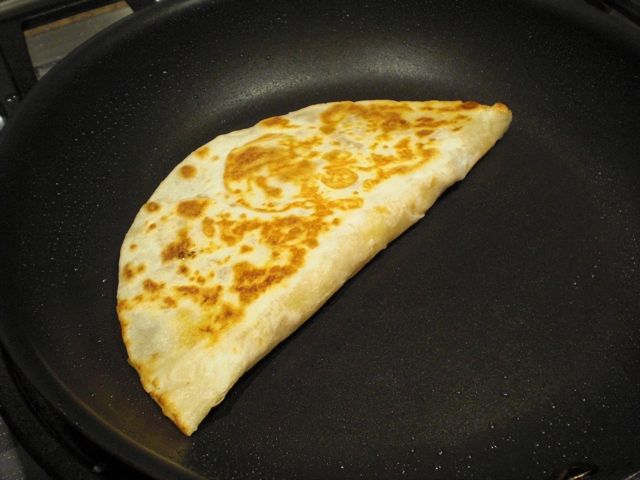
Like some favorite Japanese dishes may have an origin in China, many so-called South-Western cuisines in the U.S. are derived from or influenced by Mexican cooking. Quesadilla is one of these and a perfect bar food. Essentially, a cheese sandwich using tortillas. There is no real recipes. You can make many variations depending on types of cheeses and other proteins such as cooked shredded chicken, pork etc. My Mexican friend tells me that the authentic quesadilla is made from one tortilla and folded in half into a half-moon shape but using two tortillas may be more efficient. I just wanted to make a small amount for two of us this time, so I made it from one tortilla.
Wednesday, February 3, 2010
Quesadilla ケサディア
Monday, February 1, 2010
Japanese pork pot roast 焼豚/煮豚
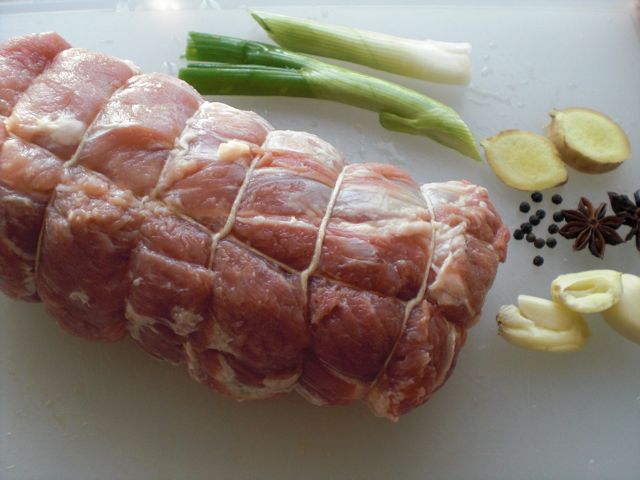
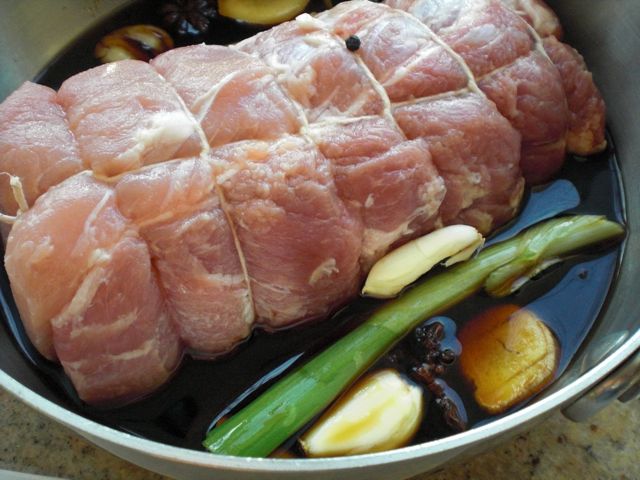
This is another favorite sino-Japanese dish, which I mentioned when I posted the Ramen noodle. I learned that the original Chinese version is called 叉焼 "Cha-siu" and the pork is indeed grilled. The Japanese version is essentially a pot roast. "Yakibuta" 焼豚 in Japanese means "grilled" pork as opposed to "Nibuta" 煮豚 "simmered" pork. But Japanese use them almost interchangeably, although the words "Yakibuta" or "Chaashuu" チャーシュウ (adapted from the original Chinese pronunciation) are most commonly used for this dish. Even though the main mode of cooking occurs in a liquid, many recipes call for browning the surface (thus, justifying the name "grilled pork" or "yakibuta") before and/or after cooking in a liquid. As I mentioned in the Ramen post, this is by far the most common topping for ramen noodles but there are many other ways to serve up this dish. Here I simply sliced it and served it as h'or doeuvre.
Saturday, January 30, 2010
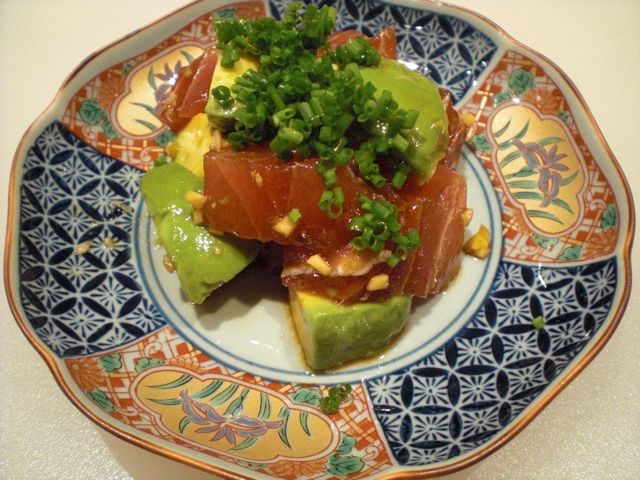
Tuna and Avocado cubes 鮪とアボカドの角切り
This is the dish shown on the front jacket cover of Mark's book. I meant to make this for some time but somehow I could not synchronize having tuna sashimi and ripe avocado at the same time. The taste and texture of avocado are quite a good match for tuna sashimi. The most significant and successful sushi invention in the U.S. must be California roll. California rolls use crab meat and avocado, which is also a good combination. We often have slices of avocado like sashimi along with other sashimi items served with soy sauce and wasabi. That is also good.
As long as you have the ingredients, making this dish is simple and quick. I followed the recipe in Mark's book in the back jacket flap verbatim. I cut avocado into 1/2 inch cubes and dressed with lemon juice to prevent discoloration. I then cut sashimi tuna into 1/2 inch cubes. The dressing is made of minced garlic (I used one fat clove), 2 tbs of soy sauce and 1 tsp each of sake and dark roasted sesame oil. I tossed the tuna and avocado cubes and served them with chopped chives. This is excellent! Quite different from the usual tuna sashimi. The dressing is rather assertive but surprisingly good. The above is a serving for one person and the amount is perfect. You do not want to eat too much of this dish. This dish definitely made it to the "teiban" 定番 list of our home Izakaya dishes.
Thursday, January 28, 2010
Rare tastes 珍味
A Japanese word "chinmi" 珍味 is often used to describe food items which are rare and/or limited to certain regions of Japan. You can assemble these rare tastes more easily nowadays by mail order and because of many special sales featuring these rare and regional food items (usually held in department stores in Japan). Even in the U.S., more and more of these "chinmi" items are becoming available, albeit much more limited compared to Japan. Tonight, we had an assortment of these rare tastes with sake.
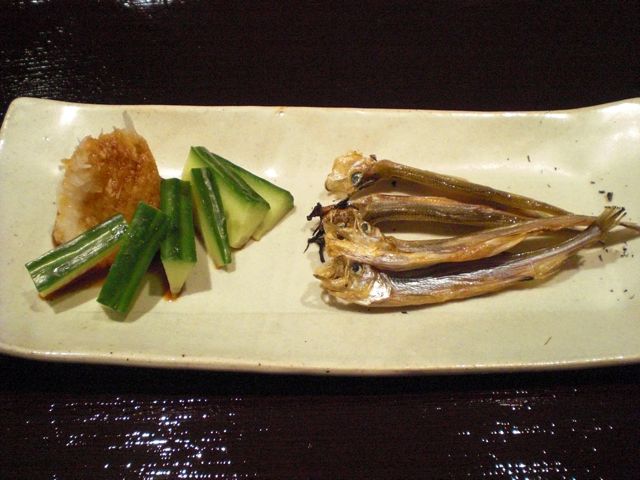
Dried "Shishamo" fish 寒干しししゃも
This small fish called "Shishamo" ししゃも or 柳葉魚、Spirinchus lanceolatus, is harvested only on the southern pacific coast of Hokkaido. I grew up with this fish and they are very popular drinking snack items especially in Hokkaido. These are usually semi-dried and we get them frozen in the United States. My mother sent these to us. They were (supposedly) "fully dried" in the cold northwind of Hokkaido. They can be eaten as is but I grilled them briefly over the gas fire and served them with grated daikon 大根おろし and soy sauce. They are a bit chewier than semi-dried (which has to be more thoroughly grilled) but they are very flavorful. To my surprise, even my wife liked them.
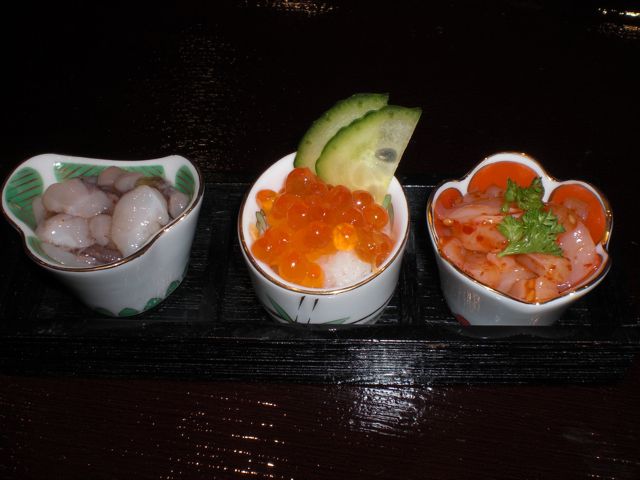
Raw Octopus marinated in wasabi sauce たこぶっかけ (lt)、Salmon roe with grated daikon いくら甘酢大根おろし (ctr)、Raw Squid mariated in hot red peper sauce イカぶっかけ (rt)
My wife and I love "squid and guts" or squid "shiokara" いかの塩辛. This is definitely an acquired taste but most people who love sake will love this as well because both go together so well. Shiokara is made from fresh squid which is salted and slightly fermented with squid innards (mostly liver). The homemade variety made with a light amount of salt (this kind does not last long) is the best. Many commercial ones are too salty but more recently, we can get a less salty kind in a small plastic pouch in the frozen case of the Japanses grocery store. Last time we were in Hakodate we had commercial but local "shiokara" which was excellent. Another similar preparation is called "okizuke" 沖漬け. "oki" in Japanese means "far-away from the shore". Supposedly, fishermen start marinading the freshly caught squid (sometimes other fish or shell fish) while in their boat and by the time they come back to shore (overnight or one day), the dish is done. Once in a blue moon, Chef Kudo at Tako Grill makes squid okizuke which is exquisite. Last time we were in Kanazawa, a small fluorescent squid called "hotaruika" 蛍イカ or firefly squid was in season. We really enjoyed "okizuke" of this small squid. Unfortunately, it is next to impossible to get a fresh squid suitable for making these dishes in the U.S. What we have here is the closest substitute.
In the above image, from left to right are raw octopus with wasabi sauce たこぶっかけ、salmon roe with grated daikon いくら大根おろし (grated diakon is seasoned with sweet vinegar which is only item I prepared)、and raw squid with hot sauce イカぶっかけ. These squid and octopus dishes are variations of "shiokara" and "okizuke" and are called "bukkake" ぶっかけ in which small pieces of raw octopus or squid are marinated in a spicy sauce. Here, the octopus is marinated in "wasabi" sauce and squid in red pepper sauce. Both come in a small plastic pouch and bought frozen. These are perfect accompaniment for sipping sake.
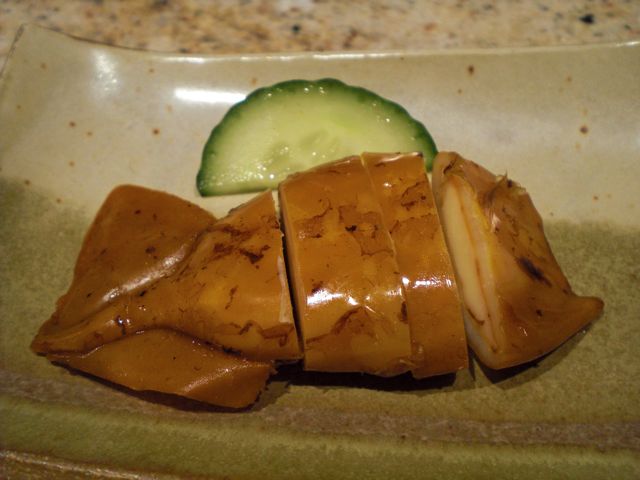
Cheese stuffed squid チーズいか
This is another item, my mother sent us. A Japanese word "Ikomi" 射込み means to "insert" or to "stuff" and this one is a type of "ikomi" squid. This is a commercial product in which a small squid was stuffed with cheese and cooked. This is eaten as is. Interesting combination of tastes. I served one for each of us but my wife went back and got another one. She must have liked it.
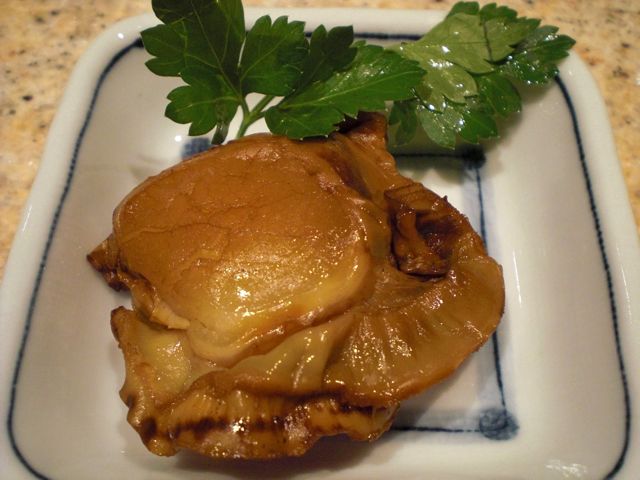
Smoked scallop 帆立ての薫製
This is a smoked whole scallop from Lake Saroma 佐呂間湖 in Hokkaido. To us, it is a bit too smoky and chewy.
Dried "Shishamo" fish 寒干しししゃも
This small fish called "Shishamo" ししゃも or 柳葉魚、Spirinchus lanceolatus, is harvested only on the southern pacific coast of Hokkaido. I grew up with this fish and they are very popular drinking snack items especially in Hokkaido. These are usually semi-dried and we get them frozen in the United States. My mother sent these to us. They were (supposedly) "fully dried" in the cold northwind of Hokkaido. They can be eaten as is but I grilled them briefly over the gas fire and served them with grated daikon 大根おろし and soy sauce. They are a bit chewier than semi-dried (which has to be more thoroughly grilled) but they are very flavorful. To my surprise, even my wife liked them.
Raw Octopus marinated in wasabi sauce たこぶっかけ (lt)、Salmon roe with grated daikon いくら甘酢大根おろし (ctr)、Raw Squid mariated in hot red peper sauce イカぶっかけ (rt)
In the above image, from left to right are raw octopus with wasabi sauce たこぶっかけ、salmon roe with grated daikon いくら大根おろし (grated diakon is seasoned with sweet vinegar which is only item I prepared)、and raw squid with hot sauce イカぶっかけ. These squid and octopus dishes are variations of "shiokara" and "okizuke" and are called "bukkake" ぶっかけ in which small pieces of raw octopus or squid are marinated in a spicy sauce. Here, the octopus is marinated in "wasabi" sauce and squid in red pepper sauce. Both come in a small plastic pouch and bought frozen. These are perfect accompaniment for sipping sake.
Cheese stuffed squid チーズいか
Smoked scallop 帆立ての薫製
Wednesday, January 27, 2010
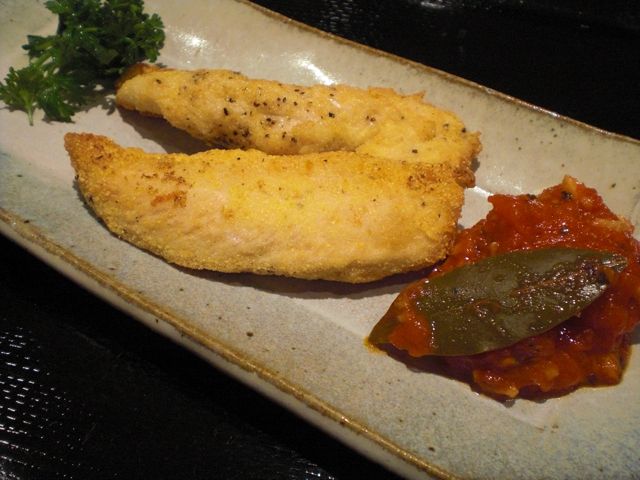
Cornmeal Parmesan Chicken tender with crispy skin 鶏の笹身のパルメザンコーンミール焼きとカリカリ鶏皮
We love a crispy skin, either chicken, fish or pork. To make chicken skin very crispy, I parboil the chicken skin in water with salt and sake for 10 minutes until the fat was rendered. Then, I patted them dry and placed them (no oil needed) in a frying pan and put another identical frying pan on the top to press down. Cook it for 5-8 minutes on low heat and turn over and cook another 5 minutes until the skin is very crispy. You may still have to remove some excess fat from the pan using a paper towel during the cooking. Sprinkle on a bit of salt while it is hot.
For dipping sauce, I made a mixture of Dijon mustard and honey (about equal amount or less honey depending on your taste). Honey will melt easily and changes the consistency and color of the mustard. This one goes well with any drink.
Subscribe to:
Comments (Atom)