Short of having fresh small clams, the important ingredient is good quality canned baby clams - not chopped clams (which tend to be too tough and chewy). We use a 10oz can of "Sun of Italy" brand (see photo) for 2 small servings. I am sure there are many similarly good brands. Drain the clams retaining the juice, set aside. I add olive oil (2 tbs) to a frying pan and add thinly sliced garlic (3-4 cloves, we like lots of garlic but use at your discretion) in medium-low heat until garlic is fragrant and lightly browned (again do not burn, it will become bitter). Add reserved clam juice and 3 tbs of sake (or dry white vermouth) and reduce to 1/2 to 1/3 of the original volume (5 minutes on high heat). Meanwhile, I cook the angel hair pasta (about 3 minutes in boiling water). I add 1/3 cup of cream to the pan as well as the clams. I reduce the sauce briefly and add, usually, finely chopped parsley but this time I used baby arugula (as much as you like, it will cook down quite a bit). When sauce is reduced and the green is wilted, add the angel hair pasta. Although, parmesan cheese is supposedly not to be used for sea food pasta, we like it on this dish. Adjust seasoning with salt and black pepper. I happened to make Baguette a few weekends ago (which was sliced and frozen). It appeared as an accompaniment for this dish. The usual choice of wine would be white but we rarely drink white so this night, we had this with a very inexpensive but quite decent weekday red wine, South Eastern Australian Shiraz "Reddust" 2007.
Saturday, February 27, 2010
Baby clams in garlic cream sauce with angel hair pasta エンジェルヘアパスタ小蛤クリームソース
Thursday, February 25, 2010
Stewed pork belly 豚の角煮
This is one of the rather classic home cooked or Izakaya dish. Pork "kaku-ni" 角煮 has an origin in China and reportedly came into Japanese culinary vocabulary through Okinawa 沖縄 and Kyushu 九州. Although one may think that Japanese food is rather low-fat and healthy (which is mostly correct), Japanese also like totally unhealthy fatty items such as this dish. Cubes of Pork belly (portions used for salt pork and bacon) are cooked a long time in a soy sauce based broth producing a meltingly soft and sweet fatty morsel. This cut of pork is very common in Japan called "sanmai niku" 三枚肉 or "bara niku" バラ肉. The closest we can get in a regular grocery store in the U.S. is pork spare ribs. But unless you get pork spare ribs which include the front side, you do not get this cut of pork. The types of meat you get under "pork spare ribs" vary and, toward the back of the ribs, you get a cut similar to pork chops. Since salt pork is exactly a block of a pork belly (which is salt cured), I decided to experiment making this dish from salt pork. There are many recipes including using a pressure cooker. The vast majority of the recipes suggest boiling the meat in a large amount of water first before cooking it in a seasoned broth. I figured that even though salt pork is salty, by boiling it in water or a seasoned broth with a lower salt content for a long time, the salt will eventually leach out from the salt pork. I looked through several recipes and decided on one which looked differet from the vast majority of the recipes and interesting by Atsushi Tsuchiya 土屋敦.
I first removed the rind (or skin) and cut a block of salt pork (about 500 grams) into 1 inch by 2 inch rectangles. Using a small dry frying pan, I browned all sides starting with the fatty side so that some fat will render out first (2-3 minutes on each side). In a small bowl, add 4 tbs of soy sauce (I used 1/3 low sodium soy sauce) and marinate the seared pork cubes for 10 minutes. I then put the pan on a low flame and cook for 5 minutes until soy sauce reduces a little and becomes slightly viscous. I add 200ml of sake and increased heat and cook 8-10 minutes and add 3 tbs of sugar.
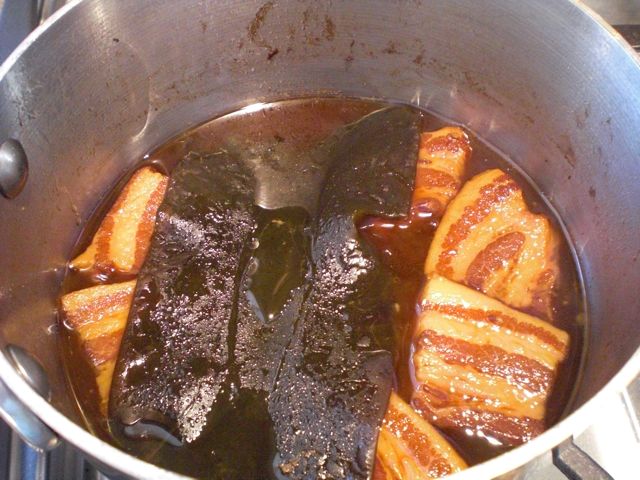
Meanwhile I soak about 5-6 inch long dried kelp in water and let it rehydrate for 30 minutes or more. Add the water in which the kelp was soaking to the pan above so that the meat is covered. As it comes back to the boil, I skim off fat and scum which will appear on the surface. I placed the kelp to cover most of the meat as shown below and turn down the heat to simmer. I cook about 4 hours on simmer turning the meat over after about 2 hours, adding more water as needed.
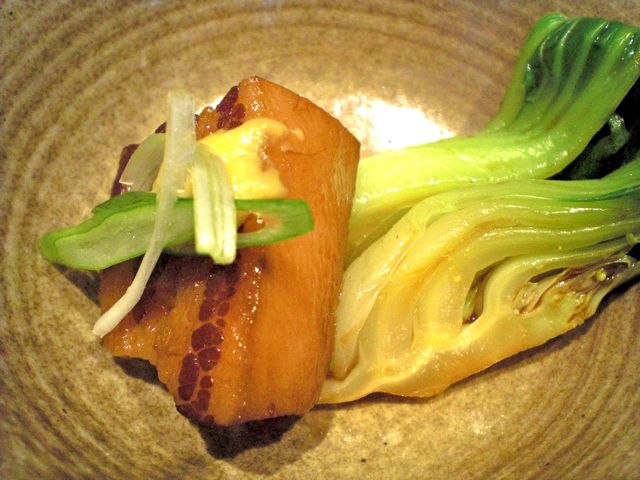
I served this with a dab of Japanese mustard and sliced scallion. As an accompaniment, I made blanched baby Bok choy or チンゲンサイ青梗菜 dressed with a mustard soy sauce (Japanese mustard, sugar and soy sauce). This is a partial success. Although the meat is not too salty and fat is nicely rendered and soft, the meaty parts are a bit dry. I have to try this recipe with pork spare ribs.
I first removed the rind (or skin) and cut a block of salt pork (about 500 grams) into 1 inch by 2 inch rectangles. Using a small dry frying pan, I browned all sides starting with the fatty side so that some fat will render out first (2-3 minutes on each side). In a small bowl, add 4 tbs of soy sauce (I used 1/3 low sodium soy sauce) and marinate the seared pork cubes for 10 minutes. I then put the pan on a low flame and cook for 5 minutes until soy sauce reduces a little and becomes slightly viscous. I add 200ml of sake and increased heat and cook 8-10 minutes and add 3 tbs of sugar.
Meanwhile I soak about 5-6 inch long dried kelp in water and let it rehydrate for 30 minutes or more. Add the water in which the kelp was soaking to the pan above so that the meat is covered. As it comes back to the boil, I skim off fat and scum which will appear on the surface. I placed the kelp to cover most of the meat as shown below and turn down the heat to simmer. I cook about 4 hours on simmer turning the meat over after about 2 hours, adding more water as needed.
P.S. We tasted this again after letting it sit in a refrigerator for 2 days (we forgot that we had this). I skimmed off any congealed pork fat and removed the kelp and warmed up the broth and pork. The pork was much better seasoned and not as dry, as compared to the last time we tasted this. The original recipe indeed recommended to keep it in a refrigerator overnight before serving and it is definitely worthwhile to do this extra step.
P.S. I posted two other attempt at making "Kakuni"; one with spare ribs and the other using genuine pork belly (to be posted).
Tuesday, February 23, 2010
Grilled chicken salad with white sesame dressing 鶏肉と椎茸の胡麻和え
This another example of making-a-dish-from-whatever-we-have. We had a left over grilled chicken thigh with salt. I decided to make a small Japanse-style salad with sesame dressing or "goma-ae" ごま和え. I often make similar dishes with some variations depending on what I have at a given moment.
Dressing: I first saute white sesame seeds (3 tsp) in a dry frying pan for a few minutes (although the sesame seeds are bought already roasted) this brings back the fresh toasted flavor. I tip the sesame seeds (reserving a few for a garnish) into a Japanese mortar or "Suribachi" すり鉢 and, with a pestle, grind the seeds until they are coarsely cracked and some oil comes out. You can smell the nice roasted sesame. Then, add 1 tsp of tahini or "shiro negi-goma" 白練りごま and 1/2 tsp of sugar, 2-3 tsp of soy sauce. I also add a very tiny amount (1/2 tsp) of rice vinegar but this is optional. The vinegar will add a subtle sourness as wel as lighten the color of the dressing.
Chicken: I just slice the one left over grilled chicken thigh with salt into small strips.
Scallion (1-2): I char the outer skin of a large scallion (white parts) over a direct gas flame for 2-3 minutes. Let it cool a little, remove the charred skin and cut into 1 inch long segments. I slice the remaining green parts into thin strips diagonally for a garnish.
Cucumber (1 mini or 1/3 Japanese cucumber): I thinly slice one mini cucumber, salt and mix and let it stand for few minutes. I ring out the excess moisture and dress it with a small amount of sushi vinegar.
Shiitake mushroom: I happened to have fresh shiitake mushrooms. I grilled 3 with the stem removed in a toaster oven for few minutes and cut into small strips and dressed it with a small amount of soy sauce while hot.
Mix all the above ingredients and dress with the sesame dressing. Garnish with thinly sliced scallion, Campari tomates, and sesame seeds. It is an extra step but dry roasting the sesame seeds makes a big difference.
Sunday, February 21, 2010
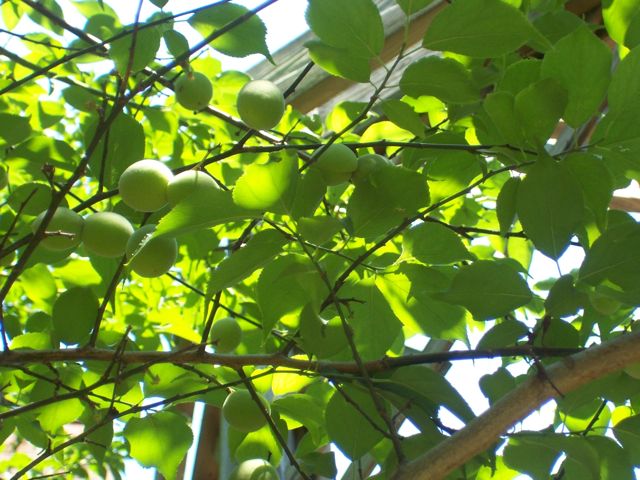
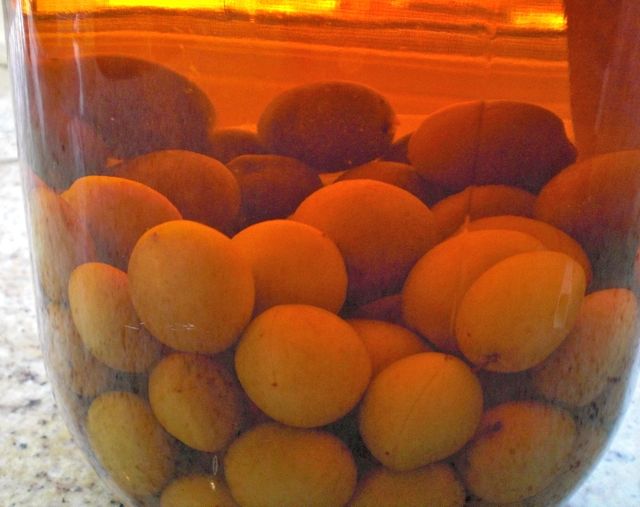
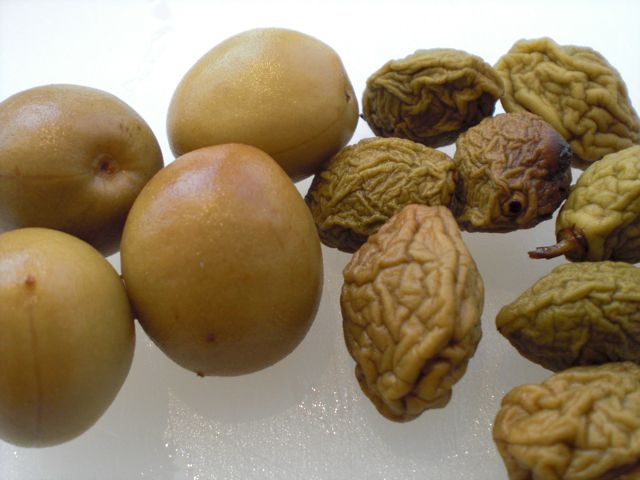
Plum wine 梅酒
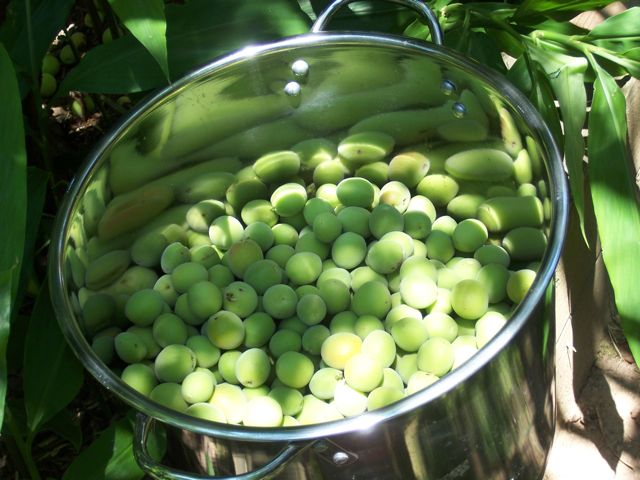
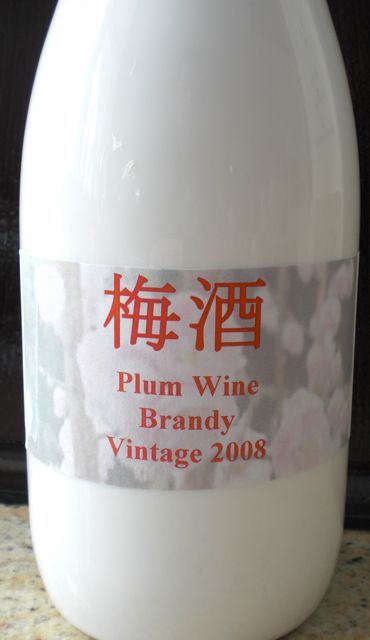
We have accumulated quite a few bottles in the past 20 some years. One of these days, we may be able to do the vertical tasting but it is a bit like Scotch tasting, your have to be very careful, otherwise you will be totally soused after a few tasting.
P.S. Please see here for additional information on Umeshu.
Friday, February 19, 2010
Sliced duck breast and scallion with Ponzu sauce
Sliced duck breast with Ponzu sauce 鴨とネギのおろしポン酢 (Mark's book p145)
Japanese consider scallion or "negi" 葱 and duck or "kamo" 鴨 to be the ultimate culinary combination. The Japanese expression "Kamo ga negi o shotte kuru" 鴨が葱を背負ってくる or a short form, "Kamo-negi" 鴨葱 literally means "A duck flies in with bundles of scallion on its back", which describes the situation in which "A perfect victim falls into your hands willingly and carrying a present to boot". I had to make a small deviation from the original recipe since I did not have a "Tokyo" scallion or naga-negi 長ネギ (You could get one at a Japanese grocery store) and I did not want to use leeks as the substitute as suggested.
I cook the duck breast in my usual way. I clean the duck and score the skin in a cross hatch pattern (rather than simply piercing the skin as indicated in the recipe since this will allow more complete and easy rendering of the fat), salt and pepper, cook it in a dry frying pan, the skin side down, on a medium-low flame. I cook it for 6-7 minutes until the skin is brown and crispy. During the cooking, I remove excess fat using paper towels. I turn over the duck and place it in a preheated (400F) oven for 6 minutes. While it is hot, I marinade it in a Ponzu sauce (Mark's book p145 but I used a commercial one from the bottle) for several hours. Meanwhile I brown the white parts of scallion (as many as you need but I used 6) in a frying pan on a medium flame with a small amount of oil (5-6 minutes), cut them into pieces a few inches long. I thinly slice the green parts of the scallion on a bias as a garnish as seen above.
Japanese consider scallion or "negi" 葱 and duck or "kamo" 鴨 to be the ultimate culinary combination. The Japanese expression "Kamo ga negi o shotte kuru" 鴨が葱を背負ってくる or a short form, "Kamo-negi" 鴨葱 literally means "A duck flies in with bundles of scallion on its back", which describes the situation in which "A perfect victim falls into your hands willingly and carrying a present to boot". I had to make a small deviation from the original recipe since I did not have a "Tokyo" scallion or naga-negi 長ネギ (You could get one at a Japanese grocery store) and I did not want to use leeks as the substitute as suggested.
I cook the duck breast in my usual way. I clean the duck and score the skin in a cross hatch pattern (rather than simply piercing the skin as indicated in the recipe since this will allow more complete and easy rendering of the fat), salt and pepper, cook it in a dry frying pan, the skin side down, on a medium-low flame. I cook it for 6-7 minutes until the skin is brown and crispy. During the cooking, I remove excess fat using paper towels. I turn over the duck and place it in a preheated (400F) oven for 6 minutes. While it is hot, I marinade it in a Ponzu sauce (Mark's book p145 but I used a commercial one from the bottle) for several hours. Meanwhile I brown the white parts of scallion (as many as you need but I used 6) in a frying pan on a medium flame with a small amount of oil (5-6 minutes), cut them into pieces a few inches long. I thinly slice the green parts of the scallion on a bias as a garnish as seen above.
I remove the duck breast from the marinade and slice it rather thin and drape the slices over three segments of the scallion and top them with grated daikon, yuzu-kosho 柚子胡椒 (Mark's book p145 but I used a commercial one from the tube) and garnish with sliced scallion (green parts). We thought that yuzu-kosho was a bit too spicy to our taste but the combination of scallion and duck is great and the grated daikon was also nice cutting through the richness of the duck. We like this dish very much.
Subscribe to:
Comments (Atom)