

Tuesday, September 14, 2010
Garlic chive and grilled abura-age in sesame dressing ニラと焼き油揚げの胡麻和え
This is another type of Otoshi お通し small dish. I bought chives in a small plastic container, along with a few other items at our grocery. The cashier was being a bit careless and the container opened while she was ringing up. Chives spilled out all over everything. So, with restless people waiting in the line behind me, I had to rush back to the produce department and grab another package. It turns out I grabbed the wrong thing. I thought I had chives but when I got home I discovered I had "garlic chive" ニラ. We have garlic chives growing in our herb garden but it tends to be tough so, even though it is prolific, we don't use it much. These garlic chives were very tender and flavorful. Thus, this dish.
I blanched the garlic chives for 30 seconds, then shocked them in ice cold water ringing out the excess moisture. I cut them into 1 inch lengths. Meanwhile, I grilled or toasted the abura-age 油揚げ or deep fried tofu pouch (I used a toaster oven) for 3-4 minutes until it becomes very crispy and slightly browned. I cut it into thin strips. The dressing is made simply; sesame (1 tbs) dry roasted in a frying pan for 2-3 minutes then ground coarsely in a suribachi Japanese mortar すり鉢. I added a small amount of sugar (1/2 tsp) and soy sauce (2-3 tsp) and a dash of dark sesame oil. I dressed the abura-age and garlic chive mixture and served. You have to enjoy this dish while the abura-age is still hot and crispy. A perfect starter dish for sake.


Sunday, September 12, 2010
Angel hair pasta pancake in "okonomiyaki" style エンジェルヘアパスタと桜えびのお好み焼き風
"Okonomiyaki" お好み焼き is a very popular Japanese pancake in which you can put "anything you like on top" (this roughly translates to "okonomi"). We are not particularly fond of okonomiyaki. Last time we tried this dish was in Himeji 姫路. It was in the "Hiroshima" style, and we decided this was not our favorite. There were so many items piled up on the pancake--toppings and sauces, the flavors became "muddy" and we could not taste anything distinctive. But, I occasionally make something like "okonomiyaki" using leftovers. In this version, you can taste all the different flavors.
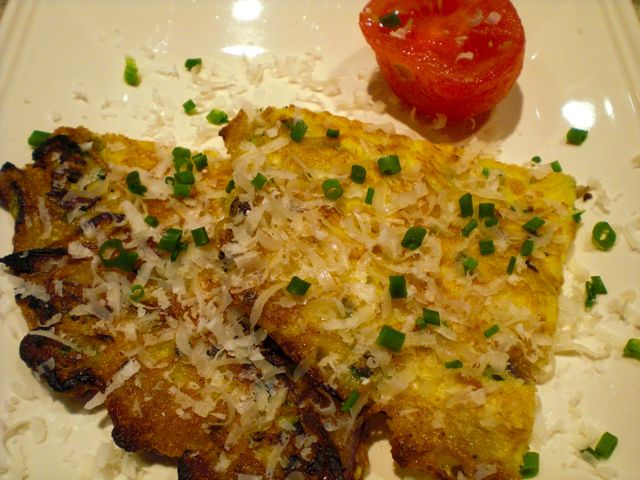
We had left over Angel hair pasta. So I made this as a starter. There are no rules on how to make this type of dish. I had about 1/2 cup (guesstimate) of cooked Angel hair pasta. To the pasta, I added grated Parmigiano Reggiano (about 4 tbs or more if you like), salt and pepper to taste and one egg. I mixed well. In a small frying pan on low flame, I added olive oil (1tbs), and spread the mixture (see the image below). After 4-5 minutes when the bottom is cooked (the surface is still wet), I sprinkled on the dried small shrimp called "sakura ebi" 桜えび but again anything goes. You could add anything you like or you do not have to put anything on at all. I then flip it so that the side with shrimp will cook (another 4 minutes).
 I flipped it one more time to make sure the bottom and edge were crispy. I used a Pizza cutter to cut the pancake in quarters and garnished it with "aonori" 青のり and ketchup. This is a very interesting fusion dish but we like this over the more traditional "okonomiyaki". We had this with a nice Spanish red, Portal del Montsant Santbru 2007. We posted our tasting of 2005 vintage in the past. The 07 vintage appears to be very similar in appearance and taste. We shared one pancake since this was a starter.

Friday, September 10, 2010
Monkfish liver "Ankimo" with Ponzu and grated daikon 鮟肝とポン酢紅葉おろし
When we received the shipment from Catalina, we did not eat the ankimo 鮟肝 immediately since it was frozen and can keep for some time. Now, having polished off all the sashimi items, we decided to hit the ankimo. This time I served it in a more traditional style with grated daikon mixed with red pepper flakes called "momiji oroshi" 紅葉おろし (meaning "red maple leaf" grated daikon), with ponzu ポン酢 instead of the orange marmalade soy sauce. I also added "nagaimo" 長芋, which was cut into match stick-sized julienne dressed with sushi vinegar and garnished with "aonori" 青のり.
 The traditional way to prepare "momiji oroshi" is to make a small hole in the middle of the daikon and insert a dried whole red pepper and then grate the daikon and pepper as one. I simply added Japanese red pepper flakes from the bottle 七味 or 一味唐辛子 and mixed it with grated daikon then poured ponzu shouyu (from the bottle) over it. The grated daikon cuts the heat of the red pepper and also the fattiness of the ankimo.
 After I made (or arranged) this dish, we realized our house sake, Yaegaki "Mu" Junmai daiginjou 八重垣 "無" was all gone but, for ankimo, we need sake. We did have several bottles of the US brewed sake called "Haiku" 俳句 (we keep it for emergencies), which is brewed from Californian rice and Sierra water in California by Ozeki 大関酒造. It is not too bad (in an emergency), and is a type of "Tokubetsu junmai" 特別純米酒 but it is a bit yeasty for our taste and we liked to have a better sake with ankimo. Then, we found the last bottle of "Nanawarai" daiginjou 七笑大吟醸 from Kiso 木曽 in our refrigerator, which we hand carried home last year from Japan.


This was good; a very gentle sake without assertive flavors. It reminded us of Dassai 23 獺祭 23. For a more clean fruity taste, we favor our house sake but this sake tasted better than I remembered it. I am not sure if I can get this sake here in the U.S. anyway. In any case, ankimo and cold sake went so well together.
Wednesday, September 8, 2010
Shrimp risotto 海老のリソト
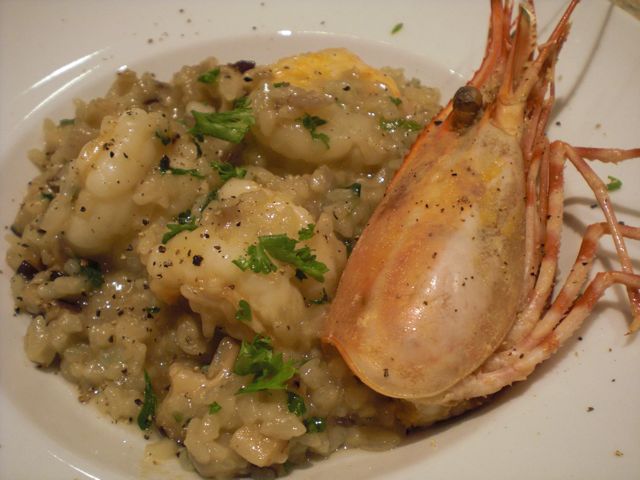
This is the amount for 2 small servings seen above. I use cooked rice instead of raw rice. The cooked rice was frozen (about 2/3 cup). I microwave it until the kernels were separated but still cold. In a non-stick frying pan I added light olive oil (about 1-2 tbs) and sautéed finely chopped red onion (1/2 medium) for few minutes. When the onion was soft, I added finely chopped fresh shiitake mushroom (2 large meaty ones I happened to have. They had a very intense flavor) and sautéed for an additional 2-3 minutes. I then seasoned with salt and pepper. I added the cooked rice and coated the kernels with oil. I then added sake (3-4 tbs) - or you could use white wine or not use any wine - and stir until all is absorbed. I added a ladle-full of the shrimp broth (warmed on low flame) at a time and kept stirring. When the liquid is absorbed, I added the next ladle-full of the broth. (I did not add any salt in the broth). After 3-4 additions of the broth, I mixed in thawed, shelled, salted shrimp (I used 3 per serving, this is rather large shrimp matching the size of the shrimp head). Keep stirring for 2-3 more minutes or until the shrimp is cooked, I added chopped parsley, seasoned with salt and pepper to taste. For good measure, I added a thin pat of butter at the very end. I garnished the risotto with the shrimp head (I fished it out of the broth). I think we used up all shrimp heads!
For a weekday evening, this is a mighty fine ending dish. This evening was a sort of Italian night and we started with leftover reheated home made pizza. Of course, we sucked out all the goodies from the head of the shrimp first, before enjoying the risotto. We had a bottle of decent red but I do not remember which one we had.
Monday, September 6, 2010
Tuna "chutoro" carpaccio with Uni 中トロのカルパッチョの雲丹添え
This is a variation of tuna carpaccio but this is a deluxe version with uni and chutoro 中トロ. I think I made this the second day after we received the goodies from Catalina Offshore products as a very first course of the evening.
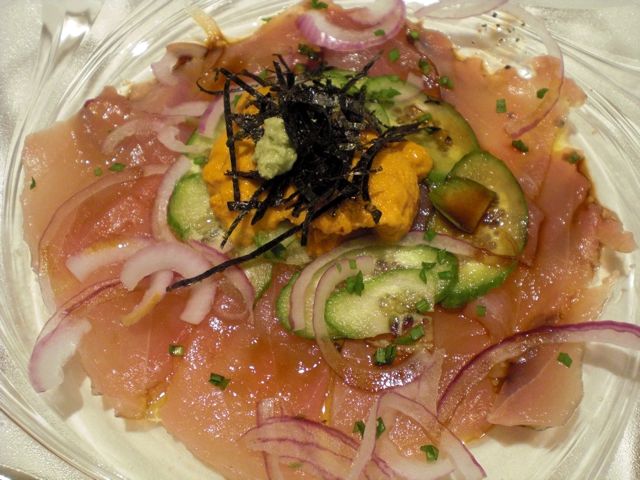
Since both tuna sashimi and uni 雲丹 were excellent, I made it very simply. I put splashes of good balsamic vinegar, good olive oil, Kosher salt, freshly cracked black pepper and soy sauce on the bottom of the plate in crisscrossed fashion. I then sliced the chutoro very thinly and place it in one layer on the plate. I sprinkled a halved and thinly sliced red onion and finely chopped garlic chive over the chutoro. In the center, I arrange a circle of thinly sliced cucumber and placed the small mound of uni on top. I garnished with thin nori strips and a dab of real wasabi. I drizzled just a small amount of soy sauce and olive oil over the top. We had this with Napa Cab Angels Landing 2007. This cab is a nice middle-of-the-road Cali cab and went well with this dish but the balsamic vinegar competed a bit with the red wine. For this pairing, I should have omitted the balsamic vinegar. In any case, this is a wonderful dish to start before changing to sake. Oh, the uni was positively excellent.
Subscribe to:
Posts (Atom)