It is a somewhat mundane dish but a nice dish to start. We had this with a red wine but I can not remember which one this was.
Wednesday, November 10, 2010
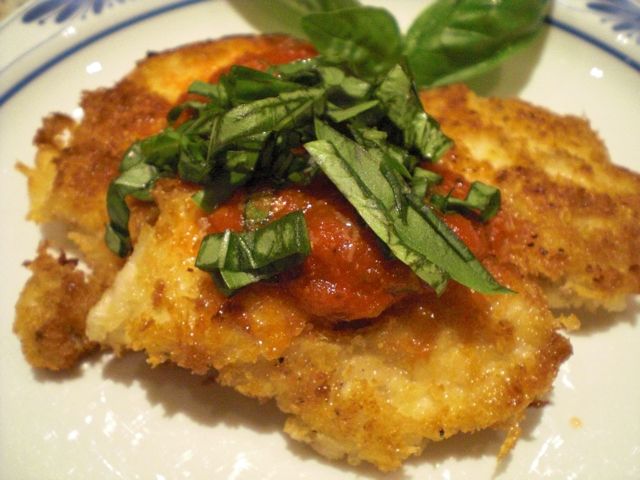
Chicken breast cutlet 鶏胸肉のカツレツ
It is a somewhat mundane dish but a nice dish to start. We had this with a red wine but I can not remember which one this was.
Monday, November 8, 2010
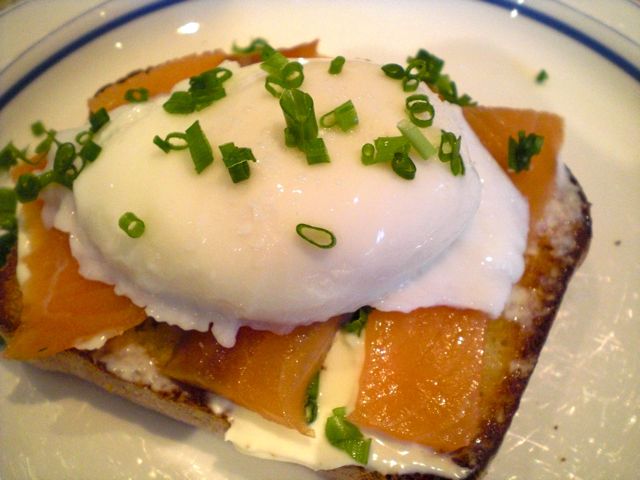
Poached egg, smoked salmon with crème fraîche ポーチドエッグとスモークサーモン
This can be a breakfast (for us) on weekends when it strikes our fancy or a mid-night snack after drinking (for younger fellow imbibers). I'm not sure how this got started but my wife came up with this one. It is a cross between bagels, lox and creme cheese (hold the bagel) and a variation of eggs benedict (hold the hollandaise). This variation may be (very) slightly, less deadly than the original because there is no hollandaise sauce and (hopefully) some benefit from the Omega 3 in the salmon.
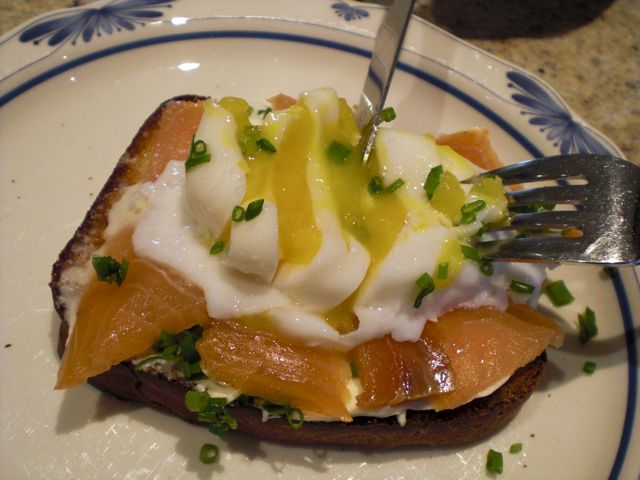
The poached egg should have a runny egg yolk so that when you cut into it, the yolk makes a wonderful sauce. The combination of all these ingredients work so well together. If you like smoked salmon, you will like this dish.
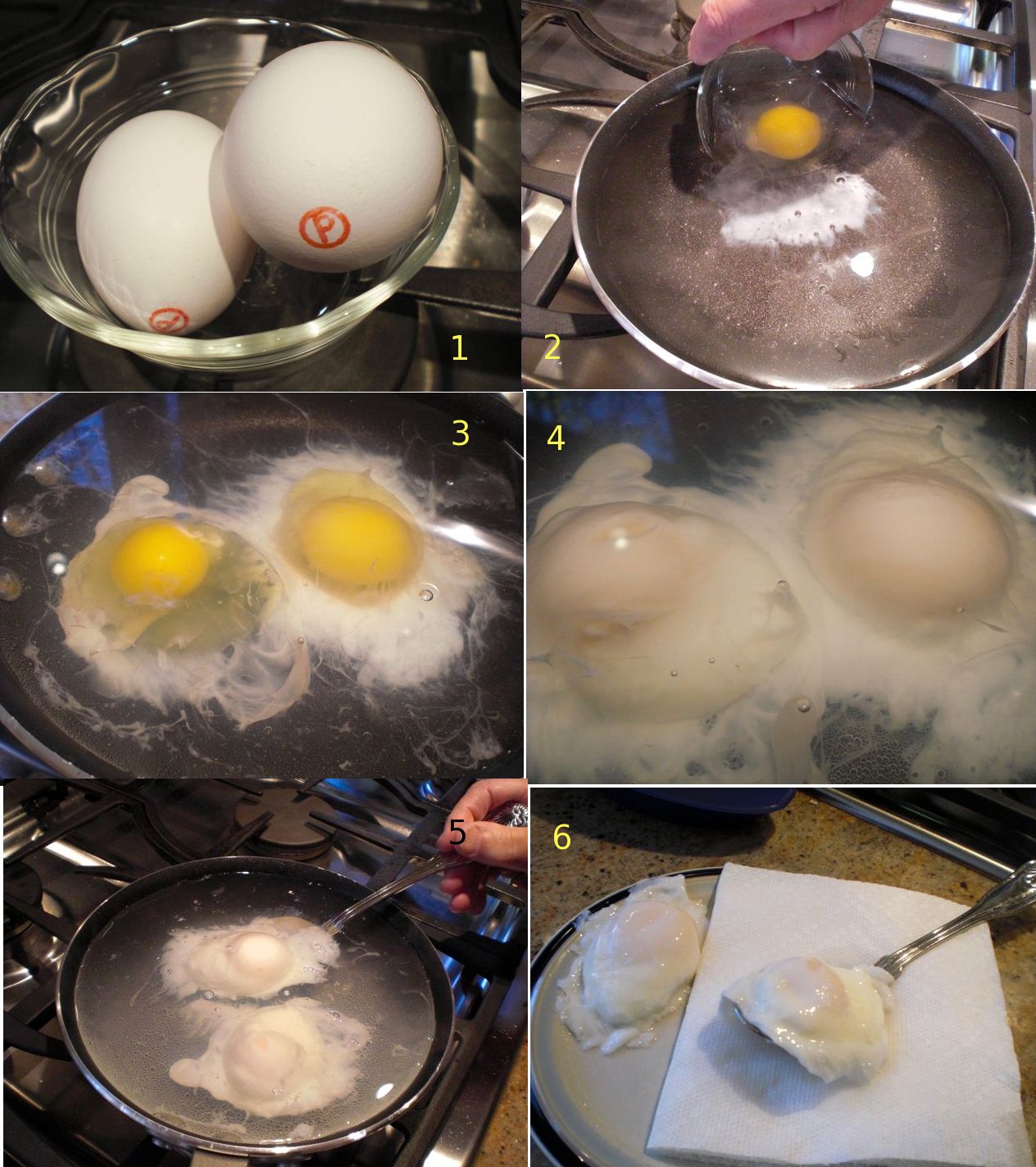
5. Using a perforated (slotted) spoon, gently separate the eggs from the bottom. It should not be difficult if the pan is a good non-stick pan. If you encounter undue difficulty, use a silicon spatula to separate the eggs from the bottom of the pan, (if that happens you may want to throw out the pan and buy a new one).
If you are into the looks, you could take off thin peripheral shaggy portions of the egg white to make it pretty.
The recipe starts with a base of toasted and buttered English muffin bread (homemade, my wife promised me to post her recipe soon). On top of that goes a generous smear of crème fraîche (if not available, use sour cream or cream cheese). Next comes a sprinkle of chopped chives (my wife puts the chives on at this point so they are held in place by the next layers. Otherwise they just fall off the piece on the way to your mouth. One layer of good cold smoked salmon follows the chives and the whole thing is topped with a poached egg. We sprinkled salt on top of the egg and more chopped chives as garnish. (It doesn't matter if these fall off the chive flavor is locked in the lower layer.)
Since I mentioned several times how easy it is to make poached eggs but never really illustrated the steps, I decided to post some visual aids. We tried many methods including an egg poacher, a classic vinegar water method, Pepin's swirl-water-and-put-an-egg-in-the center-of-the-vortex method (it appears he is not advocating this silly method any longer) but our method always works, no fuss no muss.
1. Use pasteurized eggs (in the U.S., notice a red "P" in a circle).
2. Use a good non-stick frying pan with a high side wall and add enough water so that the eggs can be completely submerged. I also salt the water for subtle seasoning of the eggs (optional) but absolutely no vinegar. (We do not like vinegar tasting eggs). The water should be just barely simmering. Crack an egg into a small ramekin and slide the egg as seen here.
3. Eggs will sink to the bottom.
4. Eggs will stick to the bottom (Do not worry). Poach them until the surface of the yolks are opaque and set but the yolks are still runny (4-5 minutes).
6. Drain the water trapped by the spoon or dripping off the egg by touching the bottom of the perforated spoon to a paper towel and place it on the plate (Do not leave it on the paper towel. It will become very difficult to transfer without breaking the yolk). I usually keep one on the spoon as seen in the picture for easy transfer.
If you are into the looks, you could take off thin peripheral shaggy portions of the egg white to make it pretty.
Saturday, November 6, 2010
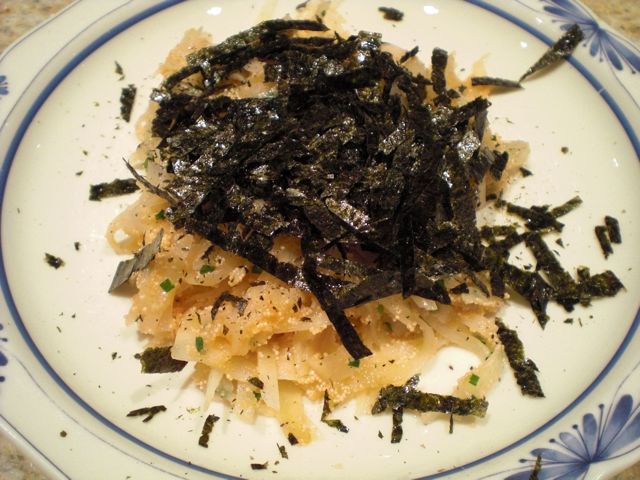
Julienned potatoes with spicy cod roe redux ジャガイモの明太子和え 再登場 (Mark's book p24)
We liked the nori taste with tarako and potatoes. Either way (the original or this version), this is an excellent dish. We really like both versions.
Thursday, November 4, 2010
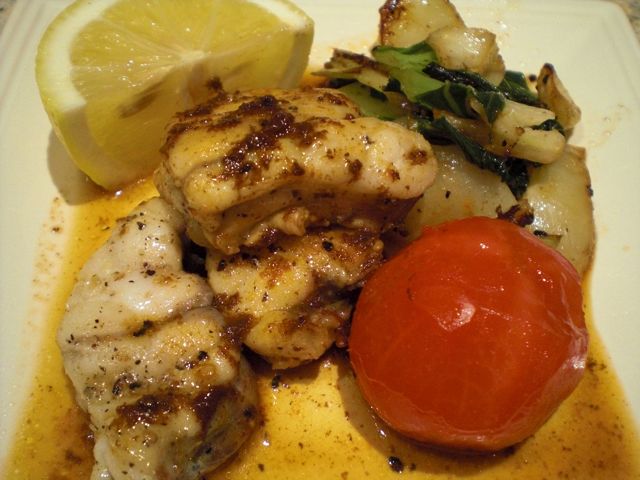
Monkfish medallion sautéed with garlic and olive oil アンコウのニンニクオリーブオイル焼き
After making the monkfish karaage 唐揚げ, I made the remaining monkfish fillet into this dish the next day.
I made medallions of fish a bit less than 1 inch thick. I then marinated them in olive oil, lemon juice and 3-4 fat cloves of crushed garlic for 24 hours. Just before cooking, I removed the excess moisture from the surface of the medallions and lightly seasoned them with salt and pepper. In a frying pan on a medium flame, I added olive oil, and crushed garlic from the marinade and fried it until it became fragrant and slightly brown. I took the garlic out and set aside. I added the medallions of monkfish and cook them for 3-4 minutes and flipped them over. At this point, I added previously blanched Bok Choy which was cut into a bite sized pieces to the center of the pan, moving the medallions to the periphery to make room for the Bok Choy. I then put two thin pats of cold butter on the top of the Bok Choy and cooked it for another 3-4 minutes. The butter will melt very slowly. As the fish was about to finish cooking, I mixed the Bok Choy and butter and added just a small amount (1 tsp) of soy sauce and also add skinned Campari tomatoes to the pan for another minute or so and, at the very last moment, added back the garlic.
This is a sort of fusion dish and almost tastes like lobster tail. The rather assertive garlic flavor goes well with this fish. The tomatoes also exude some juice to form a small amount of sauce/liquid in the bottom of the pan. The flavors of soy sauce, butter, garlic and tomato add to the dish.
Tuesday, November 2, 2010
Chestnut rice 栗ごはん
Chestnuts are such a typical seasonal food item in Japan for deepening autumn. As a kid in Japan, we ate them every fall, usually boiled and it was something I generally liked. We had quite a few mature chestnut trees in our neighborhood. Many half open "Iga" いが or outer prickly shells were on the ground and getting chestnuts from those shells was always tricky for young kids. The trick was getting the nut without being pricked. In North America, because of Chestnut blight, most of the North American Chestnuts trees were wiped out by 1940. Chestnuts, maybe as a result, appear not to be a very popular food item. The vast majority of chestnuts we see here are imported from Europe (see P.S. below). My wife tells me that her childhood memory of chestnuts was the yearly ordeal (usually around Christmas) of roasting them in the shell over an open fire in the fireplace. While they smelled great, they weren't worth the bother. Once she busted into them, they were a major disappointment--dry, chalky, tasteless.
On one of our first trips to Japan as a married couple, we came across a roasted sweet chestnut vendor, "tenshin amaguri" 天津甘栗, under the raised railroad tracks in Shinbashi 新橋 area of Tokyo. The smell wafting from the cart was divine. I suggested we get some and my wife said, "Don't bother" and kept walking. I got them anyway and the smell enticed her to try some. She was astounded at how good they were. She insisted they couldn't be the same thing she ate as a child. Last week I found chestnuts in the shell at our gourmet grocery store. I, again, could not resist and got some chestnuts for a Japanese chestnut rice or "kurigohan" 栗ごはん. Again my wife advised, "Don't bother" and warned me that they would not taste like the ones I was used to.
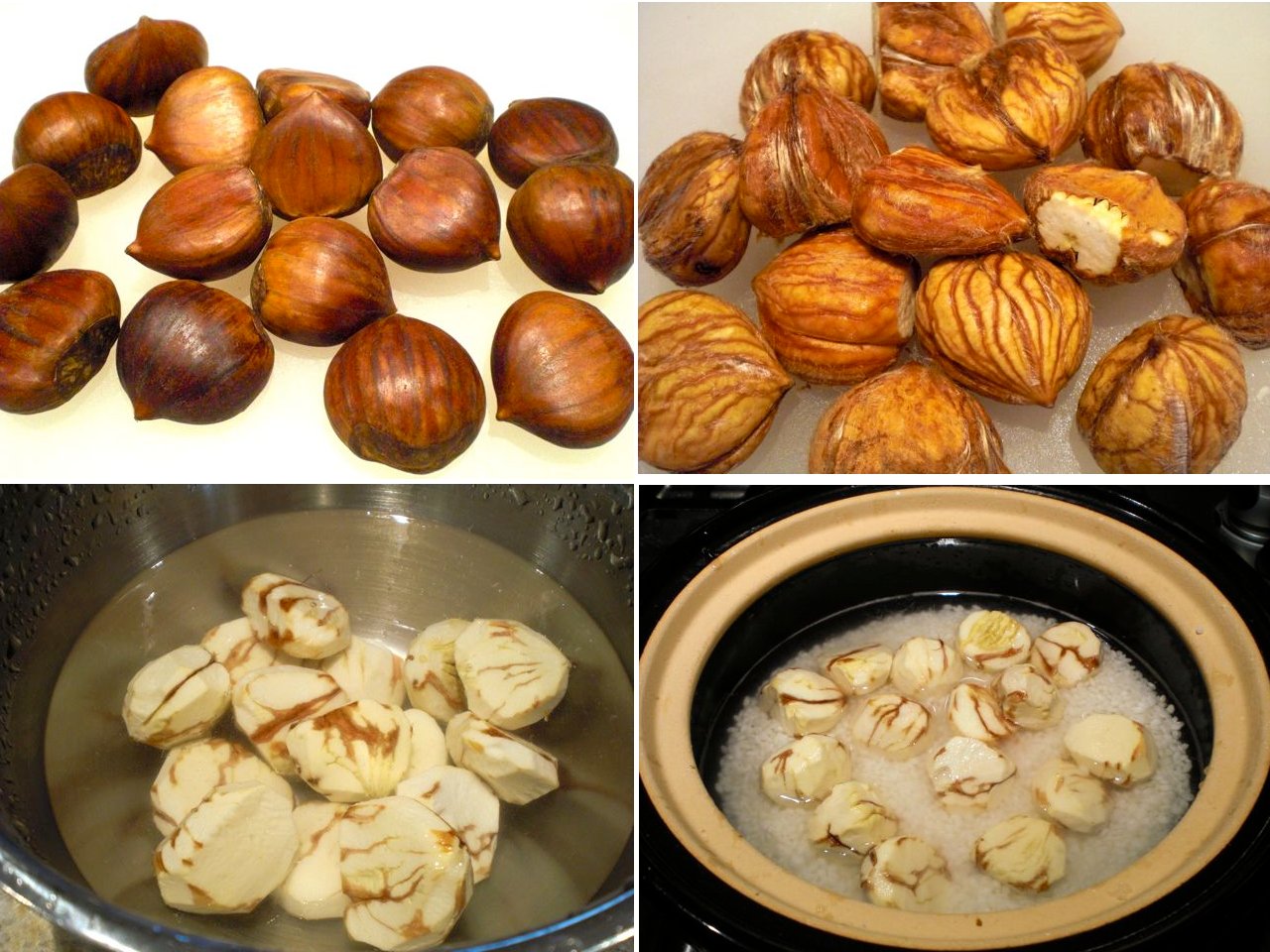
I again used the earthenware rice cooker called "Kamado san" like I did when I made "Matsutake gohan", I used kelp soaked water and added sake (2 tbs) and salt (1 tsp) to make 400ml of the cooking liquid. I did not use soy sauce to prevent the rice from darkening. I washed and drained the rice (2 Japanese cups or 360ml). I added the rice and the liquid into the cooker, and placed cleaned chestnuts on the top (lower right in the above image). As per the instruction that came with the cooker, I put on the inner lid and then the outer lid. I cooked it on a medium high flame for 14 minutes and then let it stand for 20 minutes.
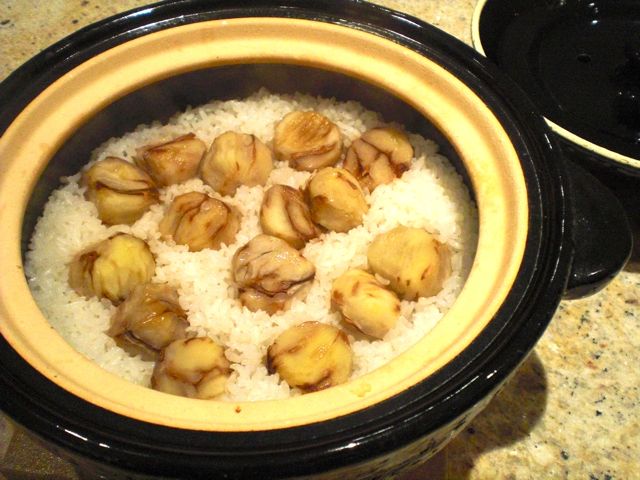
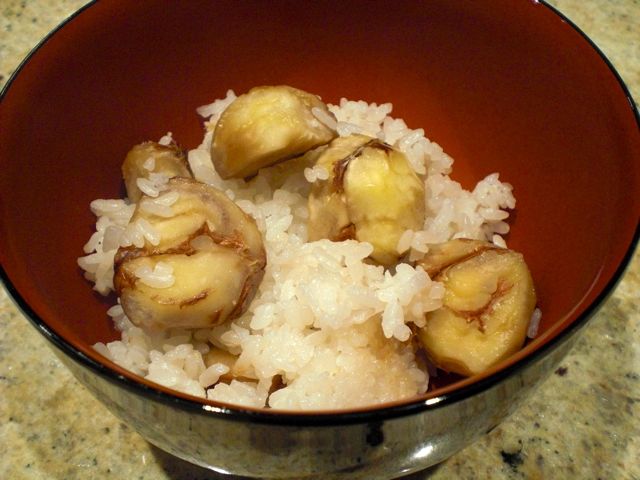
Here is the end product (above). I was a bit disappointed--I "shouldn't have bothered". The chestnuts were dry, chalky and pretty tasteless (as my wife predicted), although they were certainly edible. The rice itself was quite nice. We may try this again with bottled boiled chestnuts from France next time. But at least, I feel like I paid some respect to autumn, which has firmly arrived here.
P.S. After I posted this, an interesting article appeared in Washington post regrading chestnuts including different types and origins of the chestnuts imported here.
I first soaked the chestnuts (15 or so, upper left in the image below) in water for several hours to make it easier to peel the outer hard skin. You could also parboil to make it easier to remove the skin. It is easy to take off the hard skin called "onikawa" 鬼皮 by cutting off the bottom and peeling off the hard skin but the chestnuts are still covered with the bitter-tasting inner skin (upper right). The most labor intensive part is removing the inner skin called "shibukawa" 渋皮 meaning "bitter skin". I just used a small paring knife to remove the inner skin but it is not easy. I put these cleaned chestnuts into water to prevent discoloration (lower left).
P.S. After I posted this, an interesting article appeared in Washington post regrading chestnuts including different types and origins of the chestnuts imported here.
Subscribe to:
Comments (Atom)