Thursday, November 25, 2010

Baked cornmeal drumett "tulip" 手羽元チュウリップのコーンミールオーブン焼き

I bought chicken wings over the weekend but we did not use them. I marinated them in sake and kept them in the refrigerator so that they would stay fresh for several more days. Since it was not feasible to grill them over a charcoal fire on a weeknight - not to mention that it is getting too cold and dark to barbecue after we get home, I baked them in the oven to make a Yakitori style dish. I decided to do a slightly more elaborate preparation of the drumetts and made "tulips".

It appears this "tulip" preparation is more popular in Japan than here. First, I cut off the wing tips (discard) and then separate the wings and drumetts. For making a drumett "tulip" (here is a visual aid), just loosen the meat from the bone and nick the skin around the joint so that skin and meat can be pushed down and inverted making a "tulip" shaped meat on one end with bone sticking out as a convenient handle. Naturally, I could have deep fried them but I decided to bake them in the oven instead. To make it slightly more interesting, I added a cornmeal crust.
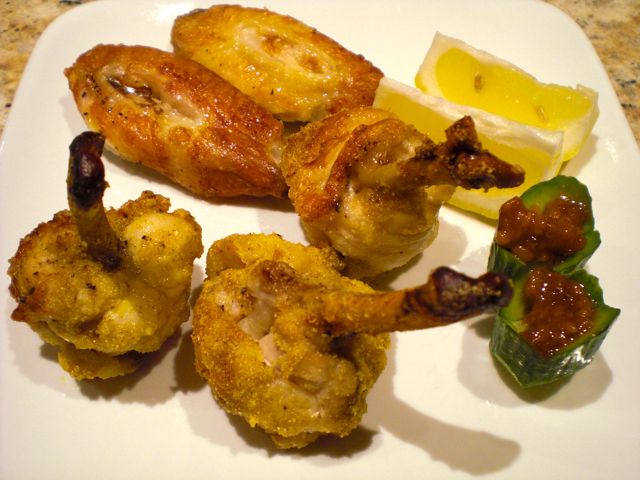
I just evenly coated the the drumett tulips with light olive oil (using my hands) and season with salt and pepper. I made a mixture of yellow cornmeal and potato starch (about 4:1 ratio) and dredged the chicken. I prepped the wings as usual making a cut beween the bones through the skin and seasoned with salt and pepper. I placed the wings and drumetts on a baking sheet with a raised metal rack (I let the drumett tulips stand up with the meat side down). I baked them in a preheated 450F convection oven (very hot) on the top rack for 20-25 minutes until the surface is golden brown as seen in the above picture.

I served this with wedges of lemon and moromi cucumber. It is a bit healthier than deep frying and the cornmeal flavor is kind of nice. 

Tuesday, November 23, 2010

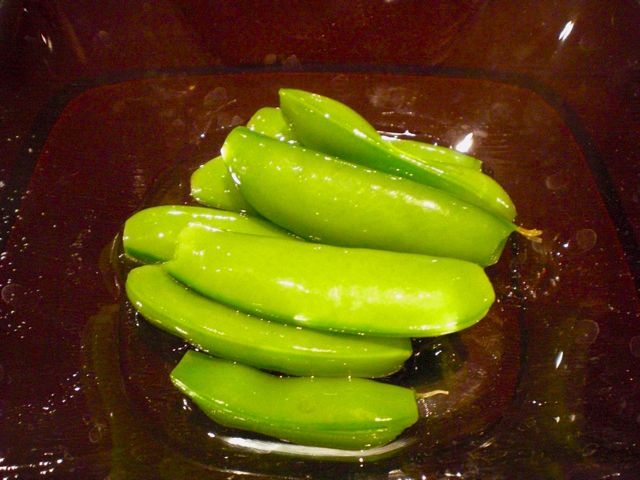
Snap peas in dashi broth スナップ豌豆の塩びたし

This is a very healthy and refreshing small dish which goes well with sake or any drink. Recently, Dave Perry recommended two Izakaya cookbooks to me called "Otsumami Yokocho" おつまみ横町. There are two volumes. Both are called "drinking snack alley". The second is distinguished from the first by the additional phrase in the title of  "Mou ikken"  もう一軒 meaning "one more place". This is an appropriate name for the second volume because this phrase is a classic nagging request made by drinking enthusiasts (read; drunkards) who have finished their first rounds but don't want the bar hopping to end..."just one more place". In any case, I got these books from Amazon Japan (The shipping was more than the cost of the books). These two volumes each contain recipes for 185 small dishes which go well with drinks. Many of the dishes are rather simple (or easy to make) and some are not really new or original but the two volumes still contain a good number of dishes that I would like to try (and post) - thank you Dave, I can continue my blog a bit longer. This is the first such dish (page 12 of the second volume). 

Disclaimer: As usual, I often read these recipes but then I end up doing whatever feels right for me, so the end result may be different from what is described in the books.

Snap peas, Japanese name is "sunappu endou" スナップ豌豆, is the hybrid developed in the U.S. but very popular in Japan as well. We like it more than snow peas. This is a rather simple but elegant and healthy dish especially for an Izakaya snack and also taste good.

I removed both ends of the snap peas and blanched them in salted boiling water for several minutes, until cooked but still crunchy. I drained and put in ice water to stop cooking. I drained again and patted dry with a paper towel.

I made a broth from a dashi pack (kelp and bonito in a tea bag) and added salt to taste. I let the broth cool to room temperature and then refrigerated. I added the above blanched snap peas to the broth and let it marinate in the refreigerator overnight.

It has nice crunch. It has a sweet taste (enhanced by mild saltiness in the broth) with subtle dashi flavor. You feel good eating this, a totally guilt free drinking snack. You can have this instead of edamame 枝豆.

Sunday, November 21, 2010

Pork loin Barbecue 豚のロースのバーベキュー

Pork is definitely the most popular meat in Japan, at least, when I was there (especially in my parents' household). Most of the time Japanese use thin slices or ground pork rather than a big hunks of the meat. Japanese style thinly sliced pork belly 三枚肉 is most commonly used in Japanese dishes but it is not easily available here in US. More recently, it appears that roasts including pork roast is getting popular in Japan. Although I posted a dish using leftover roasted pork, I decide to post it again with more details.
The cut of pork we got was a loin. I trussed it (lower left) first. I then cut thin slivers of garlic (5-6 cloves). Using a boning knife, I make 1-2 inch deep multiple slits in the meat and inserted the garlic slivers (below, right). You should make sure all the garlic slivers were completely inserted into the meat so that it will no burn on the surface.
I smeared olive oil all over the pork and applied my dry rub consisting of salt, pepper, clove, cinnamon and cumin (below, left). I use an equal amount of salt, pepper, and cumin and less amount of cinnamon and clove but this is totally up to your taste. Like my chicken, I hot smoke and babecue in a Weber using indirect heat. I put a temperature probe to the middle of the meat and when it registers 145-150F, I take it off the weber (below, right) and cover it loosely with aluminum foil and let it sit for 10-15 minutes on a plate. I remove the trusses, slice, and served it with its own juice accumulated in the plate on which the pork was resting. The Crust has nice flavors and au jus is also very nice and we can only have au jus when it was just barbecued.
This time, I served the pork with ratatouille (I made this the day before) and mashed sweet potato. My wife made the sweet potato. The sweet potatoes were cooked in the same Weber with the pork, covered with aluminum foil. She added butter, chopped chives, and soy sauce (Yes, soy sauce). I did not remove the garlic from the slices of pork but if you use it for sandwich, it may be wise to remove the garlic from the roast as you slice it. As you can easily imagine, the leftover pork is very handy to have for the weekdays.

Friday, November 19, 2010

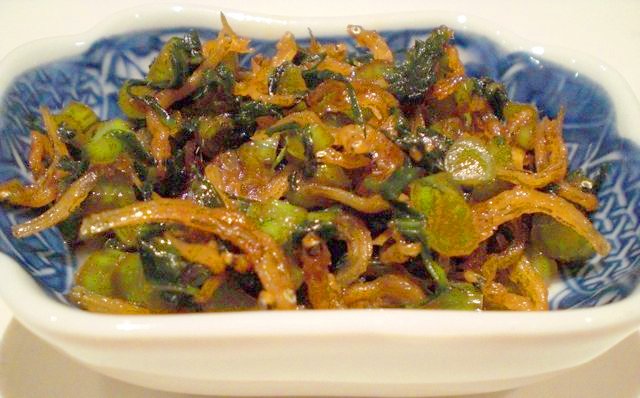
Braised Daikon green and Jako 大根葉とじゃこの炒め物

This is another one of those small nothing dishes which goes so well with sake and goes even better with hot white rice. I mentioned before that the daikon we see in the U.S. usually does not have the greens attached. But this weekend, I got one that did. When I get diakon greens, I try to make some kind of small dish from them. This is a variation on the same theme. This time, I braised them with small semi-dried and salted fish hatchlings called "chirimenjako" 縮緬雑魚 or "jako" for short.


These daikon greens were a bit on the tough side as you can see from the picture--the stalks are thick. So I blanched them in salted water first (for 2 minutes) and shocked them in ice cold water to bring back the bright green color. If the greens are tender, you can skip the blanching process. I squeezed out the excess water and chopped them finely. In a frying pan, I heated 1/2 tbs of dark sesame oil and saute one package (probably 3-4 tbs) of frozen "jako" and sauteed until they were slightly brown and crunchy. You may want to taste the "jako" at this point since the saltiness may vary quite a bit and the amount of soy sauce needs to be adjusted accordingly. I then added the blanched and chopped daikon greens and sauteed for 1-2 minutes. I added 2 tsp of sake, 1 tsp of mirin and 1-2 tsp of soy sauce.  I braised until the liquid was almost gone. You could mix in roasted white sesame seeds as well. I made this one a bit too salty so this is better with hot white rice. Just mix it in and enjoy.

Wednesday, November 17, 2010

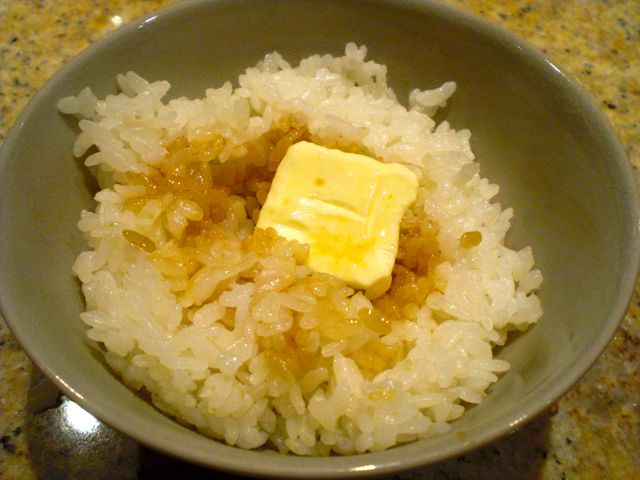
Rice with butter and soy sauce バーター醤油ご飯

This may not be post-worthy but I realized this represents a regional way of eating rice peculiar to the "Hokkaido dialect" of Japanese food culture and may be worthwhile to "document". Although many Japanese really appreciate (or pretend to appreciate) simply cooked white rice for its subtle flavors, many Japanese children and Westerners find it boring. (Many Japanese adults may also harbor the same opinion privately but do not want to appear unsophisticated or childish by expressing it). Even those who appreciate plain white rice sometimes want additional seasoning.

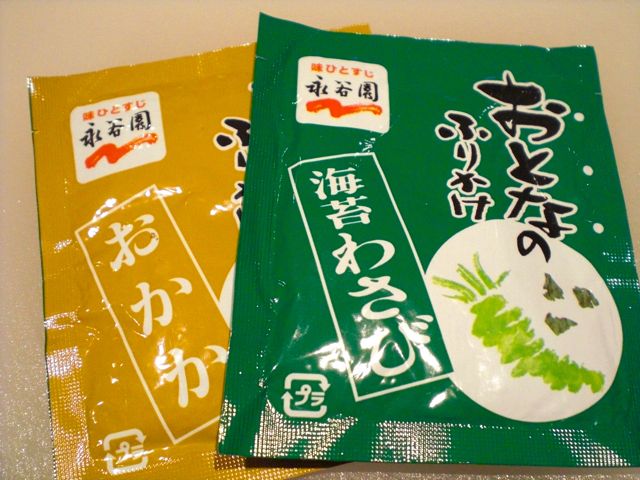
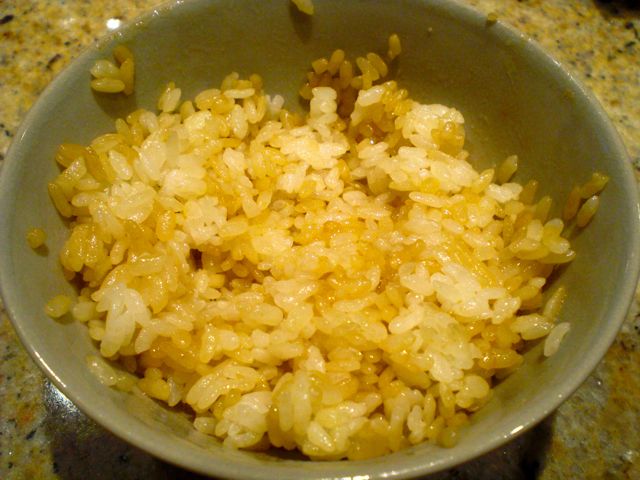
Furikake seasoning ふりかけ is the mixed seasoning used for this very purpose. It is very popular even in the U.S., and many different varieties are available; some are made specifically for kids and some are for adults. I even know somebody who uses furikake to season cottage cheese (Could that somebody possibly be my wife?). I made the big mistake, early in our marriage, of showing my wife, the way I used to eat rice when I was a kid. I just added a pat of butter to hot rice, let the butter melt first and then mixed in soy sauce as seen below. It had been a long time since I had rice that way. My wife immediately took a liking to it and this is her favorite way of eating fresh, piping hot, white rice. In horror at what I had unleashed I had to warn her about the impropriety of enthusiastically putting together her "favorite" rice at a restaurant. While eating rice for dinner at my mother's house in Sapporo, I reminded my mother of how she used to serve butter and soy sauce rice to me as a kid and how I had made the mistake of introducing my wife to the dish. My mother abruptly put down her chopsticks, got the butter out of the refrigerator, distributed it all around followed by the soy sauce. While mixing the ingredients into her rice she mentioned she used to eat her rice like that as a kid but hadn't eaten it in a long time. She took a bite, sighed and said it sure was good! 


I thought this was a fairly common way for Japanese (especially kids) to eat white rice but apparently that is not the case. This appears to be peculiar to Hokkaido. I guess that makes sense since dairy and specifically butter production are primary industries in Hokkaido.

It is always a bit iffy to season plain white rice in public by doing such things as pouring soy sauce, broth or simmering sauce from, say simmered fish 煮 魚 or miso soup over the rice. But many Japanese will do exactly that in private. If I pour miso soup over my rice, I would call it にゃんこめし meaning "cat rice" but, for people from other regions of Japan, "cat rice" is rice topped with bonio flakes and soy sauce and, they may call it "nekomanma" ねこまんま (the meaning is the same, i.e., "cat rice"). The fact that there is a specific name for this type of rice (albeit a bit derogatory) indicates many Japanese are eating rice in this (unacceptable) manner.  I do not recommend doing this in public, however. Why such doctoring of rice is frowned upon by Japanese is "not logical" as Mr. Spock would say. After all, many donburi どんぶり dishes are made using rice in a seasoned broth with toppings and dishes called hiyajiru 冷や汁 and ochazuke お茶漬け are indeed rice in a broth. It appears that as long as it is prepared in the kitchen or is meant to be consumed this way, it is a "legitimate" dish and can be eaten in public. But if you improvise at the table by pouring soup over rice, it is not OK; go figure. I think there was a lengthy discussion on this subject (in Japanese).

If you have not tried this butter soy sauce rice, I strongly suggest you try it, at least once, and let me know if you like it. You could eat this with seasoned and roasted nori "ajitsuke (yaki) nori" 味付け(焼き)海苔 which was my favorite way of eating rice as a kid (and even now). I am not responsible if you find the comforting flavor of this dish addicting.