

Sunday, March 6, 2011
Finally, our blog cookbooks are here!
My wife really wanted to have a book of our blog. Finally here it is! A two volume compendium of Norio on Wine and Food Cookbooks. Please click the rightmost tab above "NOWAF cookbooks etc" to view.


Saturday, March 5, 2011
Amuse-buche, Smoked salmon on potato スモークサーモンとジャガイモのアミューズブーシュ
Like "Otoushi" お通し in Izakaya, many restaurants in the U.S. and elsewhere are now serving a small appetizer, before the start of the actual dinner or even the delivery of the "real" appetizer. This little morsel is call "amuse-bouche" or translated "entertain the mouth". This is my version of an amuse-bouche. Since we only had a very small amount of left-over smoked salmon, I made it into a one-bite appetizer.
 I microwaved two small new red potatoes. I then removed the skin and carved it into two small cylinders. I placed this on a very small dish and seasoned it with salt, layered it with creme fraiche and garnished it with chopped chives. I put two small squares of smoked salmon on top and topped it with more chopped chives. We popped the morsels into our mouths and let the layers of flavors and textures tantalize the tongue. The combination of potato and smoked salmon was very nice. The bouche was amuzed...and thanked us for it.


Thursday, March 3, 2011
Shimeji mushroom and Canadian bacon stir-fry しめじとハムの炒め物
I had a package of fresh shimeji mushroom ホンシメジ and leftover Canadian bacon. Using these two items, I came up with this small dish. I could have used good quality ham rather than Canadian bacon. I did not know of the existence of Canadian bacon (as it is called in the U.S. but not in Canada) until I came to the U.S. it appears you can get it in Japan.
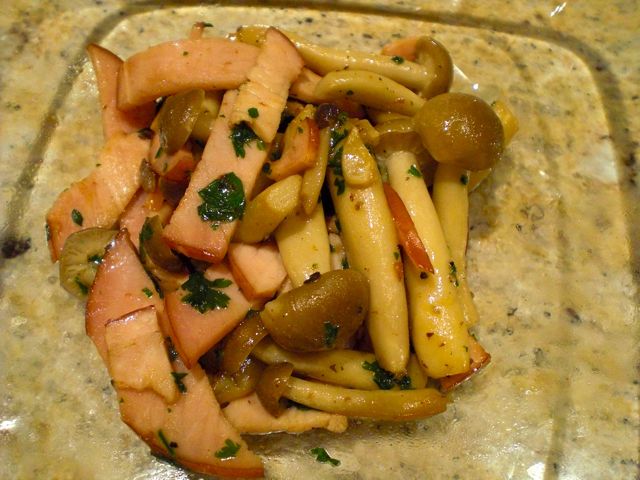
I just cut the root end of the shimeji mushroom and separated the stalks (1 package). I cut the Canadian bacon (4-5 slices) into half inch strips. I added olive oil (2 tsp) and butter (1 tsp) to a frying pan and sauté the shimeji for a few minutes and added the Canadian bacon. I seasoned with a splash of sake, soy sauce, salt and pepper to taste. Finally, I add finely chopped parsley just before shutting off the heat. Somehow, the Canadian bacon just tasted off (may be it wasn't in its prime) which ruined the dish somewhat. The idea was good and I am sure better quality Canadian bacon or ham would have made this dish much better. Although I ate everything, my wife only ate the mushrooms (she is a picky eater).
Tuesday, March 1, 2011
Simmered squid with daikon イカ大根
I found a package of cleaned frozen squid in our near-by gourmet market's freezer case. I decided to give it a try. I found that it was OK in a pinch but they were small squid and it was not as good as "Japanese" frozen squid. Since I had only a few inches of daikon left, I made this simmered squid with daikon dish, which is a rather common homey dish and also perfect for Izakaya.
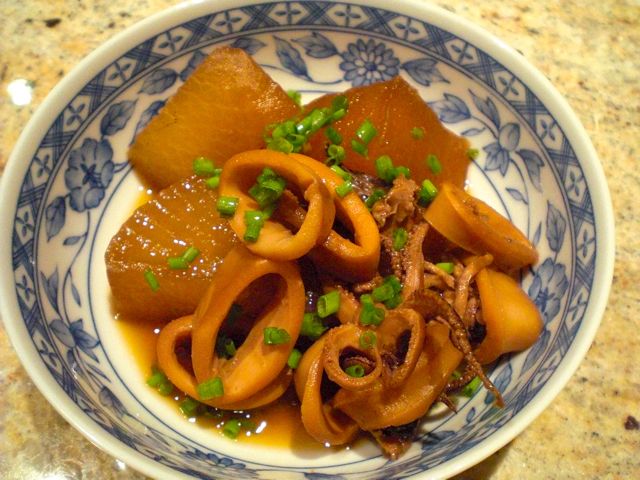
The recipe is found in "Otsumami Yokocho" Volume 1, page 40. I used my own way to make this dish but it is essentially the same dish.
For 2 servings, I used one package of frozen cleaned squid with tentacles thawed (2/3 of 8 oz or about 200 grams; 1/3 was used for the "sunomono" 酢の物 dish below) cut into half inch wide rings.
Daikon: I used daikon about 3 inches long. I peeled and cut it into 1 inch thick rounds and then quartered. I precooked the daikon in water with one pinch of raw rice for about 20 minutes and then washed it in cold running water. Although I have not done any scientific comparison, adding raw rice or using rice washing liquid or 米のとぎ汁 to precook daikon is traditional and is said to reduce the strong smell of daikon, make it softer, season better, and also prevent the cut surface from concaving during cooking. With so many claimed benefits, why argue? I just followed tradition.
Cooking liquid: I added water (1.5 cup), sake (2 tbs), mirin (2 tbs) and soy sauce (2-3 tbs) and a few thin slices of fresh ginger root into a pot on a medium flame.
I added the precooked daikon and squid rings and tentacles to the cooking liquid. When it came to a boil, I turned down the heat to simmer and skimmed off any scum that developed on the surface several times. I put the lid askew and let it simmer for 30 minutes.
Just for color, I garnished with chopped chives. This is a classic home-cooked dish. Despite not-really-good quality squid, this was a good dish and perfect for sake.
In addition, I made "karashi sumiso-ae" 芥子酢みそ和え of squid, cucumber, and wakame, which I posted before. For this dish, I used 1/3 of the body of the squid, which was cut into rings, cooked in salted and sake-added boiling water for 30 seconds and drained. I immediately seasoned them with "sushi vinegar" (from the bottle) while it was cooling.

I made "Karashi sumiso" or hot mustard miso vinegar sauce and dressed all the ingredients. I made the "sumiso" dressing a bit too "mustardy" this time (i.e. hot, since Japanese mustard is really hot). These two dishes only go with sake, which is not too difficult to accommodate for us.
I made "Karashi sumiso" or hot mustard miso vinegar sauce and dressed all the ingredients. I made the "sumiso" dressing a bit too "mustardy" this time (i.e. hot, since Japanese mustard is really hot). These two dishes only go with sake, which is not too difficult to accommodate for us.
Monday, February 28, 2011
Cabbage rolls ロールキャベツ
I do not know why and when thinly sliced raw cabbage became the most common accompaniment for Japanese Western style cuisines called "yoshoku" 洋食. It appears that a famous yoshoku restaurant in Ginza called "Rengatei" 煉瓦亭 invented raw shredded cabbage as an accompaniment for their yoshoku dishes. I suppose in contrast to "nappa cabbage" or "Hakusai" 白菜, regular cabbage is considered a "Western" vegetable, thus, an appropriate accompaniment of "Western" dishes. Although many "yoshoku" items are now considered uniquely "Japanese" dishes such as "tonkatsu" トンカツ, you can not serve tonkatsu without shredded cabbage. Another cabbage related dish, cabbage rolls, also became a classic Japanese home cooked food, although it is a Japanese modification of Western cabbage rolls. I suppose many Western cultures have similar dishes with a Polish version or American Polish version (especially in Chicago), "Gołąbki [ɡɔˈwɔmpki]", being the most famous. I mentioned previously that my old favorite "Oden-ya" おでん屋, "Katsu-ya" in Sapporo, served a Japanese version of cabbage roll or "ロールキャベツ", or "roll cabbage" as Japanese call it. My wife usually does not like cabbage and I have not made this dish for a long time but I convinced my wife that I was running out of dishes to bog and made this Japanese style cabbage roll.
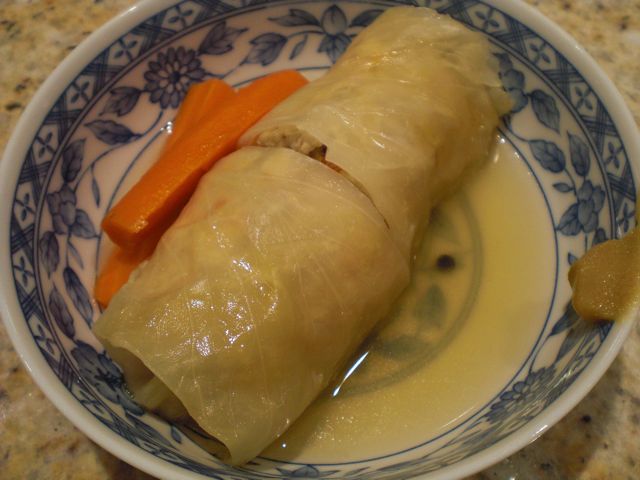
The amount below is four small Japanese size cabbage rolls.
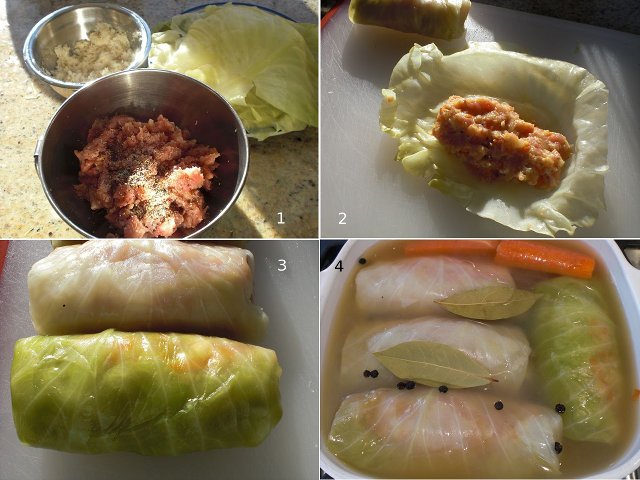
Cabbage leaves: In large scale productions, you boil an entire large head of cabbage and then separate the individual leaves. For my small scale production and small-sized cabbage rolls, I separated each cabbage leaf by first cutting into the bottom veins and then using running water (introducing it between the leaves), to separate each leaf without tearing it. (I prepared 4 leaves). I used a rather small head of cabbage. I boiled the leaves in a large pan with salted boiling water for 10 minutes covered with a plate which fit snugly inside of the pan to keep all the leaves submerged during cooking. After the leaves were cool enough to handle I shaved off the large veins toward the bottom of the leaves without cutting through them (the #1 image below in the right back).
Stuffing: I finely minced onion (1/3 medium), carrot (1/2 medium), garlic (1 clove), and ginger (one thin slivers) which I sauteed in vegetable oil for few minutes and seasoned with salt and pepper and set aside to cool. You could also add shiitake mushroom, finely chopped, but I did not have one.
For the meat, I used trimmings from a pork tenderloin. I hand chopped it into ground pork (about 200 gram, I guess. The image #1). I mixed in the vegetables above,with bread crumbs (1/4 cup, I use panko, moistened with milk, the image #1 below in the left back). I added an egg (1 large) and seasoned it with freshly ground nutmeg, salt and black pepper. I mixed it well until the stuffing become elastic and hung together.
Assembly: As seen in the image #2, I made a small cylinder and placed it closed to the root end of the precooked cabbage leaf and rolled with the both side tucked in and made four rolls. Try not to over stuff the cabbage (the image below #3). (I had some stuffing left over. I made small patties and cooked it like a hamburger and braised it with mirin and soy sauce in teriyaki style. I served it with the side of a Japanese coleslaw. I forgot to take a picture)
Cooking: I used a Japanese-Western hybrid broth. I used Swanson non-fat reduced salt chicken broth and added bay leaves, sake, whole black pepper corns and a half a carrot (left over from the above). The cabbage rolls should fit snugly submerged in the cooking liquid (the image below #4). Of course, you could cook the cabbage rolls in "Oden" broth or tomato sauce if you like. On a very low flame, I gently simmered it with the lid mostly on and when it started boiling, I set the lid slightly askew and cooked for 40-50 minutes (I added more sake in the middle to compensate for the evaporation).
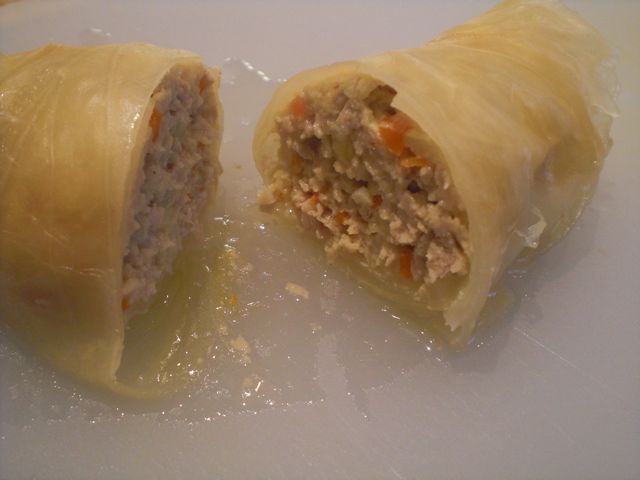
Here is the cut surface after cooking.
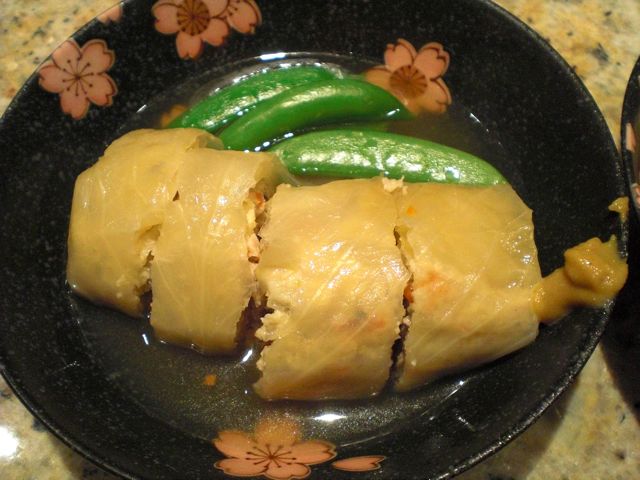
I served it in a small bowl with some broth and a small dab of Japanese hot mustard as would be used for oden. The stuffing was very tender and fluffy with very subtle rich flavor. The pork did not have a porky taste and seemed more like chicken. It was permeated with an interesting amalgamation of western and eastern flavors. The cabbage was also nicely cooked and not too strong. It was very soft, so much so you could cut the rolls with chopsticks. The hot Japanese mustard gave it a contrasting sharp jolt. Even my wife liked this one (it passed our "Mikey likes it" test). She particularly liked the light texture which was so different from the dense heavy classic stuffed cabbage with tomato sauce she learned to dislike as a kid. This dish will go with almost any drink but chilled G-sake was our choice.
Cabbage leaves: In large scale productions, you boil an entire large head of cabbage and then separate the individual leaves. For my small scale production and small-sized cabbage rolls, I separated each cabbage leaf by first cutting into the bottom veins and then using running water (introducing it between the leaves), to separate each leaf without tearing it. (I prepared 4 leaves). I used a rather small head of cabbage. I boiled the leaves in a large pan with salted boiling water for 10 minutes covered with a plate which fit snugly inside of the pan to keep all the leaves submerged during cooking. After the leaves were cool enough to handle I shaved off the large veins toward the bottom of the leaves without cutting through them (the #1 image below in the right back).
Stuffing: I finely minced onion (1/3 medium), carrot (1/2 medium), garlic (1 clove), and ginger (one thin slivers) which I sauteed in vegetable oil for few minutes and seasoned with salt and pepper and set aside to cool. You could also add shiitake mushroom, finely chopped, but I did not have one.
For the meat, I used trimmings from a pork tenderloin. I hand chopped it into ground pork (about 200 gram, I guess. The image #1). I mixed in the vegetables above,with bread crumbs (1/4 cup, I use panko, moistened with milk, the image #1 below in the left back). I added an egg (1 large) and seasoned it with freshly ground nutmeg, salt and black pepper. I mixed it well until the stuffing become elastic and hung together.
Assembly: As seen in the image #2, I made a small cylinder and placed it closed to the root end of the precooked cabbage leaf and rolled with the both side tucked in and made four rolls. Try not to over stuff the cabbage (the image below #3). (I had some stuffing left over. I made small patties and cooked it like a hamburger and braised it with mirin and soy sauce in teriyaki style. I served it with the side of a Japanese coleslaw. I forgot to take a picture)
Cooking: I used a Japanese-Western hybrid broth. I used Swanson non-fat reduced salt chicken broth and added bay leaves, sake, whole black pepper corns and a half a carrot (left over from the above). The cabbage rolls should fit snugly submerged in the cooking liquid (the image below #4). Of course, you could cook the cabbage rolls in "Oden" broth or tomato sauce if you like. On a very low flame, I gently simmered it with the lid mostly on and when it started boiling, I set the lid slightly askew and cooked for 40-50 minutes (I added more sake in the middle to compensate for the evaporation).
Two days later, we reheated the cabbage rolls with snap peas. It tasted even better.
Subscribe to:
Posts (Atom)