Friday, March 25, 2011

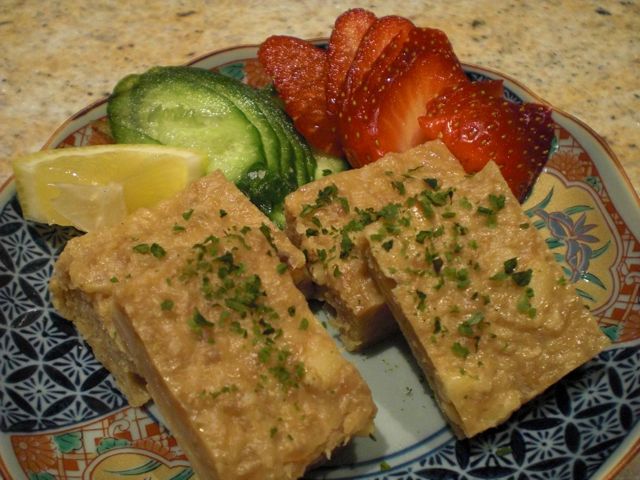
"Tarako" cod roe omelet 鱈子のだし巻き

This is another "teiban" 定番 or regular item in Izakaya. Although using a spicy tarako or "(karashi) mentaiko" 辛子明太子 appears to be more common than using regular tarako roe. I like using regular tarako with Tabasco mixed in, so I can control the spiciness.  I am not sure you will find this dish in any place other than an Izakaya or similar low-key eatery unless you make it at home. Some variations exist including adding a nori sheet or cream cheese.

It was a Tuesday night. I thawed a package of tarako the previous weekend but I did not get around to using it. So, I had to start using the tarako soon, hence, this dish.
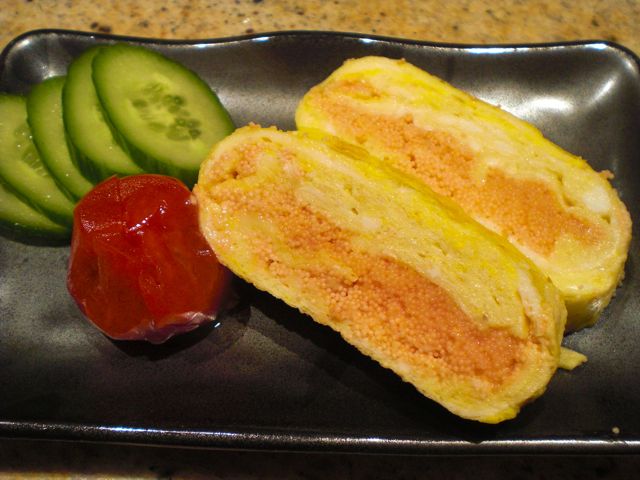
I usually make a dashimaki with three eggs but this one required 4 eggs and I could have done a better job forming the roll.

Eggs: I used large brown eggs (4). I added dashi broth (4 tbs, leftover from making another dish), sugar (2 tsp) and a pinch of salt and mixed well in a bowl.

Takako: I opened one roe sac by cutting the membrane along the long axis. Using the back of my knife, I scraped off the roe from the membrane and placed it in a small bowl. I then added sake (less than 1 tbs) and Tabasco (as much as you like) and mixed well to attain the degree of spiciness and consistency I wanted. I then made it to a rectangle with the width equivalent to that of a square Japanese Omelet pan. If you like, you could roll this in a nori sheet (if you do this step, wrap the tarako-nori roll in a plastic wrap for few minutes until nori sheet gets moist and keeps its form before placing it on the omelet).

On a low flame, I heated a square Japanese omelet pan and added vegetable oil (my pan is non-stick and I added oil to just barely coat the surface). The pan should be hot enough so that the eggs start cooking immediately but not too hot for the eggs to start bubbling. I poured enough egg mixture to thinly coat the bottom. When it was half cooked, I added the tarako mixture, about one inch from the far edge of the pan. Using a spatula (one wide enough almost encompassing the width of the pan is best), I lifted and draped the 1 inch portion of the omelet over the tarako, and started rolling (You also need to tilt the pan to help with the rolling action. I did not do as well as I could have). I repeated the same process three more times, adding vegetable oil to the pan as needed. I ended up with a rectangular omelet which looks exactly like a Japanese dashimaki omelet from outside (albeit a bit fatter). But, of course, when you slice it, you will see semi-cooked spicy tarako inside.

This is a sublime dish; nice salty taste and interesting texture of tarako in the center with mild spiciness and the surrounding omelet has nice conforming sweetness. We did not need any soy sauce because of the enough saltiness from the tarako. You need to have sake for this dish. Good effort by me on weekday night. Only problem may be that this dish is high in cholesterol.

Wednesday, March 23, 2011

All leftover mini-casserole 残り物キャセロール

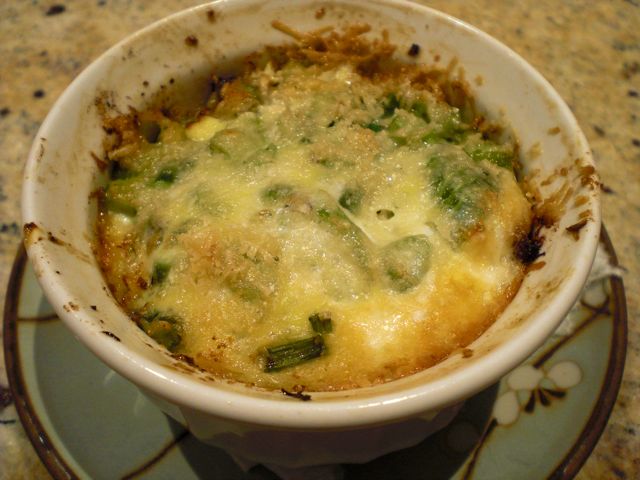
This is not really blog worthy but we liked it very much. One evening my wife gave me a list of small odds and ends leftovers which she tasked me to "clean up". The list consisted of: 1) cooked Spanish flavored rice, less than 1 cup, 2) one small cooked lamb chop, 3) 4 asparagus previously sauteed in butter, 4) two florets of cooked cauliflower (a part of baked veggie dish). I did not ask why such small amounts were left over or why she didn't just throw them away--my task was to come up with something using them.

I first buttered two small ramekins and packed each in layers from the bottom up, starting with the Spanish rice, followed by the cauliflower finely chopped, the lamb finely diced, and the asparagus chopped. I then beat one egg and seasoned it with salt and pepper, added tiny cubes of cold butter (1 tsp) and poured it over the top layer of asparagus. I then grated Parmigiano Reggiano cheese over it. I baked in a toaster oven for 10 minutes at 400F.

This was surprisingly good. With very interesting layers of flavors. It turned out to be very satisfying dish. We used up all the leftovers--my task was completed.

Monday, March 21, 2011

Chicken Patty, miso flavored, with pine nuts 鶏の松風焼き

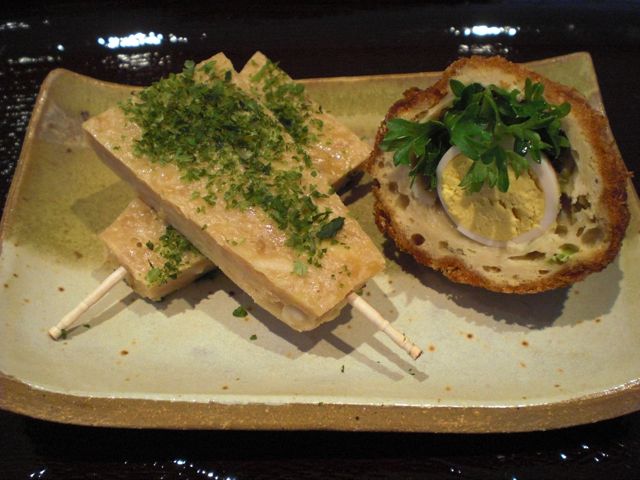
This is a variation of chicken "tsukune". The addition of pine nuts and miso make this dish distinctive. I used 1/2 lb ground chicken. Add white miso (2 tbs), mirin (2tbs), panko (1/2 cup), flour (2 tbs) and toasted pine nuts (3 tbs) and 1 egg. Mix and put in small square baking dish (I sprayed with "Pam" to prevent sticking) so that the thickness is about 1/2 inch. Put it in a 350 F oven for 15 minutes.

I think this was in one of the recipes for "Osechi" お節料理 or New Year Dishes which I saw on-line some time ago. I have made this for New Year. In that case, I cut the loaf into the shape of "Hagoita" 羽子板 and insert tooth picks to mimic the real thing and brush mirin and add "aonori" 青のり for green "pine" needle color as instructed in the original recipe (left in the above picture).

The taste is great and goes well with any drinks including red wines.

Saturday, March 19, 2011

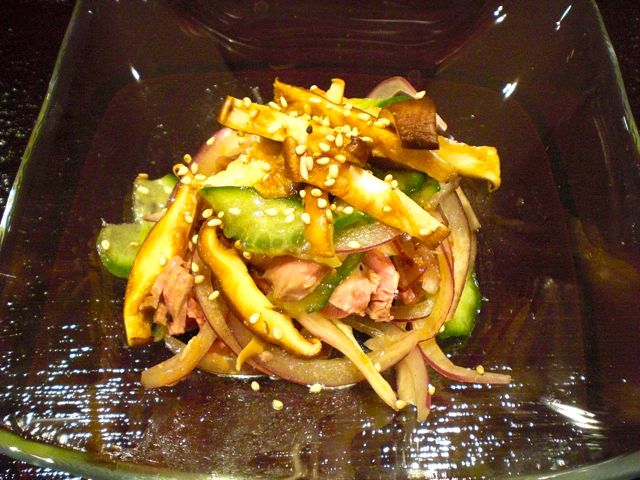
Duck breast salad with grilled shiitake 鴨胸肉と焼きシイタケのポン酢酢の物

This is another quick dish I made from the leftovers we had as a starter dish of the evening. There is no recipe for this, I just concocted it on a whim. I had roasted duck breast leftover and I thought the combination of onion and ponzu with duck will be good.

The amounts are for two small servings as seen above. I fist thinly sliced red onion (1/3 medium). I salted, kneaded, and soaked it in water for 5 minutes and wrung out the moisture with a paper towel. Cucumber was sliced obliquely very thin. I salted and squeezeed out the excess moisture (one small American mini-cuke). I thinly sliced the duck breast (cooked to medium rare with nice uniform rosy color) and then cut it into wide strips (4 thin slices per serving). I also found fresh shiitake mushroom (4, small) left in our refrigerator and decided to include it in this dish. I washed and broiled them in a toaster oven (it is sort of steam broiled). After a few minutes before it gets dried up, I removed the shiitake and cut into thin strips and dressed with a small mount of soy sauce.

I mixed all the ingredients except for the shiitake in a bowl and dressed them with ponzu shoyu ポン酢醤油 (from the bottle) and a splash of a good olive oil. I topped it with the grilled shiitake and sprinkled roasted white sesame seeds on top.

For an impromptu dish, this was a great success. The onion is strong enough but not too assertive because of the salting and soaking in water. The addition of the olive oil contributes depth of the dish. We had this with "G sake" from SakeOne. The very first US brewed sake we really like. This is a wonderful pairing. I should have made more since we had more duck breast.

Thursday, March 17, 2011

Crudités with moromi miso もろみ味噌のクルデテ

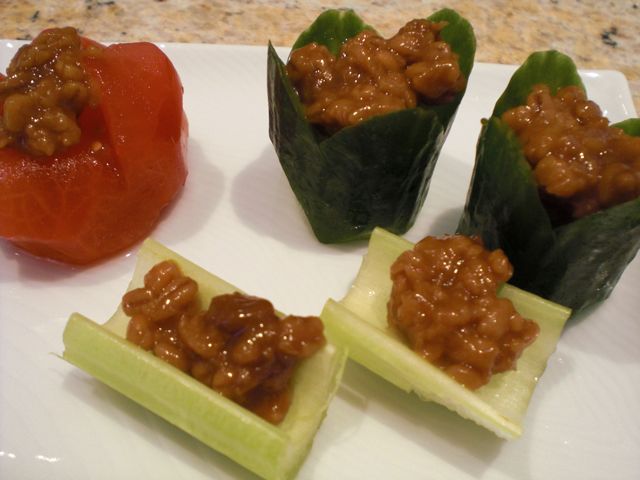
Probably this is not even worth posting but just in case I run out the items to post. This is obviously the same as "morokyu" もろきゅう but given a French name. For cucumber, I used American mini-cucues which was cut into a flower-shaped cup so that it can hold moromi miso もろみ味噌. I also made small boats of celery after I removed the strings or veins. As usual, I also used Campari tomatoes after skinning and cutting the top criss-cross halfway through. My wife particularly liked tomato and miso combination.

You could use other vegetables such as carrot, cabbage leaves, lettuce, radish etc. Besides moromi miso, you could make other flavored miso for dipping.