Wednesday, April 20, 2011

Arugula, fennel salad with flat iron steak ルッコラ、フェンネルとフラットアイアンステーキのサラダ

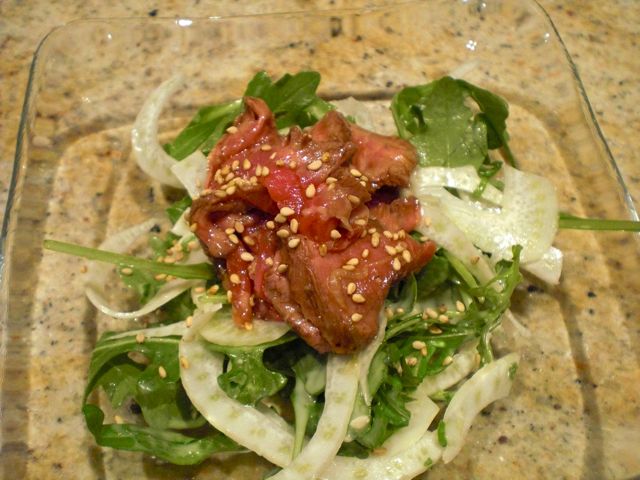
This is another small starter dish I made. This turned out to be very interesting and unique fusion salad.

The base is a mixture of baby arugula (it is interesting that this green is often called "rocket" in England, New Zealand, and Australia, "rucola" in Italy, and "rukkora" ルッコラ in Japan but in US and Canada, it is called "arugula") and thinly sliced fennel. Arugula is one of those rare greens that has a nice peppery taste on its own without help from any dressing. Fennel also has very nice anise flavor. As usual, I sliced the fennel with a Japanese mandoline slicer (Benriner) paper thin. For salad, it is important to slice fennel paper thin. I pondered about the dressing but decided to use blue cheese dressing (from the bottle). I used the dressing rather sparingly.

I topped this with thinly sliced leftover flat iron steak cooked medium rare. I dressed the steak with a mixture of ponzu shoyu, splash of dark roasted sesame oil and grated garlic. I placed the steak on the bed of arugula and fennel and garnished it with sesame seeds.

The combination of Western flavors of the salad and Eastern flavors of the steak was surprisingly very nice. All these very distinct flavors could be appreciated. 

We had this with a very good Cabernet from Sonoma,
Kunde Cabernet Sauvignon Reserve 2005. This is a Bordeaux blend (mostly Cab and some Merlot). It is rather rustic with nice smoky note and big chewy, albeit a bit rough huned, tannin (I know some will hate this type of description but tough). This is not a fruity vanilla laden sissy wine. (Although we sometimes like such sissy wines). For the price, this is a find. We usually think Sonoma Cab is not as good as Napa's but I will take an exception for this wine. This wine has a very high PQR.

Tuesday, April 19, 2011

CityZen for Japan Fundraising event on April 18

We attended CityZen for Japan on April 18 at CityZen located in the Oriental Mandarin Hotel. The location of the hotel is special. It overlooks Washington Harbor and is near the Tidal Basin. We arrived there a bit early so we sat outside on the terrace sipping wine. It was a beautiful spring day, the daffodils were out and it was fun watching the low flying planes approaching National airport over the 14th street bridge. In contrast, we thought of the quake damaged areas of Japan and felt that participating in this event was the least that we could do.

The event appeared to be a great success. Chef Eric Ziebold and Relief International did a great job organizing this. I do not know how many people participated but the restaurant where it took place was quite crowded. 

Champagne and wine were free flowing with wonderful Hors d'oeuvre. The auction included offerings from the chefs of participating restaurants. The auction packages included dinner prepared by a renowned chef for you and your friends at your house, one of a kind trip to Napa with dinners and wine tasting (at Dalla valle) etc. I was tempted.

After the auctions, all the wonderful food stations opened up including ones by CityZen and our favorite Japanese restaurants around the city offering delicious food.

This was wonderful evening for a good cause and we were glad we could participate and realized how fortunate we were. Thank you CityZen and friends to organize this event.  We wish for a quick recovery of Japanese earthquake and tsunami victims.

Monday, April 18, 2011

Fried Burdock stick 牛蒡の唐揚げ

This is a rather common Izakaya dish, although, for some reason, I have not made it at home until now. There are several different ways to make deep fried gobo. There are gobo chips like potato chip, kakiage tempura, or match sticks like shoe string fries. It can be just deep fried as is, or some kind of batter (tempura batter or buck wheat batter) or flour coating could be used. Another variation infuses some flavors before deep frying.

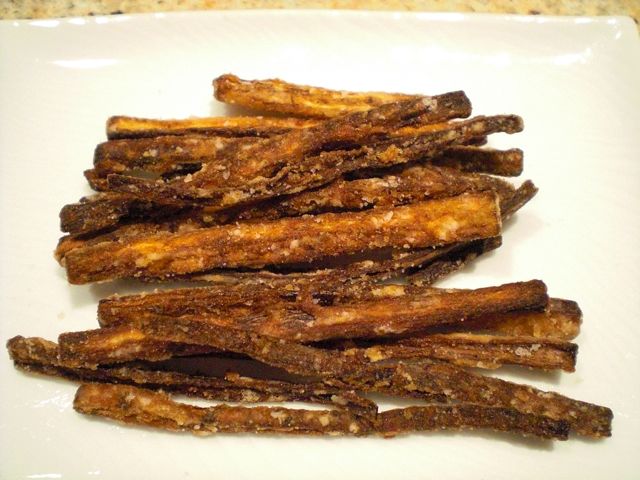
I decided to make shoe string like fries. I also marinated it with sake and soy sauce before frying. I used potato starch to coat the surface to help make it crisper.

For two small servings like those shown above (one serving shown), I used 2 root end halves of gobo. I scraped the skin and cut into match sticks and soaked in acidulated water for 10-15 minutes with several change of water. I then drained and marinated it in a mixture of sake and soy sauce (1:1) in the fridge over night (few hours at room temperature will be fine or you can skip the marinading step all together). I drained the gobo and patted it dry with a paper towel. I then dredged the sticks with potato starch (katakuri-ko 片栗粉).

Instead of deep frying, I shallow fried them using light olive oil (below image) on medium flame. I could have used peanut oil and/or deep fried them. After several minutes, the gobo sticks turned brown and crispy. I drained the excess oil and while they were hot, I seasoned them with salt. Serve while hot.


My wife was totally sold on this dish. Gobo has a very unique flavor and prepared this was they were so crunchy. It is a bit like sweet potato shoe string fries but gobo is all fibers and crunch. This is probably much healthier than fried potato. This goes well with any drink but we were having cold sake.

Saturday, April 16, 2011

Flavored rice with chicken 鶏ご飯

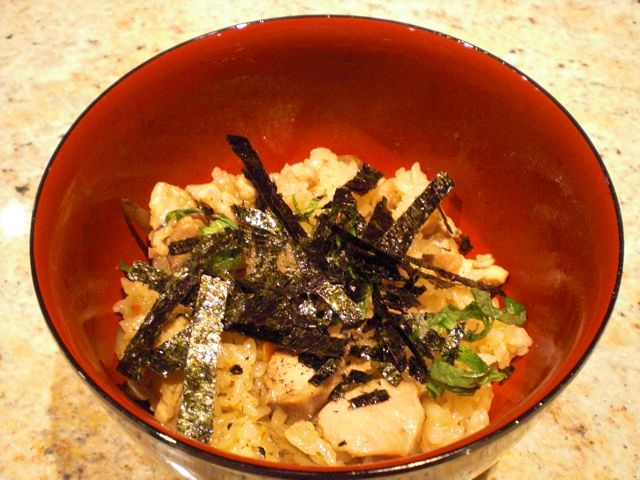
When I posted Chicken rice 鶏飯, I mentioned that if "鶏飯" is pronounced as "tori-meshi" とりめし instead of "keihan" けいはん, it means an all together different dish, which is the dish I am posting here. "Cooked rice" in a polite form in Japanese is "gohan" ご飯, so you could also call this dish, more politely, "Tori-gohan" 鶏ご飯. This is a flavored rice with pieces of chicken. There are many variations and the size and the amount of chicken in this dish also varies. This is my rendition.


The amount below is for 3 cups (Japanese cup, which is about 180ml, ones come with a Japanese rice cooker) of raw rice which serves 4-6 people (or 10 of us).

Chicken: I used two thighs, bone and skin removed, and cut into small chunks (half inch).

Vegetables: I used ginger root (one thin sliver, skin removed and minced), gobo 牛蒡 or burdock root (1/2), and carrot (1 small). For gobo, after scraping off the dark skin of the gobo using the back of the knife under running water, I cut it into small, thin, "small bamboo leaf shape" which is called "sasagaki" 笹掻き cutting ("sasa" 笹 is a type of small bamboo). This is a very common way to cut root vegetables, especially gobo. You do this by shaving the end of burdock like you are sharpening a pencil (I am not sure how many of you actually shaved and sharpened a lead pencil encapsulated in wood cylinder, i.e. an old fashioned pencil, using a knife). Here is a visual aid for "sasagaki". I put the sasagaki cut burdock in acidulated water (with rice vinegar) immediately. I changed the water several times and let it drain (to reduce the pungent smell/taste and prevent discoloration). I also cut a carrot (one small) in the same way as the gobo. If you like, you could add, a deep fried tofu pouch (abura-age), shiitake mushroom, and/or lotus root (renkon 蓮根); all cut into small pieces.

Seasoning: I added vegetable oil (1 tbs) in a frying pan on medium heat and first cooked the chicken. When the surface of the chicken became opaque, I added the burdock and carrot and sauteed them for 1-2 minutes. I then added sake (3 tbs), mirin (2 tbs) and soy sauce (2 tbs) and cooked for 1 minute or so. Using a colander or strainer, I separated the solids from the liquid (preserving both separately).
Rice: You could use a just regular Japanese rice but I added sweet rice or glutenous rice. Japanese will call this rice "mochi-gome" 餅米* since rice cakes or mochi 餅 is made from this variety of rice. I used a mixture of regular rice (2 Japanese cups) and sweet rice (1 Japanese cup).  This adds a stickier texture to the cooked rice but this is optional. I washed the rice under running cold water until the water ran clear. I then drained and let it sit in the strainer.

*(Digression alert) Mochi-gome contains mostly amylopectin as a type of starch, which gives it a stickier consistency than regular Japanese rice. It can be easily distinguished from a regular Japanese rice since the germ of mochi-gome is opaque. As a result, after washing, the rice grains look white and opaque rather than slightly transparent like regular rice. Some rice dishes, beside rice cake, can be made solely from mochi-gome, which are called "okowa" おこわ. Red rice or "sekihan" 赤飯 served on celebratory occasions in Japan is the example of "okowa".

Cooking: This time I used an electric rice cooker but I could have used a Donabe rice cooker. To set up the rice cooker, I added the washed and drained rice and then added the seasoning liquid reserved from cooking the chicken and other ingredients. I then brought the liquid level up to the 3 cup mark by adding dashi broth (or water). I added the chicken and vegetables and stirred it once or twice. I then cooked it like regular rice. After it finished cooking I let it steep for 10-15 minutes (see picture below).  With a rice paddle, I stirred the rice and other items (in Japanese culinary parlance, these are called "gu" 具).


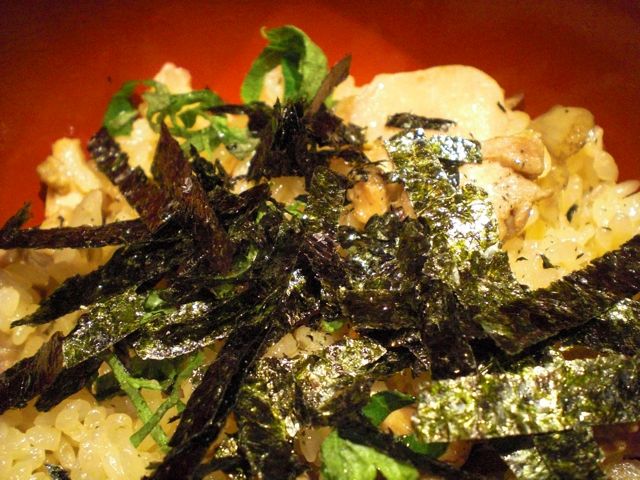
Serving: You usually want to add some greens to this dish. Cooked green beans cut into small segments, green pea, snow pea or snap pea can be added as a garnish. In my case, I added a chiffonade of perilla and nori.

This is a very nice and tasty dish. The addition of sweet rice gave it more body or a "mochi-mochi" もちもち texture, if I am allowed to use a Japanese expression. My wife thought she could not tell the difference from regular rice. This is a perfect "shime" 締め or ending dish or, by itself, with a salad or tsukemono 漬け物 and miso soup, this could be a whole meal.

Thursday, April 14, 2011

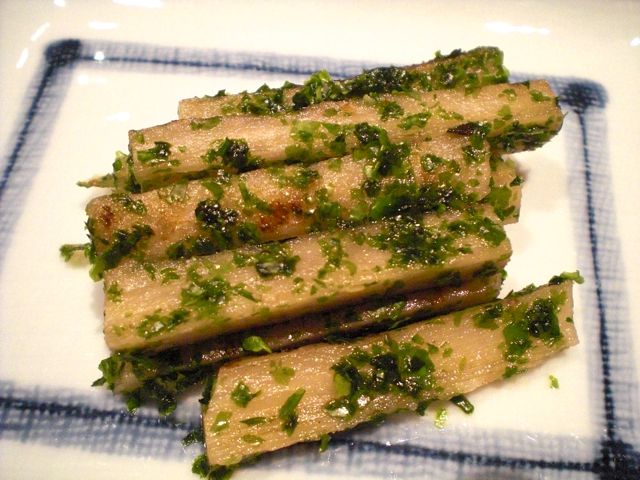
Simmered Burdock with aonori 牛蒡の青海苔まぶし

This is a new gobo dish for me.  I have not seen, made, or tasted this before. After buying two burdock roots or gobo 牛蒡, I had an excess supply and searched for gobo recipes. I came across this one at e-recipe.com. For more precise recipe, please see e-recipe (in Japanese).

For two servings of the dish seen above, I used the stem end half of the gobo. After the usual scraping of the skin with the back of a knife routine, I cut the gobo into large sticks, half inch or 1 cm diameter and placed them in acidulated water and soaked them for 10-15 minutes with several changes of water.

In a small pot, I added dashi (100ml), sugar (1 tsp) and a small pinch of salt. I reduced the sugar from the original recipe (1 tbs) but even with the reduction it was plenty sweet for me. I placed the gobo in the pot and simmered with a otoshibuta 落し蓋 made of aluminum foil on low flame for 15-20 minutes or until the liquid was almost completely gone. I let it cool down. Just before serving, I added aonori 青海苔(2 tbs or whatever amount you like) to the pot and coated the gobo.

This is a really interesting dish. Beside the flavor of gobo itself, it has sweet and salty taste and the oceanic flavor of aonori. We like other gobo dishes better but this is not bad and certainly different.