Wednesday, June 8, 2011

Spanish mackerel stewed in miso さばの味噌煮

Appropriate ingredients are the most important factor in making new and interesting dishes. At the newly opened gourmet grocery store, today's catch (whole fish selection) included some large Spanish mackerel and sardines. Although I was tempted to get the sardines or "iwashi" イワシ because I had some recipes I wanted to try, they looked like they had been in a bar fight the night before, and were much the worse for wear. So we got the Spanish mackerel. Again, it is difficult to compare the type of mackerel available in Japan vs. the ones available here.  The Spanish Mackerel we got was a bit over 4 lbs and was much larger than Japanese mackerel or まさば. The type of mackerel we call "Boston mackerel" here appears to be closer to Japanese mackerel. Size aside, these mackerels have characteristics similar to oily blue fish; nice firm reddish flesh and shiny silver blue-gray skin. They also have a rather strong taste and spoil very quickly. The classic Japanese preparation is to use miso when cooking mackerel.

Preparing mackerel: I had our Spanish mackerel filleted. I had to remove the small pin bones in the center line of the head portion of the fillet using a Japanese fish bone puller (I have one that I got from Global or you could use a needle nose pliers). Since the fish we got was rather large, I used one fillet for this miso stewed dish and the other for a miso grilled dish. I cut the fillet into half lengthwise and then cut crosswise into 2 inch wide pieces. I made shallow scores in the skin surface as well.

Simmering liquid: I combined dashi (200ml), mirin (4 tbs), sake (4 tbs), red miso (3 tbs) and sugar (2 tbs) in a frying pan. I also added ginger root (4 thin slices). After coming to the boil, I turned the heat down tasted it. I thought it was too strong and added more water and sake but, in retrospect, I should have left it alone.

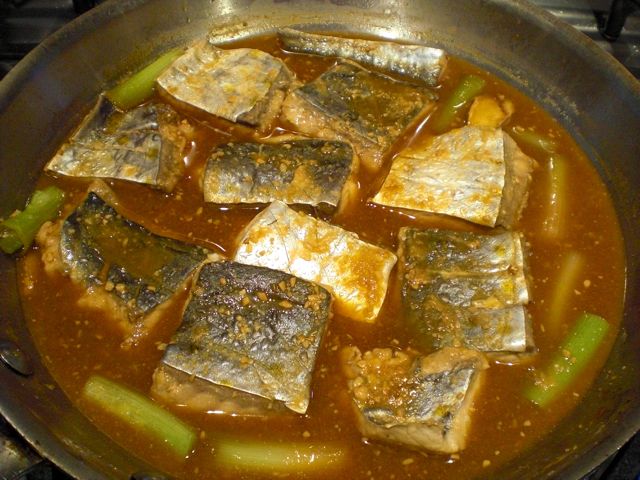
I placed the prepared mackerel in the pan skin side up and also added segments of scallion all around. After coming back to boil, I turned the heat down to simmer, I put an otoshi-buta and a regular lid (askew) and simmered it for 15-20 minutes (see image below).

Since the miso mixture was still a bit runny, after I removed the fish, I reduced it a bit to make a thicker consistency.

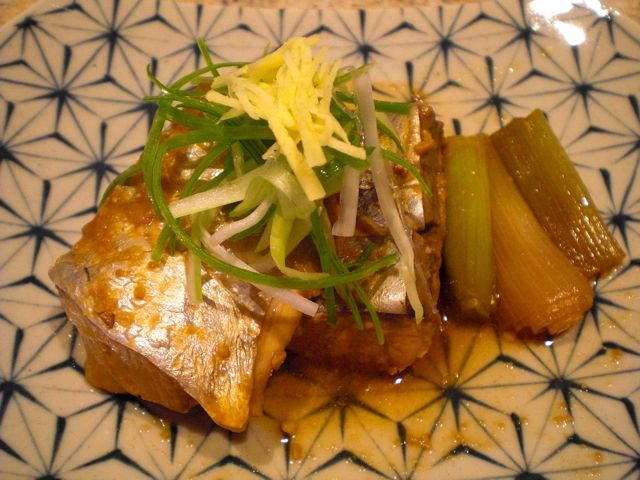
To serve, I garnished it with thin threads of ginger ("hari-shouga" 針ショウガ) and scallion cut thinly along the long axis called "shiraga-negi" しらが葱 or white hair scallion. Since I do not have naganegi 長ネギ or Tokyo scallion, this was the best I could manage.

This is a classic and very comforting dish--perfect as an accompaniment for sake. Miso and mackerel are indeed a winning combination.

Monday, June 6, 2011

Stewed kabocha and red bean カボチャのいとこ煮

This is a variation on the theme of azuki dishes. Instead of sweet potatoes, Japanese squash or kabocha is used. This is sometimes called "Itoko-ni" いとこ煮 meaning "cousin stew" but why it is called that is not clear to me or if any stewed dishes with azuki would be called "Itoko-ni".

In any case, I do not think this is one of our favorite dishes. I cooked the kabocha exactly same as before. Toward the end of the cooking, I added cooked and unsweetened red beans and dissolved a small mount of miso paste to taste. This dish needs something more. Somehow unsweetened azuki does not work well here for us.

So I made another version few days later (image below). I added my version of slightly sweetened azuki instead. I also added a bit more miso at the end than before.  This tasted much better. The sweetness was contrasted with some nutty salty tastes. We liked this much better than the original version.

Saturday, June 4, 2011

Marinated tuna "zuke" sashimi 鮪の漬け

I posted maguro-zuke to make a low-quality frozen saku of yellow-fin tuna palatable before. Of course, if you make "zuke" from good blue-fin tuna like I did here, it tastes even better. Since I happened to have Vidalia spring onion, which is extra mild and sweet, I also used that to served this zuke.


Marinade: I made some adjustment and used a more simple and less potent sake and soy sauce mixture (3 tbs each or 1:1 ratio) with the addition of grated ginger (1/2 tsp, I used grated ginger but you could add just the juice) and dry roasted (in a dry frying pan) white sesame seeds (1/2 tsp, coarsely ground in a Japanese mortar or in "suribachi" すり鉢). Compared to the original, I do not use any mirin and the amount of soy sauce is less.
Tuna: I used blue-fin tuna (slightly fatty or ko-toro 小トロ portion) which was from Catalina Offshore Porducts. I did the usual "yubiki" 湯引き process to make the surface of the tuna white (10 seconds in simmering water) and then cooled down immediately in ice water.

I sliced the tuna in rather thick pieces as seen above and marinated it in a flat sealable container in one layer for 2-3 hours in the refrigerator.

To serve, I sliced Vidalia spring onion after halving it and placed the slices on the bottom of the plate, added a few strips of shaven carrot for color, surrounded that with sliced (on a slant) American mini cucumber. I drizzled the marinade and olive oil over them. Since I had daikon left after making a daikon garnish for sashimi the night before, I grated it and squeezed out the excess moisture, added yuzu juice and made a small mound in the center of the plate.

After removing the excess marinade from the "zuke" pieces, I arranged the slices around the grated daikon. I added a small dab of real wasabi on the side.  To eat, we put a bit of wasabi on the zuke slice, added some onion, carrot and cucumber slices on top. The tuna has a remarkable resemblance to good beef. The marinade did not make the tuna "slimy" but infused lots of flavors. The real wasabi is really not too hot like the "fake" kind but has a nice fresh wasabi flavor. Sweet Vidalia is also perfect with this combination. If you feel the zuke is a bit salty (not here though) or regradless, you could add yuzu infused grated daikon on the top as well. This proves that if you make zuke from good tuna, the end result is better. For a drink, there is not much choice--it has to be cold sake.

Thursday, June 2, 2011

Simmered sweet potato and azuki beans さつまいもとあずきの煮付け

Because our new grocery store had raw azuki beans, I made several dishes with them. Here is the first sort of savory dish which can be served as a vegetable side dish.

There is some confusion regarding sweet potato and yam especially in North America. As far as I can tell the ones available in North America, either white or orange varieties, are sweet potatoes. The orange variety are frequently referred to as "yams" which appears to be a misnomer. True "yams" are reportedly botanically different from sweet potatoes. In any case, the potato I bought for this dish is the orange variety and is similar to Japanese "satusma-imo".

I simply peeled and cut the sweet potatoes (3) into half inch thick half moon shaped pieces and simmered in dashi broth just enough to cover (I guess about 200ml. I took a shortcut and used instant granulated dashi). I tested for to see if they were done by piercing with a bamboo stick after 15-20 minutes. I seasoned them with mirin (2 tbs), soy sauce (3 tbs) and sugar (1 tbs) and further simmer for several minutes. I added slightly sweetened cooked azuki beans (if using canned cooked azuki, use the unsweetened variety) and let them warm up for another 4 minutes.

It is a bit sweet but very mildly so. The combination of slightly sweetened azuki beans and sweet poteto is excellent. Can this be a drinking snack? Possibly, but I have to say I would probably have something else with a drink.

Tuesday, May 31, 2011

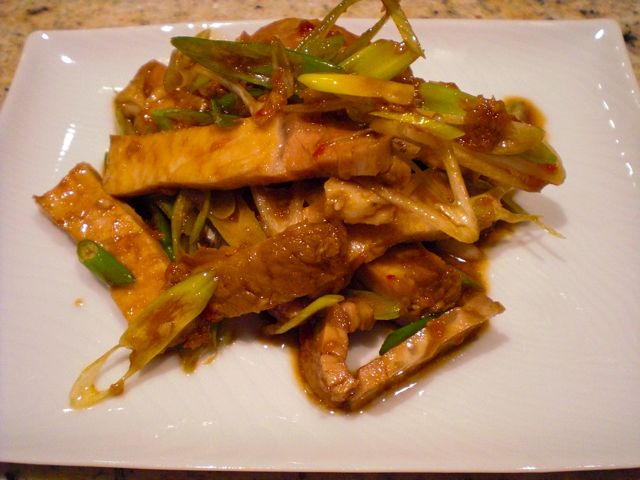
Pork pot roast and scallion salad 煮豚と葱のサラダ

This is another variation of small dishes using nibuta/yakibuta 煮豚/焼豚. This is based on a recipe from Otsumami Yokocho page 33.

To make this dish is quick and easy. This is for one small serving as seen above. Only thing is that you need to have leftover Japanese pork pot roast. I had less than 1 inch thick pork roast left. I just sliced it into thin rectangles (or cut into "tanzaku" 短冊, which is a small elongated rectangle card on which you scribble down a traditional Japanese short poem using a brush and ink.)

Dressing: I mixed soy sauce (2 tsp), dark sesame oil (2 tsp), sugar (1/4 tbs), rice vinegar (1/2 tsp) and Chinese hot sauce/paste* (1/6 tsp or more as you like), grated garlic (1/4 tsp) and ginger root (1/4 tsp) in a small bowl.

Scallion: I just sliced a scallion thinly on the bias including some of the green parts.

Just dress all the ingredients and serve. It is quite good and quite different from similar salads I made before. We like both variations very much. This one has more assertive flavors from the garlic, ginger, sesame oil as well as red chili paste.

(* "Tobanjan"  Hot bean sauce 豆瓣酱 or Chili garlic sauce 蒜蓉辣椒醬, I used the latter. You could substitute with any hot sauce you may have.)