Tuesday, July 26, 2011

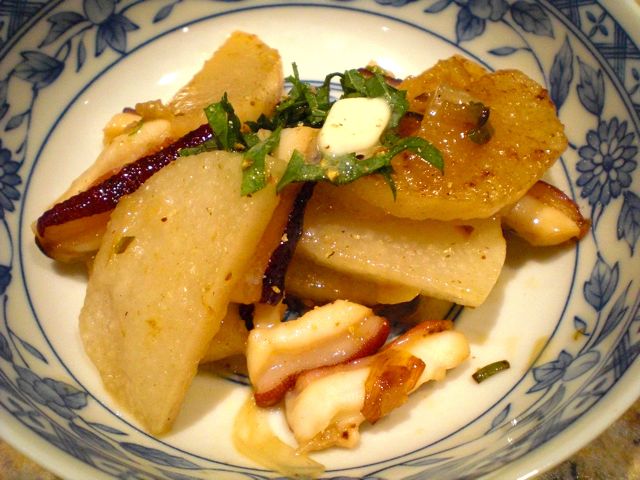
Octopus and Nagaimo stir fly with garlic 長芋とタコの塩バターソテー

I made this dish from what was left of boiled small octopus after making sumiso-ae.  I adapted this from e-recipe. I would have used soy sauce instead of just salt but I followed the recipe.

Octpus: I used boiled small octopus head (body). I sliced the octopus in to thin (1/2 to 1/4 inch) strips.
Nagaimo: I used nagaimo (2 inch segment), peeled, sliced (1/4 inch) and cut in half rounds.

I put a pat of butter (1 tsp) in a frying pan on medium low flame. When the butter melted, I added garlic (1 small glove, finely chopped). When the garlic became fragrant (1 minute), I added the nagaimo rounds and fried both sides (1-2 minutes each). I then put in the octopus and sauteed for another 1 minute. I added salt (1/3 tsp) melted in warm water (2 tbs) and  mirin (2 tbs). I braised it until the liquid is almost all evaporated. I garnished with a very small pat of butter, perilla and freshly cracked white pepper (my additions).

This is an interesting dish. The nagaimo is still a bit slimy and may not be suitable for those with slimonphobia out there but is nicely crunchy with a buttery flavor. The octopus is rather tender (relative to other cooked octopi) and nice garlic taste. Perfect drinking snack for sake.

Sunday, July 24, 2011

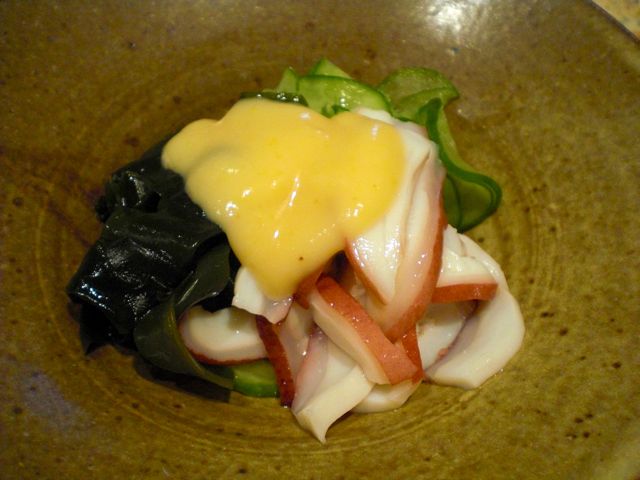
Small "Iidako" octopus and wakame dressed in vinegar-miso いいだこと塩蔵ワカメの酢みそ和え

When I visit the only Japanese grocery store left in our area, what I find is sort of hit-or-miss. On one such visit, I found boiled small octopus (only head or body portion but not the legs or tentacles) in the refrigerated case. I only saw boiled octopus legs before in this store but this was new, so I bought it.

This is probably "Iidako" 飯蛸. If I am correct, this is a small species of octopus but not a juvenile or baby of a larger octopus such as "true" octopus or 真蛸. I pondered a bit but I decided to make a classic vinegar-miso dressing with cucumber and wakame seaweed. Despite the fact I posted a few very similar dishes before, this is such a classic combination and I could not resist making this dish.

I just sliced the octopus thinly. Wakame was the salt preserved variety which was washed, hydrated and cut into a bite sized pieces (this was the last of the salt preserved wakame that we had). Cucumber was my usual American mini-cucumber, thinly sliced, salted and excess moisture squeezed out. 

"Karashi sumiso" is my usual with Saikyo miso 西京味噌 and rice vinegar and Japanese hot mustard.

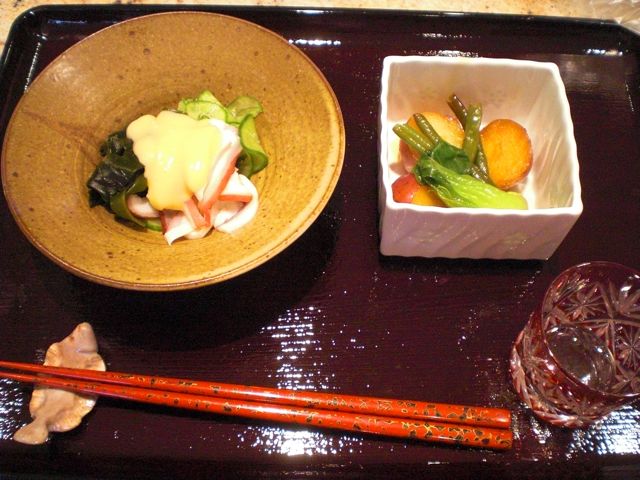
The octopus is a bit firm but very nice. It has different textures as compared to the tentacles of larger octopus. I made sumiso sauce a tad too vinegary this time. I served this with braised potato and green beans (right in the image below) as opening dishes.

We tasted a new batch of G-Sake "joy" (I suppose "G" is for "Genshu" 原酒). We think this is a new brew since the shape of the bottle is slightly different (No "BY" or "Brew Year" is listed on the bottle). The taste is about the same as before with a "umami" predominant taste profile. It has a slightly viscous but pleasant mouth feel. As compared to the old batch, my wife felt it was slightly more yeasty but I did not. If this sake had a bit more fruity and crisp upfront taste which leads to the "umami"-laden finish, which this one already posses, this sake would be formidable. But the taste of this sake is a true undiluted or "genshu" style of sake. The assertive vinegary taste of my miso dressing actually went very well with this sake.

Friday, July 22, 2011

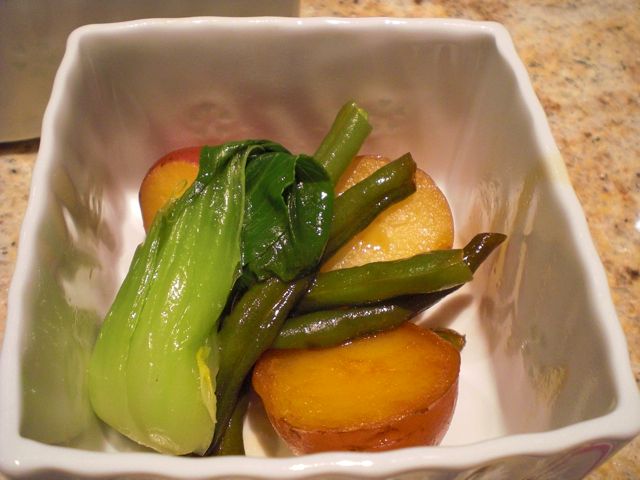
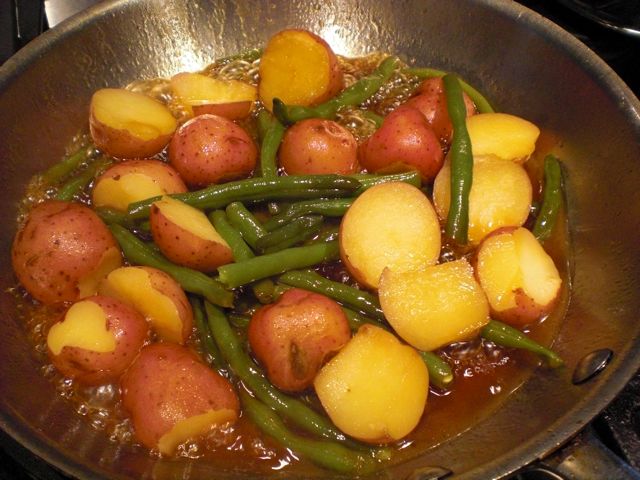
Braised new potatoes and green beans ジャガイモとインゲンの炒め煮

This is a very homey dish of potato and green beans. I grew up eating this dish and this is how my mother made it as far as I can remember. When my niece visited us many years ago, I made this dish and she immediately recognized it as her grandmother's recipe.

The amount of potato and green beans are arbitrary. The below picture shows the amount of potatoes and green beans I prepared. I used small red new potatoes (about 10, small one as is and larger ones cut in half after removing any blemish). Green beans, I trimmed off both ends after washing.

I put light olive oil (or vegetable oil, 2 tbs) with a splash of dark roasted sesame oil in a frying pan on medium heat. I sauteed both green beans and potatoes so that they were coated with oil. I added dashi (about 100ml). It immediately and vigorously started boiling. I put the tight fitting lid back on and let it cook for 5 minutes. I then added mirin (2-3tbs) and soy sauce (2-3 tbs). I put the lid back on and cooked another 7-10 minutes. I pierced  the potato and when the knife slid in easily it was done. I remove the lid and just let the liquid reduce until only a small amount of liquid remained (another 5 minutes). If the potato is not cooked but the liquid is almost gone, add water or dashi and cook a bit longer.

I added quartered baby bok choy on the top of the potato and green beans for the last 5 minutes of cooking and served this as a small drinking snack.

This is a classic home cooked dish. The green beans will lose color and it is not a fancy or pretty dish but is a very confronting dish. We went for sake with this.

Wednesday, July 20, 2011

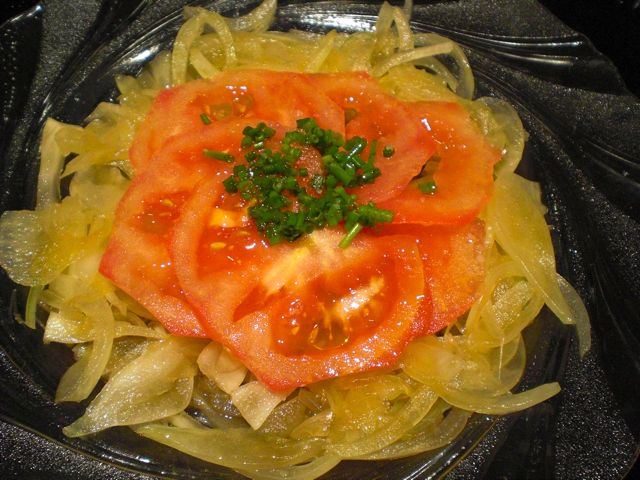
Vidalia onion salad オニオンサラダ

The health effect of onion is a bit overhyped in Japan but eating raw onion is not easy because of the strong pungent taste. Vidalia onion is a milder onion since it contains less of the sulfa compounds and its derivatives develop by enzymatic actions after slicing, which is the basis of strong smell/taste and also its alleged heath benefits. Onion salads in different incarnations are being served up in some Izakaya. Quick scan of the Otsumami yokocho cookbooks reveals at least two versions. One looks particularly interesting topped with an egg yolk and bonito flakes. This is my more tame version made of Vidalia onion and slices of tomato.

The preparation of the onion is the same as in the cucumber onion salad. I slice onion thinly, salt, knead, let it stand for 5-10 minutes, squeeze and then wash it in cold running water. I then soak it in cold water for 15 minutes or longer and squeeze dry before using. (I am sure the most important substences for the onion's health benefits will be lost in this process but at least you can eat it without crying or smelling like an onion afterwords).

For dressing, I made a mixture of soy sauce, lemon juice, mirin, and sesame oil (to your liking, I did not measure) and dressed the onion. I spread the oinon on the plate and layered sliced tomato (skinned). I sprinkled some Kosher salt, good fruity olive oil and freshly ground peper (I used white pepper) on the tomato slices and garnished it with chopped chives. I chilled it in the refrigerator before serving.

It is very nice refreshing salad in hot weather. It may have lost some of the health benefits but the taste is very mild and even those who may not like raw onion will be able to enjoy it.

Monday, July 18, 2011

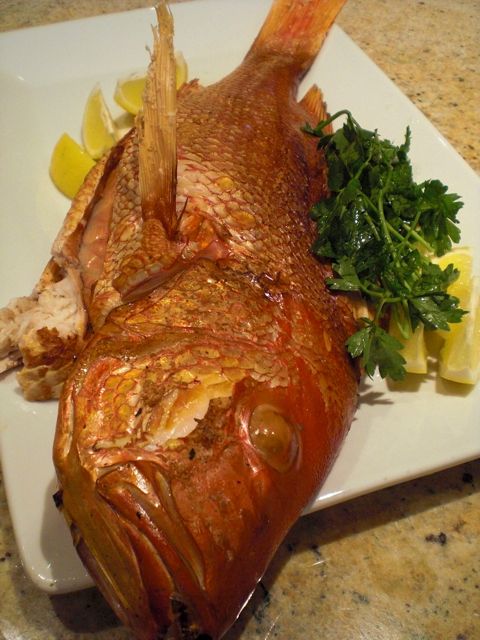
Grilled red snapper 鯛の塩焼き

When I posted "sekihan" 赤飯, I had to borrow an image of grilled "Tai" 鯛 (red snapper or sea bream? As usual, it is difficult to equate types of fish available in the U.S. and in Japan) to complete a full-fledged Japanese celebratory feast scene. Red snapper and Japanese "tai" may be totally different species but they are similar in appearance.  I was vying for a chance to get a nice red snapper to make my own salt grilled red fish. One Sunday, my wife suggested we mosey over to our new grocery store to look for a nice whole fish to grill, since it was rather hot and we did not feel like warming up our kitchen.

Among the whole fish they had, the red snapper looked the best, although many were very large. We ended up buying one of the smaller ones but it was still big (over 5 and a half pounds). I have never cooked red snapper this large before.
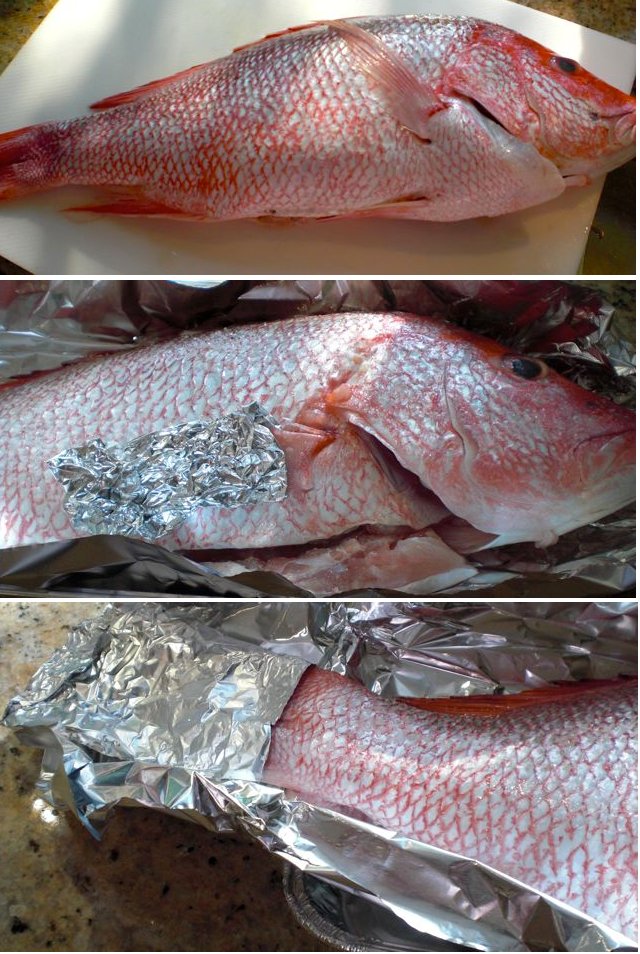
I asked the fish monger to gut and scale the fish. To my surprise, they did it in an appropriate Japanese way, meaning they left all the fins intact. Most American fish mongers, when asked to just gut and scale, will cut off all the fins using scissors. I'll admit the dorsal fins of some fish including this red snapper are very sharp and dangerous but, for Japanese (and I assume, for other Asian cultures as well), these fins are important, not because we eat them but because they are decorative. In addition, the fish monger did a good job of removing the scales from the head (face). This usually does not happen and is relevant since Japanese often eat the head of red snappers called "kabutoni" 兜煮 or "simmered war helmet". 

So, I decided to honor this fish monger's effort by salting the fins heavily (called "kazarijio" 飾り塩or decorative salting and protecting them with aluminum foil like you see on the left for pectoral fins (middle) and the tail (bottom). The rest of the fish including the skin and cavity were also salted but not too heavily. I decided not to use any lemons or other herbs in the cavity as per Japanese tradition. We deviated from tradition, however, after I made the comment that generally this type of white meat fish can be very bland. My wife suggested since we were already grilling it we should add hot smoking. I protested, "Smoking grilled fish was not traditional." But what the heck, I decide to do it.

Because the fish was so big it just barely fit into our Weber grill (there was no room to make "hot" to "cool" zones so I could move the fish between them as it cooked). I decided to use indirect heat like I do for whole chickens. This was another departure from the traditional Japanese way of grilling this type of fish. They are usually grilled over direct heat but I was concerned that if I used direct heat, the skin would be completely charred before the thickest part of the fish was done. As before, I used lump charcoal divided into two baskets on the left and right sides of the grill. I placed the fish in the center. I used soaked apple wood chips for the hot smoking. I cooked the fish for about 35 minutes (it was slightly underdone but only the meat around the back bone needed more cooking. See below.)

Before grilling, the skin is usually scored (decoratively) to prevent it from rupturing in a random fashion. I forgot to do this. As you will notice in the first picture, the skin split along the dorsal fin area (which was tactically covered by sprigs of parsley for the picture). My wife's theory is that this was fortuitous because the intact skin during cooking may have made the meat very moist but I am not sure. Despite the smoking, the skin retained its red color. Please notice the intact pectoral fin. 

This is by far and away the best red snapper or "tai" fish I have ever tasted. All of the grilled red fish I had in Japan were much smaller and totally overcooked. As a result they were rather dry and tasteless. This one is so flavorful (hot smoking helped), juicy and just excellent! We started snacking on it before we even got portions cut. We found ourselves standing over the fish, tasting morsels and exclaiming at how unimaginably good it was. We finally got control of ourselves and put some on a plate. So we actually ate 3 times more than what you see in the picture below. Since I did not use direct fire, the skin was not very crispy; it was actually fairly leathery and not good to eat (small concession).
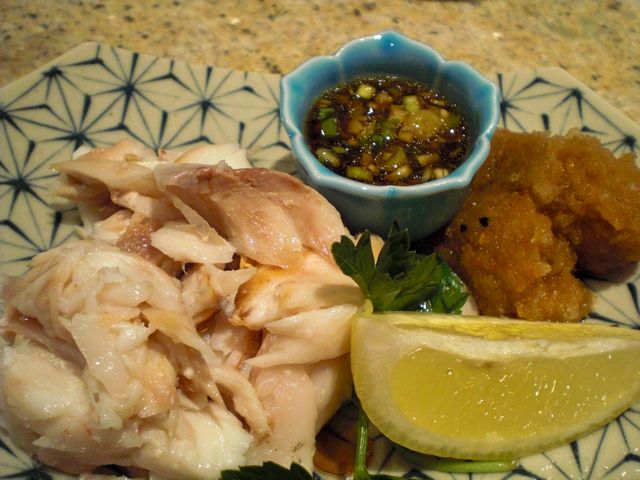
Before I started grilling this fish, my wife suggested I make some spicy sauces which would make this white meat fish more exciting. It turned out, the fish was so good we really did not need any sauces. Nonetheless I made two sauces. One was grated diakon with 7 favored Japanese red pepper flakes 七味唐辛子 and ponzu (ponzu-shouyu ポン酢醤油), the other was "negi sauce" 葱ソース or scallion sauce, which is a mixture of lots of chopped scallion, soy sauce, sesame oil, mirin, and a dash of tabasco (in the small blue cup in the picture above). The ponzu-grated daikon sauce was way too harsh and spicy (mostly due to the daikon) but the negi sauce was good.

Since the meat around the back bone was a bit underdone, I put it in a frying pan and cooked it for 7-8 minutes at 400F in a convection oven (The original idea of not using the oven and heating up the kitchen obviously did not work).

The meat around the bone was now cooked and the juice was browned on the bottom of the pan. After I removed the meat from the bone, I added small amount of water and sake to deglaze the brown bits. I tasted it. It had enough saltiness and made a nice broth.

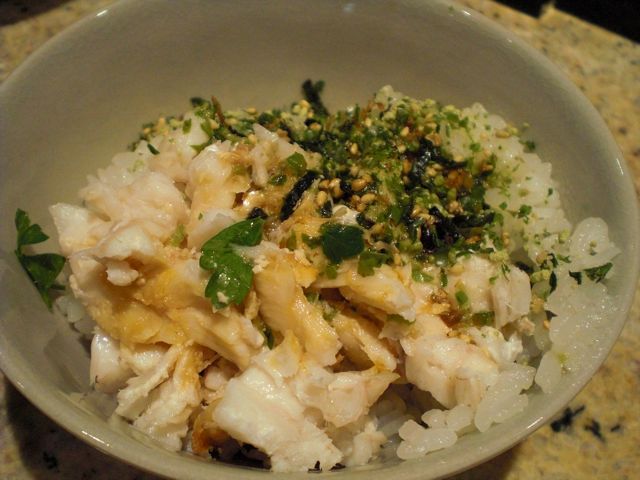
I added the meat to the hot rice as seen below. Since I had "rice seasoning" or "frikake" ふりかけwith a wasabi flavor (contains sesame seeds, nori etc as well), I sprinkled it over the rice. Then, I poured on a small amount of the broth (2-3 tbs).
This is not a true "tai chazuke" 鯛茶漬 but the combination worked well as a shime 〆dish. Since this was rather hot day, our cold house sake "mu" with its clean crisp taste was perfect. We have lots of leftover fish meat including the head. I may have to come up with some new dishes.