Saturday, September 24, 2011

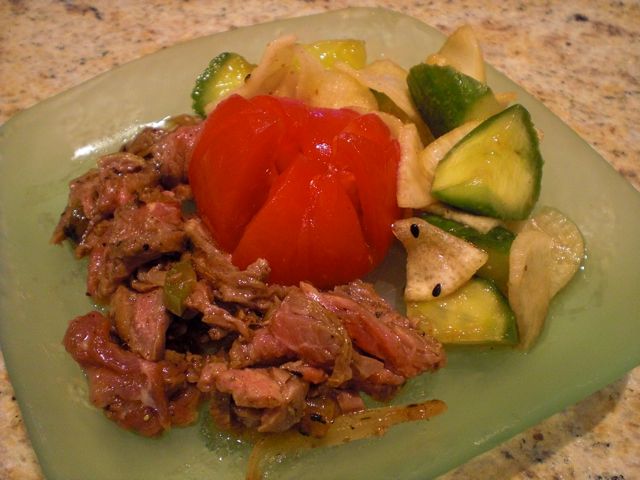
Skirt steak and quick "asazuke" vegetable スカートステーキと即席浅漬

Again, this is a nothing dish from leftovers. I usually try to make "asazuke" vegetables on the weekend so that we can eat them during the following week. I did not manage to do that last weekend so I quickly made instant "asazuke". I had a small amount of skirt steak leftover from when I made fajitas. Hence this instant drinking snack.


Instant "azsazuke": I cut a mini-cucumber into small chunks ("rangiri") (one) and daikon into thin, quarter rounds (1 inch segment of medium sized daikon).  I salted, mixed and let stand on the cutting board for 10 minutes or until the excess liquid came out. I squeezed even more excess liquid out using a paper towel.  I put the vegetables into a small Ziploc bag, poured in ponzu-shouyu sauce (from the bottle) and Japanese 7 favored red pepper. I massaged the cucumber from the outside of the bag and let it sit in the refrigerator for 30 minutes before serving.

Skirt steak: I sliced the steak thinly across the grain and mixed with leftover onion and chopped jalapeno pepper (again from the fajitas), grated garlic (from the tube), and soy sauce.

I made skinned Campari tomato cut into flower petal shapes and used it as a center piece with a sprinkling of salt. This is a nothing dish but served as a good starter.

Thursday, September 22, 2011

Sake steamed chicken breast with scallion sauce over rice porridge サムゲタンもどきのお粥

I am not sure how I came up with this "shime" 〆 dish one evening. Rice porridge, always reminds of me when I was sick as a kid since it was the food served in such situations in Japan. But as an adult, especially after excessive imbibing, rice porridge was a nice comforting ending dish. This evening, I had leftover sake-steamed chicken breast and made this rice porridge which has a very superficial resemblance to a famous Korean porridge/soup dish called "Samgyetang" which  is now very popular in Japan. The only resemblance here, however, is that it has chicken in it and is a rice porridge. (I also hasten to add that this was made due the availability of ingredients not excessive imbibing).
Porridge: I used frozen cooked rice I had in the freezer. I microwaved it for 30-40 seconds until it was just barely thawed. I put the rice in the Japanese ceramic pot for porridge called "yukihira" and poured chicken broth (Swanson non-fat and reduced salt kind as usual). After 20 minutes of simmering I added a small amount of the congieled simmering liquid made of black vinegar, mirin and soy sauce.

Chicken breast: This time, I made this with a shortcut method of microwaving it. I used a silicon steaming container for microwaving. I salted the surface of the chicken breast (two split breasts with skin on but bone out). I poured in sake (4-5 tbs). With a tight fitting lid, I microwaved it 5-6 minutes and let it rest with lid on for 10 minutes or until cooled enough to handle. I sliced and placed on the porridge.

Scallion sauce: This is my usual scallion sauce with a slight modification. I just mixed scallion (3, finely chopped), ponzu shouyu sauce (3 tbs, from the bottle), Tabasco (to taste), sesame oil (1/2 tsp) and grated garlic and ginger (to taste) and poured over the chicken slices and porridge.

I garnished it with blanched broccolini and, for good measure, sprinkled Wasabi flavored furikake.

Somehow, this hit a spot--the perfect ending to the evening.

Tuesday, September 20, 2011

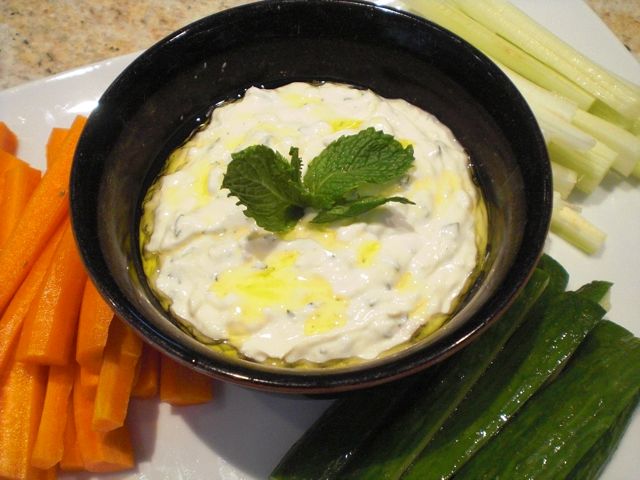
Greek yogurt dip with vegetable sticks ギリシャヨーグルトのディップ

On weekdays, when we come home and decide to open a bottle of wine, we tend to have crackers and cheese to go with it. Although we like the cheese, we were thinking we should have something (at least slightly) healthier. So one weekend, my wife picked up several different kinds of yogurt including plain Greek or strained yogurt, which is getting very popular in the U.S. She found a dip recipe on the inner seal and made it. The one shown here is based on that initial success, (this is actually the second attempt using a different brand of Greek yogurt). This one had a more appropriate i.e. thicker consistency especially for use as a dip compared to the first one*. Instead of commercial Greek yogurt, you could strain regular yogurt in a cheese cloth in the refrigerator over night.

*According to America's test kitchen, some "Greek" yogurts are not even strained but other thickeners are added. Certainly we experienced quite a difference between the two brands we tasted. The Test kitchen also taste tested non-fat varieties.

It is rather simple to make this. We just mixed in good fruity olive oil, lemon juice, chopped fresh mint, salt and pepper; all to taste. We then added crumbled feta cheese (We try not to overdo it since it will defeat the purpose of having a healthier snack). 

This time we added one cooked Italian eggplant (optional). Instead of skinning, cubing and roasting with olive oil as suggested in the recipe, we quickly microwaved it with the skin pierced multiple times to prevent an "explosion". (Quick preparation was in order, since we were making this after we came home from work). We removed the skin and cut up the meat into small pieces and mixed it in. 

The recipe also called for adding chick peas which we did in the first attempt but we omitted it this time since it did not add much and the chickpeas make it difficult to scope up the dip with vegetable sticks. 

If the dip tastes too sour, you could add honey (we added honey in the first version but we didn't need it in the current version). The dip will improve if you leave it in a fridge overnight. I served this garnished with a bit more olive oil and mint leaves accompanied by carrot, cucumber and celery sticks. If you have thin wedges of tomatoes, they also work.

As a dip, on its own, this is surprisingly good with a nice fresh minty note and good creamy texture. We also felt good eating all the veggies. The dip however, did not go well with the red wine we were having. The wine was Summit Lake Cabernet Sauvigon 2003 from Howell Mountain district in Napa. This is an interesting wine but more in the old world style. The color of the wine had a brownish hue which is more than the vintage of this wine would suggest. In any case, the dip by itself was good, the wine by itself not bad, together--not a great pairing. 

Sunday, September 18, 2011

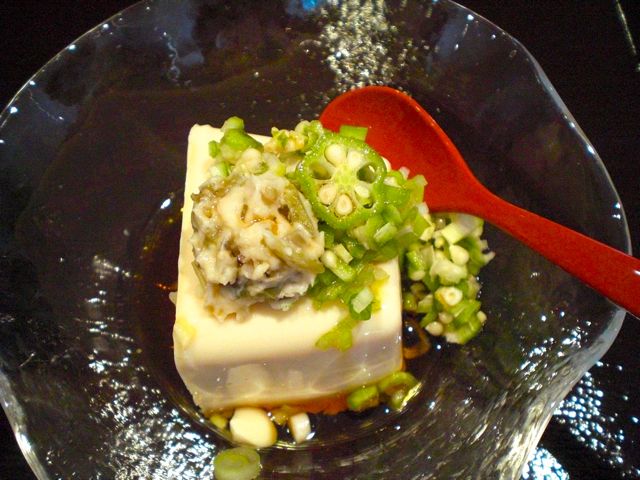
Cold tofu with okra and wasabi in sake lee 冷や奴のわさび漬けとオクラ添え

Most Westerners do not like slimy food (slimophobia). My wife told me a longtime ago that she hated (strong word!) okra which is one of the rare slimy food items available in a regular market in the U.S. Okra is thought to have been brought to the U.S. by slaves who were familiar with its use in Africa. Gumbo is a famous dish in New Orleans which uses okra. My wife's account was that as a kid she was served frozen and boiled okra as a vegetable side dish. It was grey-green with thickly viscous slime the consistency of snot (my wife's word precisely). I can imaging how terrible this was--she was thoroughly traumatized. From time to time, I have tried to get fresh okra but my wife made me put it back. Okra became rather popular in Japan as well, since Japanese love (many of them anyway) slimy food in general. Since my wife has been primed over time with various types of slimy Japanese food and there has been a catharsis of time factor as well, I thought I should try some okra.

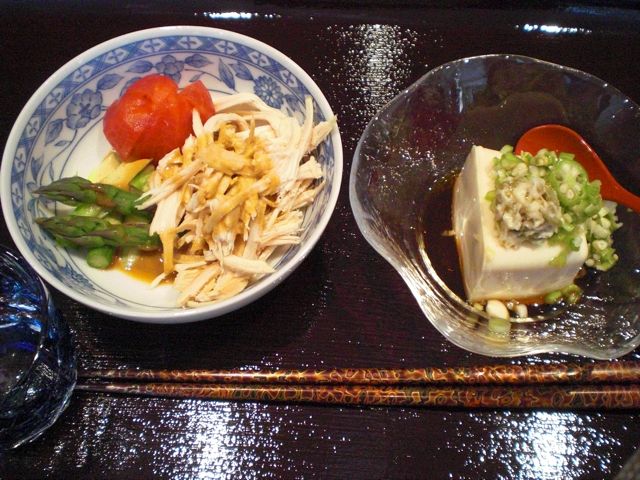
I found this fresh okra in the market and it had only minimum blemishes. It looked much better than the ones I can usually find, my wife was not with me, so I just bought a few. I served it on a hot day over a cube of cold tofu or 'hiyayakko" 冷や奴. Obviously this is one of many garnish variations you can serve with cold tofu.

I first washed the okra and then added a good amount of kosher salt in my palm and rubbed the surface of the okra to remove the fine fuzz. I then washed it to remove the salt. I finely chopped the okra by hitting it with a blade ("tataki" たたき technique). I also set aside a few slices of okra for decoration. This way, the sliminess is not too bad. I happened to have "wasabi-zuke" 山葵漬け and used it to top the tofu as well. I also added finely chopped scallion. I could go on and added more items such as bonito flakes, perilla, nori, etc but I restrained myself to only these three toppings. For the sauce, instead of straight soy sauce, I used concentrated "mentsuyu" 麺つゆ from the bottle. This combination worked well and my wife found the fresh taste and minimal sliminess surprisingly quite acceptable (quite a step-up from "hated" okra).


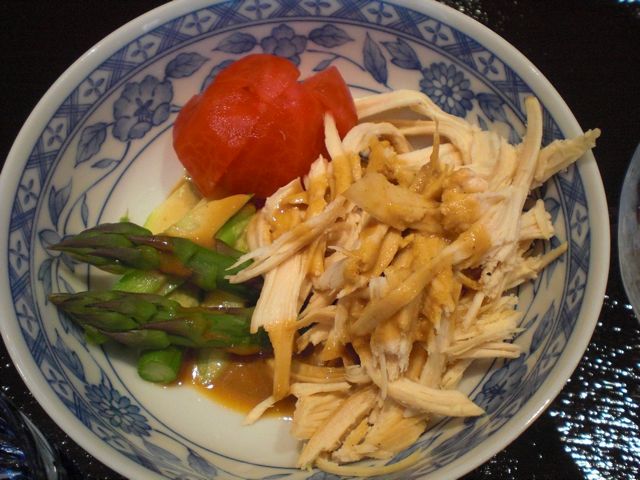
As starters, I also served chicken breast (previously barbecued) with sesame dressing with blanched green asparagus and Campari tomato.


These two dishes are regular small dishes I make but small variations make them more interesting.

Friday, September 16, 2011

Vinegared mackerel and smoked salmon molded sushi しめ鯖、スモークサーモンの押し寿司

The molded sushi or "oshizushi" 押し寿司 ("oshi" means "to press or push") or sometimes called "hakozushi" 箱寿司 ("hako" means a box). As opposed to more familier "edomae sushi" 江戸前寿司 or Tokyo-style sushi, the molded sushi is easier to make as long as you have a special wooden mold. Sometime ago I saw a wooden sushi press mold or "oshizushi hako" and bought it so I could experiment with it. In general oshizushi is not commonly available in the U.S. restaurants or sushi bars. I do have a very nostalgic memory, however, of one of the few times we had oshizushi.

Digression alert: We had recently moved to Los Angles and were looking for a new sushi bar to call home. We stopped at one "Japanese" restaurant and I started ordering several small dishes a-la-carte as we usually do, when the very bossy Kimono-clad middle-aged Japanese waitress informed us that we would be ordering one of their combination platters--no choice. A very large platter appeared featuring sashimi and other many American-style Japanese dishes (yakitori skewers, tonkatsu etc) with big slices of water melon on the side. This looked more like a American-Mexican combo-platter. As a result, we dubbed this place "Casa sushi". Needless to say, this was the first and last time we visited. 

After some more, less-than-sucessful explorations, we finally found a small sushi place that became our regular.It was recommended to my wife by a carpet cleaner (an unexpected source of such information) who happened to notice Japanese artifacts in our household while cleaning the carpet and asked if that meant we liked sushi. We were astounded to learn that he was a sushi connoisseur having conducted an extensive survey of sushi restaurants in the LA basin. He pronounced this restaurant the best in the region.  It turned out to be the type of restaurant where drivers of 18 wheelers fresh off the freeway parked their rigs out front, bellied up to the bar to eat sushi and discuss the finer points of raw fish with the owner chef (the LA sushi scene was quite different from what we were used to). The owner-chef of the sushi bar was from Kyushu 九州 and the young chef-de-cuisine was from Osaka 大阪. The young chef was quite creative. One evening he presented deep fried tempura sushi roll with the comment, "when it comes to food I'll try anything once." One evening he presented us with "oshizushi" (off the menu), which was from his native Osaka. Somehow that one dish particularly stuck in my mind when I thought about that restaurant or oshizushi. 
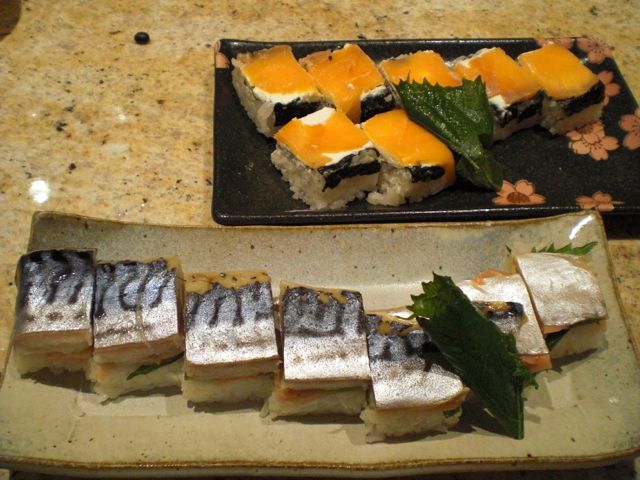
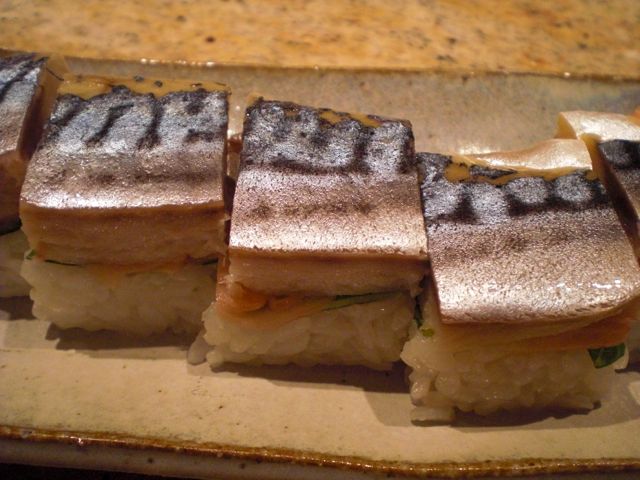
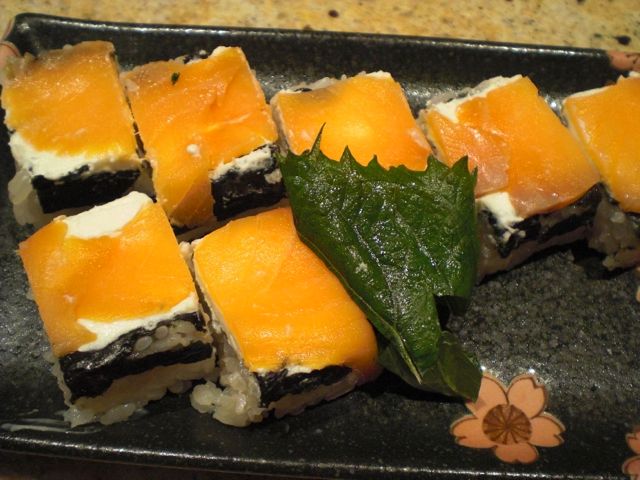
Back to the sushi: I made two kinds; one is the classic of oshizushi called "battera" バッテラ (near side in the above picture and the picture below) and the other more Western style, smoked salmon and cream cheese oshizushi (the far side of the picture above).

The non-tradtional oshizushi with smoked salmon, cream cheese and nori (the picture below) was based on my wife's suggestion (she referred to is as the Osaka version of Philadelphia roll). Actually she lined up all the necessary ingredients without my asking. So this was her creation and I just assembled it.

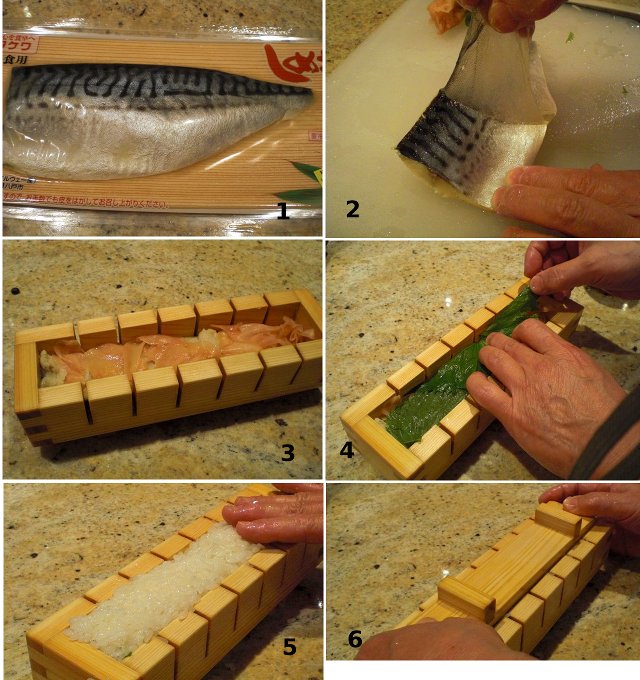
To make battera, I used a packaged "shime saba" しめ鯖 which is bought frozen and vacuum packed (#1). I cannot get fresh enough mackerel to make "shime saba" myself. After thawing, I removed the transparent thin skin first (#2) and cut it lengthwise (the width has to match the size of the mold. You may have to solve some geometric puzzle to fit the fish best in the bottom of the mold with the skin side down. I layered it with thinly sliced vinegared ginger (#3) and perilla leaves (again cut into the width of the mold, #4). I then placed the sushi rice, about even with the edge of the mold with out pressing (#5). I then pressed the rice with the top plate of the mold (#6).

To make the smoked salmon oshizushi, I placed the smoked salmon on the bottom of the mold,  a thin slab of cream cheese, and a narrow sheet of nori and sushi rice.

You could make any kind of oshizushi this way. You could flavor the sushi rice by mixing chopped up perilla, pickled plum, or even aonori or "furikake" ふりかけ. You could make two different flavored rices and assemble oshizushi with two layers of rice. The topping could be anything such as fish, meat, omelet, and vegetables like avocado, myouga, cooked shiitake etc. Actually, if you do not have or do not want to get the special mold, you could just use a plastic wrap to make a cylinder of rice (which is called "bouzushi" 棒寿司, "bou" means "log") instead making it rectangular using an oshizushi mold.

This was the ending dish of the evening. We originally tried to go to Tako Grill for dinner but just as we were about to leave, a severe thunderstorm rolled in. We waited for a while but there was no sign of the rain letting up so we decided to stay in. Although we were eating at home our mouths were ready for the flavor of vinegared rice and this is what we came up with.  We both really enjoyed these two kinds of oshizushi. Although if truth be told, I also had a hankering for "toro" and there was no substitute for that in our freezer. 

In a true traditional way, battera should have been covered with thin sheet of kelp shaving called "shiraita konbu" 白板昆布 or "baterra konbu" バッテラ昆布 but I did not have one and I have not even tried to get one. My wife suggested that it might help to make the thickness of the shime saba more even. I will try to improve next time. I have a feeling that my wife may be inspired to come up with other ideas for oshizushi--lamb sushi anyone?