Friday, November 25, 2011

Sautéed octopus, mixed mushroom in sherry sauce 蛸ときのこのシェリー酒ソース

This is another octopus dish which could be served at an Izakaya. Since I used Fino sherry this could be considered in the Spanish style.  Again, this was made totally on a whim in the moment and there is no recipe on which this is based. Since I had leftover mixed mushroom (white and brown clam shell and Royal trumpet mushrooms), which I bought a few days ago, and green asparagus, this is the dish I came up with as a starter.
The amounts of these ingredients are all arbitrary. I had a leftover boiled octopus leg which I cut into about 12 thin slices (for two small servings). I also used green asparagus (4, After I removed and discarded the bottom parts, I cut the bottom half into thin slices on a slant and left the tips intact), garlic (two fat cloves finely minced). I removed the root ends of the clam shell mushrooms (not much whatever amount I had) and tore the royal trumpets along the length of the mushrooms in 4-5 pieces (one large)

I first sauteed the garlic and asparagus in a frying pan on medum flame with olive oil (1 tbs) for several minutes and added mushrooms. After the mushrooms were mostly cooked and soft, I added the octopus slices and sauteed for 30 seconds.  I seasoned it with salt and cracked black pepper and added Fino sherry (3 tbs, or any dry sherry). I turned up the flame and quickly reduce the liquid. I added more freshly ground black pepper after I plated the dish for good measure.

The octopus was slightly chewy but had a nice texture. Reduced sherry added a good nutty flavor, although this sherry is extremely dry you could also taste a very slight sweetness. The freshly ground black pepper gave a nice contrast. This dish will go with any drink but we had this with another classic Napa cab, Rudd "Crossroad" 2006 (75% cabernet sauvignon, 14% cabernet franc, 7% merlot, and 2% each petit verdot and malbec). This is the second label of Rudd estate. It is highly extracted with lots of upfront back fruit (black cherry, blueberry etc.) and nice vanilla and dark chocolate notes ending in firm tannin with a long finish. This dish went well with this wine. 

I may have been a bit too heavy on the black pepper since my wife somehow inhaled it (this was meant to be tasted and eaten not inhaled) but nice black pepper taste was needed in this dish.

Wednesday, November 23, 2011

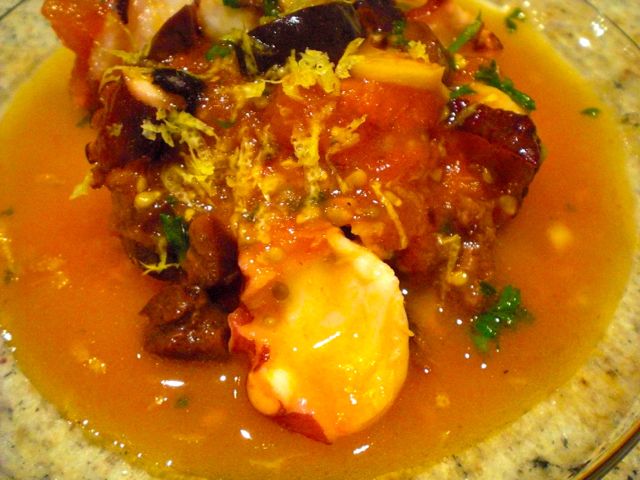
Octopus with tomato and olive イタリア風 たこ、トマト、黒オリーブ煮

I bought a boiled octopus leg at the Japanese grocery store on the weekend but I did not use it. I thought I should use it for something before it goes bad. I usually make Japanese dishes from octopus but this evening, we had already opened a bottle of "Bennett family Cabernet Sauvignon 2006". This wine will not go well with "sumiso-ae" 酢みそ和え. So, I concocted this dish; sort of Italian in style but I did not follow any recipe or I did not have any dish in mind to base this one on.

Octopus: The tentacle was medium in size, just boiled but not previously vinegared. I just sliced it rather thinly. To prevent it from getting too tough during cooking, I made shallow scores on one side.

I decided on making a quick tomato sauce "on the fly". So I skinned Campari tomatoes (4) and cut them into large chunks. I crushed and minced garlic (2 fat cloves). I removed the stone from black olives (6 or so, I am not sure what kind).

In a small skillet, I added olive oil (3 tbs) on low flame and added the garlic, red pepper flakes and slowly cooked it until the garlic became fragrant and very slightly brown. I added the tomatoes, chopped black olive, salt, and pepper. I turned up the heat to medium and cooked for 2-3 minutes (This is not really a tomato sauce). I then added slices of octopus and cooked for 30 more seconds or just until warm--not really cooking it further. I cut the heat and tasted it. I adjusted the seasoning by adding salt and a pinch of sugar since I thought it was a bit on the acidic side. I was thinking of adding lemon juice but changed my mind and only added grated lemon zest (using a micrograter) to give it a lemony flavor. I garnished  with chopped parsley (If I had fresh thyme, I may have used thyme). My wife quickly toasted some bread (store bought semolina bread) for mopping up the juice. 

For an instant improvised dish, this was not bad at all. The octopus slices were tender and not chewy. The red pepper flakes gave a pleasant buzz in your mouth. Even some acidity did not complete with the red wine we were having. This cab from the Bennett family winery is a middle of the road Napa cab, not over-the-top and not too austere. 

Monday, November 21, 2011

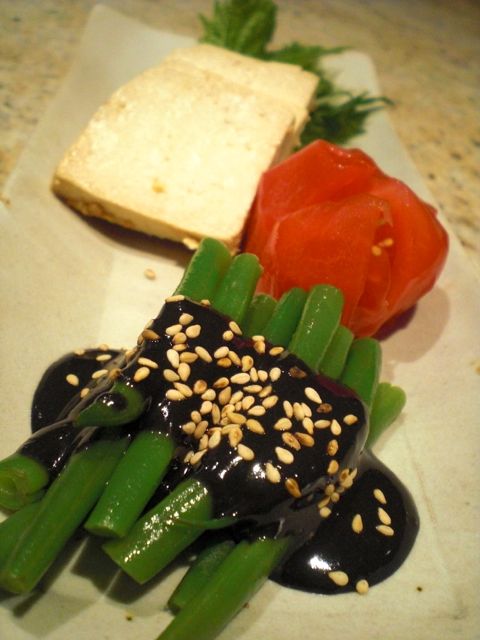
Green beans with black sesame sauce インゲンのねり黒ごま和え

This is another small dish I made one evening as a drinking snack. I usually use white sesame paste or "shiro-nerigoma" 白練り胡麻 to make sauce for green beans but I found that I was out of white sesame paste (it can be bought in a Japanese grocery sore and comes in a small can, glass jar, or plastic pouch) but I had black sesame paste "Kuro-nerigoma" 黒練り胡麻.

Not many food items are completely black; black sesame, nori sea weed, and squid ink are three I can think of. Some Japanese food products do contain charcoal powder and black, touting some health benefits, but I do not consider pure carbon powder food.

In any case, I trimmed and boiled green beans for 5 minutes or so until cooked but still crunchy. I immediately shocked them in ice water to make the color bright and to stop the cooking.

Dressing: I put the black sesame paste (3 tbs) in a small Japanese mortar or "suribachi" すり鉢 and added sugar (1 tsp), soy sauce (1 tsp) and mirin (2 tsp). Using a pestle "surikogi" 擂り粉木, I mixed it until a nice saucy consistency is reached.

I garnished it with roasted white sesame seeds. The taste is similar to white sesame paste but the visual effect is quite different. I served this with slices of miso-marinated tofu. This dish really depends on the quality of the green beans. Some green beans have tough skins and no matter how long you cook them, the skin remains tough and fibrous. This time, we were lucky. These beans were still crunchy but not fibrous at all and the black sesame dressing looked nice with great contrast to the red of tomato and white of tofu.

Saturday, November 19, 2011

Baked pork tenderloin salad オーブン焼き豚ヒレ肉のサラダ

Am I having too many padding posts?  I usually have two cooked meats readily available in our refrigerator--oven roasted pork tenderloin and microwaved chicken breast. This time it was the left-over pork that I used. I made this pork tenderloin several days ago using a dry rub I recently came up with (a mixture of ground smoked paprika, cumin, clove, cinnamon, black pepper and salt). Without searing the surface of the pork I put it in a 350F oven for 30 minutes or until temperature of the thickest part registers 145F.  The pork came out very tender and flavorful and it is surprisingly easy to make.

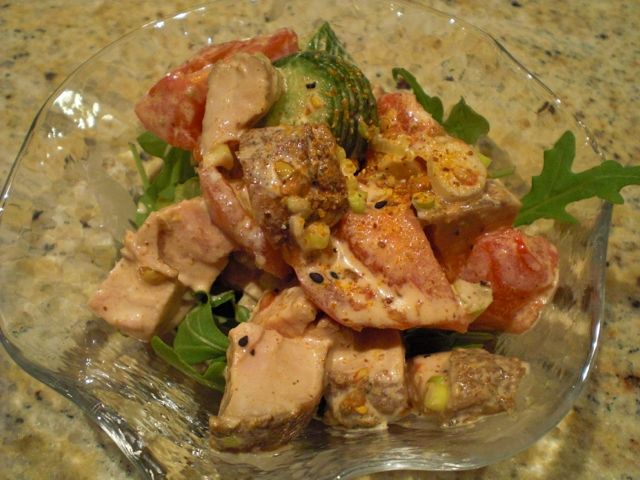
Using this tender and moist pork, I made this quick salad as a starter. I used all the usual suspects; small cubes of cooked pork tenderloin, snake-belly cut American mimicucumber, skined and quartered Campari tomato, finely chopped scallion and baby arugula. The cucumber was first dressed in sushi vinegar and then the excess liquid was squeezed out before comabining with the rest.

The dressing is simple store bought (real) mayonnaise, Dijon mustard, soy sauce and Japanese 7 favored red pepper powder 7味唐辛子. For good measure, I sprinkled 7 flavored pepper on the top.

We had this with a highly extracted Napa Cab loaded with fruits and full body, Hall Cabernet Sauvignon 2008. RP gave 95. With this price point, this is a good buy.

Thursday, November 17, 2011

Otokomae tofu 男前豆腐

The kind of Japanese dishes I can make in the U.S. is really driven by what ingredients are available.  I may have lamented the fact that the tofu we could get here was not really good especially the kind found in the supermarket. One of the Kyoto tofu makers called "Kyozen-an" 京禅庵 built a factory in New Jersey some years ago and their tofu was pretty good but after the incidence of salmonella contamination in their bean sprout products and failing FDA inspection, their tofu is no longer available in our near-by Japanese grocery store. Last weekend, when I was there, however, I found another Kyoto tofu called "Otokomae tofu" 男前豆腐. Sometime ago, I read about this tofu maker in Kyoto foodie. 

So, without hesitation, I bought one. It came in a very un-traditional shaped container (shaped like a surf board) and the printing on the front said something like "Blowing in the wind tofu maker, Johnny". "Johnny" is supposedly the nick name of the president of the company, Shingo Ito. I also noticed that the bar code on the lower right is shaped like a wave (tune 90 degree anti-clock wise) with a surfer on it (You will find a close up image at Kyoto foodie). It also states that it contains Hokkaido daizu 大豆 soy bean and natural coagulant (nigari にがり) from Okinawan sea water.

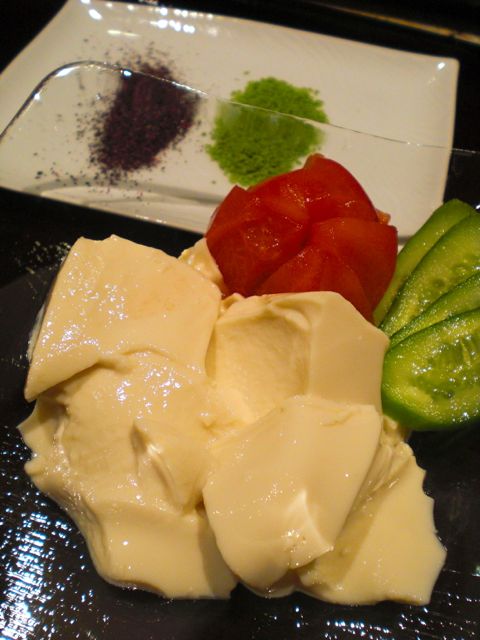
In any case, I figured that this could not be bad. I also thought that  this type of tofu was best eaten as is. I scooped up the tofu into glass bowls. Instead of my usual condiments for cold tofu, I decided to go with the simplest way to really enjoy the flavor of tofu.

As you can see below image, I served this tofu with green tea salt-obviously, the green one on the right and "Yukari" ゆかり salt - red one on the left - which is dried red perilla and salt, by-products of making picked plum or "umeboshi" 梅干し.

Most Westerners think tofu does not have any taste. Actually many supermarket varieties even have some unpleasent smell and taste. This tofu has a real nice flavor of soy beans and unctious creamy texture. We just sprinkled either green or red salt and really enjoyed this tofu. Hope I can get this next time I go to this Japanese grocery store (the only such store left in the neighbourhood).