Saturday, March 10, 2012

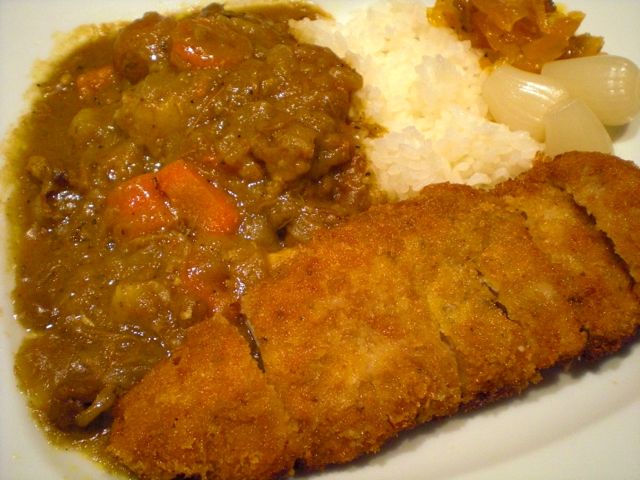
Pork Cutlet curry with rice カツカレー

This is another Japanese invention of "Yoshoku" 洋食 or Japanese-style Western (not cowboy Western) dish. Japanese like anything "curry" and put curry sauce even on noodles such as udon. This dish,"Katsu curry" is Japanese-style curry with rice which is topped with a cutlet of pork chop or "tonkatsu" トンカツ. This is a rather high-fat and high-calorie dish. I decided to make this dish one weekday evening since I had leftover curry sauce I made on the prior weekend and frozen pork chops in our freezer which, I deemed, were "aged" enough.

Curry: I made the curry sauce in a similar maner as I posted before using S&B brand mild curry roux. the only difference was that the amount of sauce I need to prepare (we had guests) was more than one package of the roux could handle. I supplemented the packaged amount with my own brown roux (olive oil and flour, onion, and Japanese curry powder). The vegetables included potatoes (small red new potatoes), carrots, and onion. It originally contained chicken thighs.

Pork cutlet: (This was made from pork chops I had sliced from the whole loin of pork and froze immediately some time ago). After I seasoned the pork chops with salt and black pepper, I dredged with flour, coated with egg water and Japanese panko crumbs. This time, instead of deep frying I shallow fried (half inch of peanut oil) (left in the image below). I cooked them on medium-low heat for 5-6 minutes on each side or until done. According to a French cook, Madeline, if you freeze pork for 21 days or longer, there is no more danger of contracting cysticercosis or pork tape worm even from undercooked pork. Althouhg my pork chops were safe by the Madeline's criteria, I was not taking a chance here and made sure the pork was fully cooked.
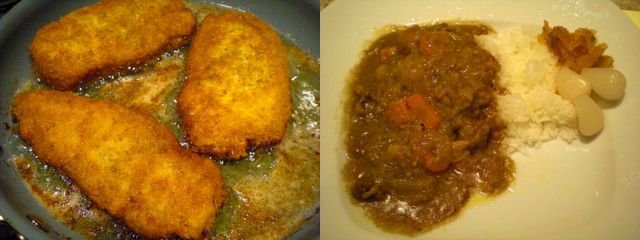
There are many different ways to serve the pork cutlet in this dish (on the top of curry and rice, additional curry sauce on the top, with shredded cabbage underneath, etc) but I just put the rice with side of regular Japanese condiments of pickled cocktail onion or "rakkyo" ラッキョウ and mixed pickled vegetable, "fukushinzuke" 福神漬け as you see above and then placed the cutlet of pork chops (pre sliced) on the side (the first picture).

My wife did not see the point of combining curry and rice with pork cutlet. She prefered eating the cutlet separately. So, I added Japanese hot mustard and "Tokatsu" sauce on the rim of the plate as well.

We had this with a very unususal and good Italian red from Umbria called Sportoletti Rosso Villa Fidelia 2008. This is a Bordeaux blend (Merlot and Cab Saub) of Italian wine. This one had lots of fruit upfront and was remarkably good. It tasted like a Bordeaux blend from Napa (coming from us, this is a compliment). This one also got 93 from Wine Advocate. I wonder, though, whether this is meant for export (especially to the U.S.) rather than for domestic consumption in Italy.

Thursday, March 8, 2012

Mixed mushroom stir fry with "shiokara" squid しめじとエリンギの炒め物塩辛いり

This is another example of making something out of whatever is available. I made a stir fry of three mushrooms and added squid "shiokara" 塩辛 or "squid and guts" to add interest. I had a combo package of three mushrooms which included white and brown clamshell (shimeji しめじ) and royal trumpet (simialr to eryngii エリンギ) as seen in the bottom picture (#1). I bought this at least one week ago and needed to use it quickly. Although these mushrooms, especially royal trumpet, will last a long time, aging does not improve the flavor. In addtion, I found a small pouch of "shiokara" or fermented squid and guts leftover in the refrigerator, which was thawed sometime ago. I checked it and it was still Ok but moving past its prime. So, the combination of these two ingredients culminated in this quick dish.

Mushrooms: I separated the white and brown clamshell mushrooms at the root end (left half in #1). I cut into the end of the royal trumpet and tore it into two or four pieces depending on the size the mushroom. (#2).

I first sautéed a shallot (one medium, thinly sliced) in olive oil and dark sesame oil (1 tbs) on medium high flame for s few minutes until soft and slightly browned. I then added the mushrooms. After an additional few minutes of sautéing, I added garlic (one small clove, finely chopped). When the garlic became fragrant I added sake (1 tbs) mirin (1 tbs), and soy sauce (1/2 tbs) and put on a tight-fitting lid and turned down the flame to let it steam for several minutes.
After the liquid was almost all gone (#3), I added "shiokara" squid and guts (2 tsp) and quickly mixed in then cut the flame (#3). After cooking, the volume of the mushrooms reduced quite a bit and the amount was just perfect for two small servings (#4).

I further garnished it with chopped chives and sprinkles of Japanese 7 favored red pepper powder or Shichi-mi tougarashi 七味唐辛子. This was a good dish for cold sake but, to me, it was too sweet (from the mirin and sautéed shallot). The addition of shiokara gave some saltiness and subtle and interesting sea food (or "fishy" if you prefer) flavor. I am not sure adding shiokara was particularly successful. Next time, I may stick to more simple butter and soy sauce with sake to make this dish.

Tuesday, March 6, 2012

Chicken cutlet 鶏のカツレツ

This is not blogworthy but I needed a padding post. When I made tsukune, I reserved the nicest solid pieces of meat from the chicken thighs with all the fat and small muscle removed (skin off) after using the rest to make hand chopped ground chicken. I just placed them in a small Ziploc bag smothered in sake for later use. We found that marinading the chicken (or other meat for that matter) with sake makes it last longer and tenderizes it. I made this dish one evening.


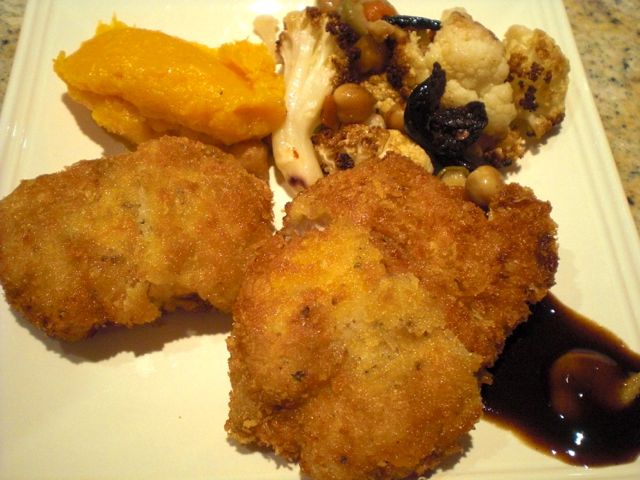
I seasoned the chicken thigh meat with salt and pepper. Dredged with flour, egg water and panko bread crumbs.  Instead of deep frying, I shallow fried with not more than 3 tbs of oilve oil in a small (8 inch) frying pan. I fried it in medium-low flame for few minutes on each side until just done. I served this with tonkatsu sauce with Japanese hot mustard, my wife's baked cauliflower, olive and chick peas, mushed baked butternut squash (with butter and honey added). These are just a simple good combination. 

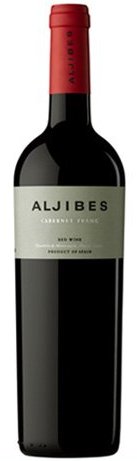
We had this with a very unusual Spanish wine made of 100% cabernet frank, Bodegas Los Aljibes Castilla Leon Cabernet Franc 2007. This one got 93 from Wine Advocate. I am not a big fan of Cab frank especially 100% cab frank. I am not sure I would give 93 for this wine. For me it is 89-90. Nevertheless, this food and wine combination was certainly nice enough for a weekday.

Sunday, March 4, 2012

Braised "kinpira" lotus root 蓮根の金平

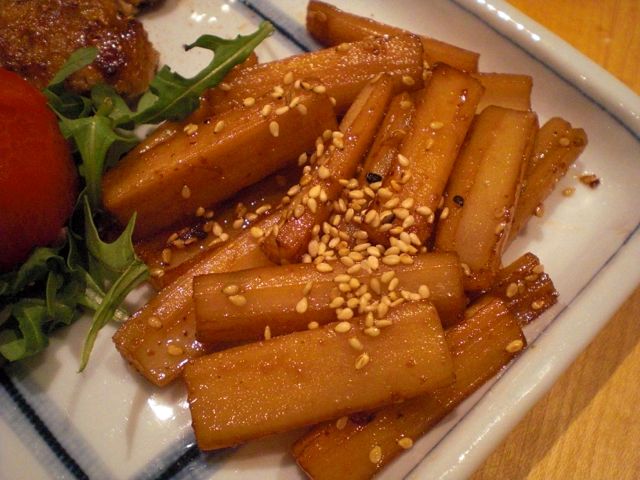
When I made chicken "tsukune" つくね patties with chopped lotus root or renkon 蓮根, I made this dish from whatever lotus root was leftover. I usually slice lotus root across so that it looks like a round with multiple concetric holes. I decided to cut it differently this time to make it really crunchy and made "kinpira" 金平 or braised lotus root. 

Lotus root or renkon: Since it is nearly impossible to get fresh renkon, I usually get cleaned and boiled lotus root which is vacuum packed. Actually, it is much easier to prepare and the texture remains quite good and crunchy. I first cut the lotus root across in 2 inch or so segments. Then cut the segments into thick (1/2 inch) pieces along the long axis. I then cut, again, along the long axis to make thick battons like you see above. I used about 3/4 of the one package of renkon which yielded 2 servings.

Kinpira reparation is the same as before. I first sautéed the rekon for few minutes in a vegetable oil (1/2 tbs) with a splash of sesame oil. I sprinkled on Japanese 7 flavored red pepper powder 七味唐辛子.I then braised it by adding sake (1 tbs), mirin (1 tbs) and soy sauce (1-2 tbs) until the liquid was almost all gone. I garnished it with roasted white sesame seeds. 

Compared to the more classic burdock root kinpira, this has a better nice crunchy texture but burdock root has a more nutty earthy flavor. This was served with tsukune with chopped renkon

Friday, March 2, 2012

Chicken "tsukune" with lotus root; two ways 蓮根入り鶏のつくね、2種類

I posted two versions of chicken patties or "tsukune" before. There are many variations to the recipe. Some put egg, grated nagaimo or yamaimo, chopped up chicken cartilage, shiitake mushroom etc. We do not particulary like having bits of cartilage in the meat. Instead, to add an interesting texture contrast, I added finely chopped lotus root or renkon 蓮根. The renkon bits do give some crunch but not like cartilage or bone bits.

Tsukune mixture: I hand chopped to make ground chicken from thighs (2 large) but of course you could just buy ground chicken or use a food processor. I like to use thigh meat with a bit of fat. I mixed in finely chopped onion (1/2 small), ground ginger (1/4 tsp), sliced and chopped lotus root (1/4 of vacuum packed pre-boiled), yuzu-kosho (1/2 tbs or more). As I mentioned, one could add more ingredients such as ground nagaimo or yamaimo, tofu, beaten egg etc. Using the same mixture I cooked it in two ways.

In the first version, I spread the meat mixture on the square (1/4 of full nori sheet) of nori and fried it--meat side first and then nori-side. Dishes with nori involved often include a word "seashore" or "Isobe" 磯辺. So this is "Isobe" grilled chicken patty. I made an equal mixture of mirin and soy sauce and added it to the pan towards the end of cooking and coated the chicken patties. After removing the patties from the pan, I further reduced the sauce until it was rather thick and put back the patties to coat. I sprinkled Japanese "sansho" 山椒 powder. I served this with "kinpira" or braised lotus root (This was made from the remaining lotus root, a subject for another post). I should have taken pictures with this dish turned over to show the piece of nori.
 The next day using the same mixture, I made the tuskune in the regular way (pan fried and then braised in mirin and soy sauce) and served it with celery salad with powdered kelp or "kobucha" 昆布茶 and olive oil.
The Addition of lotus root and yuzu-kosho made this tsukune pretty good. I like grilled yakitori style tsukue best but when you cannot grill, pan frying like this is also excellent.