Saturday, November 14, 2020

Grilled yellowtail filet ハマチの塩焼き

Choosing among the whole fresh fish available from HMart Korean grocery store, we tried "yellowtail" this time. The Japanese name may be "hamachi" ハマチ  but the Japanese name changes as this fish grows. If the fish is over 80 cm, it is called "Buri" ブリ which appears to be the uniform nomenclature throughout Japan.  The younger, smaller yellowtail, however, has many different names depending on the locale. The one we got may have qualified as a small "hamachi". Of course, the best way to enjoy hamachi is as sashimi, but this one was not fresh enough for that. So, after I cleaned the fish I made what is known in Japanese as sannmai-oroshi 三枚おろし  or “three layers” which consist of two filets and a central layer of bone with bits of meat still attached between the bones. I cut one of the filets into serving size, salted it and let it stand in the refrigerator for several hours. I blotted the surface with paper towel, re-salted and cooked it. It would have been best grilled over a charcoal fire but I simply cooked it in a frying pan with a small amount of olive oil. I served it with salted vegetables 浅漬け (Cucumber, nappa cabbage, thick rectangles of daikon), myoga in sweet vinegar 冥加の甘酢漬け and blanched broccoli. I found that we had a chopstick rest shaped like myoga so in keeping with the theme included it for the chopsticks on the tray. This dish was quite good with cold sake.


When we received the fish, it was about 30cm in length and came gutted with tail and fins cut off but the head was still on. After I prepared the fish, we had two half heads (cut in half along the spine,) two collars and two filets.

I cut the two filets into small serving size. I cooked one of the filets as shown here. I marinated the other filet in sake lee ハマチの酒粕味噌漬け. I simmered the heads as "Kabuto-ni" 兜煮, and the collars or "Kama" カマ were frozen for later. I also scraped off all the meat from the bone and also removed the meat from skin of the tail portions and used it to make a yellowtail burger ハマチバーガー (all the subjects of future posts). So every part of the fish, except the bones and fins was used— nothing was waste. In so doing I hope we did justice to what this lovely fish had to offer.

Wednesday, November 11, 2020

Banana carrot muffin バナナニンジンマフィン

 This is another muffin my wife made. We thought it was a bit unusual since it uses grated fresh carrot and banana. My wife got this recipe from her sister. It came from “Wild about muffins” by Angel Clubb.  Although we do not know the published date, this book appears old. After just a quick search on the internet, however, it appears that there are quite a few muffin recipes using bananas and carrots. So, apparently, although we have not heard of it before,  this is not such an unusual combination.


Some recipes add nuts but my wife added raisins as per the recipe she used.


Ingredients: (Makes 12 muffins)
Dry ingredients
1 1/2 cup (210g) AP flour
1/2 cup (85g) sugar
2 tsp baking powder
1 tsp baking soda
1/4 tsp salt
1/2 tsp nutmeg
One pinch of ground cloves
1 cup (125g) grated carrot

Wet ingredients
2 eggs
1 Tbs. molasses (this plus the white sugar results in brown sugar)
1/2 cup(125ml) oil
1/2 cup (125) buttermilk
1/2 cup (125ml) mashed banana
1 tsp vanilla

Other ingredients 
1/4 cup (40g) raisins (optional)
nuts (optional)

Directions:
Combine the dry ingredients and add the carrots stirring until they are coated with the flour. This helps keep them from sinking to the bottom of the muffin. Mix the wet ingredients together and combine them with the dry ingredients. Add the raisins and mix until they are incorporated. Using a large scoop put the batter in a well greased muffin tin. Cook in a 400 degree oven until a skewer comes out clean about 18 to 20 minutes.


These muffins were quite good. They were very moist with a mild nutmeg banana flavor. The raisins are a nice addition. They are a nice addition to any breakfast. Next time we might add some nuts.

Sunday, November 8, 2020

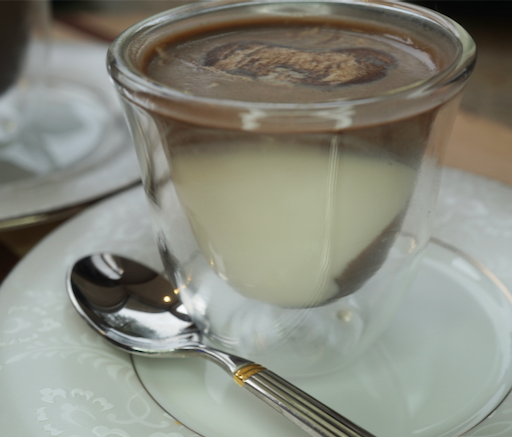
Chocolate vanilla panna cotta チョコレート、バニラ パンナコッタ

As I mentioned before, my wife grew up with desserts as the end to a dinner. It was a kind of parental bribe, "eat all your dinner or you won't get dessert." So for a little kid the dessert was almost the goal of the meal. As I also mentioned I did not grow up with desserts so if my wife wants one usually she has to make it. (I, however, am not the least bit averse to helping her eat any dessert she may come up with) She makes a buttermilk panna cotta that we really like. With this success and after cruising several recipes on the internet, she was inspired to try a variation. She came up with this two layer, chocolate and vanilla panna cotta. She served it in a small double walled espresso glass. This makes a nice dainty dessert that is perfect for us. The recipe, however, can be scaled up for larger servings. 


Ingredients:
1 tsp. gelatin
3 Tbs. water
3/4 cup 4% milk
3/4 cup cream
1/4 cup sugar

for flavoring:
1/2 tsp vanilla
3 Tbs. cocoa powder

Directions:
Bloom the gelatin in the water and set it aside for a few minutes. Add the milk, cream and sugar to a sauce pan and heat gently until the sugar melts (don't boil). Take a ladle of the warm milk mixture and add to the gelatin mixture until the gelatin is completely melted into the milk. Add the melted gelatin into the rest of the milk mixture. Divide the milk mixture in half. Add the vanilla to one of the halves. Pour into a glass container that has been tipped on its side. See picture below.


Put into the refrigerator until it becomes firm. Meanwhile put the cocoa powder in a small bowl. Scoop in some of the milk mixture and stir to form a paste. Add back into the milk mixture. Stir to fully incorporate. When the vanilla mixture become firm add the chocolate mixture on top. Put back into the refrigerator until everything becomes firm.

This is a lovely little dessert. The texture is very creamy and smooth with a nice chocolate flavor contrasted with the vanilla. Just a few sweet bites to round out any dinner.

Thursday, November 5, 2020

Cream cheese and chive with white bread muffin

This is one of my wife's baking projects. She likes cream cheese with onions and chives. It come in a small plastic tub. She usually uses it for mashed potatoes. She noticed that there were several containers in the fridge that were not getting any younger. She also like muffins stuffed with a “surprise” such as sweet potato or flavored ricotta cheese. So she decided to use the cream cheese in muffins. She used her favorite white bread recipe (which surprisingly we have not blogged before) and filled it with cream cheese as shown below.


I will turn the next part over to her

Ingredients
1/2 cup milk
3 Tbs. sugar
2 tsp. salt
3 Tbs. butter
2 packages yeast
1 1/2 cup warm water
4 -6 cups bread flour

for the filling:
1 tub of Philadelphia cream cheese with chive

Directions:
Combine the milk, sugar, salt and butter in a sauce pan and heat up until the milk is scalded and the other ingredients have melted or dissolved. Add the water and let the mixture cool. Add 4 cups of bread flour and yeast to a stand mixer. When the milk mixture has cooled add it to the flour while stirring on speed 2 with the bread hook. Add more flour as needed to make a smooth workable dough. Put dough in a bowl and coat the surface with vegetable oil to keep it from drying out. Let rise until doubled.

Form the muffins by punching down the dough. I weighed the dough and decided to make muffins weighing 2 1/4 or 63.78 grams. With this dough I got 20 muffins. I then used a small ice cream scoop for the cream cheese and made 20 balls weighing about 11 grams. I folded the dough over the individual cheese balls and placed the muffins in a heavily greased pyrex baking dish. I baked them at 400 degrees for 18- 20 minutes or until they sounded hollow when tapped.

These muffins were pretty good. As usual an air space developed above the cheese. I fully expected the cheese would melt into the bread but was surprised to find it sitting there about the same consistency as when I put it in the dough. (Made me wonder what the cream cheese was actually made of). The bread was good as always and the cream cheese flavor was very pronounced. But I have to say in all honesty the easiest thing to do in the future if we want this flavor combination is just to make the muffins and smear the cheese on with a butter knife.

Monday, November 2, 2020

Baguette bake in ceramic baker version 4

This is the 4th installment in the continuing saga of trying to bake baguette using the Emil-Henry ceramic baguette baker. I think this time, it came out best among the 4 tries. Again, I made sure we only used 3 cups of flour in total, otherwise the baguettes become too large and fuse together.  The below is when it came out of the oven. The center portions of each baguette still stuck to the baker.


So we decided to let them cool before trying to remove them. Although, even then, we had to use a small spatula to “encourage” them to give up their stronghold on the baker. We were finally able to take them out without breaking the crust (below).


Here is the summary of tips for using the Emil-Henry ceramic baguette baker.
1. The total amount of flour is 3 cups. In our case we used a biga starter (1 cup bread flour, 1 cup buttermilk and 1/8 tsp instant yeast, let it ferment overnight). I added 2 cups more of bread flour). This time I had to add a bit more water.
2. Baked 25 minutes450F with lid on and an additional 10 minutes with the lid off. The additional 5 minutes of baking without the lid on made the crust more brown and harder. The harder crust appeared to help in removing  he baguette without breaking the crust.
3. Let it cool down before removing the baguette.
4. As suggested by a friend, I dusted the baker with cornmeal. I am not sure whether this helped or not. The cornmeal did not stay in the area that stuck the most since the baguettes are not flat.

In any case, we had the best baguette so far without a broken crust. Because of the slightly longer baking time, the crust was browner and a bit harder than in the previous tries. Nonetheless it tasted really good and the crust was just nicely crunchy not too thick or hard. They should have included better instructions with the baker. It should not be this difficult but, in the end, you cannot beat the crust this baker produces

Addendum (10/26/2022)
Despite all the tips described above, the next time I made baguette the center baguette stuck to the two on either side. So, this time, I made only two baguettes and left the center slot empty. This worked much better. There was some minor sticking but the baguettes came off the baker with intact crust. Finally perfection has been achieved. 


Ingredients for two mini-baguettes
2 cups bread flour
1 cup water 
1 tsp active yeast
1 tsp salt

Bake 450F with the lid on for 25 minutes and with the lid off for 5 minutes.