Thursday, June 3, 2021

Mint and pea kakiage ミントと豌豆のかき揚げ

Sometime ago, I saw this recipe in the web version of a Japanese newspaper. I thought mint and pea kakiage (a type of tempura made with several small food items) かき揚げ was very interesting and unique but was dragging my feet in actually making it. The mint crop is flourishing in our herb garden and my wife harvested some to make mint tea recently. She reserved some mint leaves for me to use for this kakiage (so I found myself fresh out of any excuses for not making it.) Finally, I made this dish one weekend evening. I served it with wedges of lemon and green tea salt.


I did not remember the details of the original recipe (and I could not find it any longer) but I used cake flour and carbonated water to make rather thin tempura batter and it came out very light and airy.


Ingredients (I did not precisely measure anything but it made four kaiage tempura).
About 1 cup of fresh mint leaves, washed and dried.
About 1/2 cup of peas (I used frozen petit peas, thawed).
Cake flour for dusting.
Peanut oil for frying.

For Tempura batter
About 1/2 cup cake flour
Cold carbonated water.

Directions:
Lightly dust the mint leaves and peas with the cake flour (#1 in the third picture)
Mix the cake flour and the carbonated water to make thin tempura batter and add the peas and mint leaves (#2)
Using a slotted spoon, I scooped up the mint and peas and slid the clump into the hot oil (350F) (#3)
Turning once, I fried them until crispy and slightly golden then drained them (#4)


We couldn’t taste much of the peas but this was very light, airy and crunchy with refreshing mint flavor. Perilla leaves, which are a bit similar to mint leaves, are a standard tempura item which I have used in several variations but mint leaves are certainly unique. Since we have a good supply of fresh mint leaves during the summer, we might try this in different combination...asparagus and mint immediately comes to mind.


Addendum
I made this dish again a few days later. I also found the original recipe and only thing I missed was adding potato starch (should equal 1/2 the amount of cake flour used). I also added fresh corn. I lowered the hot oil temperature to avoid browning. All worked better.


Monday, May 31, 2021

Tarako from Korean grocery store Hmart 焼きたらこ

 Lightly grilled salted "tarako" たらこ cod roe is not really a new dish as I posted it many years ago,  but it is a very common dish in Izakaya and goes perfectly well with sake. I usually get tarako (frozen) from our Japanese grocery store, but this time I got it from Hmart, the Korean grocery store, through Instacart.  The groceries were delivered while I was not at home so my wife received them. During a subsequent phone call,  she mentioned that it was not a completely successful grocery run since the three types of fresh mushrooms and the mackerel we ordered were not available. The good news was that the "tarako" did arrive. She said something was wrong, however, because it was covered with a red goopy stuff and suggested that maybe the little egg sacks had somehow ruptured spilling their contents. (Not good!) So when I got back in the evening and inspected the tarako I found it was coated with a Korean hot sauce "gochujang". We were both relieved and had a good chuckle. Since we are not into very hot spicy food, I quickly rinsed off the hot sauce. I made "Tarako" pasta たらこスパゲッティwith it and it was just fine. I made the dish shown below from the last sac of tarako. I just cooked it in the toaster oven until the surface was cooked but the insides were still raw. I served it with a Dashimaki omelet だし巻き I had made.


This was a part of several appetizers I served that evening (second picture). From left to right; Eggplant in seasoned broth 茄子のお浸し、deviled egg from pickled eggs my wife made,  salmon in sweet vinegar 鮭の南蛮漬け. The bottom right are oven-baked potato chips which my wife is in the process of perfecting and which will be subject of another post. The dish on the bottom left is a dipping sauce my wife made to go with the potato chips.


In any case, we started the evening with these small appetizers.

Friday, May 28, 2021

Eggplant in seasoned broth 茄子のお浸し

We got 2 fairly large Japanese (or also called Chinese or Asian) eggplants (long and light purple colored). So, one evening, I made this dish from one of them. This is based on a recipe I found on-line. It was a shortcut recipe since the eggplant was microwaved but it turned out pretty good.


I topped this with dried bonito flakes or "Kezuri-bushi" 削り節.


Ingredients: (makes about 6 small appetizer servings like in the first picture)
One Japanese eggplant (this was large about 10 inch long)

For seasoned broth (mix first two items)
1/4 cup Bonito dashi broth (As usual I made this from a dashi pack).
1/4 cup or "to taste" concentrated Japanese noodle sauce (from the bottle)
Dried bonito flakes for topping.

Directions:
Remove the stem end of the eggplant and remove the skin in stripes using a vegetable peeler,
Cut lengthwise into two pieces.
Cut the two pieces further into bite sized pieces (called "ran-giri" 乱切り, cut in 45 degree angle as you rotate 90 degree).
Immediately soak in salted cold water for 10 minutes (water darkens).
Wash in cold running water.
Place the eggplant in a silicon container for microwave cooking and microwave for 1 minute (depending on the size of the eggplant and the wattage of the microwave oven).
Let it cool down until it can be safely handled.
Place the eggplant in the seasoned broth and refrigerate for a few hours.
Top with the bonito flakes just before serving. 

Since this type of eggplant is not as "bitter" or astringent as Western eggplant, soaking in salted water and microwaving worked. The skin is also much more tender than that of Western  eggplants. The seasoned both really made this dish. Perfect gentle cold dish for summer.

Tuesday, May 25, 2021

Scalloped potato with cauliflower puree

My wife came up with this dish one day. A few days before I had made my usual Cauliflower puree. Beside eating it as an “adult baby” food, we have made Mac-and-cheese using the puree instead of Béchamel sauce. I am not sure how she came up with this dish but, it is essentially scalloped potatoes made with the Cauliflower puree, cheese, onion and jalapeño pepper. This was topped with several kinds of cheese and baked.


After the servings were cut out, you could see multiple layers of thinly sliced potato with cheesy sauce. The green bits are chopped Jalapeño pepper. She ended up making a quite large amount but we managed to enjoy it all as a side for lunches and dinner and also as appetizers. Probaly not as rich as if we made this with full-fledged Béchamel sauce but it was quite good.


I ask my wife to provide the recipe. I help her by slicing potatoes, onions, and chopping up Jalapeño pepper.


Ingredients:
Two russet potatoes thinly sliced
2 onions thinly sliced
2 jalapeño pepper
1 cup of cheddar cheese grated
1 cup monterey Jack cheese grated
1/2 cup parmesian cheese grated
Several slices of smoked gouda to top.
Enough cauliflower puree to cover several layers


Directions:
Cover the bottom of an oven casserole dish with the puree. Distribute a layer of potatoes (#1) then the sliced onions, jalapeño pepper and the various cheeses (# 1&2) then the cauliflower pure (#3) Keep layering until all the ingredients have been distributed. End by putting on slices of smoked gouda (#4). Cook in a 400 degree oven covered for 30 minutes. Remove the cover and continue cooking for 30 minutes until the potatoes are tender and a knife slides in easily. Let cool for 15 minutes before serving.


This is a very comforting dish with thin layers of potatoes between custard like layers of warm cheese. The jalapeño peppers and onion give a nice flash of flavor. You would never guess that cauliflower was one of the main ingredients. It heated up nicely in the microwave. This would the a staple for any menu. 

Saturday, May 22, 2021

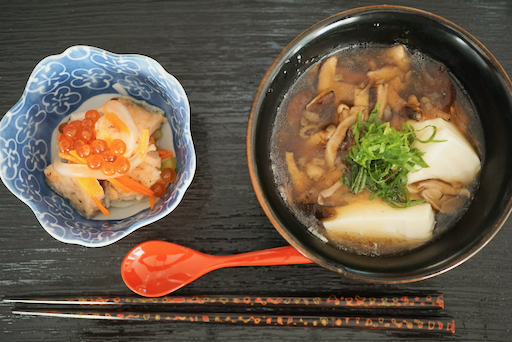
Warm tofu with shiitake sauce 豆腐の椎茸あんかけ

 For some reason, it is getting more and more difficult to get fresh whole shiitake mushrooms. Our regular grocery store used to carry them but now only pre-sliced shiitake are available.  Whole foods used to have them regularly but it is now hit or miss. This time, we tried Hmart, Korean grocery store, through Instacart. Despite  the specific instruction that we wanted only whole fresh shiitake, we got pre-sliced. I decided to cook them so that they would keep longer and if needed I could also freeze them. So I just sautéed the mushrooms with olive oil, finely chopped red onion (I happened have extra finely chopped red onion left over from another dish). Several days later, I made this warm tofu dish from silken tofu (right, in the first picture). I also served fried salmon in sweet vinegar 鮭の南蛮漬け topped with ikura (left in the first picture)


I garnished it with chiffonade of perilla.


This is our stand-by dish but the ikura was soaked in a mixture of Japanese bonito broth and concentrated noodle sauce which makes the individual ikura swell up and give a nice snap with more flavor. 


Ingredients:(two small servings)
1/4 silken tofu, cut into two cubes
1 inch long dried kelp (for making broth)
Water

For "ankake" 餡掛け sauce
1/2 cup (arbitrary) sliced fresh shiitake mushroom (in my case mixture of finely chopped onion and pre-sliced shiitake sautéed in olive oil)
1/2 cup dashi broth (I used bonito broth using dashi pack)
1 tsp potato starch ("katakuri-ko")
1 tbs sake
1-2 tsp of concentrated noodle sauce (from bottle) to taste.
1/4 tsp grated ginger
chiffonade of perilla (optional)

Directions:
Wipe the kelp with a wet towel. Put in a pan and add water. When it comes to boil turndown the flame to simmer and add the tofu cubes to warm (5-10 minutes)

In a small sauce pan, add the bonito broth and the shiitake. Let it come to boil then turn down the flame to simmer. Cook for a few minutes. Add the concentrated noodle sauce to taste. Thicken the sauce by mixing in the potato starch slurry (with sake) and cook for few more minutes. Add the grated ginger and cut the heat.

In a bowl, carefully scope up the warm tofu cubes with a slotted spoon draining water. Pour over the "ankake" sauce and garnish with chiffonade of perilla (if using).

This is a nice, very gentle dish with soft and warm silken tofu with mild flavors of soy sauce, broth and shiitake. Although the day was not cold, we enjoyed this with cold sake.