Thursday, April 28, 2011

Parent-offspring (chicken and egg) bowl 親子丼

This was a "shime" 〆 dish I served one evening. Chicken and egg bowl or "Oyako donburi" 親子丼 is a classic "donburi" or one bowl dish. It sounds a bit gruesome when it was translated literally into English. Albeit less common, the combination of salmon and salmon roe donburi also falls into this category of "parent-offspring" bowl.


For 2 servings, I used chicken thighs (2, deboned, skin removed and cut into bite size), small onion (1, halved and thinly sliced), shimeji mushroom (root end cut and divided, or fresh shiitake mushroom stem removed, arbitrary amount or "tekiryou" 適量), some kind of green (spinach is most commonly used, here I used baby arugula, again, an arbitrary amount) and eggs (two, I used one brown and one pasteurized shell eggs for the reason you will see below).

Broth: I just used instant dashi granules dissolved in hot water (half cup), I added mirin and soy sauce (1 tbs each). You would like to have the broth a bit stronger than a soup but not as strong as a dipping sauce. I tasted and added a bit more soy sauce.

In two non-stick small (8 inch) frying pans on a low flame, I poured the broth and arranged the onion and mushroom. I put on the lids and let it simmer for 5 minutes or until the onion was almost cooked. I then added the chicken and let it cook for another 3-4 minutes or until the chicken was just cooked through. I added the greens and poured the beaten brown egg over it (divided between two pans). I put the lids back on and let it simmer for 2-3 more minutes or until the egg is almost completely cooked (image below), I turned off the fire and poured the beaten pasteurized shell egg over everything and put back the lids letting the pans steep for 1 -2 more minutes. (The beaten pasteurized egg should not be completely cooked).

I slid everything onto a bowl of warm cooked rice (I used leftover frozen rice, microwaved). By this time only a small amount of the broth remained.

This is best when the egg is semi cooked (or "hanjuku" 半熟). This is the reason, I added the beaten pasteurized egg after I cut the flame. This dish is a classic comfort food and perfect for lunch, dinner or "shime" 締め.

Tuesday, April 26, 2011

Daikon "steak" with balsamic vinegar reduction 大根のステーキ

This is a very interesting dish. This may be the best way to introduce "daikon" to the uninitiated. I had a daikon I bought sometime ago sitting in the refrigerator. I wanted to use it before it went bad. I decided to explore something I have not tried. I came across this dish in e-recipe. I deviated very slightly from the original recipe, although this was the first time for me to make this dish (my instinct makes me change the recipe on the fly).


Daikon: I first cut about 1 inch thick rounds (two) and peeled the skin. I precooked the daikon in water with a pinch of raw rice for 30 minutes. After it was cooked, I washed it in cold running water. I kept this cooked daikon in a container in a refrigerator for later use.

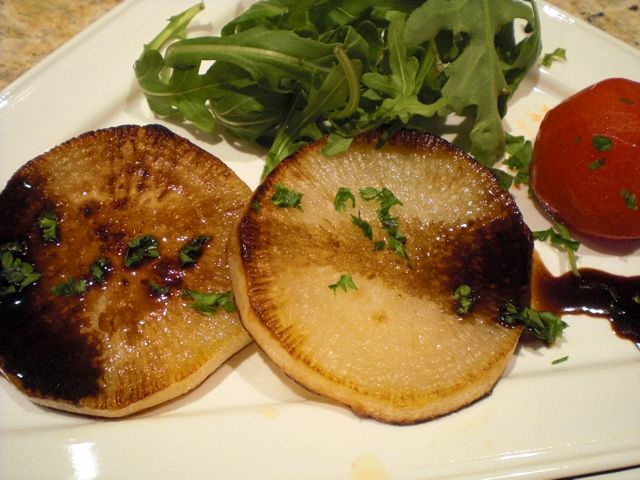
Several days later on a weekday evening, I decided to finish this dish. (Since this dish turned out to be very good, I made it again several evenings later, see #4 in the image below). I decided the rounds of daikon might be a bit too thick and sliced each round into two 1/2 inch thick rounds. I simply fried the daikon rounds in a flying pan on medium flame with light olive oil (1 tbs) for 2-3 minutes on each side until both sides were nicely brown (#1 in the image below).

Sauce: After I removed the daikon from the pan, I added balsamic vinegar (5 tbs) and let it reduce in half (#2). Instead of sugar or honey (as suggested in the original recipe), I added mirin (2 tbs or, as in my steak sauce, I could have added port wine here), soy sauce (2 tbs) and let it reduce further. When the bottom of the pan was just covered with liquid and the sauce was getting somewhat viscous, I added pats of butter (2 tsp or whatever amount) and finished the sauce (#3). This is the next evening when I served the same dish with drunken Camapari tomato and brocollini (#4).


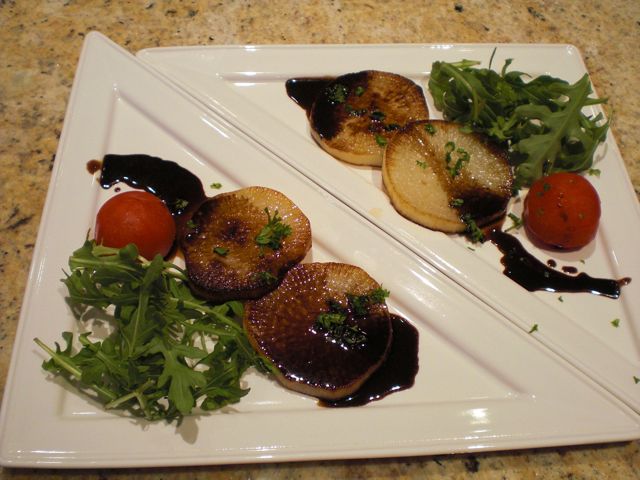
My wife got these funky triangular plates sometime ago and I decided to use it for this dish (2nd image above). I garnished the daikon with chopped parsley with an accompaniment of Campari tomatoes and baby arugula. This is a very good dish. Not quite steak but it has a similar consistency and the sauce went very well with it. This arugula had a very strong peppery taste complimenting the dish. The wine we had with this is not outstanding but OK California Malbec, 2007 Dry Creek which went very well with this daikon steak. Very good and interesting fusion dish.

Sunday, April 24, 2011

Chicken breast with sesame paste dressing 鶏胸肉の胡麻和え

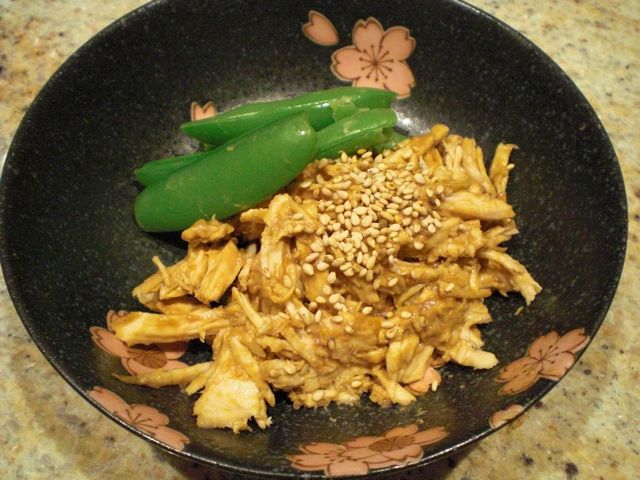
This is a classic small dish perfect for an Izakaya. In the original form, the chicken breast is steam cooked in sake or "sakamushi" 酒蒸 and thin strands of breast meat is teased out rather painstakingly and dressed in sesame paste dressing. This was a weekday quick dish, so I just used the leftover chicken breast which was barbecued. As a result, the chicken has a bit of smoky flavor which added a dimension of complexity to this dish. I did not teased out the chicken breast as carefully as I should have but strands of the meat were separated along the grain of the meat. The sesame dressing is made as usual; in a small Japanese mortar or "suribachi" すり鉢, add Japanese white sesame paste or "nerigoma" 練り胡麻 (2 tbs), sugar (1 tsp) and soy sauce (2-3 tabs) and mix with a pestle or "surikogi" 擂り粉木. I taste and add more soy sauce and/or sugar during the process. If the consistency is too thick, add some dashi broth or just water. Dress the chicken meat and top it with roasted white sesame seeds. I blanched "sugar snap*" peas (shocked them in a cold water to preserve the vibrant green color) and served as a garnish.

*My understanding is that these sugar snap peas are a hybrid cultivar developed in the U.S. and then introduced to Japan. This is often referred to (or at least used to be) as  "Snack" endou スナック豌豆 in Japan. Obviously Japanese misheard "snap" as "snack". Japanese government corrected this and this type of pea is now officially called " Snap" endou or スナップエンドウ.

Friday, April 22, 2011

Sautéed squid with ginger soy sauce イカの生姜焼き

Just after we got married, we rented a house that had a locally-owned grocery store within walking distance. The fishmonger there was Asian and really knew his fish. As a result, we were able to get some remarkably good and interesting fresh seafood. It is really good the store was within walking distance because the refrigerator in the house was from the 1950s and the freezer was only large enough to hold a box of frozen peas. As a result we had to stop almost everyday to buy food for dinner. One day, I came home and there was a bag of fresh squid sitting in the kitchen sink. Apparently, my wife bought fresh uncleaned squid from the fish monger. According to my wife, the cashier asked her, during checkout, if she knew how to clean and prepare squid. She answered with a definitive "NO", but said she assumed, since her husband was Japanese, he would know. Luckily, she assumed correctly. She should have realized, however, that not all Japanese, especially men, know how to clean and prepare squid. I can not remember what I made from the squid that day, just that my wife had such implicit faith (well placed or otherwise) in my culinary skills.

In contrast, where we now live, most squid is of either the previously or "presently" frozen pre-cleaned variety. To my pleasant surprise, however, I found fresh squid (uncleaned) at one of our regular grocery stores. Naturally, I had to get some. Although the freshness was nothing close to those available in Japan (many are still alive), this is much better than frozen ones. Although the exact variety is unknown to me, it was larger than most frozen squid.
I pondered what to make from this squid but decided to make it in a classic Izakaya or street food way; grilled squid with ginger soy sauce. Otsumami yokocho おつまみ横町 page 74 has a similar recipe but this type of squid dish is rather classic. I remember this type of squid (served on a stick, see image on the left) was one of my favorite food stand foods during Japanese festival days* or "en-nichi" 縁日 when I was a kid. (Image from http://wallpaper.free-photograph.net/jp/photobase/yp5821.html).

*The closest equivalent I can think of in the U.S. would be a county or state fair.
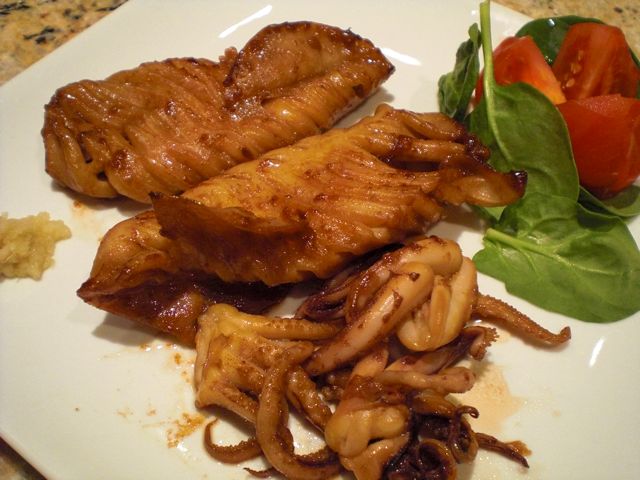
Just in case you have never cleaned squid: You first have to remove the innards by gently pulling the tentacles while holding the body. If you pull it correctly, all the innards come out in one piece. Then remove the cartilage which runs the entire length of the body of the squid. My squid must have had a hard life. The cartilage was broken in the middle in almost all of them. In that case, you have to go back with you finger into the body cavity of the squid and get the remaining cartilage out. As for the tentacles, I cut into them just beneath the eyes and go under the "beak" to cut them from the eyes and innards. If the beak was still attached to the tentacles, make sure you remove it. I then cut the tentacles at the base into two parts. I removed the skin from the body tube, although you do not have to do it. I did not remove the "fin" at the top of the body called "enpera" エンペラ. I scored the tube in an oblique fashion on both sides to make it easier to eat.

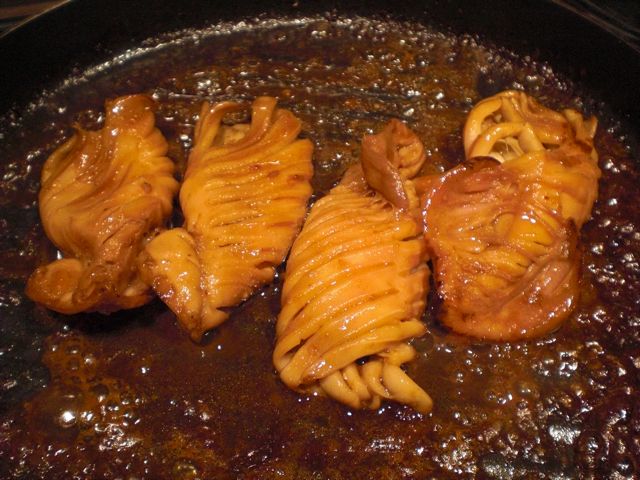
I first marinated the prepared squid in a mixture of sake and soy sauce (1:1) and grated ginger root (1/2 tbs) for several hours in the refrigerator. Since I could not have a charcoal fire to grill the squid, I sauteed it instead. After I removed the squid from the marinade, I carefully dried them with paper towels despite this liquid came out from the squid while cooking and prevented it from nicely browning. This was unavoidable since I did not grill on a charcoal fire. After a few minutes turning once I added a small amount of the marinade and reduced the heat for 2-3 minutes and made a sauce to coat the surface of the squid (see below). If I was grilling I would have brushed on the marinade towards the end of the grilling.

This was not one of my best efforts but the squid was very tender and soy sauce ginger flavor was perfect. For a good measure, I also added a small dab of freshly grated ginger root. We had this with cold sake.

Wednesday, April 20, 2011

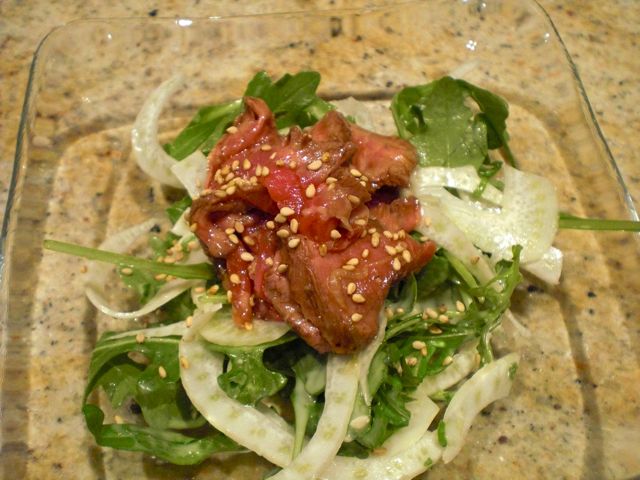
Arugula, fennel salad with flat iron steak ルッコラ、フェンネルとフラットアイアンステーキのサラダ

This is another small starter dish I made. This turned out to be very interesting and unique fusion salad.

The base is a mixture of baby arugula (it is interesting that this green is often called "rocket" in England, New Zealand, and Australia, "rucola" in Italy, and "rukkora" ルッコラ in Japan but in US and Canada, it is called "arugula") and thinly sliced fennel. Arugula is one of those rare greens that has a nice peppery taste on its own without help from any dressing. Fennel also has very nice anise flavor. As usual, I sliced the fennel with a Japanese mandoline slicer (Benriner) paper thin. For salad, it is important to slice fennel paper thin. I pondered about the dressing but decided to use blue cheese dressing (from the bottle). I used the dressing rather sparingly.

I topped this with thinly sliced leftover flat iron steak cooked medium rare. I dressed the steak with a mixture of ponzu shoyu, splash of dark roasted sesame oil and grated garlic. I placed the steak on the bed of arugula and fennel and garnished it with sesame seeds.

The combination of Western flavors of the salad and Eastern flavors of the steak was surprisingly very nice. All these very distinct flavors could be appreciated. 

We had this with a very good Cabernet from Sonoma,
Kunde Cabernet Sauvignon Reserve 2005. This is a Bordeaux blend (mostly Cab and some Merlot). It is rather rustic with nice smoky note and big chewy, albeit a bit rough huned, tannin (I know some will hate this type of description but tough). This is not a fruity vanilla laden sissy wine. (Although we sometimes like such sissy wines). For the price, this is a find. We usually think Sonoma Cab is not as good as Napa's but I will take an exception for this wine. This wine has a very high PQR.

Tuesday, April 19, 2011

CityZen for Japan Fundraising event on April 18

We attended CityZen for Japan on April 18 at CityZen located in the Oriental Mandarin Hotel. The location of the hotel is special. It overlooks Washington Harbor and is near the Tidal Basin. We arrived there a bit early so we sat outside on the terrace sipping wine. It was a beautiful spring day, the daffodils were out and it was fun watching the low flying planes approaching National airport over the 14th street bridge. In contrast, we thought of the quake damaged areas of Japan and felt that participating in this event was the least that we could do.

The event appeared to be a great success. Chef Eric Ziebold and Relief International did a great job organizing this. I do not know how many people participated but the restaurant where it took place was quite crowded. 

Champagne and wine were free flowing with wonderful Hors d'oeuvre. The auction included offerings from the chefs of participating restaurants. The auction packages included dinner prepared by a renowned chef for you and your friends at your house, one of a kind trip to Napa with dinners and wine tasting (at Dalla valle) etc. I was tempted.

After the auctions, all the wonderful food stations opened up including ones by CityZen and our favorite Japanese restaurants around the city offering delicious food.

This was wonderful evening for a good cause and we were glad we could participate and realized how fortunate we were. Thank you CityZen and friends to organize this event.  We wish for a quick recovery of Japanese earthquake and tsunami victims.

Monday, April 18, 2011

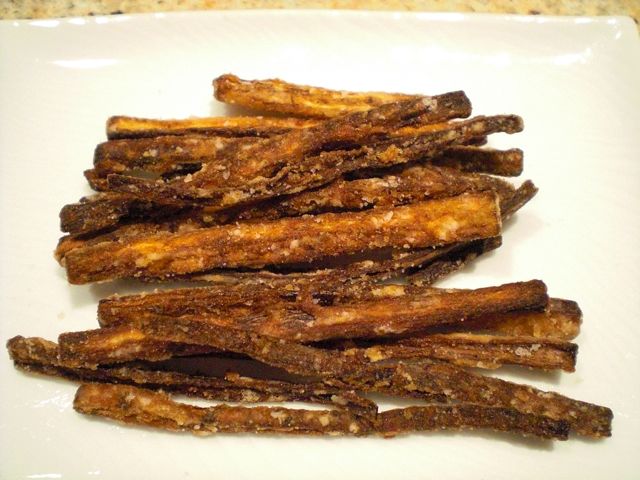
Fried Burdock stick 牛蒡の唐揚げ

This is a rather common Izakaya dish, although, for some reason, I have not made it at home until now. There are several different ways to make deep fried gobo. There are gobo chips like potato chip, kakiage tempura, or match sticks like shoe string fries. It can be just deep fried as is, or some kind of batter (tempura batter or buck wheat batter) or flour coating could be used. Another variation infuses some flavors before deep frying.

I decided to make shoe string like fries. I also marinated it with sake and soy sauce before frying. I used potato starch to coat the surface to help make it crisper.

For two small servings like those shown above (one serving shown), I used 2 root end halves of gobo. I scraped the skin and cut into match sticks and soaked in acidulated water for 10-15 minutes with several change of water. I then drained and marinated it in a mixture of sake and soy sauce (1:1) in the fridge over night (few hours at room temperature will be fine or you can skip the marinading step all together). I drained the gobo and patted it dry with a paper towel. I then dredged the sticks with potato starch (katakuri-ko 片栗粉).

Instead of deep frying, I shallow fried them using light olive oil (below image) on medium flame. I could have used peanut oil and/or deep fried them. After several minutes, the gobo sticks turned brown and crispy. I drained the excess oil and while they were hot, I seasoned them with salt. Serve while hot.


My wife was totally sold on this dish. Gobo has a very unique flavor and prepared this was they were so crunchy. It is a bit like sweet potato shoe string fries but gobo is all fibers and crunch. This is probably much healthier than fried potato. This goes well with any drink but we were having cold sake.