Showing posts sorted by relevance for query scrapple. Sort by date Show all posts

Sunday, October 3, 2010

Auntie N's no-crapple scrapple with Pennsylvania Dutch sweet coleslaw スクラップルとペンシルバニアダッチコールスロウ

We were expecting a visiting dignitary to come to "Chez Norio" recently, Jon of EOITWJ, but things did not work out and we will have to wait for another chance. In any case, said dignitary is quoted as saying  "Now Scrapple, it's cool because you know it's full of crap, or rather is made of nothing but crap, and that's expected". In response to this statement, I let him know of the existence of Auntie N's no-crapple scrapple. So, we thought it would be most appropriate that our visitor should try her scrapple. Since it is a two-day process to make no-crapple scrapple and weekends are the only time she can do it, I asked my wife to make her specialty before we learned that our visitor could not make it. Actually, she made the best scrapple ever.

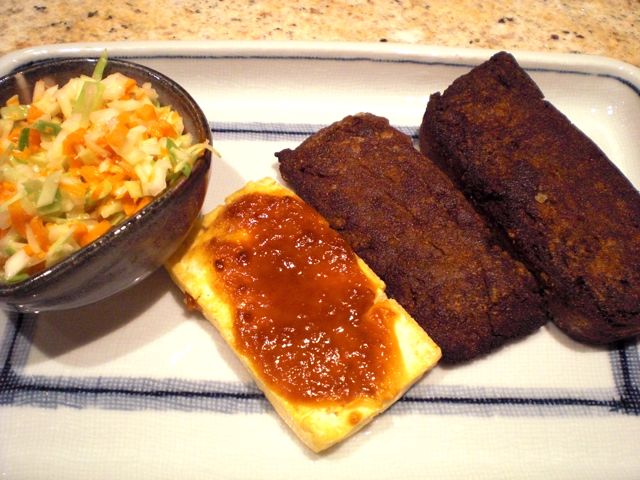
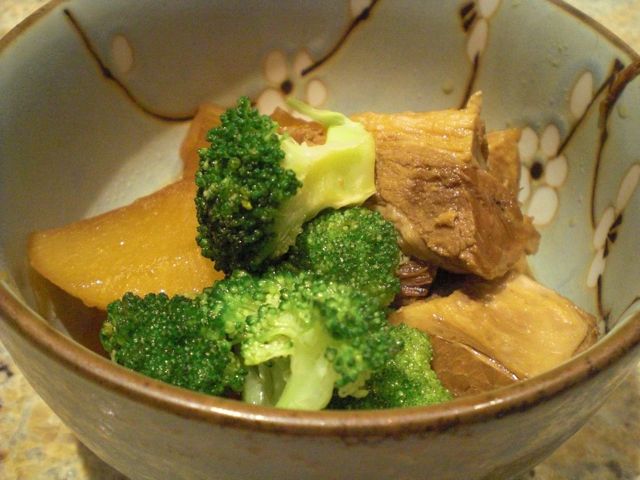
We had this as a part of an eclectic series of small dishes for the evening (mostly leftover from the weekend). The other small dishes included Yakitori-style drummetts and wings, and stewed daikon, pork spare rib (left over from the scrapple making) with the addition of tofu and broccoli. Since I had only a small amount of tofu left after the daikon, pork spare rib, tofu and broccoli dish, I made it as tofu dengaku (in a toaster oven) to use it all up. I served it with the scrapple and Pennsylvania Dutch sweet coleslaw (it may look too eclectic but, at least, it has about the same dimensions as the scrapple) as shown below.
This was the best scrapple ever! Nice mix of spices and porky flavor. Jon, you missed a good one. But don't worry there is more where that came from.
Look at this lovely mud/sewer water color. The addition of buckwheat flour really added flavors and made the color authentic but since this is no-crapple scrapple, no mystery meat or crap is in this one.

Monday, August 29, 2011

Auntie N's no-crapple scrapple redux スクラップル 再登場

We previously posted scrapple which is a well-known and somewhat dreaded Pennsylvania Dutch breakfast item widely served in diners in Philadelphia. The authentic recipe requires a hog's head but my wife made it from stewed pork spare ribs and since it is not made with any offal, we called it "Auntie N's no-crapple scrapple". I came across another "civilized" scrapple recipe in the Washington Post on line which does not call for a whole hog's head boiled for several days. I forwarded this recipe to her hoping she would try it--which she did.

Ingredients from the Post article:
1 1/2 pounds ground pork
25 ounces chicken broth, preferably homemade
1 cup yellow cornmeal
1/2 cup flour, plus 1/4 cup for dusting the scrapple
1 tablespoon minced garlic
1 tablespoon minced shallots
1 teaspoon Old Bay seasoning
1 teaspoon chopped fresh thyme
1 teaspoon chopped fresh basil
Salt
Freshly ground black pepper
2 tablespoons olive oil, or more as needed (may substitute butter)

The recipe calls for ground pork. Since this is "no crapple-scrapple" we didn't want to use ground pork from the market because then we couldn't guarantee it didn't contain any crapple. So we purchased a pork butt roast and ground the meat ourselves. Grinding the pork was the extent of my contribution to the dish. I handed the prepared pork to Auntie N and she took over the preparation.

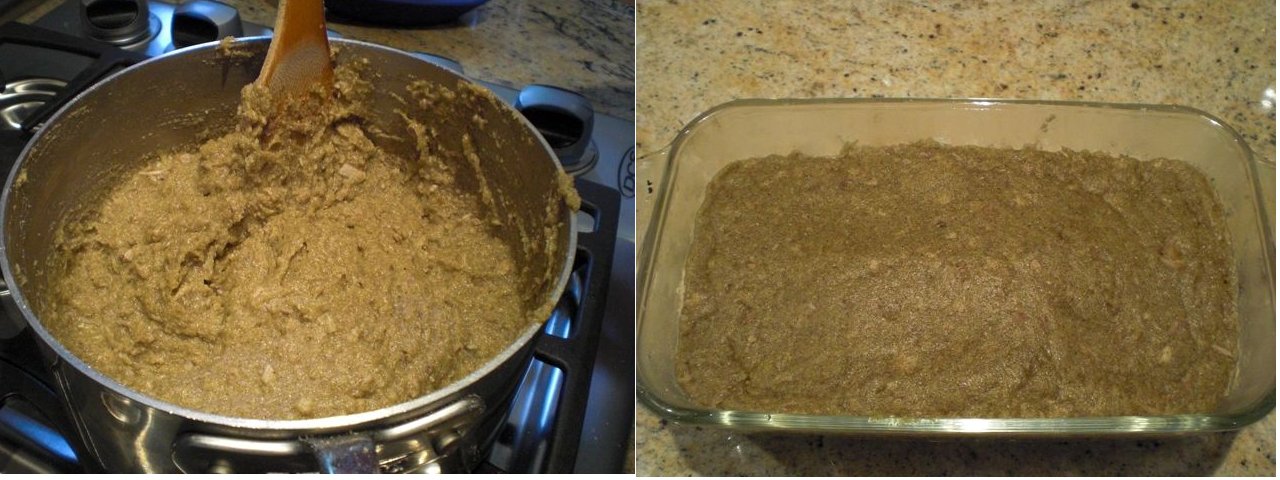
Auntie N wrote: While I used the basic ingredients from the Post article I put them together differently based on previous experience making scrapple. I browned the pork in a saucepan then added the broth bringing the mixture just to a boil. I added the garlic and shallots. In a separate bowl I combined the cornmeal and flour. I slowly added the dry ingredients to the pork broth mixture whisking briskly to prevent lumps. As if making polenta I stirred the mixture until it got very stiff and pulled away from the sides of the pan. Then I added the old bay seasoning, chopped fresh thyme and basil as well as salt and pepper to taste. I poured the mixture into a bread loaf pan to cool.

To cook, I sliced the pieces that were about 1/2 inch thick, lightly floured the surface and pan fried them on medium high heat for about 5 minutes a side.

The pieces cooked up very nicely with a pleasing crust outside and soft center. It turns out that this is a much more refined scrapple than the one I am used to. While it had a pleasing pork taste it was not as permeating as the more traditional recipe. In addition the various herbs and spices are a very good combination in their own right but not the intense rustic flavors characteristic of traditional scrapple (which in fact many people don't entirely appreciate). If you are one of those people this is a nice variation and worth trying.

Saturday, March 13, 2010

Scrapple スクラップル


Although my wife is not Pennsylvania Dutch, she grew up in the middle of Pennsylvania Dutch country in a small town near Philadelphia. While she was growing up people in her town still spoke mainly the 17th century german dialect know as Pennsylvania dutch in everyday conversation. English was a foreign language for them. She used to shop for food at Yoder's general store at the corner of 1st and Main street. As a result, many of the foods from her childhood are Pennsylvania dutch and unique to the region in which she grew up. These include pies and sweets such as shoo-fly pie, funny cake and this dish, scrapple. I was first introduced to this when we went to Philadelphia to visit her brother a long time ago while we were living in California. We had it in a small diner and I did not particularly like it then. It was unique to Pennsylvania and as far as I was concerned it could stay there. Later, when we visited one of the family's friends on their boat on the Chesapeake, they prepared wonderful scrapple which was much better than anything even my wife had before. 

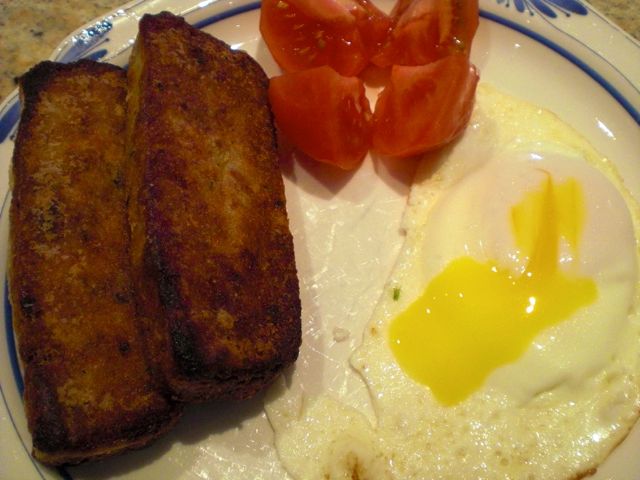
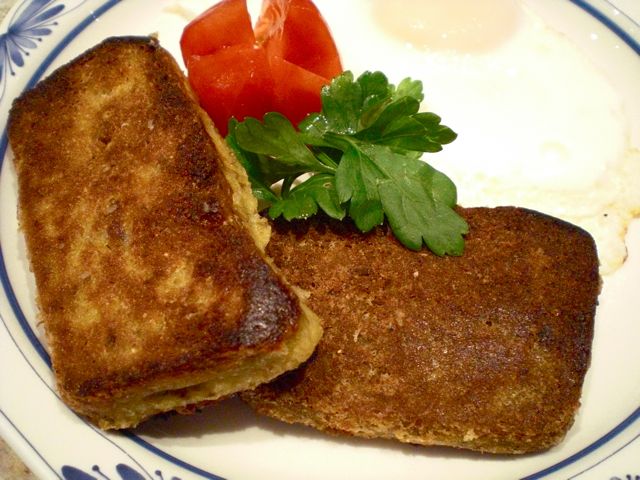
For some reason, my wife wanted to make scrapple from scratch. The traditional recipe is made of scraps gleaned from the traditional fall hog slaughter (the Pennsylvania Dutch did not waste anything). The first recipe my wife read calls for a whole hog's head hacked in half (Although I may have the skill to do it, I would have refuse, if asked. Fortunately, she did not ask.) and boil it for long time and all the meat and bits are then removed from the hog's head and made into a loaf containing cornmeal, buckwheat flour and many spices. Since my wife has been making polenta in a loaf form and we really like it, she must have thought this is an interesting variation. Instead of a hog's head, she first boiled pork spareribs as though she was boiling the hog's head but the result was a bit disappointing with a sort of tired meat flavor. So she made some adjustments and perfected her recipe. We eat this most often for breakfast but sometimes for lunch over the weekend. We also enjoyed this as a part of Izakaya feast for evening. I will hand to my wife for the recipe and how to properly fry (sauté) it to get optimum crispy outside and creamy inside. Here, we served scrapple with a fried egg.

This is a very "sanitized" version of this dish because it does not use any pork offal or scraps. Start with 4 or 5 country style spareribs. Parboil for about 5 minutes. Put into a pyrex baking dish with some onions and carrots, a bay leaf and several pepper corns. Cover the ribs half way with boiling chicken stock. Cover and place into a 350 degree oven and cook for 1 1/2 to 2 hours (until the meat is tender and falls off the bone).

Remove meat from the bones and remove any excess fat. Chop the meat into very fine pieces but do not grind. Take 3 cups of chicken stock add 1 tsp sugar, 1/2 tsp salt, 1 bay leaf, 1/2 tsp dried sage, 1/4 tsp margoram, 1/8 tsp mace and several grinds of pepper. Boil for a while until the liquid has been infused with the taste of the spices. Strain the liquid, remeasure to get 3 cups total and put back into pot. Meanwhile mix 3/4 cup corn meal with 1/4 cup buckwheat flour until they are uniformly mixed.(The recipe can also be made with just 1 cup of cornmeal if buckwheat flour is not available. The buckwheat however seems to result in a finer texture and adds an additional element to the final flavor). Bring the infused chicken stock back to the boil. Lower the heat and slowly whisk in the cornmeal mixture. Keep stirring for about 5 minutes as it thickens. Toward the end add about 2 cups of the meat and continue stirring until the meat is completely incorporated (you shouldn't be able to distinguish any individual pieces of meat) . Turn the mixture into a loaf pan which has been rinsed in cold water (the water keeps the mixture from sticking).

After the scrapple has cooled (usually over night), it is ready to be cooked. Turn out the loaf and slice into 1/2 inch pieces. (The final cooking makes the difference between really good and really bad scrapple. The thickness of the piece is important to get just the right combination of crispy to creamy soft. If the pieces are too thick the overall texture is too mushy and much less pleasant.)  Lightly coat the pieces in flour with salt and pepper added. Heat several tablespoons of peanut oil in a saute pan on medium high heat (peanut oil is best because of its high smoke point). Put the pieces in the pan making sure that the sides of the pieces don't touch each other. Let 'er rip on that fairly high temperature with out touching for 5 minutes. This forms the nice crunchy crust. Lower the heat slightly and turn the pieces over and again let it cook undisturbed for another 5 minutes. (At this point the pan may be smoking a bit but don't let that bother you if it looks like it is getting too hot turn down the heat slightly.) If it looks like the first side needs more of a crust turn the piece back over and cook a bit longer. Drain the pieces on paper towels. 

The scrapple can be cut into individual pieces and frozen. If it has been frozen don't thaw before cooking. Just go ahead a dredge the pieces and put them in the pan. It will thaw in the cooking process and the cold keeps the interior creamy. 

The traditional way of eating this is with maple syrup but we like to eat it plain served with a fried egg on the side. It has a lovely porky spicy flavor and the crunch of the crust with the smooth creaminess of the inside is wonderful. Again there are many variations on this recipe. Some add liver, some add much much more pepper. This is a rather tame version but we like it. 

Monday, August 22, 2011

Chow-chow pickles チャウチャウ ピクルス

In the food section of Washington Post online, I found a recipe for scrapple (a fairly "refined" version) and sent it to my wife. Since she created Auntie N's no-crapple scrapple, I thought she would be most interested in this recipe. As she was looking through the scrapple recipe, she also came across a recipe for a dressing which is based on (store-bought) "chow-chow", Pennsylvania Dutch pickles.  Although she is not Pennsylvania Dutch, she grew up in the Pennsylvania Dutch country. She tells me that chow-chow was ubiquitous and appeared everywhere. It was even served in the school cafeteria.

Chow-chow is one of the classic Pennsylvania dutch "Seven Sweets and Seven Sours" which by tradition should be included in every dinner served to company. The seven sours included: pickled vegetables (such as pickled cauliflower, beets, or cabbage), coleslaw, dill pickles, green tomato relish, meat jelly and spiced cucumbers in addition to chow-chow. (For those who are interested the sweets included: jelly (currant or apple), apple butter or apple sauce, preserves such as quince, candied watermelon rind or wild strawberry, two or three pies such as schnitz, shoofly, funeral or montgomery and cheese cake). As a kid, my wife particularly liked chow-chow because she could pick out the veggies she liked best from the wide selection that made up the dish. Although my wife knew chow-chow as exclusively PA dutch, we found out that it is also a southern dish. The Pennsylvania version, however, is said to be much sweeter than the southern.  Over the years my wife has looked for but never found a recipe that reproduces the chow-chow of her childhood.  She searched on line and found this one based on an old Pennsylvania dutch cookbook from the 1930's.
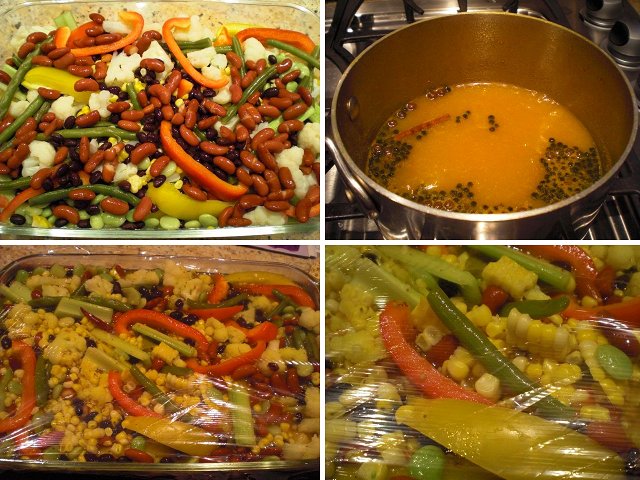
Vegetables: Red and yellow pepper, cut in strips (one each), Cauliflower (one head, separated into small florets), celery (two stalks cut in to 3 inch buttons), green beans (on hand full), corn (kernels from 2 cobs, uncooked), kidney beans (one 15 oz can), black beans (one 15 oz can), Lima beans (one package, frozen thawed) (picture below upper left). The cauliflower and beans were precooked by steaming.

Pickling liquid: She used sushi vinegar (1 cup), (this is obviously her modification--sushi vinegar is not traditional to Pennsylvania Dutch cooking. She said she used it because it is milder than the traditional cider vinegar), sugar (1 cup), water (1 cup), kosher salt (2 Tbs.), ground turmeric (1 tbs), black pepper corns (1 tbs), cinnamon stick (one), whole all spice (1/2 tbs). She simmered these ingredients in a pot for about 30 minutes. (top right picture).  

Then she strained the syrup to remove the spices. She poured the strained syrup back into the pot and added whole bay leaves (3), hot red peppers (dried, 2), yellow mustard seed (2 tbs), celery seeds (1 1/2 tsp) and simmered the mixture for another 10 minutes. 

She arranged the vegetables in a glass baking dish (top left picture, since we did not have a glass pickling jar) and poured the hot liquid over the vegetables, stirred well and covered. After it cooled she put it in the refrigerator. The recipe said 'wait at least a week before serving. Because of the way these pickles were made they are considered "refrigerator pickles" meaning that they should be kept in the fridge and will not last more than a couple of weeks. The traditional PA dutch method is, of course sterilized, "heavy duty" canning.
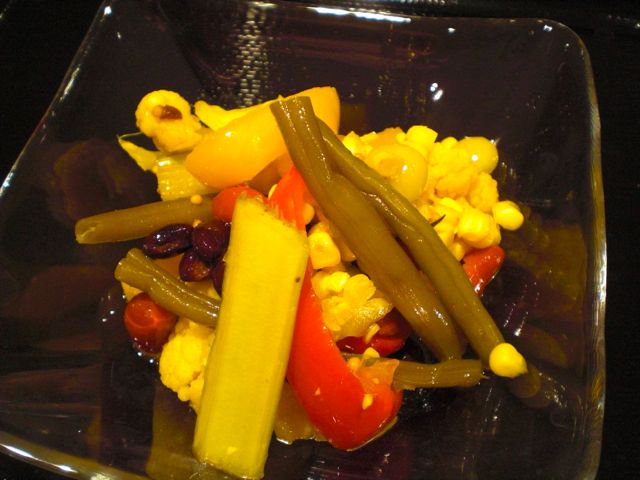
After waiting a week my wife tasted the chow-chow...she was ecstatic!! This was the traditional taste of her childhood that she had been looking for all these years.  She was so excited she called me at work to tell me the pickles were a success. She said that the minute she tasted them she was instantly transported back to her childhood--summer picnics, dinners at friend's houses, cafeteria lunches, community suppers at the firehouse. As she said, Proust really knew what he was talking about with those madelaines.  

This is a very mild pickle with a pleasing sweet and sour taste. If truth be told, it is a little too sweet for me (my wife says that she probably liked it as a child because it was sweet--she said she still likes it a lot). All the additional spices give it a distinctive depth of flavor. The veggies are still very crisp and the diversity of ingredients makes it very interesting. Chow-chow is sometimes referred to as "the end of summer pickles". It includes such a variety of vegetables because these are all the veggies that are left over from pickling individual vegetables from the summer harvest. I suspect my wife will be making this again. It is certainly worth the effort.  

Friday, April 16, 2010

Simmered daikon and pork 大根と豚肉の煮物

This is something I made without any particular recipe one weekday evening. The weekend before, I got pork spareribs, not because we had something in mind to make but because I could not resist the good amount of front portion, i.e. pork belly or "sanmai niki" 三枚肉 in the package. Unfortunately we did not have enough time to make any particualr dish such as "Kakuni" or Pork baked in barbecue sauce. So, my wife decided to cook it like she did for making scrapple. Quoting from the scapple post; "Parboil for about 5 minutes. Put into a Pyrex baking dish with some onions and carrots, a bay leaf and several pepper corns. Cover the ribs half way with boiling chicken stock. Cover and place into a 350 degree oven and cook for 1 1/2 to 2 hours (until the meat is tender and falls off the bone)." We figured that once it is cooked this way, we may be able to use it more easily in some dish during the week and, at worst (a figure of speech, not really worst, actually it will be "best") case scenario, my wife can make it to scrapple next weekend.

I think I was loosely basing this dish on "simmered daikon and pork" or 大根と豚肉の煮物. The way the pork was cooked to this point is not much different from the first portion of the preparation (traditional recipe) for "Buta no kakuni" 豚の角煮. I just took out one rib (removing any congealed fat) and cut the meat into 1 inch cubes. Meanwhile, I peeled and cut daikon (about 3 x 2 inches) into 8 pieces. I sauted the daikon with a small amount of peanut oild and a dash of dark sesame oil for 1-2 minutes in a small deep pot on a medium flame. I added the pork cubes (also some of the pork aspic that accumulated on the bottom of the baking pan for good measure), mirin, soy sauce (3 tbs each) and water to cover (probably about 1 cup). When it came to the boil, I turned it down to simmer and cooked for 30 minutes (We went out to the back deck to enjoy the last of the cherry blossoms with a glass of wine at this point, so it may have cooked longer than 30 minutes). In the last 3 minutes, I added broccoli. This was a surprisingly good dish especially for a weekday evening. The daikon was well cooked, soft, and a good match for the fatty pork. The pork is unctuous and flavorful similar to "Kakuni".

Tuesday, August 11, 2015

PA Dutch Crumb Cake クラムケーキ

Recently we visited rural Pennsylvania where my wife grew up. The trip was very nostalgic for her. One of the highlights was stopping at two regional grocery stores; Henning's and Landis. When she was a girl they were just small country stores which have grown a lot larger. (Henning's boasts 57,000 square feet). She was beside herself standing in front of the deli department stocked with all the Pennsylvania Dutch goodies such as beet pickled eggs, chow chows of all types, multiple types of scrapple. I had to remind her that  there was only so much room in the car. The real piece de resistance was the stop at Landis. Every Christmas she mail orders shoofly pie and funny cake from them. There, she stood confronted with shelf after shelf of shoofly pie, funny cake, apple sauce cake, apies pie, hard tac cake and others.  They even offered free samples with a small cup of coffee!! She couldn't resist and loaded up. Despite the mother load she brought back with her, she was inspired to make some PA Dutch dishes. This is one of them called "Crumb cake". It is not too sweet, and is very moist with interesting rough texture. I really like this cake. (Like many Pa Dutch baked goods although it is a cake it is made in a pie pan).


The name "Crumb" comes from the fact the whole cake; both top and bottom are made from "Crumbs".


Ingredients

3 cups flour
1 teaspoon baking powder
1 1/2 cups brown sugar
2/3 cup butter
3 large eggs
1 teaspoon baking soda
1 cup buttermilk
2 teaspoons vanilla extract
1 teaspoon almond extract

Directions

Sift together flour, baking power, salt, sugar and soda.
Using a pastry cutter, cut in the butter until the mixture has the consistency of course meal or small peas. (These are the crumbs for which the cake is named. )
Reserve about 1 1/2 cups of this mixture and set aside.
Combine the eggs, milk and extracts and stir into the remainder of the dry ingredients and blend. (First picture below)
Pour into 2 well-buttered 10-inch pie pans.
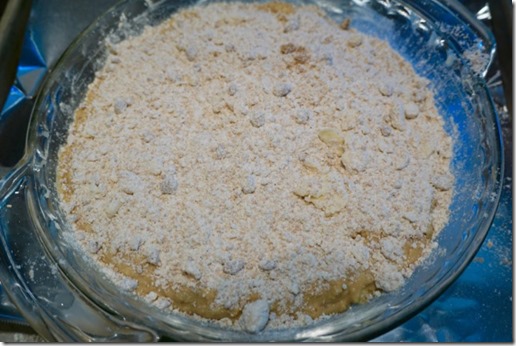
Brush the top of the dough w/ butter and sprinkle with the reserved crumb mixture. (Middle picture below)
Bake at 350° for 25-30 minutes or until cake is done. (Last picture).

(Pie pan filled with wet and  dry "Crumbs" mixture).


(After reserved dry "Crumbs" were put on).


(After baked at 350F for 30 minutes).


The cake is mildly sweet with a lovely moist texture. The combined flavors of the brown sugar, vanilla and almond is very distinctive but delightfully mild. The cake went so well with our espresso. The cake is so easy to make. We'll be seeing this one again.

Tuesday, December 23, 2025

”Boti Gosht” Indian style Meat Cubes インド風の豚肉キューブ

Whenever we get a large bone-in, skin-on, hind-or fore-quarter pork (called picnic cut), I do secondary butchering to produce one large and one small roast. We cook the large roast in the Weber grill and make the small roast into Chinese-style simmered pork using the InstantPot pressure cooker. I cut the remaining trimmings into small chunks and cook them in the InstantPot. We usually use these to make some kind of curry but this time my wife used them to make scrapple. After all this, we found ourselves with leftover roasted pork. My wife decided we should use it to make something interesting that we hadn’t made before. She came up with this Indian-style meat (pork) cubes dish based on a recipe in Madhur Jaffrey’s cookbook “Quick and Easy Indian Cooking”. (The original recipe called for uncooked cubes of goat/lamb/pork.) This is a highly seasoned dish but does not include the extra sauce characteristic of a regular curry. In any case, this turned out to be quite good. It was quite spicy (but not too spicy, at least for me). (My wife ate it topped with yogurt to mute the spiciness a bit and she said it was very good), with lots of flavors. 


Ingredients
3 tablespoons vegetable oil 
1 or 2 onions roughly diced
½-inch piece fresh ginger, peeled and very finely chopped 
4 cloves garlic, peeled and very finely chopped
15 fresh or dried curry leaves, if available
1 pound boned shoulder of lamb or pork, cut into 1-inch cubes (We used the left over roasted pork cut up) 
2 teaspoons store-bought garam masala
1 teaspoon ground cumin
¼ teaspoon ground turmeric
¼ teaspoon cayenne pepper
1 fresh, hot green chile, finely sliced
½ teaspoon salt or to taste
Freshly ground black pepper
1½-2 teaspoons fresh lemon juice

Directions:
 Saute the onion in a frying pan until soft and lightly browned. Add the ginger, garlic, and curry leaves and stir until wilted. When the garlic is wilted add the spices to bloom their flavor.  Add the meat. Add enough chicken broth so the ingredients in the pan do not scorch. Cover and simmer for about 20 minutes. Remove the lid and cook, uncovered, until all the liquid has gone. Stir as you do this and be careful it doesn’t scorch. Then stir in the lemon juice.

Friday, March 13, 2020

Cheesy spinach squares

My wife is into making small cheesy appetizers--particularly green cheesy appetizers. This recipe fulfilled both conditions and she had to make it.


The cheese squares were fairly easy to make but despite all the cheese and other ingredients that went into it, we felt, in general, it was pretty bland. The spinach gave it a green color but didn't add much flavor. To jazz it up a bit we tried it with my tomato sauce which was made from skinned Campari tomatoes. The addition of the tomato sauce added more flavor and really helped.


My wife was on the look-out for other ways she could improve the cheese squares and one evening when she was frying up some scrapple for an appetizer she decide she would fry up the cheese squares the same way since she had peanut oil in the pan and it was hot  .


She dredged the squares in flour and fried them on all sides until they had a nice brown crust as shown in the picture below. This was an improvement. The crust had a nice crunchy toasted flavor and the inside was soft with a slight cheesy flavor.  It was okay but not outstanding.


Ingredients (#1 in the composite picture):
1 cup flour
1 tsp salt
1 tsp baking powder
1 cup milk
1 and 1/2 cups grated cheddar cheese
2 eggs, lightly beaten
4 tbs butter, melted
1 cup chopped fresh spinach (original recipe calls or 1package or 9oz frozen chopped spinach).


Directions:
Mix all the ingredients (#1 in composite picture) together (#2 in composite picture) . Place the mixture in a greased 9 inch square pan lined with parchment paper and greased again. (This makes it easier to get out after it is done.) (#3 in composite picture)  Bake in a 350 degree oven for 30 to 35 minutes. Loosen the edges from the sides of the pan as soon as it comes out of the oven (#4 in composite picture) . Let it cool slightly before cutting.

This wasn't bad and certainly went together quickly. It was quite edible but not exciting. If we make it again we will have to make some significant alterations.

Monday, October 11, 2010

Barbecued Cornish Game Hen 若鶏のバベキュー


This is certainly not Izakaya food but this small young chicken must be rather unique to the U.S. and I decided to post this dish. Exactly what is Cornish game hen is not really clear; whether this is a just young regular chicken or descendants of the original cross breed of Cornish game cocks and Rock hens (from which the name derived) in 1950 or similar cross breed developed later (1965) by Tyson food. But since the vast majority of "Cornish game hens" are supplied by Tyson, whatever cross breed that Tyson may have developed must be what we are eating here. Because of its small size, it is perfect to serve one whole bird per person. In the past I've served these birds instead of a big turkey for such occasions as Thanksgiving. For us, half of the bird is usually enough. We like this small bird since the meat is more tender and juicier than regular chicken, albeit it may not have a strong taste. I have never seen this bird in Japan but, apparently, Tyson brand can be had by mail order in Japan.

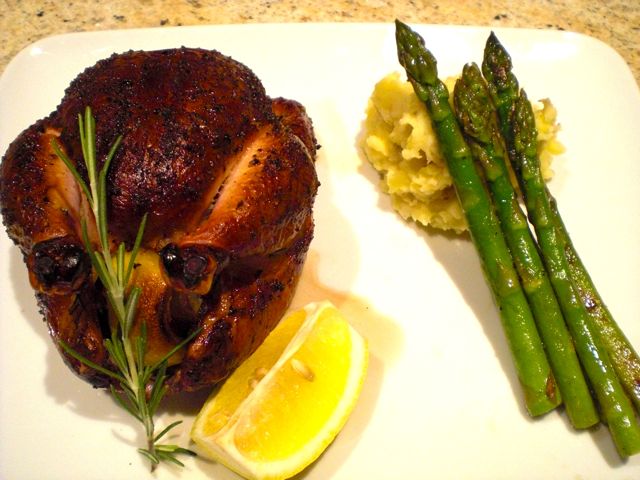
This could have been what we served if Jon had visited us along with no-crapple scrapple. The way I barbecue Cornish game hens is near identical to the recipe for regular chicken. I first squeeze the juice from two wedges of lemon inside and out the chicken and generously salt and pepper inside the cavity. I put the lemon wedges (the ones I used for the juice), coarsely chopped onion, crushed and skinned garlic cloves (as many as you like), and finely chopped fresh rosemary in the cavity. (Things have to be cut relatively small to stuff the small cavity of the bird). I truss it. I smear olive oil on the outside of the chicken and again generously coat the skin with salt and black pepper. I hot smoke/barbecue in a Weber kettle using indirect heat. This time I used hickory chips for smoking. I cook until the deepest part of the thigh registers 165-170F. I let it rest for at least 10 minutes.

My wife made mashed potatoes which were quite excellent. We used small (or baby) Yukon gold potatoes. After removing the "eyes" (leaving the skin on), she just wrapped several potatoes together in aluminum foil and put them along side the chickens in the Weber. The chicken took almost 45-50 minutes to cook and during that time, the potatoes were perfectly done. She mashed the potatoes and added salt, pepper, and very, very finely chopped red onion (this adds a nice burst of onion flavor to the bite), and creme fraiche instead of butter. 

I also briefly grilled blanched and oil coated asparagus.

We think this is the best way to cook (hot smoke barbecue) and enjoy a chicken. Cornish game hens are particularly elegant (we think) when the whole bird is served per person. Although I have tried stuffing the cavity with porcini mushroom and grapes, or stuffing the space under the breast skin with herbs/goat cheese mixtures etc, we settled on the current simple method. Of course, you need to use your fingers to eat the bird, at that point, "elegance" is out-the-window.

Our neighbor's small dog has started showing up as an impromptu dinner guest when we have barbecue. Tonight was no exception.

Wednesday, September 13, 2017

Fresh Corn Polenta 新鮮コーン入りポレンタ

We thought we must have posted our polenta recipe a long time ago but we have not. We just mentioned it in passing. Since it is still local corn season, my wife decided to make polenta with fresh corn kernels. This is perfect for breakfast but we also had this as our ending "shime" dish one evening. We served it with a fried (pasteurized) egg. As you can see, the one in the picture is a bit overcooked the egg (you should have runny yolk with polenta or scrapple).


This is a picture of the polenta just before frying. You can see the fresh corn kernels.


Ingredients:
1 cup corn meal
3 cups of corn cob broth (#3)
1 tbs butter
3 tbs sugar
1/2 sp salt
1 cup corn kernels (ears of corn microwaved for 4 minutes, covered with paper towel, kernels removed) (#1 and 2).

Direction:
1. If you try to remove the corn from the cob on a cutting bored, the kernels go all over the place. I placed a Pyrex ramekin upside down in a metal bowl and put the ear of corn on top of the ramekin. I then cut off the kernels using a knife (from top to bottom). The kernels are captured in the bowl (#1 and 2).
2. For making the corn cob broth, put 4 cups of water in a pan and add 6 corn cobs after the kernels have been removed. Also add coarsely chopped one medium onion and boil gently for 1 hour (#3). if you want stronger broth after straining the liquid it can be further reduced.
3. Pour the corn cob broth into a pan. Add the butter, sugar and salt and let it come to a boil. Add the corn meal in a steady stream while vigorously whisking to prevent lumps from forming (#4).
4. As the mixture gets thicker switch the whisk to a wooden (bamboo) spatula and continue stirring (this is where I help my wife since stirring polenta is hard work). Keep cooking and stirring until the polenta starts coming off the side of the pan. Add the corn kernels and mix. (#5).
5. Place the polenta in a loaf pan which has been rinsed with cold water (not oiled) (the residual water on the pan allows the cooled polenta to drop out when the pan is inverted . Make sure there are no air bubbles trapped. Smooth the surface (#6).
6. Cover with a plastic wrap and refrigerate overnight after cooled to the room temperature.
7. Just before serving, slice the polenta into 1/2 inch thick pieces (#7).
8. Dredge with flour and pan fry using peanut oil turning once until both sides develop a nice brown crust (#8).


We have not had polenta for some time and this tasted really good. Using the corn cob broth and fresh corn kernels really added a nice fresh intense corn taste. The kernels provided a sweet burst of flavor and a nice crunch element to the texture. Our only regret was that the eggs were overcooked.

Wednesday, August 31, 2011

Baked Stuffed "Giant" yellow squash イエロースクワッシュの肉詰め

This was a bit of a challenge. I was given this over-(and home-)grown yellow squash with a comment from my friend, Jimmy, "Maybe YOU can do something with it" implying he would not cook this giant.  I decided to make stuffed baked squash.

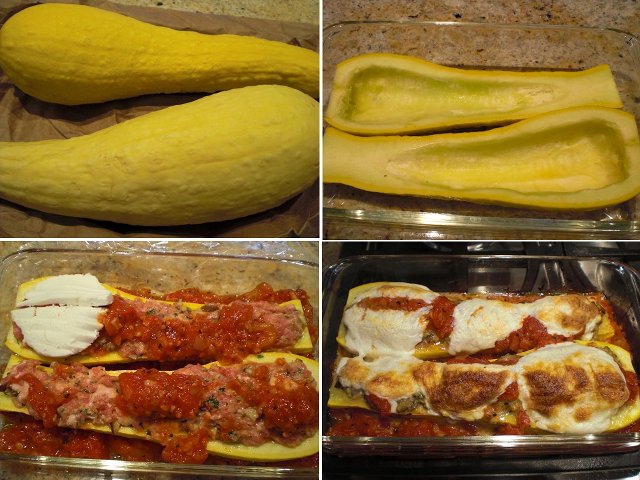
Here is the home (over)grown yellow squash (below, upper left). It is at least 10 inch long. I scooped out the seeds in the center and sliced the skin side so that the squash would sit flat inside the glass baking dish (below upper right).

Ground pork: My wife was making a scrapple from ground pork and I used whatever she did not use. Instead of buying ground pork, we bought 2.5 lb of a pork butt roast and ground it ourselves. I intentionally did not remove all the fat. I first cut the meat in small cube with a knife and then pulsed it in a food processor until I attained the desired texture.

Meat stuffing: I used about 1 lb of ground pork. I mixed in shallot (1 medium, finely chopped), garlic (1 fat glove finely chopped), fresh parsley (1 tsp, finely chopped), dried oregano (1/4 tsp), dried basil (1/4 tsp), black pepper (1/4 tsp) and salt (1/2 tsp), Japanese "panko" bread crumbs (about 1/2 cup), and egg (one large, beaten) and kneaded it by hand until it became a bit sticky and well mixed.

Sauce: I quickly made my marinara sauce from garlic (4 cloves finely chopped) and canned whole plum tomatoes (the tomatoes from 2 cans (8 oz. each) crushed into small chunks). I cooked the garlic in olive oil (3 -4 tbs) until fragrant (1 minute) and added the tomatoes with the  juice and turned the heat to simmer. I added salt, black pepper (to taste), bay leaves (2) and dried oregano and basel. After simmering for 5 minutes I tasted it and added sugar (1/4 tsp, optional) to cut the acidity.

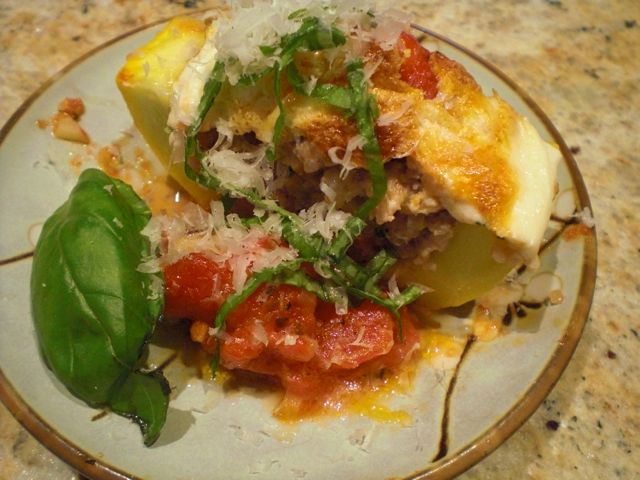
Assembly: I stuffed the squash cavities with the pork mixture and spread the sauce over and around the squash (above lower left). I placed slices of fresh mozzarella cheese on top and baked it in 350F convection oven for 40 minutes (above lower right).

I served this with a chiffonade of fresh basel leaves. The squash was still a bit hard! I thought baking it for 40 minutes would make this giant squash soft but I was wrong. I should have pre baked or pre-cooked it. We only tasted small portions. The next day, I added a bit more sauce and a mixture of shredded aged cheddar and Mozzarella cheese and re-baked it for another 30 minutes in a 350F oven. This time, the squash was soft. Of course, you could stuff the squash with your favorite uncooked Italian sausage (out of its casing). This tasted pretty good especially with red wine. Since I did not have suitable Italian reds handy, we went for Califronia Cab Ridgeline 2004 from Alexander valley with this dish.