Kanpyo 干瓢, literally means "dried gourd", is a rather common item used in Japanese cuisines. The meat of the gourd (a certain edible kind, I suppose) is peeled like a narrow tape and then dried. You can buy it, in this dried form, in a Japanese grocery store. I do not think it has much flavor by itself but, certainly, it will absorb any flavors in which it is cooked. It is often used as an edible tie to tie off something. For example, when I stuff a deep fried tofu pouch or abraage with a rice cake or "mochi" in my version of the New Year Soup, I use kanpyo to tie the pouch closed. It is also a common item to be included in scattered sushi "chirashi-zushi" ちらし寿司 or sushi roll "norimaki" のり巻き. To prepare kanpyo, you first wash, rehydrate (30 minutes or longer), and briefly (5 minutes) boil in water. After this, you could cook further a few different ways. If you are going to use this to tie off something, I will just use it without further cooking. The dish I am describing here is one of the rare dishes in which kanpyo is used as the main ingredient. After using kanpyo as a string/tie for another dish, I had a lot of unused kanpyo and decided to make this dish. It is very subtle in flavor and a bit of a chore to make but it looks more "professional" than "home made".
Thursday, May 13, 2010
Kanpyo with checkered daikon and carrot カンピョウの市松
Tuesday, May 11, 2010
Fresh corn Kakiage tempura トウモロコシのかき揚げ (Mark's book P47)
I found corn in the husk for the first time this year in our grocery store. I asked the woman, stocking the shelf, where the corn came from (thinking it must have come from a foreign country like Mexico). She showed me the mark on the crates they came in. It was clearly stamped "U.S.A." but she did not know where in the U.S. It appears that seasonal items become available earlier and earlier every year. So I bought 8 ears (less than $2). They were white corn and rather small but the kernels were full and sweet when I tasted them raw. So I decided to make kakiage tempera かきあげ. Kakiage is a version of tempera where small items (sliced onions, julienned Burdock roots, small shrimp or fish etc are fried with a batter as a binder).
The "corn kakiage" appears on Mark's book p47, but it is a rather standard recipe except the use of corn is a bit uique. I made my tempura batter with cake flour (1/2 cup), potato starch or "katakuriko" (1 tbs) and egg yolk (1/2) and mixed in ice cold water (about 1/2 cup) to a desired cosistnecy. For Kakiage, I made it to the consistency of a loose pancake batter. I removed the kernels from the cob (one ear of corn yielded about 1/2 cup) using a knife and placed them in a bowl. I added enough tempura batter to coat every kernel and a bit more. Using a soup spoon, I slipped the batter and corn mixture into hot oil (170C or 340F) and fried until crispy and lightly browned, turning once (about 2-3 minutes on each side). I drained and served while hot and crispy. I also made my usual green beans and shiitake mushroom tempura. I served this with green tea salt and wedges of lime. The corn was very sweet with a nice light tempura crust. The lime juice added a nice citrus acidity and made the salt stick better. We had a bit of red wine left but switched to cold sake for this dish.
Monday, May 10, 2010
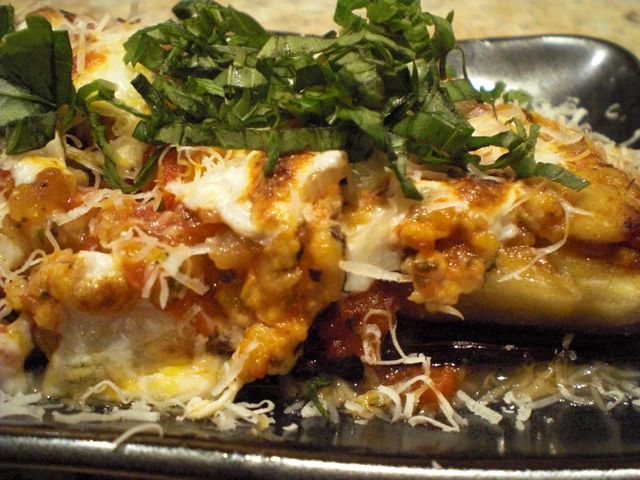
Eggplant Gratiné with meat sauce 茄子のミートソースグラタン
This is not a classic Izakaya food but goes well with red wines or beer if you are having one. I used a medium-sized Italian eggplant for this dish. Again this is a very simple quick dish to make as long as you have a good eggplant. I could have made this with layered slices of eggplant and meat sauce and cheese in a casserole (similar to eggplant parmesan) but it would have taken too much time particularly when we have already opened a bottle of wine.
I cut the eggplant in half lengthwise and scored the meat (cross hatching) taking care not to cut the skin. I salted them lightly and let it stand for 5-10 minutes and the patted dry. I put small amount (1 tbs) of olive oil in a non-stick frying pan and put two halves of the eggplant--the cut surface down, on medium heat. I put on the lid and cooked for 10 minutes (it half steamed) until the eggplant was soft (Cut side should have a nice brown surface).
For the meat sauce, I just cooked ground chicken (leftover from making other dishes) in a frying pan (with olive oil, salt and pepper) and then added my marinara sauce (leftover) and simmered to warm and make sure the chicken is cooked through. Of course, nothing will prevent you from making a more fancy "ragu" or something.
Put the cooked eggplant in the ramekin or gratiné dish which can hold the eggplant snuggly. Pour the meat sauce over and place several slices of Mozzarella cheese on the top and put it in a 450F toaster oven (400F if using a regualr oven) for 10 minutes until cheese has melted and sauce is bubbly. Remove from the oven and grate Parmesan cheese over it, drizzle good olive oil, and garnish with chiffonade of fresh basil. It went well with a bottle of Italian-style (super Tuscan) wine from Washington state "Saggi" 2007.
Saturday, May 8, 2010
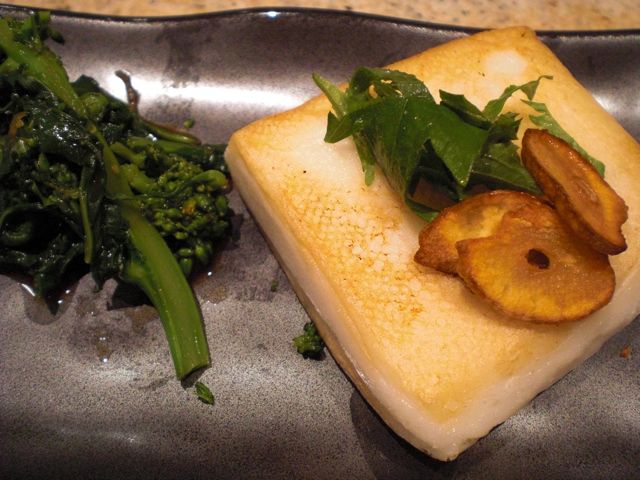
"Hanpen" fish cake sauteed in olive oil はんぺんのオイル焼き
Japanese have many variations of fish cakes such as kamaboko 蒲鉾, Satsuma-age 薩摩揚げ etc. "Hanpen" 半片 is the most dedicate in taste and texture among Japanese fish cakes. It is usually a square shaped, white and light in texture, made of white fish meat (mostly Alaskan Pollock or すけとうだら) paste called "surimi" すり身, egg white and grated mountain yam 山芋. It is boiled rather than deep fried. It is a very common item in oden おでん but I did not have it when I made oden. Besides serving it as oden, I use hanpen in leu of "surimi" すり身 when making a New Year sweet rolled omelet called "datemaki" 伊達巻き. I just bought frozen hanpen in a Japanese grocery store and decided to serve it very simply.
First, I thaw one hanpen and cut it into 4 rectangles. Add 1 tsp of olive oil and thin slices of garlic (one medium clove) to a non-stick frying pan on a low flame. Slowly fry the garlic turning once until nicely brown (do not burn). Remove the garlic and set aside on a paper towel. I, then, place 4 pieces of hanpen and sauté for one minutes or until nicely light brown, turn it over and cook another 1 minute. I served with blanched broccoli rabe dressed with mustard soy sauce (Japanese mustard from a tube, sugar and soy sauce), topped with the garlic chips, which I set aside previously, and chiffonade of perilla. Add a small amount of soy sauce before eating. If you like you could just use butter and soy sauce instead of olive oil and garlic.
This is a very simple quick dish but a perfect accompaniment for a drink. The texture and taste of hanpen are so delicate but goes very well with olive oil, garlic and perilla.
Thursday, May 6, 2010
Oven baked spicy chicken オーブン焼きピリ辛チキン
Our favorite ways of preparing chicken thighs for Home Izakaya are yakitori 焼き鳥, shio-yaki 塩焼き, kara-age 唐揚 or tatsuta-age 竜田揚げ. To expand our repertoire, I picked up this recipe from e-recipe.org. We thought that this is a bit healthier than deep frying and that it may attain similar crispness of the surface and skin as the deep fried chicken.
As suggested in the recipe, I served this on the bed of thinly sliced red onion. It is not bad but the skin was not uniformally crispy as it is with the other cooking method. This has potential but it may require some work to make our Home Izakaya "Teiban" 定番 list.
Subscribe to:
Comments (Atom)