Tuesday, August 17, 2010

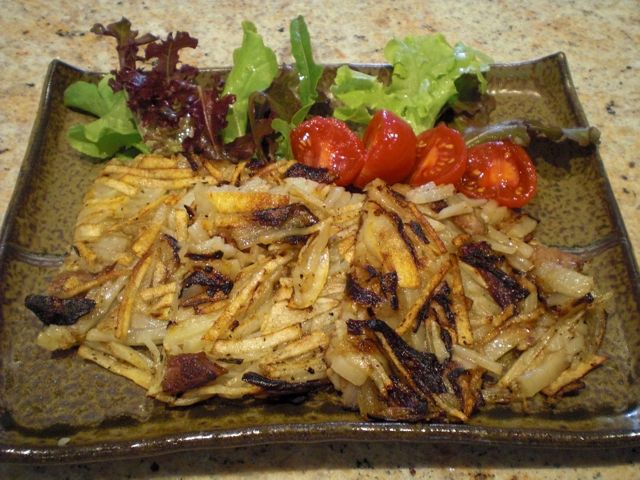
German Potato Hash ジャーマンポテトハッシュ

Japanese Izakaya version of so-called "German potato" appears to be rather fatty and they often (not always) use commercial frozen french fries. Onion is cooked with bacon and then combined (Mark's book p24). Instead of the Japanese variation or a classic German potatoes, I make a hybrid between Potato hash and German potatoes. This is perfect for breakfast as well as a snack with a drink. My version is less fatty but not bad (albeit not photogenic either).

This will make a generous (for us at least) serving for two. Instead of bacon, I use roasted pork tender loin seasoned with rosemary, which we cook often. We use the leftovers for sandwiches and other dishes such as this one. I cut small strips of roasted pork tenderloin (about 2 inches long) and fry it with a small amount of olive oil (1 tbs) until the edges get crispy and start to smell a bit like bacon (it's the same animal after all). I add onion, halved and sliced into thin strips (one small) and saute until soft and slightly browned. I season it with salt and pepper. I set these cooked items aside on a plate. 

Meanwhile, I thinly slice and julienne white potatoes (2 medium) and add olive oil (1 tbs) in the same frying pan and saute until all the potato pieces are coated with oil and add the mixture of the pork and onion back into the potatoes. I season again with salt and pepper. After sauteing for 1-2 minutes, I flatten the mixture into a thin disk using a silicon spatula (just in case you have not noticed, I love silicon spatulas) (left images below). I turned down the flame to low and put on a tight fitting lid so that the bottom browns and the rest of the potatoes steam. I cook it like this for 10 minutes. Shake the pan to make sure the entire disk of hash moves as a single unit (meaning the bottom is not sticking and all the potato pieces are sort of melded together because of the starch.) If any portion is sticking, use the spatula to encourage the potato to unstick from the bottom of the pan and flip (right image below). (The flipping part requires some skill to make it all return to the pan as desired. That is one reason you make sure that the pieces are melded together)
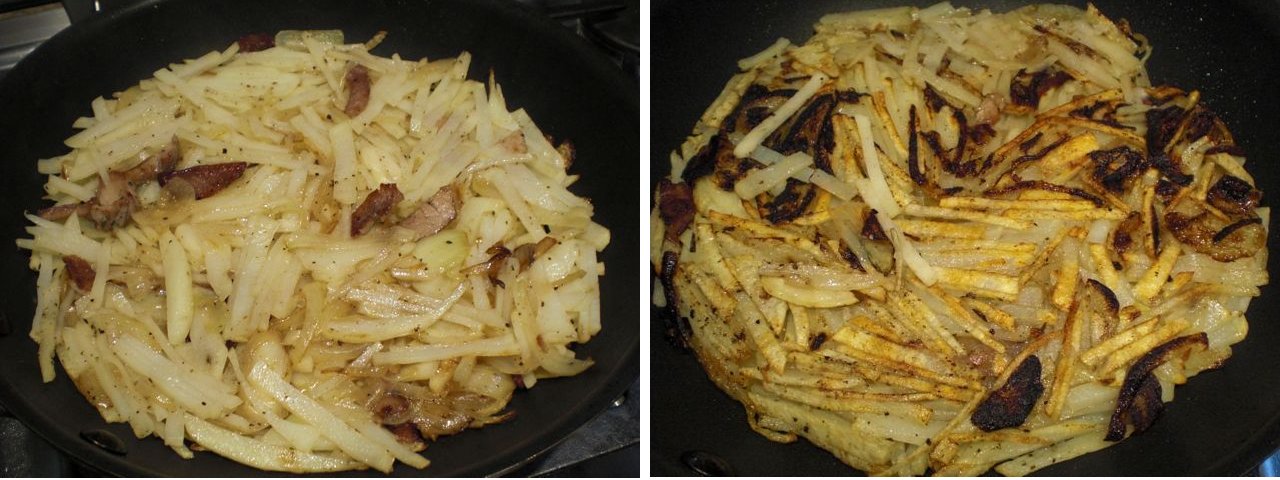
Now, keep frying for another 5 minutes, so that the other side becomes brown and crispy. I cut this into 4 quarters and serve. You could serve this with a side of ketchup. For breakfast, serve this with fried egg(s). You could, of course, use real bacon and bacon grease to fry the onion and potato which will make this dish definitely better. But for a lower-fat alternative, this is not bad at all.

Sunday, August 15, 2010

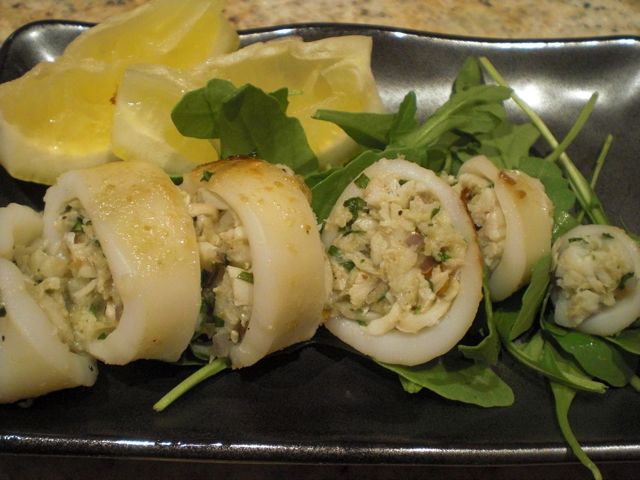
Small squid stuffed with crab meat イカのカニ肉詰め

Squid body is a perfect structure to be stuffed. I saw this recipe in "Takashi's noodles" and wanted to try it for sometime. Instead of serving this on the top of squid ink pasta, I simply served it as an appetizer on a bed of baby arugula with a wedge of lemon. The flavor profile is not particularly Japanese but this can be served with any drink including sake.

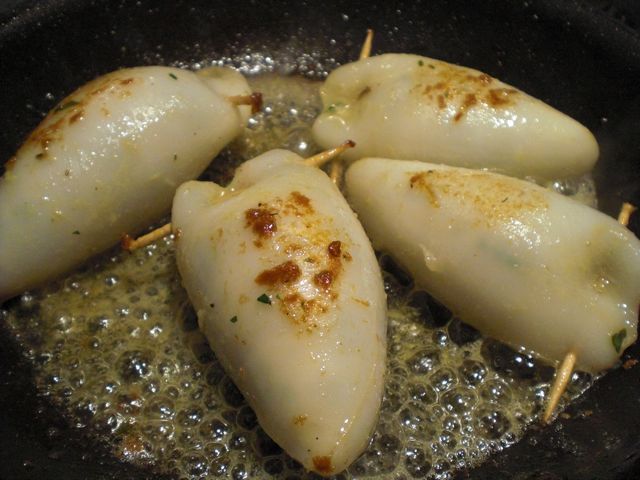
I used the body of rather small squid. The stuffing is lump crab meat (not canned), minced shallot, minced fresh tarragon (from our garden) and basil. I seasoned it with salt and pepper. The proportions are sort of arbitrary as I made it. Stuff  2/3 of the squid body with the crab meat stuffing and close it with a tooth pick. I sauteed it in a frying pan with a bit of olive oil for 3 minutes on each side and added a small pat of butter and then put the frying pan in a 450F oven for 3 minutes to complete the cooking. Since there was stuffing left, I added a bit of mayonnaise and Dijon mustard and made small crab cakes as well.

When it slightly cooled, I removed the toothpick and sliced. This is a nice dish and especially the tarragon favor comes through nicely. The freshness of the crab meat appears to be most important. Our crab was not the best. On balance, this is an easy dish to make as long as you have the ingredients. This will pair nicely with a cold white wine such as good crisp Sauvignon Blanc with some acidity but we had it with cold sake, which also went well.

Friday, August 13, 2010

Store bought sushi from a near-by market アメリカ市販のお寿司

This post is to remind those people privileged enough to have easy access to quality sushi and bento boxes, particularly in Japan, how good they have it. In the past 10 years or so, increasing numbers of gourmet markets in the U.S. as well as even regular supermarkets started carrying sushi. In many food courts like the one in Union station, you can find small sushi bars mainly for take-out. Some gourmet markets even have a small sushi bar in the store. Some cafeterias may even offer a box of sushi (mostly rolls). The quality of the sushi served in these places, however, often leaves much to be desired. If we like to have take-out sushi for a party, our best bet is to place a take-out order in our favorite sushi bar for pick up just before the party.
This one was bought from the near-by gourmet market. It is made on the premises, but not to order, the plastic sushi boxes are placed in the cold case. So, sometimes these sushi boxes may be sitting in the cold case for quite some time. I served the sushi on a plate with my asazuke and real wasabi to make it more presentable. I also made a tofu and nameko (small slimy Japanese mushroom) miso soup with a garnish of chopped scallion and myouga.
While the fish, luckily was fairly fresh if somewhat spongy, in general the quality of the sushi was dismal. As you can see in the picture the California roll barely held together. The rice balls were huge (in the U.S. big is better) and unless we practically choked ourselves stuffing them into our mouth in one bite they quickly fell apart while trying for a more manageable two bites. The rice was especially disappointing. It turned out to be dry and hard without much vinegar flavor.  Although sushi means vinegared rice for some reason much of the sushi sold this way seems to leave it out--(saving costs? Americans won't notice?) So why did we even bother buying this stuff? It's better than nothing when you need a sushi fix for lunch. Desperate times call for desperate measures (Due to recent demands at work and other factors we did not have a chance to visit our sushi bar much this summer). At least, the miso soup was excellent (because I made it). We have to hit the sushi bar soon!!

Wednesday, August 11, 2010

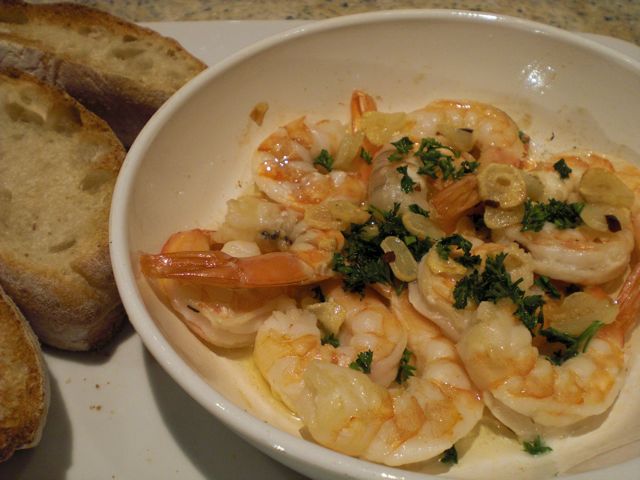
Gambas al Ajillo 海老のニンニクオリーブオイル焼き

This is a quintessential tapas dish. As far as I am concerned, any good tapas dish can be a good Izakaya food. Many years ago, our Spanish friend served this to us at a small party held in his backyard. Since then, this "gambas" became our favorite and quick snack accompanying a drink. I think the way I make this dish is based on the recipe in my old tapas cook book with my slight modification (of course).


Shrimp: For this dish, relatively small shrimp (20-25 count/lb) works best. Since the vast majority of shrimp we buy here are previously frozen and thawed at the store (they say "for your convenience" but sometimes they are sitting in a case for several days after thawing), I rather buy frozen raw shrimp and thaw it myself. For quick thawing, I use running tap water. Some say the flavour will be lost in the running water but it is quick and convenient for me. Sprinkling salt on the shrimp after thawing appears to bring back some briny flavours of the ocean. This one is peeled and deveined except for the tail segment. I dry them on a paper towel.

I use a small flat Pyrex pan as seen above but any small flat pan will also work. I add 3-4 tbs of good quality olive oil (olive oil is an important part of the dish and we dip the bread to soak it all up). I thinly slice garlic (2-3 fat cloves) rather than finely mincing it. I slowly fry the garlic pieces on a low flame with red pepper flakes (whatever amount you like) until they are fragrant and the garlic slices are slightly browned. "Slowly" is important since the garlic flavour is transferred to the oil better and the garlic slices become crispy (become garlic chips) without imparting a burnt bitter taste. Take the garlic chips out of the pan and put them on a small paper towel lined plate and set aside. I then fry the shrimp in the garlic scented olive oil for 30 seconds on each side or until just done and take it off the heat. I sprinkle chopped parsley, lemon juice on the cooked shrimp and garnish with the garlic chips. You could sprinkle Spanish paprika if you wish (mostly for decoration). I do not add any salt since it was already added after the shrimp thawed.

For this, we need a rustic and crusty bread like good baguette or ciabatta. We happened to have a very nice crusty ciabatta from a local bakery. We opened the last bottle of Vilafonte. It went with the meal very well.

Monday, August 9, 2010

Grilled salmon with Ponzu soy sauce and Grated Daikon radish 焼塩鮭のポン酢みぞれ和え

"Mizore" みぞれ means "sleet" in Japanese. Whenever you use grated daikon in your dressing it is called  "Mizore-ae" みぞれ和え for an obvious reason. We were getting low on our groceries and I did not see much in the fridge that I could use to make a dish to go with sake. But I found several little pieces of leftover salted and grilled salmon. They were too small to make a dish by themselves. I also found a small end piece of leftover daikon. OK, I have enough to make something.

I grated the daikon and squeeze out the excess liquid (about 1/4 cup) and added ponzu soy sauce (about 1 tbs from the bottle). I then crumbled the grilled salmon leftovers and mixed them into the daikon. I splashed Yuzu juice (from the bottle) on the top and garnished with finely julienned radish and finely sliced scallion (I used the green part for color). A simple quick dish but it was quite nice with cold sake. A good start.