
Thursday, August 26, 2010
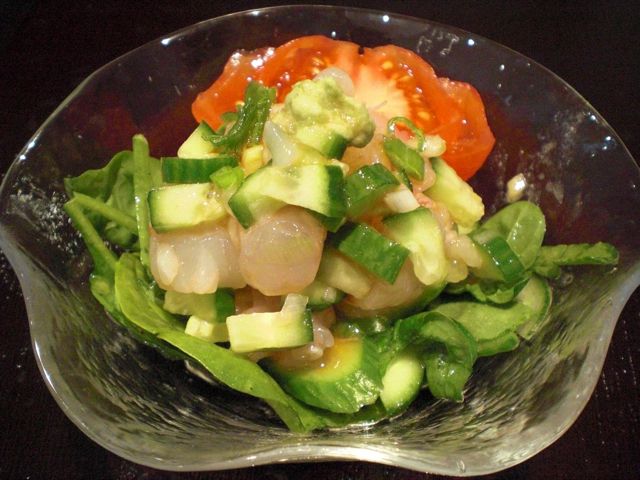
Sweet shrimp ceviche Japanese style with yuzu and wasabi 甘エビの和風サビーチェ


Tuesday, August 24, 2010
Sashimi from Catalina Offshore products カタリーナオフショア プロダクツからの刺身
We were deprived of good sushi and sashimi this summer for various reasons. Finally we stopped by our Izakaya substitute, Tako Grill, and enjoyed sake and food, especially seki-saba 関サバ but this "tease" of Japanese food left us wanting more. Then I received an e-mail announcing that Catalina was having a special on several of their products. The targeting of the e-mail couldn't have been better aimed. We responded by ordering a feast of sashimi items from Catalina Offshore products. This time, we ordered fresh blue fin tuna 本マグロ, live amaebi 甘エビ ("live" at least when it was shipped--twitching when it arrived), uni 雲丹, and ankimo 鮟肝. Everything arrived in good condition. The bottom segment of the package had frozen ankimo packed with dry ice and a Styrofoam board separated the fresh fish compartment with plenty of ice packs still mostly solid. The amaebi was a bit too large to my taste (6 to a pound, see picture below) but for something still moving (albeit barely) about as fresh as it can be. The tuna is a 2 lb block with "chiai" 血合い, "akami" 赤身 and "chutoro" 中トロ but no "ootro" 大トロ (this block is toward the tail without a belly portion). As I mentioned, previously, you have to remove the chiai and skin and block out appropriate portions before preparing sashimi. (In my anticipatory zeal to get from tuna block to sashimi as quickly as possible without actually gnawing on the block itself I forgot to take pictures of this preparation process). For some reason, Catalina does not carry toro of fresh blue fine tuna any longer but only frozen Ootoro.
Here are two sashimi servings to start.
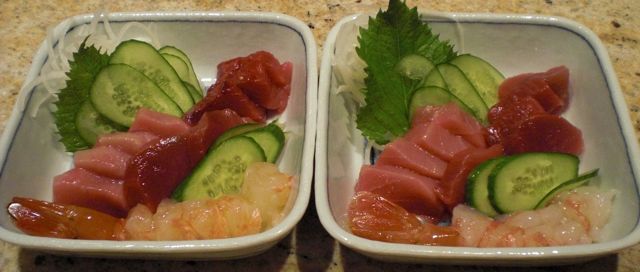
It is an amateurish presentation, or you can say, a true Izakaya style rustic presentation; chutoro (left), akami (right) and amaebi (front). Since amaebi (more like botan ebi or spotted prawn) was large, after removing the head, shelled, and deveined, I cut it into small pieces. It was a cross between Iseebi 伊勢エビ and amaebi and was very sweet with firm texture and was excellent. The akami and chutoro were very fresh and likewise excellent, although it may not be the very best we ever had.
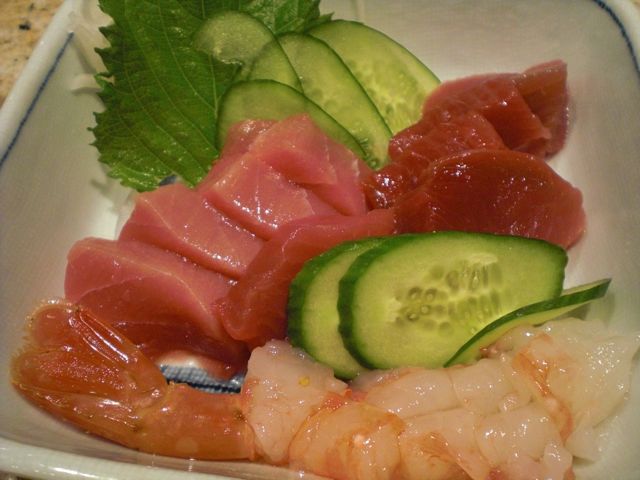
You can see how big these amaebis are. We used to get amaebi from the company in Alaska but Catalina has much fresher (mostly alive as I mentioned) and better.
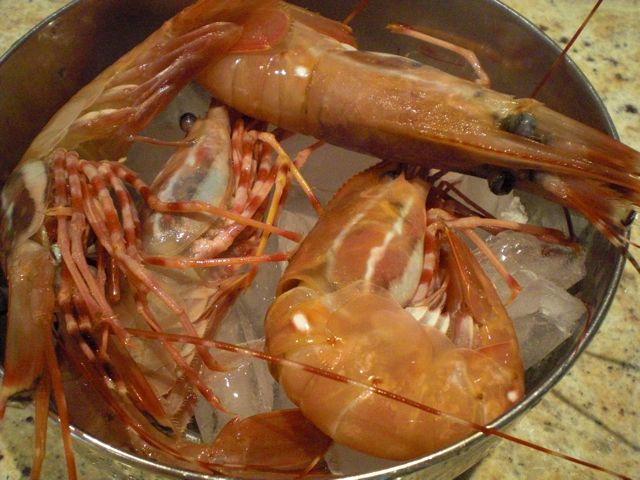
The only problem is that the shrimp heads are too big for deep frying so I made shrimp head miso soup. Some disassembly required for the shrimp head, and nothing delicate about it, you have to use your fingers; to begin, suck out the goodies from the bottom of the head, then dismantle and enjoy all the small bits you can find (whatever than may be). One thing we can say is that the Uni from Catalina is the best, even compared to those we had in Hokkaido or elsewhere in Japan. This is absolutely the best in our opinion; from California, creamy, flavorful and fresh. We had an uni donburi ウニ丼 (sushi rice - with a good amount of vinegar of course - chiffonade of perilla 大葉 and nori 海苔 with a small dab of real wasabi on the top. We did not even need soy sauce since it had such good flavor.
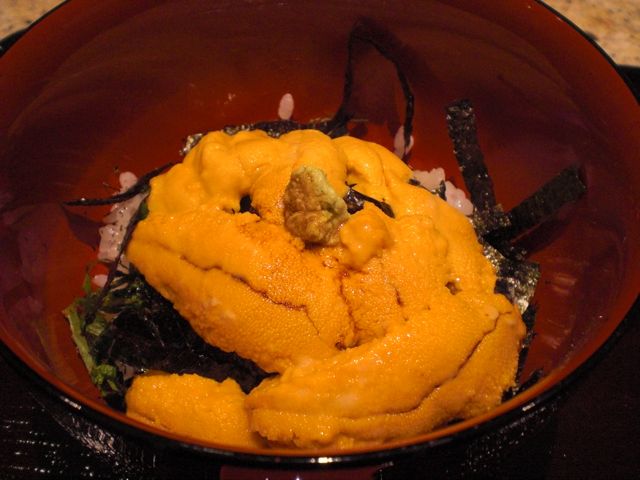
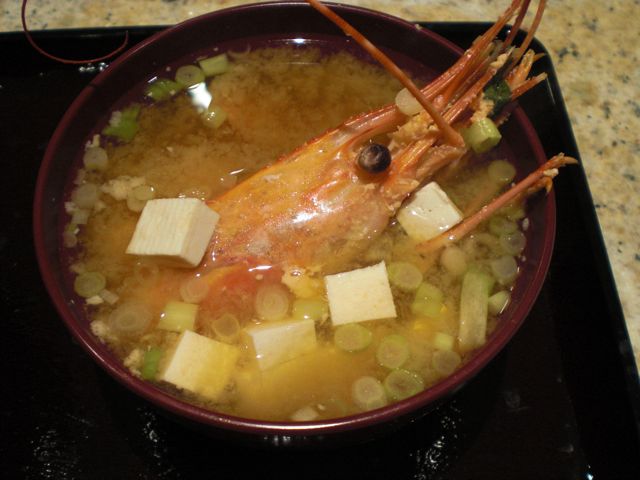
I think we may OD on sashimi in the next few days. (Two pounds of tuna sashimi and 4 trays of uni are quite a lot for two. Although we did justice to the amaebi, in a surprisingly short period of time). But this is exactly the "fix" we needed.
Monday, August 23, 2010
Norio's slider スライダー
Small hamburgers are called "sliders" in the U.S. and they are a very popular bar food. There appears to be several theories about the origin of the name. The small burgers sold at White castle burgers are trade-marked as "Slyders". In any case, I made this one day because I had extra ground chicken breast and we had just bought a nice crusty baguette. I made this as an open sandwich on an ellipse of toasted baguette. I served this as the first or second dish (do not remember which) accompanied with a bottle of Von Strasser Cab. This Cab happens to be the vintage 2000 (we previously tasted 04 and 06) and it was quite good; still lots of nice fruits remaining with mellow but well-structured tannin.
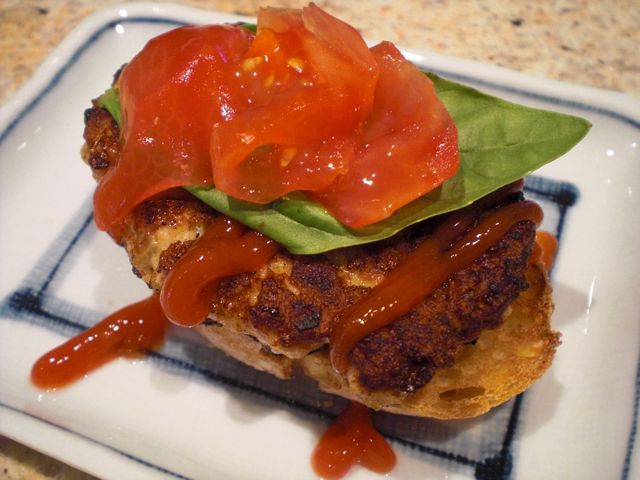
The meat patty is a mixture of ground chicken breast seasoned with minced shallot, chopped basil, garlic paste (I used garlic from a tube), beaten egg, salt, and black pepper. For good measure, I also added a bit of Yuzu kosho 柚 子胡椒 from a tube, which added a certain zing to the meat. I made an oval flat patty matching the size of the baguette. I fried it in a frying pan with a bit of olive oil for 3-4 minutes each side or until done. To assemble, I smeared Dijon mustard on the baguette, layered the chicken patty, added a squirt of ketchup, and topped it with basil leaf and sliced Campari tomato. It sure slid down well!
Saturday, August 21, 2010
Simmered squid stuffed with ground chicken イカの鶏肉詰め
I am not sure where I got this recipe. It may be that this is how my mother made it. I used to make this often but somehow stopped making it for some time. Since we had some nice small squid, my wife requested it.
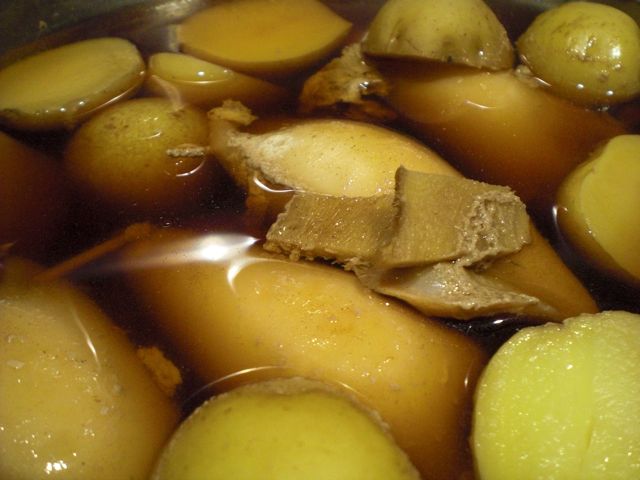
 I just followed my memory and did not look for any recipe. I made the stuffing from ground chicken breast (I could have used thigh), grated ginger, chopped scallion, chopped up squid legs and squid bodies (I used the ones with nicks or holes which were not suitable for stuffing), salt and pepper (the amount is all arbitrary). Make sure the squid body is clean and the cartilage is out. Stuff it to 2/3 full with the chicken mixture and close the end by inserting toothpicks as if it were a needle worked into cloth. I used a classic Japanese simmering liquid consisting of broth, mirin, sake, and soy sauce and added a few slices of ginger for added ginger flavor. I added small baby Yukon gold potatoes in addition to the stuffed squid and simmered it for 30 minutes with the lid on. In the last 4 minutes, I added florets of broccoli. You could add any kind of greens such as snow peas, green beans or asparagus, instead. You can serve this immediately after removing the tooth pick and slicing it into a ring. You could leave the leftovers in the broth in the refrigerator and reheat it the next day. It actually tastes better as all the flavors marry.

Thursday, August 19, 2010
Steamed pork spareribs with black bean garlic sauce 豚骨付きバラ肉の豆鼓蒸し
This is derived from a Cantonese dish called 豉汁蒸排骨 "si zap zing paai gwat". I should have used "rib tips" to be authentic (which apparently can be had in a Chinese butcher/grocery store) but I used the entire spare rib which has significant belly portions attached and much more meat than the traditional "rib tips".
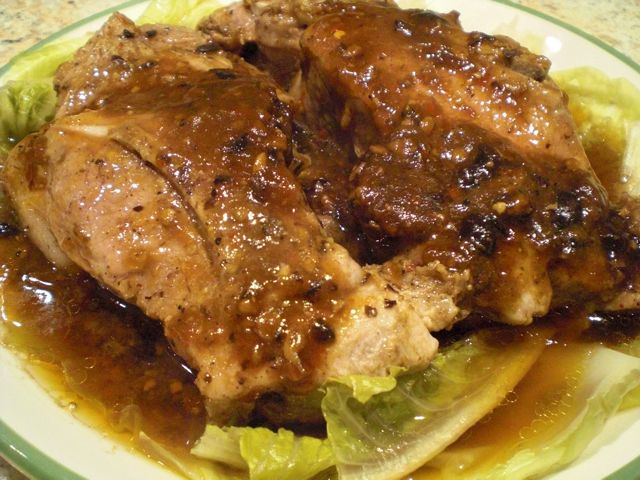
I used two bone-in pork spare ribs (about 400-500 grams or about 1 lb.). The marinade is made of black bean garlic sauce 蒜蓉豆鼓醤 (2 tbs), chili garlic sauce 蒜蓉辣椒醬 (1 tsp), soy sauce (1 tbs), sake (2 tbs), roasted sesame oil (2 tsp), sugar (1 tsp), potato or corn starch (2-3 tsp) and grated ginger (1/2 tsp). I did not add more garlic or red pepper since both sauces contain garlic and the chili garlic sauce is quite spicy (but you could add these). I first season the meat with a sprinkle of salt and black pepper (go light, the sauce has enough salt) and massage in the marinade and let it sit for 30 minutes at room temperature. I then set up a steamer (I use an electric wok). I place several leaves of cabbage and lettuce on the bottom of a large deep plate (I used a pasta plate) and set it in the steamer with strong continuous steam. Since the size of meat is much larger than "rib tips", I steamed for about 1 hour. Because of the potato starch, a nice sauce will form on the bottom of the plate.
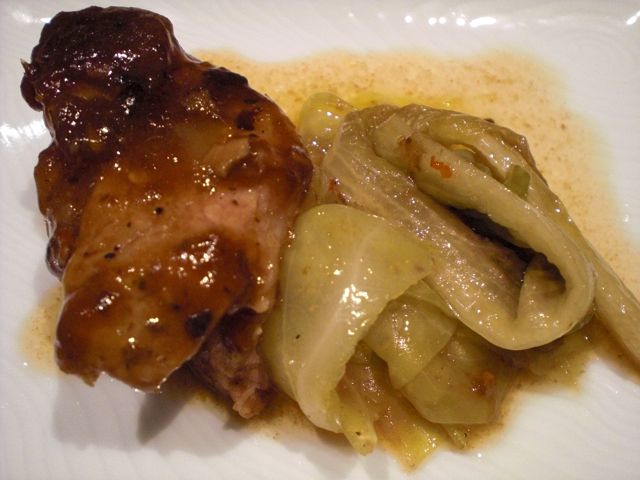
I cut a small portion and serve it with steamed cabbage and lettuce. Although the meat has nice flavors, it is a bit tough. I put the left-overs in the refrigerator. A few days later, after removing the congealed fat, I re-steamed it for another 20-30 minutes with a base of fresh lettuce leaves. The meat became much more tender and the flavor better amalgamated. I served this dish as a small drinking dish but you could serve a larger portion over cooked rice with more sauce, that will be a dinner.
Subscribe to:
Posts (Atom)