Monday, September 20, 2010

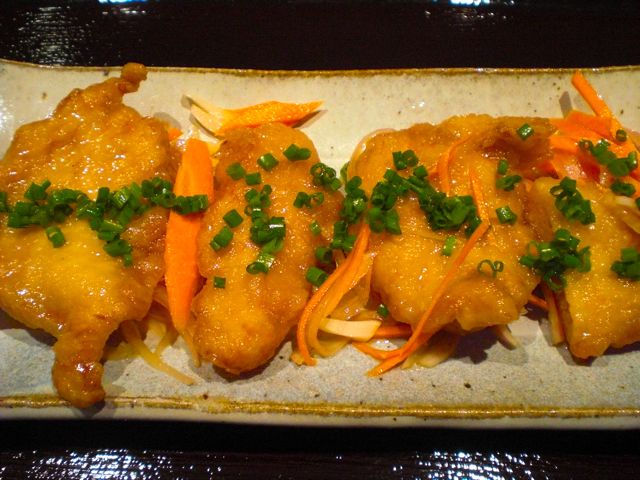
Chicken breast "nanban", Escabeche Japanese style 鶏胸肉の南蛮

The type of Japanese dish in which fish or meat is first fried and then dressed in a sweet and slightly spicy vinegary sauce is called "nanban" 南蛮. The word "nanban" literally means "southern barbarians". (No offense to the people who used to be classified as "southern barbarians" 南蛮人 by Japanese). Hot red peppers are sometimes called "nanban" indicating they may have come through the southern trade to Japan, in addition, at least two totally different types of Japanese dishes carry the name "nanban". One dish is very similar to escabeche (which is the dish posted here) and it may be that the Portuguese brought this dish to Japan along with Tempura while trading in Nagasaki 長崎, located in Kyushu 九州, the southernmost (main) island of Japan, during the Edo 江戸 period. Another is the noodle and duck dish, "kamo nanban" 鴨南蛮.  One theory why this dish is called "nanban" is that this dish also features Japanese scallions or "negi" 葱 and the place near Oosaka 大阪 called "nanba" 難波 used to be famous for its production of "negi". Thus, this dish was originally called "Kamo Nanba" 鴨難波, which somehow became "kamo nanban" but I have no idea if this is correct.

In any case, this Japanese style escabeche or nanban, is best when you use small bony fish. Deep frying and marinating in vinegar makes all the bones edible. The reason I made this dish is two fold; I found a tall bottle of a good quality (made of 100% rice) rice vinegar more than half used on the uppermost shelf of our pantry (since it did not fit to the shelf where I keep the rest of the Japanese items, I totally forgot about it--"out of sight out of mind") and I also discovered that I had chicken breasts which I bought last weekend and they had to be cooked quickly.

Sweet vinegar: "Amazu" 甘酢 can be made ahead. It keeps a long time in the refrigerator. I put the aforementioned rice vinegar (it was about 1 and a half cups) in a non-reactive (such as stainless steel or Pyrex) pan on low flame and added sugar (half the amount of vinegar, either by volume or weight) and a small amount (I used 1/2 tsp but could be more) salt. Stir and make sure the sugar is completely dissolved and let it come to boil (called "nikiru" 煮きる), this makes the vinegar mellow. Let it cool down and put it in a plastic or glass container and keep it in the refrigerator. This can be used for many other recipes.

Marinade: I use 2/3 cup of sweet vinegar for one chicken breast. I add dashi (1/4 cup), mirin and soy sauce (1 tbs each). Put it in a sealable flat container to be ready for receiving the chicken.

Chicken: I make thin bite size pieces from one skinless, boneless breast by cutting across the grain of the meat on a slant. I season it with soy sauce and grated ginger (just enough to coat the meat pieces but no extra liquid should remain) and coat each piece of meat by mixing by hand and let it sit for 10-15 minutes at room temperature.

Dredging: I use potato starch or katakurko 片栗粉. This creates a nice even crust which does not come off easily and also produces a nice slippery surface after the cooked chicken is soaked in the vinegar marinade.

Frying: I again used shallow frying at 170C (340F). Since the meat is thin, it takes 1-2 minutes on each side and comes out very crispy but meat becomes kind of dry but that is OK. It is good to eat as is (which we did). It is quite different from the chicken thigh tatsutaage 竜田揚げ and it is very good in its own right.

Marinating: While the chicken pieces are still hot, add them to the sweet vinegar marinade. I also add thinly sliced red onion, julienned carrot, and red pepper flakes. You should add as much vegetables as you like or the marinade can accommodate. They are very good after pickling. I marinade them at least overnight or longer in the refrigerator.

The end result is quite nice. It is a very interesting melding of flavors. The frying cuts the acid of the sweet vinegar and the vinegar cuts the oiliness of the frying. The result is a refreshing dish with real depth. In addition, over time the chicken picks up the flavor of the vegetables with which it is sharing the marinade. The texture of the chicken is nice because the crust from the frying is still intact but develops a nice slippery or smooth surface (but not slimy, for those who have slime-o-phobia). The pickled vegetables are a nice accompaniment. Beer or sake may be a safer pairing but we had this with a Cali cab, Louis.M.Martini Cab Sauv, Alexander valley, Reserve 2007*. This wine has a nice earthy overtone with good firm tannin and went surprisingly well with this dish. The acid in this dish appears not to compete with this wine.

*P.S. Even after it was bought out by Gallo, Louise.M.Martini keeps making reasonably priced good quality wines, we liked their Napa cab and this reserve from Alexander valley (regular cab from Sonoma is so-so). Ghost pine, which is one of the Gallo's numerous brands but made by L.Martini, is also good.

Saturday, September 18, 2010

Enoki mushrooms braised with miso and butter えのき茸のバター味噌

I found a package of fresh enoki mushrooms えのき茸 at the grocery store and made this dish. My wife said she tasted enoki for the first time when I took her to a Robatayaki 炉端焼き restaurant in San Francisco Japantown eons ago on one of our first dates. (The restaurant has been long defunct). I decided to make enoki the way we had it there or the closest approximation of what I remember. They put the enoki and sauce in a pouch made of aluminum foil and grilled it but I cooked this in a frying pan.

I cut off the root end of the enoki and sauteed it in a frying pan on a medium flame with butter. While it was being sauteed, I tried to keep the top and bottom ends together in the same orientation for better presentation. You may have to separate the enoki, since they may be still attached to each other near the root end. Turn them several times to cook evenly for 2 minutes or so. Meanwhile I made a miso broth consisting of dashi (1/4 cup), I used granulated instant dashi with hot water, sake (1tbs), mirin  (1tbs) and miso (2 tsp). When, the butter was bubbling and browning slightly, I added the broth and put on a tight lid for 2-3 minutes until the enoki is done. I garnished it with the chopped green parts of scallion and sprinkles of Japanese 7 flavored pepper "Shichimi tougarashi" 七味唐辛子. The butter and sweet miso combination goes so well with enoki mushrooms and took us back the fond memory of the old robatayaki restaurant we liked so much. Such a simple but wonderful dish.

Thursday, September 16, 2010

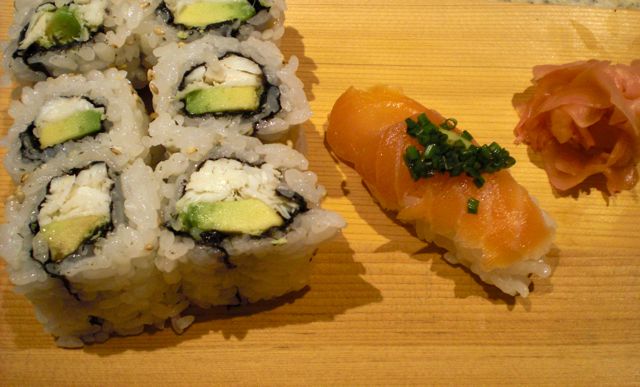
California roll and smoked salmon sushi カリフォルニア巻きとスモークサーモン寿司

When I posted tekkamaki 鉄火巻き, I said that I often make  California roll. My wife corrected this statement by reminding me that I have not made this for ages. So here it is. This was the shime 締め dish for the evening. We also had some leftover smoked salmon (just enough to make two nigiri) so I made two smoked salmon nigiri sushi or nigirizushi にぎり寿司.

The ingredients are crab meat (I got nice jumbo lump crab meat in a small container), avocado, nori sheet, sushi rice and sesame seeds. I did not have tobiko とびこ or masago roe まさご. I do not like to use imitation crab or "kanikama" カニかま for my California rolls or, for that matter, in any dishes calling for crab meat.  At sushi bars, we ask for real crab meat (if they have it) in our California roll instead of the imitation crab (for an extra charge, of course). If they do not have real crab, we order something else

This time, I recruited my wife to take the pictures so that I can show each step, (although anybody in their right mind should not follow my instructions for this or any dish).

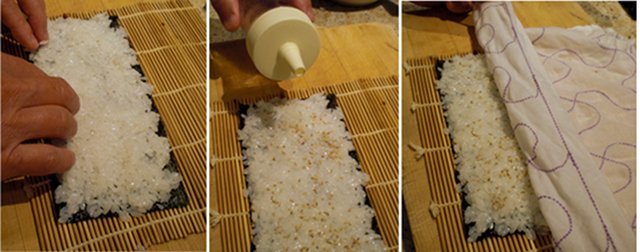
Since this is uramaki 裏巻き (the rice layer is outside), I spread a thin layer of sushi rice to the edges of the nori sheet (I need not to leave a strip of nori without the rice layer like tekkamaki) (below left). I sprinkle white sesame seeds on the rice (below middle). Now, since this is uramaki, you have to flip over the nori-rice combination. There are several way to do it; 1). Covering one of the bamboo mats or makisu 巻き簾 with plastic wrap on both side and dedicating that mat strictly for uramaki, 2). using a sheet of plastic wrap, and 3) using a moist tea towel. I used the last method but any one of these will work. I align the edge of the tea towel with the edge of the rice/nori (below right) and flip over the nori and tea towel together.
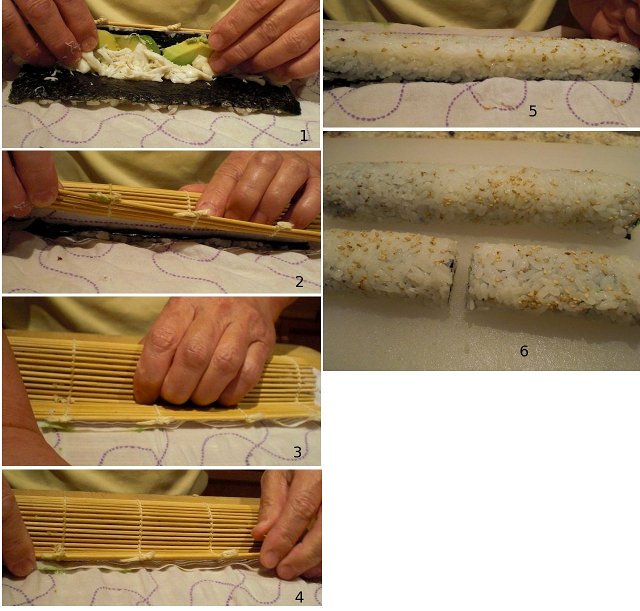
Make sure the edge of tea towel/nori-rice is aligned with the front edge of the bamboo mat (above left). I smear real wasabi down the center of the nori and put strips of avocado and crab meat as shown in the image above on the right.
While trying to hold the crab and avocado in the middle of the roll, start rolling by lifting the edge of the makisu (#1 below). When I reach the other side of the nori surface (#2), I ease the bamboo mat and pull the tea towel from underneath the roll and while holding the tea towel and the bamboo mat together, roll forward to complete the roll. I grab the far end of the tea towel with my right hand and squeeze the bamboo mat and pull toward me using my left hand while keeping the tea towel in place with my right hand (#3) to make sure it is tightly rolled. I make sure the roll is securely together by evenly squeezing the makisu with both hands (#4). Remove the bamboo mat and the tea towel and you see the completed roll emerges (#5). Slice it using a narrow blade knife (#6) in the same manner as tekkamaki (actually I should have made 4 pieces from the half of the roll instead of three; this tells you I have not made this for a long time.

We happened to find wooden sushi serving boards called "sushigeta" 寿司下駄 which we forgot we had in the back of the drawer earlier in the day. It looks like traditional Japanese wooden sandals called "geta" hence its name. I used this to serve the California roll. The avocado was OK but not the best. The crab meat, however, was excellent and (as per my wife), the sushi rice was better than what we often get in sushi bars. Somehow the combination of crab, avocado, sushi rice and nori with soy sauce works very well. No doubt, it is one of the great American contributions to the world of sushi.

Tuesday, September 14, 2010

Garlic chive and grilled abura-age in sesame dressing ニラと焼き油揚げの胡麻和え

This is another type of Otoshi お通し small dish. I bought chives in a small plastic container, along with a few other items at our grocery. The cashier was being a bit careless and the container opened while she was ringing up. Chives spilled out all over everything. So, with restless people waiting in the line behind me, I had to rush back to the produce department and grab another package. It turns out I grabbed the wrong thing. I thought I had chives but when I got home I discovered I had "garlic chive" ニラ. We have garlic chives growing in our herb garden but it tends to be tough so, even though it is prolific, we don't use it much. These garlic chives were very tender and flavorful. Thus, this dish.

I blanched the garlic chives for 30 seconds, then shocked them in ice cold water ringing out the excess moisture. I cut them into 1 inch lengths. Meanwhile, I grilled or toasted the abura-age 油揚げ or deep fried tofu pouch (I used a toaster oven) for 3-4 minutes until it becomes very crispy and slightly browned. I cut it into thin strips. The dressing is made simply; sesame (1 tbs) dry roasted in a frying pan for 2-3 minutes then ground coarsely in a suribachi Japanese mortar すり鉢. I added a small amount of sugar (1/2 tsp) and soy sauce (2-3 tsp) and a dash of dark sesame oil. I dressed the abura-age and garlic chive mixture and served. You have to enjoy this dish while the abura-age is still hot and crispy. A perfect starter dish for sake.

Sunday, September 12, 2010

Angel hair pasta pancake in "okonomiyaki" style エンジェルヘアパスタと桜えびのお好み焼き風

"Okonomiyaki" お好み焼き is a very popular Japanese pancake in which you can put "anything you like on top" (this roughly translates to "okonomi"). We are not particularly fond of okonomiyaki. Last time we tried this dish was in Himeji 姫路. It was in the "Hiroshima" style, and we decided this was not our favorite. There were so many items piled up on the pancake--toppings and sauces, the flavors became "muddy" and we could not taste anything distinctive. But, I occasionally make something like "okonomiyaki" using leftovers. In this version, you can taste all the different flavors.

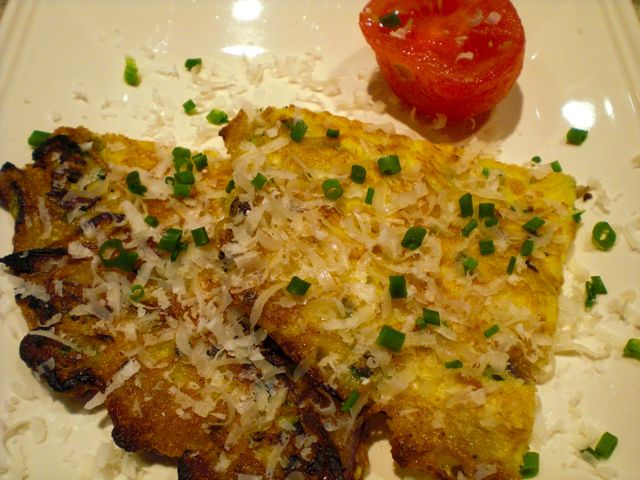
We had left over Angel hair pasta. So I made this as a starter. There are no rules on how to make this type of dish. I had about 1/2 cup (guesstimate) of cooked Angel hair pasta. To the pasta, I added grated Parmigiano Reggiano (about 4 tbs or more if you like), salt and pepper to taste and one egg. I mixed well. In a small frying pan on low flame, I added olive oil (1tbs), and spread the mixture (see the image below). After 4-5 minutes when the bottom is cooked (the surface is still wet), I sprinkled on the dried small shrimp called "sakura ebi" 桜えび but again anything goes. You could add anything you like or you do not have to put anything on at all. I then flip it so that the side with shrimp will cook (another 4 minutes).
I flipped it one more time to make sure the bottom and edge were crispy. I used a Pizza cutter to cut the pancake in quarters and garnished it with "aonori" 青のり and ketchup. This is a very interesting fusion dish but we like this over the more traditional "okonomiyaki". We had this with a nice Spanish red, Portal del Montsant Santbru 2007. We posted our tasting of 2005 vintage in the past. The 07 vintage appears to be very similar in appearance and taste. We shared one pancake since this was a starter.