Thursday, October 7, 2010

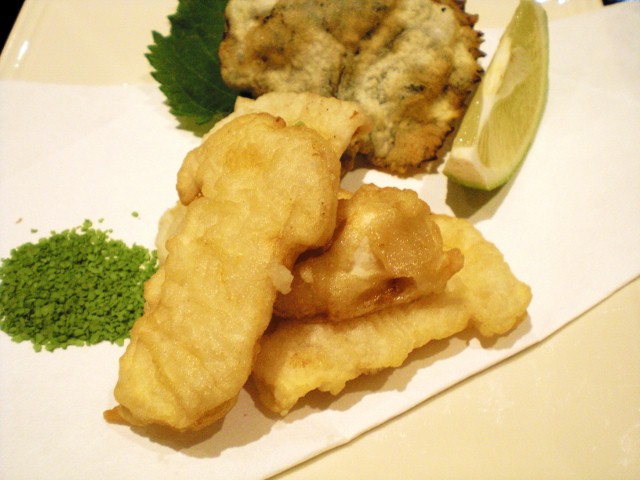
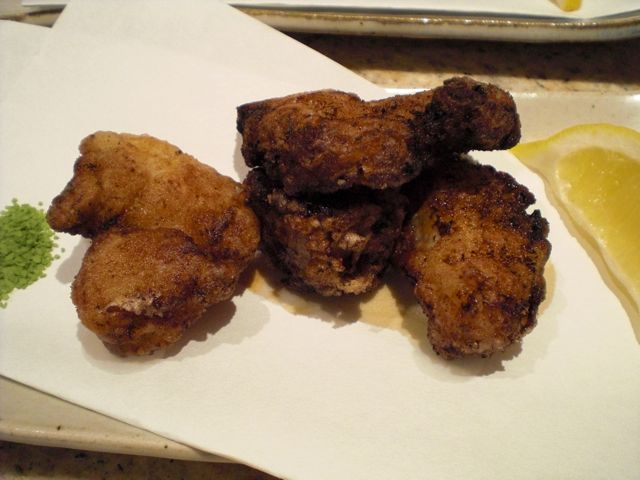
Monkfish karaage アンコウの唐揚げ

We used to get monkfish or anglerfish 鮟鱇 tail meat fillet at our nearby fish market but, for some reason, we have not seen it for some time. Since we now occasionally go to a different grocery store to get pasteurized shell eggs, we checked their fish department and found monkfish.

Monkfish is an interesting deep water fish and Japanese eat almost every part of this ugly fish. I posted several Ankimo 鮟肝 or monkfish liver dishes--the liver is the best part of the monkfish. One of the most popular Japanese ways to cook monkfish is as a nabe 鍋 dish called "Ankou nabe" アンコウ鍋 in which the meat, liver, skin and even cartilage are cooked in miso flavored broth with vegetables. This fish has a very firm texture somewhat resembling lobster tail but does not have a strong taste. I used to bake this fish fillet imitating lobster tail by using paprika to give it a red "lobster" color. This time I decided to make a portion of it as "karaage" 唐揚げ. It is very similar to chicken "Tatsuta-age" 竜田揚げ in terms of how this is made.

The fillet has a slimy membrane covering the surface. Although once cooked, it is not too bothersome, it is best to remove most of the membrane. I used my fingers to pinch, pull up, and raise the membrane from the surface and slice it horizontally using a fillet knife. This way you could remove most of it without slicing off too much meat but you can decide if this is worth the effort. I cut the fish meat into bite sized chunks and marinate them for several hours in the refrigerator in a mixture of soy sauce, sake and mirin (2:1:1) with grated ginger. Just before cooking, I drain and pat dry with a paper towel and dredge the pieces in potato starch or "Katakuriko" 片栗粉 shaking off any excess flour. Meanwhile I heat up the peanut oil to about 170C (350F). I deep fry the fish until the surface is set and the meat is done (2-3 minutes depending on the size of the chunks).

Although I served this with green tea salt, it has enough seasoning so just lemon juice was fine. It has a nice crunch on the surface with firm texture and very nice flavor. We restrained ourselves and only enjoyed a small amount.

Tuesday, October 5, 2010

Matsutake rice 松茸ご飯

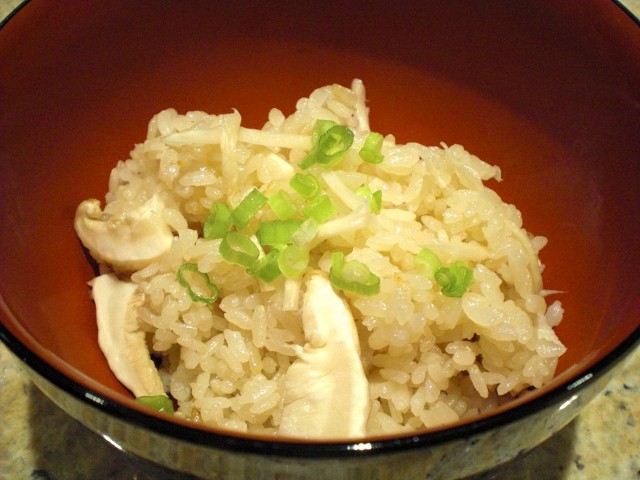
This is the last installment of Matsutake dishes. Because Japanese consider rice to be the main stay of the meal or "shushoku" 主食, "Takikomi goahnn" 炊き込みご飯 or rice seasoned with other ingredients is something special, especially if seasonal items are incorporated such as mushrooms (especially matsutake 松茸) and chestnuts 栗 in fall and bamboo shoots in spring. As I mentioned earlier, we got 1 Lb of of North American (Oregon) matsutake mushrooms. One of the dishes I made was a type of seasoned rice, "Matustake rice" 松茸ご飯. I made this with only matsutake so as not to cover up the subtle but distinctive aroma and flavor of the mushroom.
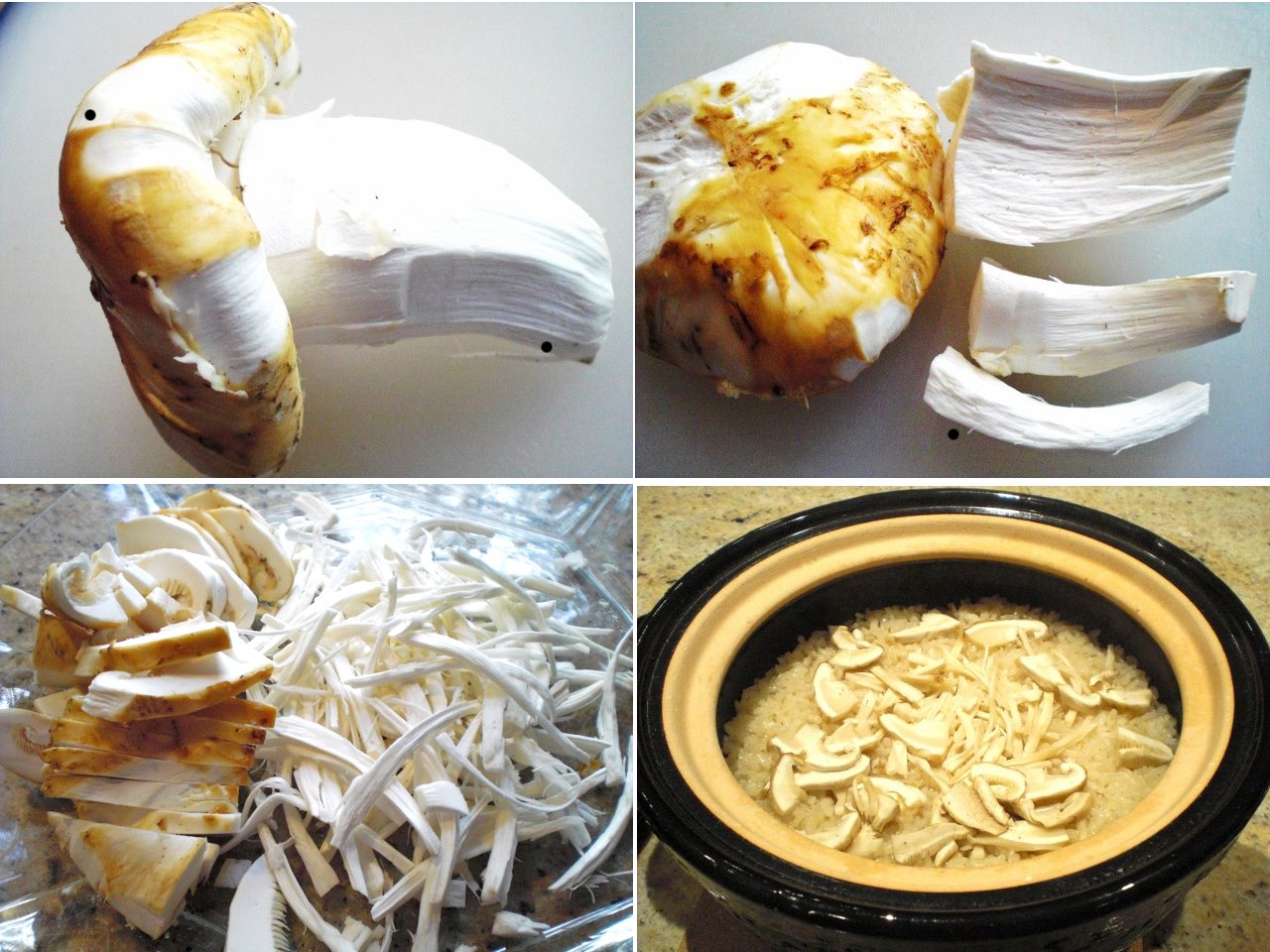
Matsutake: Among the matsutake we got, I picked a very large one for this dish (left upper in the image below). After clearing the matsutake as I described before, I separated the stem and the head since this was a large one. I torn the stem in the direction of the fibers (right upper in the image below). I made rather fine shreds of the stem and then halved the head and sliced it (left lower). I doused the pieces with sake and light-colored soy sauce or usukuchi shouyu 薄口醤油 and let it be absorbed for few minutes.
Cooking liquid: I could have used just water but it is better to use a very mild dashi broth and sake to enhance but not cover up the flavor of the matsutake. I soaked 5-7 inches of dried kelp 昆布 in about 500ml of cold water (I used filtered water) and let it stand overnight or, at least, several hours. The kelp will absorb water and assume its original state. It imparts a subtle kelp flavor to the broth. For 360 ml of rice, I used 400ml of the cooking liquid consisting of the kelp broth, 2 tbs of light colored soy sauce and 2 tbs of sake.
Rice: Many people like to add a small amount of glutenous rice (mochigome もち米) but I only used regular short grain Japanese rice from California (a brand called "Kagayaki"). I washed 2 cups (Japanese cups) or 360ml of rice. I washed the rice until the water came out clean not turbid. In the last few washes, I again used filtered water and drained the rice in a fine mesh strainer. I let it sit for 20-30 minutes. This appears to let the rice grains absorb just the right amount of water before cooking.
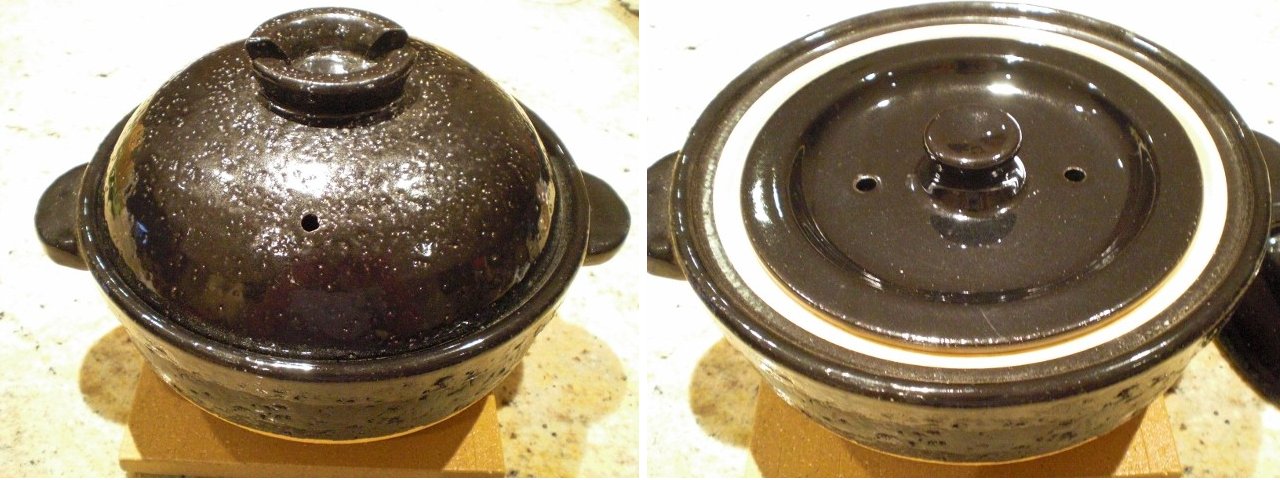
Cooking rice using an earthenware rice cooker:  I could certainly have used my electric rice cooker but this time I used "Donabe" 土鍋 or earthenware rice cooker called  "Kamado san". You can see the final product (right lower in the above image). When I removed the outer lid (see image below), I could really smell the matsutake. This type of rice cooker has an inner lid and an outer lid which make the pot act somewhat like a pressure cooker. As per the instructions that came with the cooker, I added the washed and drained rice (the original 2 Japanese cups or 360ml) and the cooking liquid (400ml). I placed the pot on a medium flame for 14 minutes and then turned off the heat and let it stand for 20 minutes.
I do not use the donabe cooker that often just because it is a bit of work to clean and dry (especially drying) it after use.  But there is no doubt it produces better cooked rice. The matsutake rice turned out really well with lots of flavor and a nice slightly firm texture-- it was perfect. Usually a special Japanese herb called "mitsuba" 三つ葉 is called for but I did not have any. I used the thinly sliced green part of a scallion instead for garnish. We were not able to finish all the rice, so we put the leftovers into small packages and froze them. We'll let you know how that works out. You should taste this at least once a year.

Sunday, October 3, 2010

Auntie N's no-crapple scrapple with Pennsylvania Dutch sweet coleslaw スクラップルとペンシルバニアダッチコールスロウ

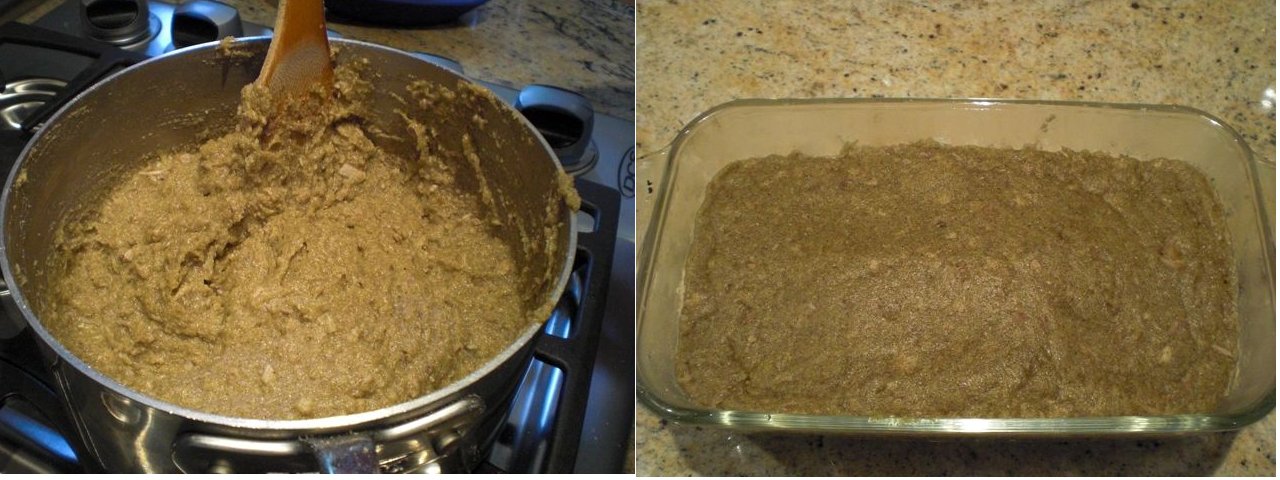
We were expecting a visiting dignitary to come to "Chez Norio" recently, Jon of EOITWJ, but things did not work out and we will have to wait for another chance. In any case, said dignitary is quoted as saying  "Now Scrapple, it's cool because you know it's full of crap, or rather is made of nothing but crap, and that's expected". In response to this statement, I let him know of the existence of Auntie N's no-crapple scrapple. So, we thought it would be most appropriate that our visitor should try her scrapple. Since it is a two-day process to make no-crapple scrapple and weekends are the only time she can do it, I asked my wife to make her specialty before we learned that our visitor could not make it. Actually, she made the best scrapple ever.

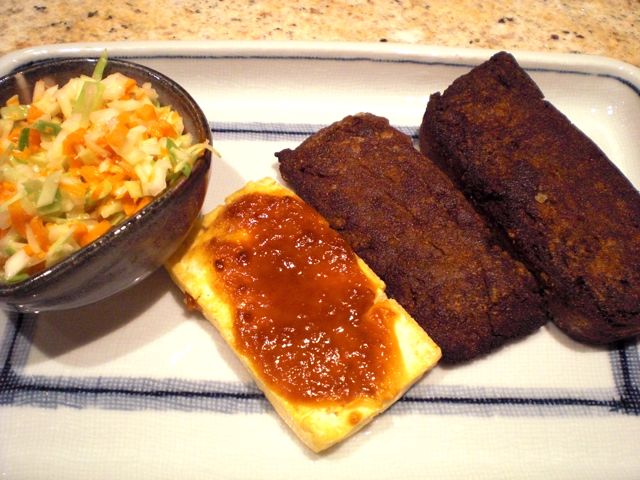
We had this as a part of an eclectic series of small dishes for the evening (mostly leftover from the weekend). The other small dishes included Yakitori-style drummetts and wings, and stewed daikon, pork spare rib (left over from the scrapple making) with the addition of tofu and broccoli. Since I had only a small amount of tofu left after the daikon, pork spare rib, tofu and broccoli dish, I made it as tofu dengaku (in a toaster oven) to use it all up. I served it with the scrapple and Pennsylvania Dutch sweet coleslaw (it may look too eclectic but, at least, it has about the same dimensions as the scrapple) as shown below.
This was the best scrapple ever! Nice mix of spices and porky flavor. Jon, you missed a good one. But don't worry there is more where that came from.
Look at this lovely mud/sewer water color. The addition of buckwheat flour really added flavors and made the color authentic but since this is no-crapple scrapple, no mystery meat or crap is in this one.

Friday, October 1, 2010

Shrimp boil at Hilton Head Island ヒルトンヘッド島での茹で海老

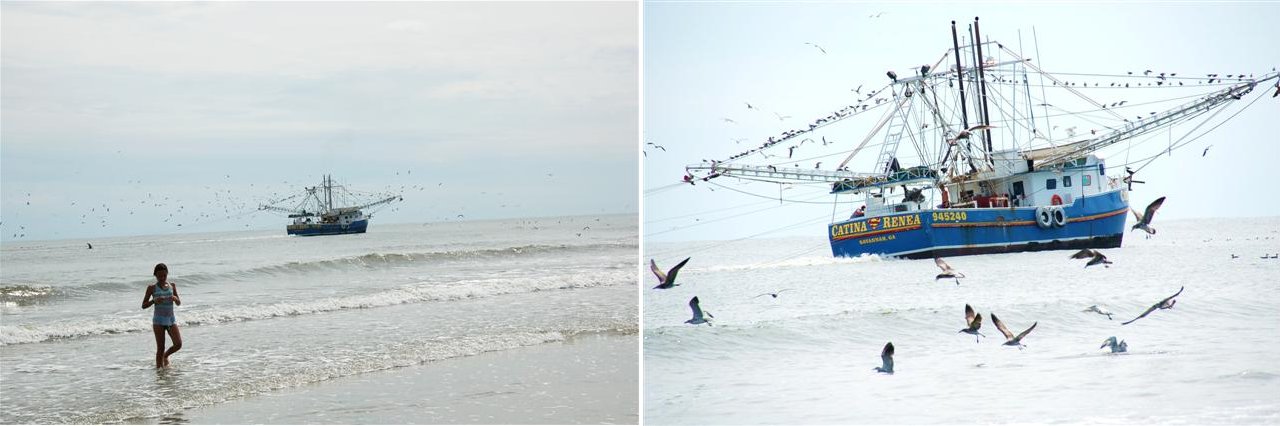
We stayed on Hilton Head island in South Carolina for one week for our vacation. Numerous shrimp boats were visible in the coastal waters. Sometimes, they came very close to shore during the day. At night, they tended to stay off shore with their lights visible beacons on the horizon.


On a previous visit several years ago I saw they were having a special on local white shrimp at the grocery store. I put two and two together figuring that with all these shrimp boats around, the shrimp should be pretty good. I suggested we buy a pound and my wife who had experienced only previously frozen shrimp in the grocery store at home suggest a 1/4 pound.  We settled on 1/2 pound. We cooked them up and discovered one of the absolute delights of the region. The shrimp were very, very fresh, very sweet, tender and succulent--we had never tasted anything like it before. We were hooked. We now buy them by the pounds. They became a culinary focus of our visits to the island. 
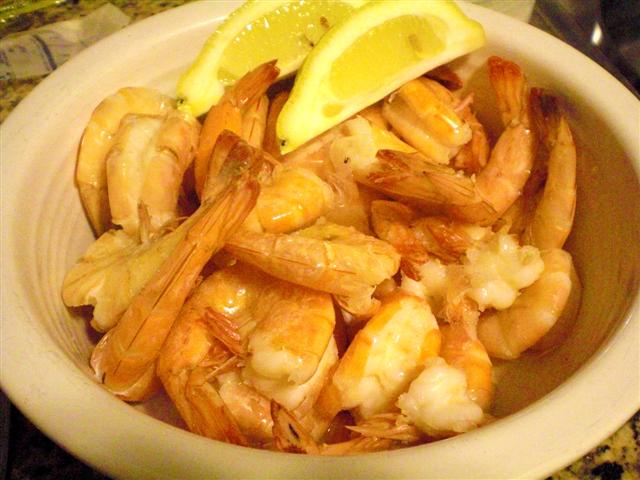
The best way to eat this fresh shrimp is to simply boil them in salted water with the shells on. I sometimes de-vein the shrimp (without taking the shells off) but other times, I do not. The secret to de-veining shrimp without removing the shell is to use a serrated small knife to cut into the back side of the shrimp through the shell. If I see a dark vein (intestine, actually), I take it out. To boil the shrimp, I use just enough salted water to cover them. After the water comes to the boil, I put the shrimp in and cook them for 1 minute or less. I sometimes make a separate dipping sauce but I usually just pour melted butter over the cooked shrimp, add more salt if needed, and freshly squeezed lemon juice. Just shell the shrimp and eat.This is such a good dish because the basic ingredient is so fresh and special it shines even with the simplest preparation. This is also a classic American finger food, "Peel 'n Eat shrimp". For example local bars along the beach have "shrimp by the bucket" specials. It's great fun to sit in the sun, next to the beach peeling and eating shrimp. The shrimp makes this a particularly wonderful appetizer or, in our case, even dinner with a good Ciabata bread from a local market. We use the bread to soak up the juices that gather in the bottom of the bowl. Beer or white wine, such as Sauvignon blanc, are the usual pairings but we stuck with a red wine, Orin-Swift Papillon 2007. This came in the heaviest body builder bottle for 750ml that I have ever known. It was overpriced in the local wine store to boot but it is a big wonderful red.

Thursday, September 30, 2010

Matsutake Tempura 松茸の天ぷら

This is another classic dish made of matsutake 松 茸. I have to confess that this is my least favorite way to enjoy matsutake but in order to post something new, I have to explore many permutations of matsutake dishes. I do not particularly like making tempura of matsutake because, in my opinion, deep frying overwhelms the subtle flavor of the matsutake. Nonetheless, it is a popular way to cook matsutake

I used small sized matustake (two for two small servings like those shown above) which were cleaned and sliced. I made a tempura batter which was relatively thin. I used cake flour with the addition of a small amount of potato starch and added cold water until the thin batter was formed. But I was careful not to over mix, otherwise the gluten will develop and the result will be tough crust. Although I used peanut oil from force of habit, retrospectively, I should have used a flavorless oil such as canola or vegetable oil. The peanut oil adds an essence of peanut flavor to the matsutake--a somewhat confounding element. The oil temperature should be a bit higher (about 180C, I guess, I used my put-a-drop-of-batter-and-it-floats-back-immediately method of judging the temperature of the oil) ), so that the matustake will cook quickly and a nice crust is formed. It may splatter a lot (mine certainly did), so be careful.
I served this with a lime wedge and my ususal green tea salt. It is a very nice dish but the subtle flavor of matsutake is somehow lost. (That extra peanut taste didn't help). The texture is nice; a good contrast of slightly chewy matsutake and crisp crust.