Friday, February 17, 2012

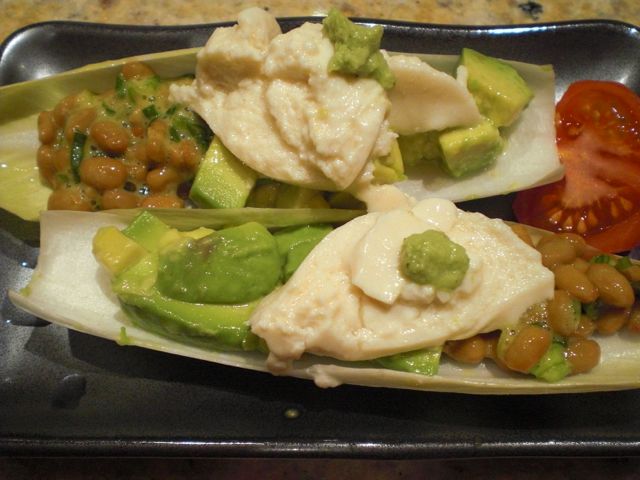
Natto, avocado and tofu on Belgian endive チコリの納豆、豆腐とアボカドの乗せ

Sometimes, what we have dictates what I can make. I bought 4 avocados last weekend but all of them were now quite ripe. If I missed this moment of avocado perfection, they would become mushy, start developing blemishes in a hurry and guacamole would be inevitable. Of course, just nanoseconds before this moment, they were rock hard. In fact, two of them had passed into guacamole land. Another graced a sandwich for the next day's lunch. I made this dish from the last avocado. I came up with this dish since I happened to have a small container of Otokomae tofu and frozen natto in the freezer. In addition, my wife, after many years of abstention, has now come around to eating natto.
This is a simple spur-of-the-moment quick dish. Did I tell you I also had Belgian endive? (which is called "Chikori" or chicory in Japan. Chicory in the U.S. usually means a root of this plant which is used as a coffee substitute or additives).

In any case, this is not a recipe. I just prepared nattou as usual using the seasoning liquid and mustard packets that came with the natto. I just added chopped scallion and mixed it using my nattou mixing contraption well. I removed the stone, skin and cubed the avocado and dressed it with lemon juice and placed the pieces on the endive leaves. I added a few small scoops of soft otokomae tofu and placed a dab of real wasabi on top. Just before eating, we sprinkled on soy sauce and mixed with a small spoon. We ate this with our fingers; picking up the endive leaves. (A word of advice: Start eating from the soft tip of the leaves, otherwise, the leaves will not hold the contents. You do not want to spill nattou on your shirt).

This is not bad at all. The combination of avocado, silken tofu, and nattou is remarkably good. With nattou, sake is the recommended libation.

Wednesday, February 15, 2012

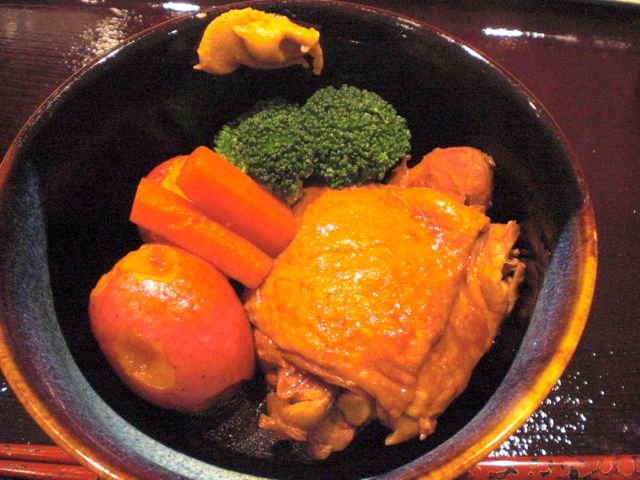
Black vinegar soy sauce simmered chicken 鶏もも肉の黒酢煮

This is just a variation on what I posted before. This time, I added potatoes, carrot and broccoli and served it like "nitsuke" 煮付け or a Japanese traditional stewed dish.

As I have mentioned before, I simmered/steamed chicken breast in a mixture of black vinegar (Japanese not Chinese variety), mirin and soy sauce which was called Kurosuni 黒酢煮. I expanded this to include chicken wings and then chicken thigh in the same sauce. I was initially discarding the leftover broth after the chicken meat was consumed. Then, instead of discarding the broth every time, I added water (to compensate for any evaporation during cooking) and added more soy sauce, black vinegar and mirin (1:1:1 ratio) and reused the broth. I strained the broth between uses and also started adding slices of ginger root (fresh ginger root for every batch discarding the old spent ones). I also changed the way I cook the chicken. instead of cooking it and eating it the same day, I now cook it but eat it later. For example, on the first day, I cook the chicken parts in the broth, then let it cool down and put it in the refrigerator. The next day or few days later, I reheat it. This multi-day process provides a few benefits. One of them is that the chicken becomes much more flavorful and tender as a result of it's extended bath in the liquid. The other is that I can skim off the excess chicken fat.
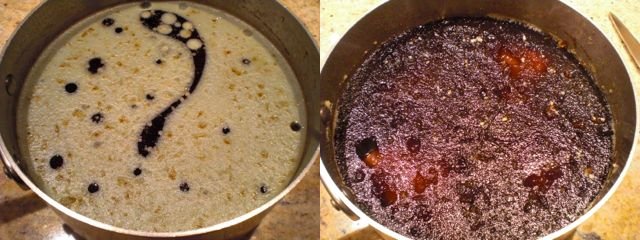
The above picture on the left is after an over night in the refrigerator. I remove the chicken fat using a large spoon (of course, if you are so inclined, you could save it and use it as "schmalz".) After removing the fat (on the right), the broth is completely jelled because of the collagen and protein leached into the broth from the chicken--many batches of which were cooked in the broth. This gellee could be used as a dressing by cutting it into small cubes.

To make a complete dish, I have added nagaimo (the sliminess disappears leaving a very nice texture), daikon (I precooked and then finished cooking in the broth), potatoes (I also precooked), and carrot; all worked well.

Today, I microwaved small red potatoes and placed them in the black vinegar sauce with carrot and simmered them for 20 minutes with chicken thighs. I also added steamed broccoli. I served all these with Japanese hot mustard. So, I have been using the simmering broth for at least several months. The flavor is getting better and better. This time I did not remove the bone from the thigh but we could eat this chicken using chop sticks. The meat was succulent, flavorful and fell right off the bone. 
Since the black vinegar is very mild, this dish will go with wine, especially sturdy reds. We had a very reasonably priced (read "cheap") Tempranillo Bodegas Ondarre Reserva Rioja 2004. This is a sort of everyday wine but went well with this dish.

Monday, February 13, 2012

Scattered sushi cooked in Donabe 炊き込み寿司

This is a variation of scattered sushi "chirashizushi or chirashi sushi" ちらし寿司. Scattered sushi can have many different toppings including raw fish (in that case, it is called nama-chirashi 生ちらし or kaisen-chirashi 海鮮ちらし) but the most original form is made with mostly vegetables such as shiitake 椎茸, kanpyou 干瓢, renkon 蓮根, and gobou 牛蒡. The common way to make chirashizushi is to make white rice first, dress it in sushi vinegar and mix in or top with the seasoned cooked vegetables, other items, and garnish. 

In this version, I cooked rice and seasoned vegetables together as though I was making flavored rice. After the rice was cooked, I dressed the rice with sushi vinegar and garnished. There is not much difference between this and usual method but this tastes more like flavored rice than classic chirashizushi. I decided to make this after I made "ganmo" since there was excess dried shiitake mushroom and a last bit of gobou remained.
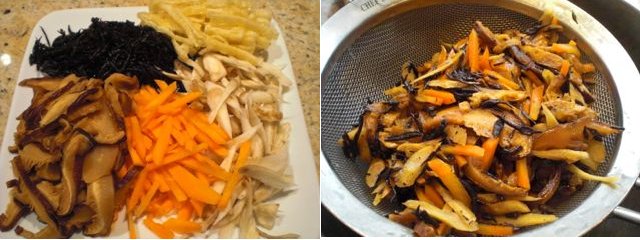
The following amount is for 2 Japanese cups of rice (360ml). The first thing I did was  "mis en place" as you can see on the left of the image below. The black thing is "me-hijiki" 芽ひじき about 1/3 cup after hydration, hydrated and sliced shiitake mushrooms (3-4 medium in size), shredded carrot (1/3 medium), gobou (1/4), and abura-age or deep fried tofu pouch (one regular size, cut in small strips).

I first put dark roasted sesame oil (1 tsp) in a frying pan and sautéed all the ingredients for one minute and added the soaking liquid from the shiitake mushrooms (about 1/2 cup), mirin (2-3 tbs), sake (2-3 tbs) and soy sauce (2 tbs) and simmered it for 20 minutes. I then separated the solids from the liquid (right in the image above). Whatever liquid I collected in the bowl below, I added water (or dashi broth) to make it 400ml.

Meanwhile, I washed the rice (2 Japanese cups, 1 cup=180ml) until the water was no longer turbid and strained it with a strainer.

In Kamado-san donabe rice cooker (or you could use an electric rice cooker), I put the washed rice, the seasoned vegetable mixture and seasoning liquid plus water (400ml) and mixed. As per the instructions that came with the donabe rice cooker, I set the inner and outer lids properly and cooked for 14 minutes on medium flame, turned off the flame and let it stand from 20 minutes without opening. 

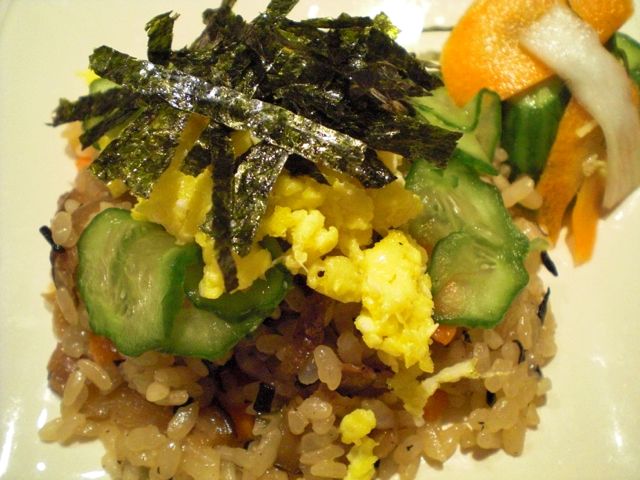
While I was waiting for the rice to steep, I put about 1/2 cup of sushi vinegar (from the bottle) in a Pyrex measuring cup and heated up by microwaving. After 20 minutes of steeping, I mixed the rice, remove it to a mixing bowl, and dressed it with the sushi vinegar (use as much as the rice could absorb without getting too wet). I let it absorb for 5-10 minutes and served. I made thinly sliced cucumber (American mini-cucu, salted, kneaded and extra moisture squeezed out) and scrambled egg (for two small servings you see here, one large egg seasoned with salt). I also used thin strips of nori as a garnish. On the side, I served asazuke  浅漬け of cucumber, daikon, and carrot.

This was a nice ending dish for the evening.  The rice was still warm and has many more flavors in the rice than the regular scattered sushi. I used the leftover rice for lunch boxes the next. Even so, we have a lot left. (Just a head-up that you may be seeing more of this rice in the near future.)

Saturday, February 11, 2012

Cheese stick wrapped in wonton skin チーズのミニ春巻き

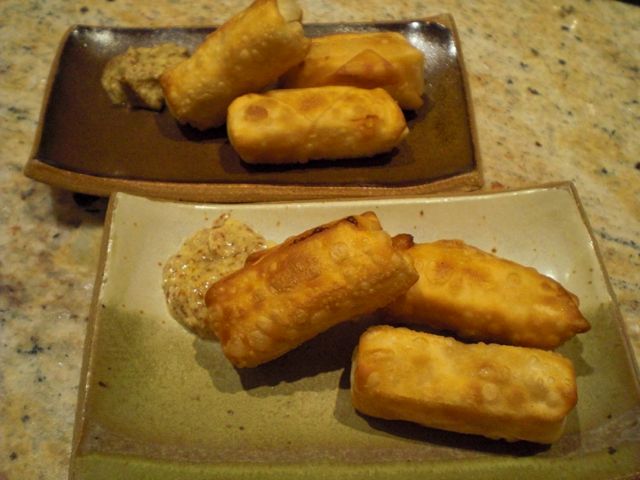
When I was growing up this was what my mother used to make as a drinking snack when guests came over. She deep fried this but I just fried all the surfaces using a small amount of oil in a non-stick frying pan (with the hope that this was slightly less deadly than my mother's method).

I think this is a fairly common homey dish in Japan. Essentially, this is a cheese stick (Japanese "processed" cheese) wrapped in Gyoza or Wonton skin and fried.
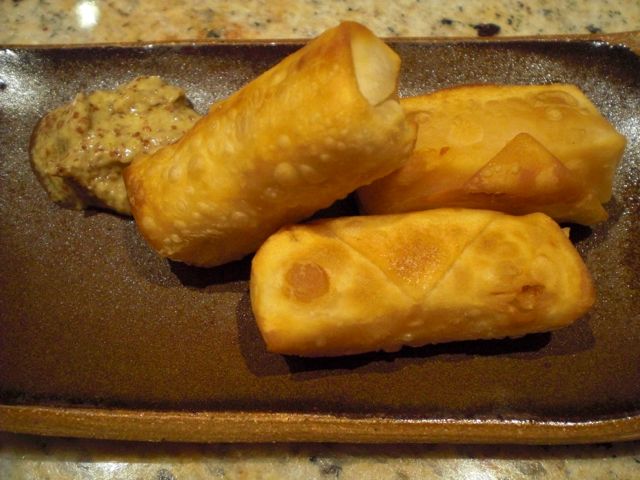
Here I used smoked cheddar cheese cut into a stick that would just fit the Wonton skin. I wrapped it and sealed the end by moistening it.
Using a scant amount of oil (less than 1 tbs), I fried all four sides in a non-stick frying pan on low heat until all sides are golden and crispy. Depending on the cheese, it may melt or as in the case of smoked cheddar, it may soften but not actually melt much.

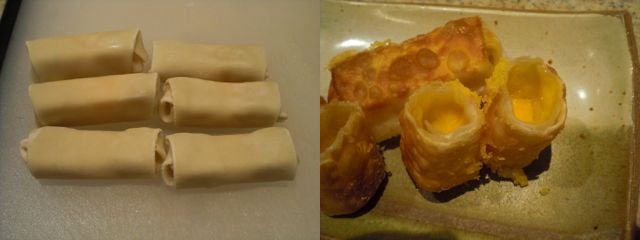
The image on the left shows cheese sticks wrapped with wonton skin before being fried. On the right is the finished stick made with aged but not smoked cheddar cheese which melted and puddled in the bottom of the wonton skin. If you use melting cheese, the cheese may leak from the seams of the wonton skin if you are not careful.
I served this with Dijon mustard. Either the smoked or non smoked cheddar cheeses were good. This type of snacks can't go wrong albeit it may not be too healthy.

Thursday, February 9, 2012

Fried tofu ball がんもどき

Ganmodoki is one of the common items used in oden おでん. Usually I buy this ready made and  frozen but since I had 1/2 tofu left over and happened to have the other ingredients to make "ganmodoki" or "ganmo" for short, I gave it a go. Hot freshly fried ganmo is very different from what you eat as an oden item. 

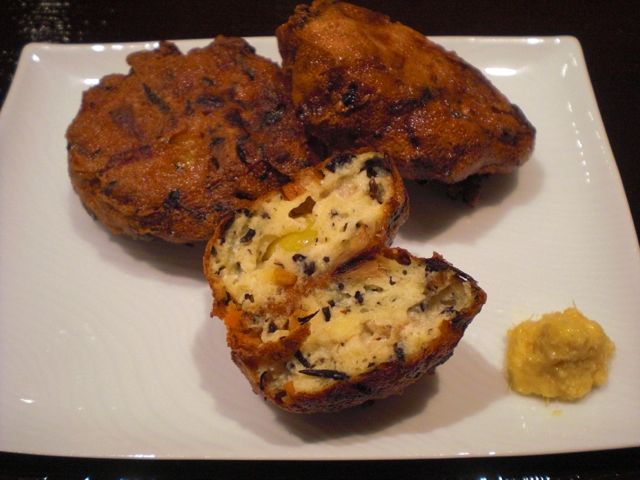
Here I served it hot with grated ginger and soy sauce. (You can see a ginko nut peeking out of the cut surface.) There appear to be many theories as to the origin of the name. The corresponding kanji letter for ganmodoki is 雁擬き meaning "imitation goose" but this certainly does not resemble, in any way, shape or form, goose meat.
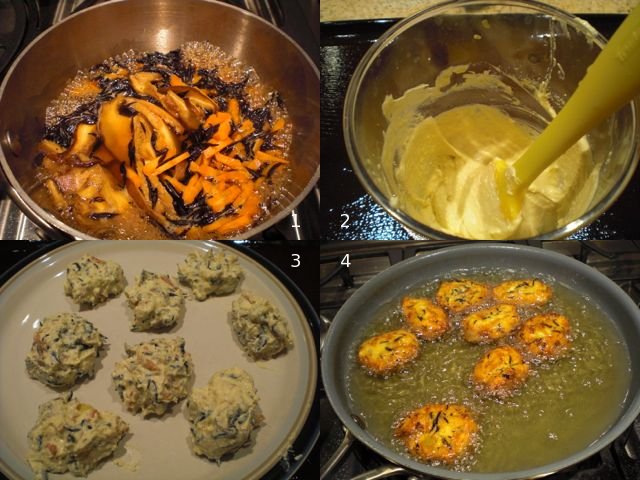
I had 1/2 a block of soft tofu to use. I wrapped it in a paper towel and microwaved it for 1 and half minutes and let it cool down, allowing the excess water to be absorbed into the paper towel. I placed the tofu and a whole egg (1 large) in a plastic blending container and homogenized using an immersion blender (#2 in the image below). You can use a food processor or Japanese mortar, suribachi すり鉢, for this as well.

Other ingredients included; dried shiitake mushroom (1 large, hydrated, stem removed and thinly sliced), black sea weed called "hijiki" ひじき (dried 1 tbs), gobou (1/4 tail end, leftover from the New Year) and carrot (1/4 medium). For hijiki sea weed, this time, I used "me-hijiki" 芽ひじき which is shorter and smaller than long hijiki or naga-hijiki 長ひじき I posted before. After hydration (with several changes of water for 30 minutes), hijiki increased in volume by almost 10 fold. I squeezed out the excess moisture and combined with shredded gobout and carrot.*  I added the soaking liquid from the shiitake (100ml) and simmered (#1 in the image below). I added mirin (2 tbs) and soy sauce (1 tbs) and further simmered on a low flame for 5-10 minutes until almost all the liquid was gone. I let it cool down and further removed any remaining liquid by squeezing. I added the mixture to the homogenized tofu and added potato starch (1 tsp or a bit more depending on the moisture level) and mixed well. Since I seasoned the vegetables, I did not add salt to the batter.

Moistening my hands with vegetable oil, I made small round disks (eight 2 inch diameter) and I also inserted ginko nuts (from a can) into the center (#3 in the image below). The batter was very soft and sticky. You could use two spoons in a manner similar to making quenelle and directly drop it in the oil.

* These were cut in  "sasagaki" ささがき. In Japanese curinary parlance, sasagaki is to shave off vegetables (mostly thin long items such as gobou) as though you are sharpening a pencil. Supposedly, the shape of the resulting pieces resembles small bambo ("sasa" 笹) leaves.
I deep fried it in 170C (340F) vegetable oil until golden (#4, turning a few times, total time of 4-5 minutes).

Homemade and hot freshly fried ganmo has an all together different taste and texture from the frozen variety we are used to. Hot and crunchy on the outside you can't go wrong. Although, we have to admit, this does not remind us of goose meat, it is quite good on is own right. A perfect drinking snack especially with cold sake.