Tuesday, May 1, 2012

Chicken teriyaki 鶏腿肉の照り焼き

"Teriyaki" 照り焼き was popularized in the U.S. early on as a Japanese dish, probably in the same period "Sukiyaki" was getting popular. It has been incorporated in American home cooking (especially backyard BBQ) and you can buy a bottle of "Teriyaki" sauce (from Kikkoman and others) in any grocery store. I am not sure American-style "Teriyaki" even qualifies as an authentic Japanese dish. Usually, the teriyaki sauce is used as marinade and/or like a BBW sauce for meat. The meat is then grilled. 

The original Japanese cooking technique of "Teriyaki" is braising not really grilling. "Teri" 照り means glossy surface or luster and "Yaki"  焼き means grilled but "Yaki" in Japanese could mean braised as in "Sukiyaki". So, any dish braised in a sauce (usually soy sauce based with sugar) until the sauce is reduced and thick (due to the sugar content) and coats the surface of the food items is called "Teriyaki" either meat or fish. 
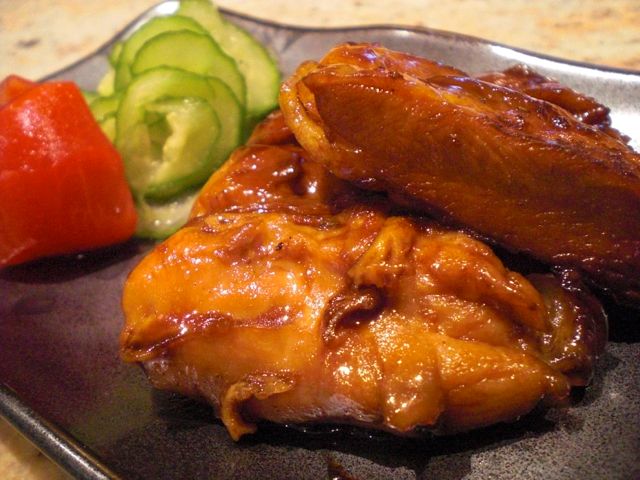
If I am making teriyaki chicken from scratch, I prefer to use thigh meat, deboned but skin on. I butterfly the thickness part to make the entire piece even thickness. I could marinate (mirin and soy sauce or sake and salt) but that is optional. I cook it from the skin side first in a frying pan until the skin is well browned (removing some excess oil by blotting with a paper towel) and cook the other side. In this occasion, I used leftover thigh meat which was salted and grilled (two thighs, that had been grilled in a George Forman's grill) so I skipped this process. Since the chicken was already cooked I went directly to the "saucing" step.

I then poured in "Teriyaki sauce"* and put the lid on for a few minutes (in this case, I really did not need to cook the chicken further). With the lid off, I turn up the flame and reduced the sauce until it became thick; clinging to the surface of the chicken giving "teri" or luster to the surface. Just to be slightly different, I sprinkled Chinese 5 spices (or Japanese "sansho" 山椒powder) to finish.

*You could use a bottled one but I just use a mixture of soy sauce and mirin (about 1:1).

Since this was made from leftover grilled salted chicken, it took less than 5 minutes to make. This was a sort of cannot-go-wrong type of small dish if not exciting. The cinnamon flavor of the Chinese 5 spices came out rather prominently. If you do not like this, stick to "Sansho" powder.

Sunday, April 29, 2012

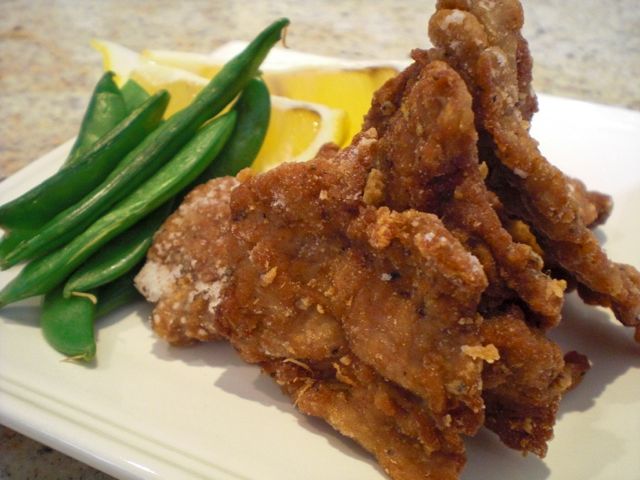
Crispy Pork "Tatsuta" fry 豚肉の唐揚げ竜田揚げ風

This is another small dish I made from the trimmings of pork tender loin. This is a variation of "tatsuta-age" 竜田揚げ but I pounded the pork thin so that the entire thing fries up quickly with a very crispy crust.

This is a perfect starter and is the best just coming out of the hot oil but it is highly seasoned and it tastes good even cold.

Pork: I used trimmings from two pork tenderloins. I cut the trimming into half inch medallion and pounded thin (1/4 inch or less). I seasoned both sides with salt and pepper (easy on salt).  I added a small amount of soy sauce and grated ginger and mixed in to the meat.

Dredging four: I used a mixture of potato starch and rice flour (1:1). I dredged each piece of the pork, shaking off excess flour.

Deep frying: I used only half a inch deep vegetable oil but since the meat was very thin, it was deep frying. I fried it in 180C or 350F oil for one minute on each sides turning once. 

After draining the oil, I served it with wedges of lemon and microwaved snap pea. Since it is well seasoned with pepper, salt, soy sauce and ginger, there is no need for sauce. You mostly enjoy eating the "crust" than the meat itself. My wife thinks that the leftovers from this dish are a great sandwich item.

Friday, April 27, 2012

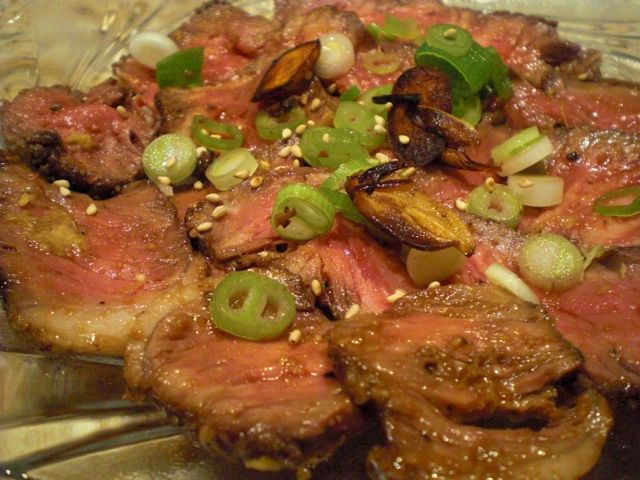
American Wagyu Tataki アメリカン和牛のたたき風

This is another padding post. This is a dish made from the Wagyu steak leftovers we had. We ate a bit less than half as steak on the day we cooked it. The next day we ate 1/4, thinly sliced with grated daikon and ponzu sauce. We really do not like to eat just one thing to fill us up. So we are able to stretch the steak this way. The reaming 1/4 I served as a more traditional "tataki" on the third day.
I first sliced the remaining steak thinly. Since the meat was cold, the marbling is very visible. In a bowl, I put the thinly sliced steak, grated garlic (1/3 tsp) and grated ginger root (1/3 tsp) and soy sauce (1/2 tsp) and mixed it well. I let it sit for a few minutes and then spread the pieces on a plate. I garnished it with chopped scallion, thinly sliced, fried garlic, and roasted white sesame seeds.

To me, cold Wagyu beef taste better than eating it as a steak. The fat portion is not as oily or strong but gives a much nicer mouth feel. Compared to American prime beef which is much leaner, Wagyu is much better for this type of tataki preparation. But for a regular steak, I may even prefer leaner American beef.

Wednesday, April 25, 2012

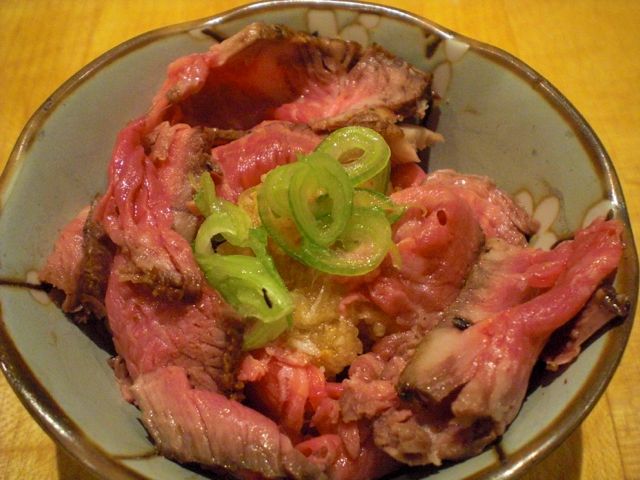
American Wagyu tataki with grated daikon and ponzu sauce アメリカ和牛のたたきポン酢大根おろし和え

This is actually leftovers from the Wagyu steak we had. When the steak was cooked the marbled fat layer became transparent and sort of disappeared but when the steak get cold, the marbling reappears as white streaks. Although this was not a true "Tataki" preparation, this Wagyu New York Strip steak cooked medium rare is really close. So the next day, I sliced the steak paper thin and served it as though it was beef tataki*.

Dressing: I grated diakon (about 1/4 cup), squeezed out the excess moisture and added ponzu shouyu sauce (from the bottle) and 7 flavor Japanese red pepper powder 七味唐辛子 and mixed. The amount of ponzu is as much as grated diakon can absorb.

I garnished this with thin slices of scallion.

Ponzu and grated diakon really cut the fat of the beef and makes this dish. Because of the acidity of the ponzu, sake will be the best bet. We still have more than 1/4 of the Wagyu stake left. I can make something else.

*Tataki: "Tataki" preparation can mean two totally different Japanese cooking techniques. The first is to chop up raw fish as in "Aji-no-tataki" 鰺のたたき. The second is to sear only the surface of the fish or meat and keep the center raw such as in "Katsuo-no-tataki" 鰹のたたき. Beef can be prepared this latter way.

Monday, April 23, 2012

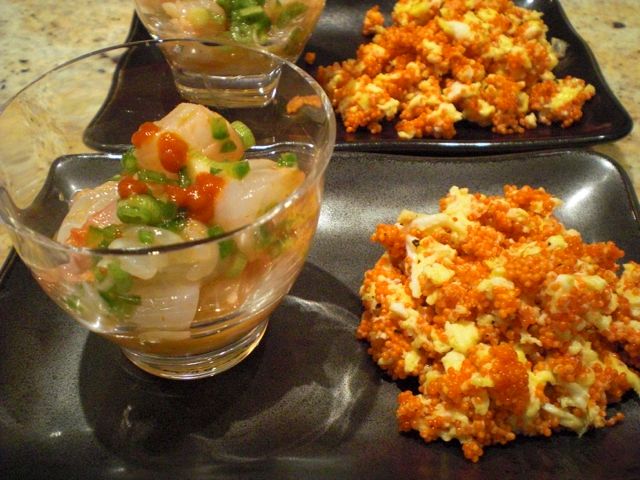
Sweet shrimp ceviche and shrimp roe scrambled egg 甘エビのサビーチェと海老の卵入りスクランブルエッグ

The second day after we receive amaebi, I tend to make it to ceviche. This time I had very large roe-bearing amaebi or side spotted prawns. I made cerviche and, from the roe, made scrambled eggs similar to the shad roe dish which appears to be the only fish roe besides cavier and salmon roe available in the U.S.. Shad roe is not considered to be gourmet or high-end food like caviar. I have never seen shad roe in Japan.


For cerviche, I shelled and cut up the shrimp (2 huge ones) and mixed with scallion (2, finely chopped), Jalapeño pepper (1/2 medium, seeds and veins removed, finely chopped), salt, pepper, lime juice (about 2 tbs, from one lime). I also added a small amount of hot sauce (Sriracha, instead of regular Tabasco. The taste test by "Cook illustrated" chose Sriracha as the Best and Tabasco the worst. We do not totally agree with this but Sriracha has thicker texture, less vinegary and a bit more complex). I also put few drops on the top as a garnish.

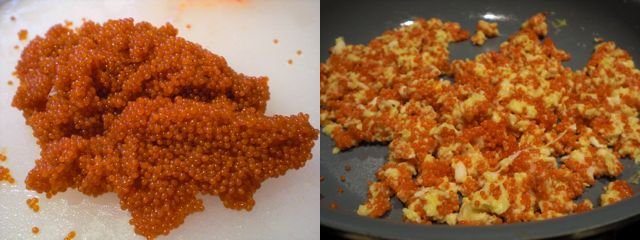
For scrambled eggs, I first removed the roe and made sure all the shells were removed (left, this is from two large amaebi). In a non-stick frying pan, I melted a pat of butter (1/2 tbs) and sautéed the roe. After one minute or so, I added beaten eggs (two large) and scrambled. I seasoned it with salt and pepper.


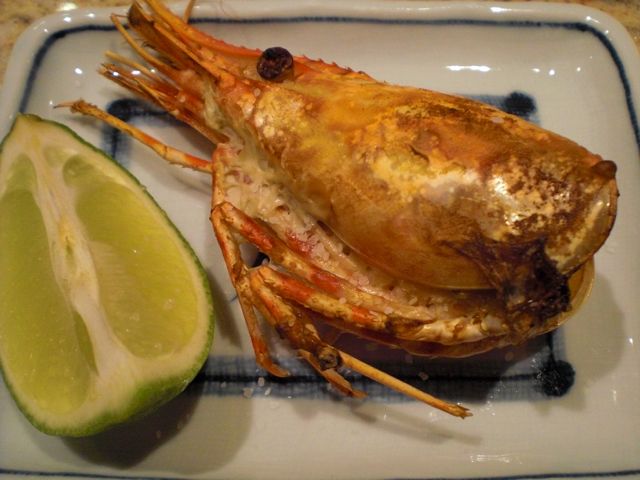
Since the heads were too large, I decided to just go for the inside stuff not the outer shells. In the past I have put large heads in miso soup but this time I baked it for 20 minutes in a 450F toaster oven (antennae trimed). To eat, we removed the outer shell and ate whatever inside and portion of legs that was crunchy but edible. We seasoned with  some salt and lime juice.


The cerviche was kinda hot but not tongue numbingly so. The difference between Sriracha and Tabasco may be less in this type of preparation but Sriracha has a slightly sweet and complex taste beside heat. The shrimp roe scrambled eggs were interesting. Although, the roe are mostly for texture, the combination of the soft texture of the scrambled eggs was very nice and enjoyable. My wife added extra juice from the cerviche to the eggs. As far as the shrimp heads are concerned, the best stuff is inside and baking is easier than deep frying and maybe a bit more healthy to boot. We have to find a source of calcium elsewhere.