Thursday, June 11, 2015

Grated nagaimo and onsen egg トロロ温泉卵入り

This is a classic way of eating nagaimo 長芋 or yamaimo 山芋 in Japan. This preparation of grating or "Tororo" トロロ, however,  is not for most Western audiences since it is ultimately "slimy". My wife appears to have overcome the sliminess most of the time after gradual conditioning over the years. Although grated nagaimo  has right consistency as is, yamaimo tends to become very thick and to eat as "Tororo", it may have to be diluted with dashi (or my mother used to dilute it with miso soup since this was often served as a breakfast item and miso soup was also regularly served for breakfast).


I grated the nagaimo, seasoned with soy sauce with wasabi and chopped scallion. Since I had onsen eggs 温泉卵 which I had made previously sitting in the refrigerator, I dropped that in the middle and garnished it with thin strips of nori seaweed.


When you dig in you see the nice creamy egg yolk. The egg can be poured over rice and enjoyed as is the traditional way, we just ate as a accompaniment for sake. Since the potato has lots of starch, this is surprisingly filling and remarkably went well with sake.

Monday, June 8, 2015

Three appetizers お通し三種

This is another one of my otoshi お通しappetizer threesome. We got small covered containers and divided wooden trays  at a small shop in the Nishiki Market 錦市場 in Kyoto 京都 some years ago. Square and pentagonal bowls were from Gumps in San Francisco. This was one of the warmer days so far this year and for the first time, we were having this outside.


When you open the lids, it is ”fermented squid and guts” or shiokara 塩辛 . When written out in English it sounds very un-appetizing but it is one of the delicacies perfect for sipping sake and my wife's favorite. This one came frozen in a small pouch and. It is not as salty as ones we had before and was quite good.

The left is wakame seaweed 若芽 and cucumber salad (dressed with sushi vinegar, sesame oil and light colored soy sauce), the right is onsen egg 温泉卵 (cooked in my Sous Vide machine), dressed with ponzu sauce and garnished with finely chopped scallion and salmon roe or ikura いくら.


These are the ultimate for sipping sake. We gazed at our plum blossoms, tasting a little of these appetizers and sipping more sake.

Friday, June 5, 2015

Duck fat roasted potato 究極のオーブンポテト

My wife is always in pursuit of the "ultimate" fried potato without actually frying. She has been making "oven fried potato" which is very good but a bit of work. This time, from the same source, "Cook's illustrated",  she saw a recipe for "duck fat roasted potato" with rosemary. Duck fat is not something we regularly stock. When I cook duck breast I usually mop up the fat with paper towels but last time, I poured the rendered duck fat into a small ramekin since the amount of rendered fat was unusually large. I did not have any intention of saving it but my wife apparently covered it and placed it in the refrigerator. So when she came across this recipe, it was like the stars and the moon were lining up properly and she had to try it. The below is the final product; nice thick crispy crust and soft center with nice rosemary flavor.


Unlike myself, my wife measures, weighs and follows the recipe precisely. She had to scale the original recipe to 2/3 but the amount given below is from the original recipe.

Ingredients:
3 1/2 lb Yukon gold potatoes, peeled and cut into 1 1/2 inch pieces (#1)
              Kosher salt and pepper
1/2 tsp   baking soda
6 tbs      duck fat
1 tbs      chopped fresh rosemary

Instruction:
  1. Preheat oven to 475F with a rimmed baking sheet on the top shelf. (Note to self: when using the dark nonstick rimmed baking sheet reduce the temperature to 400 and check periodically to see about adjusting the time.)
  2. Add 10 cups of water to a pot and boil over high heat, add potatoes, 1/3 cup of salt and baking soda. Return to a boil and cook for 1 minute. Drain potatoes. Return potatoes to pot and place over low heat. Cook, shaking pot occasionally, until surface moisture has evaporated, about 2 minutes. Remove from heat. Add 5 tablespoons duck fat, 1 teaspoon of salt, mix to coat (#2).
  3. Remove (hot) baking sheet from the oven spread potato in one layer and bake for 15 minutes (3#, surface is showing just few brown spots).
  4. Using metal spatula, turn the potatoes over (#3), the bottom developed nice brown crust. We made sure that the pale side of potatoes is down and brown side up #4) and baked 12-15 minutes longer. While potatoes roast, combine finely chopped rosemary and the remaining 1 tbs duck fat in a bowl.
  5. Spoon rosemary mixture over the potatoes (#5) and using spatula turn.  Bake an additional 3-5 minutes (#6). Season with salt and pepper as needed.


ultimate orasted potato

This is less work than oven-fried potato and the result is better. Because of the par-boiling and baking soda, a thick crust forms during baking and the fresh rosemary adds a nice flavor. Although the entire kitchen smelled of duck fat, we did not taste not much "duck" flavor on the potato.

We may try this with just olive oil or with bacon dripping. Another alternative may be using white potato instead of Yukon Gold. In any case, this is indeed a fantastic oven potato. The leftovers heat well in the toaster oven.

Tuesday, June 2, 2015

Pork and Potato 豚肉じゃが

Nikijaga 肉じゃが is traditionally made from thinly sliced beef and potato which I posted some years ago. As usual, when I prepared pork tenderloins, I hand-chopped trimmings into ground pork. After consulting with my wife, I made two dishes; mapo tofu 麻婆豆腐 (which I will posted soon) and nikujaga made from ground pork. Either using beef or pork, this is a Japanese version of meat and potato comfort food.


For green, I added steamed green beans at the very end and the noodle is "shirataki" 白滝 or threads made of konnyaku コンニャク (devil's tongue).
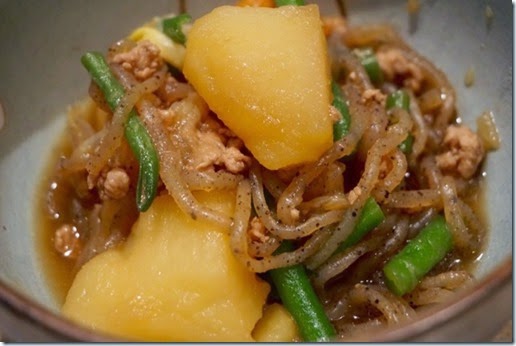


The amount of ingredients is arbitrary but these are the estimates.

Potato: 4 large Yukon Gold potato, peeled, eyes removed and cut into 1 inch chunks.
Onion: 2 medium, cut into small wedges.
Pork: about 150grams or 1/3 lb (you can use whatever amount and also thinly sliced rather than ground).
Green beans: Either boiled or steamed, still crispy.

Seasoning:
Dashi broth: 250-300ml or about 1 cup, just enough to cover the ingredients. I used one I previously made from a dashi pack (Bonito and kelp).
Sugar: 1 tbs
Mirin: 2 tbs
Sake: 2tbs
Soy sauce: 2-3 tbs, I added in several increments as I tasted.
Vegetable oil: 1 tbs

In a pot, I added the vegetable oil on medium flame. When the oil was hot, I added the pork and cooked until the color chanced (2-3 minutes) and it was done. I added the onion and sautéed until soft (3 more minutes), then added the potato, mixed and added the broth to cover.  When the broth came to a boil I turned down the flame to simmer and added the seasoning. I added the soy sauce in several increments tasting the broth each time. I cooked with a lid on for 20 minutes until the potato was cooked through. I removed the lid and reduce the broth a bit, gently shaking the pot for 5-7 minutes. I added a small amount of soy sauce to give a fresh taste and then added the green beans. After a few more minutes, I turned off the fire and served warm.

I think this is perfect for a small dish served with either wine or sake. I must say, I rather like the pork version of this dish since that is how my mother used to make it and I generally like pork more than beef.

Saturday, May 30, 2015

Miso-marinated grilled cod たらの味噌焼き

This was the last dish I made from a filet of cod we got the other day. This is miso-marinated cod with miso-based sauce on the top. This was a one-plate dinner one weekday evening. I broiled the cod after I smeared on the miso-based sauce but it did not char much. Maybe I should have used my kitchen torch.


I served the cod with an eclectic assortment of accompaniments; wedge of skinned tomato (seasoned with salt and olive oil), Cauliflower a la Montoparnasse, steamed green beans with sesame sauce, braised cabbage with onion and lemon* and butter-soy-sauce fried rice with parsley.

* recipe from Cook's illustrated.


Miso marinated cod:
Cod filet; four small filets for two
Miso marinade: red miso, mirin, and sake (2:1:1 ratio), mixed and then placed in a Ziploc bag with the fish filets, the miso marinade to coat all surfaces.

I marinated the cod for 2 days (It should be marinated at least 24 hours) in the refrigerator.

Before cooking, I removed the fish and scraped off the excess miso marinade, washed in cold water and then pat dried (to prevent scorching during cooking and to reduce the saltiness from the marinade. I could have gotten the same effect by separating the marinade from the fish by using a layer of cheese cloth).

I baked the marinated cod in the toaster oven preheated for 375F for 10 minutes on a metal grate over an aluminum foil covered drip pan. (The small footed grate raised the fish slightly above the bottom of the pan and prevented the fish from being steamed/boiled instead of baked).

Meanwhile, I made a miso-sauce for the fish by simply heating the remaining miso marinade and added yuzu juice and more mirin to make it a  looser consistency. I heated the sauce while stirring to thicken it just a bit. I added frozen yuzu peels at the end. I spread the miso-sauce over one side of the fish and switched the toaster oven from bake to broil to make the miso sauce slightly browned and fragrant (it did not char/brown as much as I wanted under the broiler of the toaster oven).

The cod had a nice flakey moist texture and the miso marination and miso sauce both added nutty, salty and sweet flavors and a hint of Yuzu citrus.

So this is a rather complete meal with protein, vegetables and starch.