This combination of greens and salads was our lunch on one weekend. Among the three salads, salmon salad and potato salad are our usual but couscous salad with fresh mint is new. The greens are home-grown arugula, blanched broccoli, and sugar snaps. For color, I added skinned Campari tomato. After taking the pictures, I added my honey mustard dressing on the greens.
The couscous recipe came from WP food section as a way to use mint from your yard which may be profusely growing at this time of the year. The original included frozen sweet peas but we omitted it. Since we planted mint late spring this year, this was a recipe we had to try. The lunch included cheese muffins my wife made some time ago. (She just realized we did not post the muffin recipe).
Ingredients (2 servings, for us more like 4-6 servings)
3/4 cup dried plain couscous.
1 cup chicken broth (our usual Swanson no salt and no fat kind).
1/4 tsp salt
2 tbs butter
1/4 cup finely minced fresh mint leaves.
1/4 tbs chopped parsley.
For dressing
1/4 cup live oil
1/4 rice vinegar
black pepper
Directions:
let the chicken broth with the salt, butter come to boil and add the couscous, remove from the heat and let it steep with the lid on for 15 minutes. Use a folk to fluff the grains and let it cool.
Add the minced mint and parsley (see below).
Mix the oil and vinegar together.
Mixed it into the couscous.
This is very refreshing couscous salad. Because of the dressing, it is not too dry and there is no danger of inhaling it (which can happen when eating dry couscous). Especially with the combination of other salads and greens, this is a really nice summer lunch. Once the salads are made up, it is a cinch to put together a lunch without having to do any cooking.
Thursday, August 16, 2018
Monday, August 13, 2018
Nagaimo and daikon yukari-ae 長芋と大根のゆかり和え
These are small dishes we started the evening meal. Among the five items I served, only one is new which is in the blue bowl on the upper left. Upper center is squid stuffed with caramelized onion イカの飴色玉ねぎ詰 and tentacles, upper right is chicken liver simmered in red wine 鶏レバーの赤ワイン煮, lower left is sugar snaps soaked in dashi broth スナップ豌豆の塩びたし, and one in the small yellow container looking like a citrus fruit is uni or sea urchin "shuto" from Maruhide 丸秀のウニの酒盗.
This is a new item made from nagaimo and daikon. It is rather interesting and we like it.
As we mentioned before, when this squid dish is cold, I can slice it without separating the stuffing and the squid body. As you can see on the cut surface, quite few squid legs are stuffed. I drizzled our favorite spicy Spanish olive oil.
The below is another "teiban" 定番 in our household, red wine simmered chicken liver. This time I garnished with fresh thin slivers of ginger or "Hari-shouga" 針生姜.
Sugar snaps are good just blanched but this one was soaked in lightly seasoned Japanese broth. When you bite down, instead of water, you can get the subtle taste of the broth which makes an already good veggie nicer.
This is one of the five different kinds of sea urchin or uni "shuto" from Maruhide. When we got fresh uni last time, we also got these "shuto". Although frozen, they won't improve with age, so we have been hitting them regularly. This on is with hot chili and indeed the spiciness creeps up on you afterwards. This is almost as good as fresh uni.
For "Nagaimo no yukari-ae" 長芋のゆかり和えfrom E-recipe. I changed the amount of Yukari thinking the original recipe will make this dish rather salty.
Ingredients (for 2 servings, for the amount shown probably make 4 servings):
1 inch long daikon, peeled, sliced thinly and cut into thin julienne.
1 inch nagaimo, peeled, sliced thinly and cut into thin julienne.
1/2 tsp Yukari salt
1 and 1/2 tbs sweet vinegar (300ml rice vinegar, 120-150 gram sugar and 5-10 gram salt)
Directions:
Put both the daikon and nagaimo in boiling water. When it comes back to a boil, drain and let it cool in a colander.
Dress with Yukari salt and sweet vinegar.
This is a nice dish. My wife thought everything was nagaimo but this is a mixture of daikon and nagaimo which give an interesting texture difference. Yukari (dried red perilla) salt and sweet vinegar combination is very good giving nice refreshing taste. This is another way to use nagaimo and more interesting than sushi vinegar and aonori combination. In any case, we had cold sake with these starters.
This is a new item made from nagaimo and daikon. It is rather interesting and we like it.
As we mentioned before, when this squid dish is cold, I can slice it without separating the stuffing and the squid body. As you can see on the cut surface, quite few squid legs are stuffed. I drizzled our favorite spicy Spanish olive oil.
The below is another "teiban" 定番 in our household, red wine simmered chicken liver. This time I garnished with fresh thin slivers of ginger or "Hari-shouga" 針生姜.
Sugar snaps are good just blanched but this one was soaked in lightly seasoned Japanese broth. When you bite down, instead of water, you can get the subtle taste of the broth which makes an already good veggie nicer.
This is one of the five different kinds of sea urchin or uni "shuto" from Maruhide. When we got fresh uni last time, we also got these "shuto". Although frozen, they won't improve with age, so we have been hitting them regularly. This on is with hot chili and indeed the spiciness creeps up on you afterwards. This is almost as good as fresh uni.
For "Nagaimo no yukari-ae" 長芋のゆかり和えfrom E-recipe. I changed the amount of Yukari thinking the original recipe will make this dish rather salty.
Ingredients (for 2 servings, for the amount shown probably make 4 servings):
1 inch long daikon, peeled, sliced thinly and cut into thin julienne.
1 inch nagaimo, peeled, sliced thinly and cut into thin julienne.
1/2 tsp Yukari salt
1 and 1/2 tbs sweet vinegar (300ml rice vinegar, 120-150 gram sugar and 5-10 gram salt)
Directions:
Put both the daikon and nagaimo in boiling water. When it comes back to a boil, drain and let it cool in a colander.
Dress with Yukari salt and sweet vinegar.
This is a nice dish. My wife thought everything was nagaimo but this is a mixture of daikon and nagaimo which give an interesting texture difference. Yukari (dried red perilla) salt and sweet vinegar combination is very good giving nice refreshing taste. This is another way to use nagaimo and more interesting than sushi vinegar and aonori combination. In any case, we had cold sake with these starters.
Friday, August 10, 2018
Squid stuffed with caramelized onion イカのアメ色たまねぎ詰
As usual, when I go to a grocery store and see cleaned small squid I end up getting it. I thought I should make something different with it this time. While I was searching for squid recipes I stumbled across a short video of a PBS cook show on YouTube by Jose Andreas. The video was a bit sketchy but I filled in some of the missing parts and made this dish.
I served this immediately off the frying pan and made a quick sauce by deglazing the pan with white wine. I garnished it with our favorite Spanish olive oil and parsley and served with wedges of lemon. My wife added small slices of baguette to soak up the sauce/juice.
This was quite good but when we cut into it while it was still hot the stuffing tended to separate and fall out. The next day, I served this cold. This time I sliced the squid before serving and the stuffing stayed put. We like this dish cold. The sweetness of the caramelized onion gets milder or smoother. I served it with a bit of the olive oil and our home grown arugula.
Ingredients:
1 lb cleaned squid with tentacles (I got 11 bodies and tentacles)
2 medium onion, cut in half and sliced
1 jalapeno pepper, de-veined and seeded, cut into thick julienne (original recipe uses green pepper)
2 tbs olive oil
1 clove garlic, minced (original recipe calls for crushed garlic without removing the skin)
1/2 cup of white wine (I used sauvignon blanc from France), devided into two potions
Salt and pepper to taste
Directions:
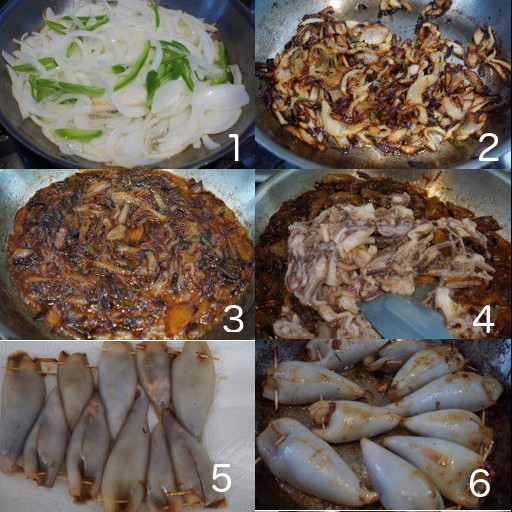
Sauté the onion, garlic and pepper in olive oil on low-medium flame (#1)
Keep sautéing until caramelized (#2)
Deglaze the pan using 1/4 cup white wine (#3)
Add the tentacles (I cut them up into bite sized pieces) and sauté until done (1-2 minutes (#4) and season with salt and pepper.
Using a small spoon stuff the body of the squid with caramelized onion/tentacles mixture and close the end with toothpicks (original recipe does not closed the open end before cooking) (#5)
Add a bit more olive oil to the pan and cook one side for a few minutes and turn over and cook for another few minutes (#6)
I added 1/4 white wine and put on the lid to steam cook for 1 more minute. Remove the squid.
Reduce the wine while scraping any brown bits on the pan to make pan juice/sauce.

I used "Francois de La Roche Touraine Sauvignon Blanc 'La Coulée' 2016" in the sauce and also enjoyed "sampling" it while cooking. I served it with the squid dish.
Either warm or cold, this is a good and unique squid dish. The caramelized onion is very sweet and squid legs add additional texture. Using the same wine we are drinking somehow connects the dish and wine. Although we rarely drink white wine especially sauvignon blanc (sort of boring nothing wine usually). This one is not too bad. It had citrus and melons flavors and minerality with crisp acidity. By the time, we got to drinking this wine with the squid dish, the wine warmed up enough to have the flavors come alive. We really enjoyed the wine and the dish.
I served this immediately off the frying pan and made a quick sauce by deglazing the pan with white wine. I garnished it with our favorite Spanish olive oil and parsley and served with wedges of lemon. My wife added small slices of baguette to soak up the sauce/juice.
This was quite good but when we cut into it while it was still hot the stuffing tended to separate and fall out. The next day, I served this cold. This time I sliced the squid before serving and the stuffing stayed put. We like this dish cold. The sweetness of the caramelized onion gets milder or smoother. I served it with a bit of the olive oil and our home grown arugula.
Ingredients:
1 lb cleaned squid with tentacles (I got 11 bodies and tentacles)
2 medium onion, cut in half and sliced
1 jalapeno pepper, de-veined and seeded, cut into thick julienne (original recipe uses green pepper)
2 tbs olive oil
1 clove garlic, minced (original recipe calls for crushed garlic without removing the skin)
1/2 cup of white wine (I used sauvignon blanc from France), devided into two potions
Salt and pepper to taste
Directions:
Sauté the onion, garlic and pepper in olive oil on low-medium flame (#1)
Keep sautéing until caramelized (#2)
Deglaze the pan using 1/4 cup white wine (#3)
Add the tentacles (I cut them up into bite sized pieces) and sauté until done (1-2 minutes (#4) and season with salt and pepper.
Using a small spoon stuff the body of the squid with caramelized onion/tentacles mixture and close the end with toothpicks (original recipe does not closed the open end before cooking) (#5)
Add a bit more olive oil to the pan and cook one side for a few minutes and turn over and cook for another few minutes (#6)
I added 1/4 white wine and put on the lid to steam cook for 1 more minute. Remove the squid.
Reduce the wine while scraping any brown bits on the pan to make pan juice/sauce.

I used "Francois de La Roche Touraine Sauvignon Blanc 'La Coulée' 2016" in the sauce and also enjoyed "sampling" it while cooking. I served it with the squid dish.
Either warm or cold, this is a good and unique squid dish. The caramelized onion is very sweet and squid legs add additional texture. Using the same wine we are drinking somehow connects the dish and wine. Although we rarely drink white wine especially sauvignon blanc (sort of boring nothing wine usually). This one is not too bad. It had citrus and melons flavors and minerality with crisp acidity. By the time, we got to drinking this wine with the squid dish, the wine warmed up enough to have the flavors come alive. We really enjoyed the wine and the dish.
Tuesday, August 7, 2018
Polenta with tomato sauce and meatballs ポレンタとトマトソース
This was also inspired by a recipe in "Perfect Pairings" called "Baked Polenta Casserole". The idea is to put polenta on the bottom of the casserole and add tomato sauce and pecorino cheese and bake it. In the" Perfect Pairings" book this dish was paired with Sangiovese. My wife makes polenta loaf every-now-and-then. She usually slices it into half inch thick slices, wraps it in plastic wrap and then aluminum foil and freezes it. So we usually have slices of her frozen polenta loaf in the freezer. I also made marinara sauce and meatballs several days ago. So we have all the ingredients to make this dish plus meatballs. We also added more vegetables (to make it healthier?) and used a combination of cheeses. We had this with Cabernet from Napa (Do not remember which one) and the wine went very well.
The bottom is composed of one slice of the polenta loaf.
First, place three slices of polenta on the bottom of a small Pyrex baking dish, add sliced meat balls with marinara sauce. Add blanched broccoli and sugar snaps.
Top with slices of double Gloucester cheese and smoked Gouda.
This turned out to be a quite good dish. Since we already had all the ingredients ready to go, it was a synch to put it together. This went well with our red wine.
The bottom is composed of one slice of the polenta loaf.
First, place three slices of polenta on the bottom of a small Pyrex baking dish, add sliced meat balls with marinara sauce. Add blanched broccoli and sugar snaps.
Top with slices of double Gloucester cheese and smoked Gouda.
This turned out to be a quite good dish. Since we already had all the ingredients ready to go, it was a synch to put it together. This went well with our red wine.
Saturday, August 4, 2018
Cold "shippoku" udon noodle with simmered vegetables 冷製卓袱うどん
Since we had several hot and muggy days recently in the Washington DC area, I made this cold noodle dish from ingredients I had on hand. I had cold simmered vegetables and prepared udon noodles (which were leftover for making cold fresh tomato pasta dish). I call this cold "shippoku" udon 冷製卓袱うどん. This (warm version) is a popular dish in the Southern islands of Japan (Shikoku 四国 and Kyushu 九州). I do not know the exact definition of it but I take it as a noodle (either soba or udon) dish with lots of cooked veggies and other toppings. I made this all cold for a hot summer day.
Cold cooked vegetables included daikon, carrot, skinned Campari tomato and sugar snap. Since I had Chinese-style simmered pork or "Chashu" チャーシュー (this one is made from pork butt and has much more fat than meat made from pork loin), I cut it into batons and added it to the dish.
The original simmered vegetables included daikon, carrot, shiitake mushroom, Campari tomato (simmered in Japanese broth which was lightly seasoned with light colored soy sauce and mirin. After the veggies were soft/done, I let it cool and then refrigerated it). We ate the veggies by themselves for several days so by the time I made this dish only a few pieces of daikon, carrot and tomato were remaining. The sugar snap was just blanched and cooled. For the broth, I added more concentrated noddle sauce from the bottle to the broth in which the veggies were cooked.
This was all leftover control but it was nice cold refreshing dish, perfect for our lunch over the weekend.
Cold cooked vegetables included daikon, carrot, skinned Campari tomato and sugar snap. Since I had Chinese-style simmered pork or "Chashu" チャーシュー (this one is made from pork butt and has much more fat than meat made from pork loin), I cut it into batons and added it to the dish.
The original simmered vegetables included daikon, carrot, shiitake mushroom, Campari tomato (simmered in Japanese broth which was lightly seasoned with light colored soy sauce and mirin. After the veggies were soft/done, I let it cool and then refrigerated it). We ate the veggies by themselves for several days so by the time I made this dish only a few pieces of daikon, carrot and tomato were remaining. The sugar snap was just blanched and cooled. For the broth, I added more concentrated noddle sauce from the bottle to the broth in which the veggies were cooked.
This was all leftover control but it was nice cold refreshing dish, perfect for our lunch over the weekend.
Subscribe to:
Posts (Atom)