Friday, January 3, 2020

New Year's eve sashimi and Black label "Mu" sake 大晦日の夕、大吟醸 黒乃無

On New Year's eve, we feasted on bluefin tuna sashimi and boiled octopus (with daikon namasu 大根なます, not in the picture) which we got frozen from Catalina offshore products and thawed for the celebration. I also served marinated "zuke" tuna 鮪の漬け (it's the darker tuna on the right upper corner of the plate)  along with "datemaki" 伊達巻 New Year's Japanese omelet and "salmon" Russian marinade 鮭のロシア漬けtopped with ikura all of which I made (except for the Ikura).


We opened a sake we haven't had before called "Kuro-no Mu" or "Black Label Mu" daiginjo 黒乃無 純米大吟醸 which is supposedly a step up from our house sake "Mu" daiginjo. Black Label Mu is made from sake rice with an RPR (rice polishing rate) of 40% meaning 60% of the rice's outer shell has been polished away. This compares to Mu which has a RPR of 50%; the minimum amount of polishing to be classified as daiginjo. Since less of the sake rice remains after polishing Black Label Mu is obviously more expensive than Mu.


So, our expectations for this sake were high--maybe somewhat over inflated because somehow this was not what we expected. To us it tasted much sweeter than the regular "Mu" and had a more sherry-like characteristic. What our taste-buds experienced is apparently confirmed by sake metrics shown below (cited from "Tippsy Sake" website which will be the subject for a separate blog in the near future). The SMV (Sake Meter Value or 日本酒度) for Black Label is +1.0 which is on the "slightly sweet" side (neutral is +3.0). Acidity also determines perceived "sweetness". With the acidity of 1.5 and  SMV of + 3, shown as the red dot on the taste metric graph below, the Black Label is still classified "light and dry (but on the border).  (Similar metrics were not available for a regular Mu). Black Label is good for sipping but we prefer regular Mu as an accompaniment with food.


We had a few more food items and ended by making tonkatsu (I breaded it earlier and just fried it).  We had hand made/cut soba noodles from Sushi Taro but as usual, we did not eat it on New Year's eve because we were too full. I fell asleep but my wife stayed awake and woke me up just before midnight. We saw the ball drop at Times Square on TV and welcomed the entrance of 2020.

Wednesday, January 1, 2020

Happy New Year 2020 明けましておめでとうございます

Happy New Year 2020 which is also the end and beginning of a decade. 2019 was not a year we would like to repeat. Hope 2020 is a bit less "eventful". We started New Year 2020 as we would any other New Year. I put up the new "Kagami-mochi" 鏡餅 decoration in our Japanese "tea" room alcove or "Tokonoma" 床間 and displayed the zodiac mouse figurines子の年 from our collection of zodiac figures.


The largest mouse appears to be dressed in ”Kannushi" 神主 shinto priest attire. I am not sure what the smaller one is up to. It seems to be carrying a pouch and has on a backpack. (On closer inspection, this guy appears to be carrying a "Kome-dawara" 米俵; a traditional old fashioned woven-straw sac containing rice, no doubt a symbol of prosperity). It's cute.


We also displayed a small carved wooden mouse figure shown below which was not as anthropomorphized as the other two--he just looks cutely "mouse-ish".


Since we cannot start the day, even the first day of the year, without coffee, we gave up having a new year's "ozoni soup" お雑煮 for breakfast, instead, we had "ozoni" soup as a lunch as shown below. Not shown below, it was accompanied with a symbolic small cup of sake.


Nothing is  different from any other year but this year, I got fresh "mitsuba" 三つ葉. As usual, our mochi 餅 is wrapped in "abura-age" 油揚げ deep fried tofu pouch for easier handing/eating (especially for my wife).


I tried not to serve too much of food to make sure we can "adequately" hit the Sushitaro osechi box 寿司太郎のおせち重箱 and other goodies in the evening. All of the below are what I made. Two squares are "matsukaze yaki" 松風焼き (miso and pine nuts) and its variation (fig and bleu-cheese). I also served "kobu-maki" 昆布巻 kelp roll which was made from kelp and kanpyo 干瓢 "dried gourd peel") that were left over from when I made salmon kelp rolls 鮭昆布巻. I also made "datemaki" 伊達巻.


To help digestion (my father used to say "daikon" helps digestion), I also served  daikon namasu 大根なます topped with boiled octopus leg and ikura salmon "roe". This roe came from an Alaskan company. which we used for the first time. The ikura is much smaller than the ikura we usually get--it actually looks a bit more like trout roe but tasted the same as salmon roe.


So, this was how we started 2020 and more to come in the evening.

Sunday, December 29, 2019

Grilled feta, olive and grapes

My wife found this recipe in the food section of the Washington Post. It's a rather simple dish but we really like it.  It makes a good appetizer and goes well with wine. We served it with mini-baguette.


The original recipe suggested cooking this in a cast iron skillet. We thought that might be too big for the quantity we wanted to make so we cooked this is a small anodized cast aluminum pan (this was a Japanese style pot (mini version) with a wooded lid for an individual "nabe" dish) which worked perfectly.


The cubes of feta cheese get brown and crispy on the outside but soft inside. My wife thought it is also good just to enjoy without bread. The combination of spices (fennel seeds, red pepper flakes and ground black pepper), salty olives and sweet grapes all worked well.


Ingredients:

1 tablespoon extra-virgin olive oil, plus more as needed
1/2 cup (2 3/4 ounces) seedless red grapes, (we cut the amount in half).
1/3 cup (1 1/2 ounces) pitted and halved Kalamata olives. (We used a combination of the different olives we had on hand. We cut some of the large ones in half.)
1/2 teaspoon fennel seeds, crushed
1/2 teaspoon crushed red pepper flakes
Freshly ground black pepper
8 to 10 ounces feta cheese (in a block)
Good, crusty bread slices, for serving

Directions:
Preheat the oven to 425 degrees with the rack in the middle (we used our toaster oven on convection mode on the bottom rack). Oil a small, oven-proof casserole dish or cast-iron pan. Add the grapes, olives, 1 tablespoon olive oil, fennel seeds, red pepper flakes and a few grinds of black pepper, and stir to combine.
Break the block of feta up into irregular pieces, then nestle them among the grapes and olives. Drizzle with more olive oil, then bake, 20 to 25 minutes, until the grapes are softened and the feta is browned in spots.

This is a really good dish. We had only a small portion the night we made it and reheated it later in the microwave which worked well. My wife kept reminding me as I made the dish, "a little bit of fennel goes a long way". Don't over do it' the fennel actually made the dish. The combination of fennel, olives and grapes were made for each other and the total went remarkably well with red wine. Definitely this will join to our line up of "regular" dishes.

Thursday, December 26, 2019

Parsnip carrot mash

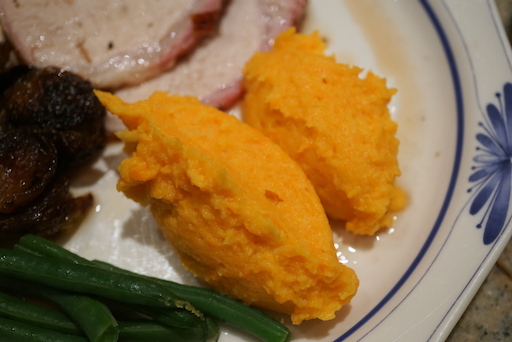
This is my wife's innovation. She really likes parsnips and came up with this combination one evening. Since we were roasting pork loin as we do frequently, we also cooked the carrots and parsnips wrapped in aluminum foil in the Weber grill. The black item on the plate is blackened Brussel's sprouts which may not look appetizing but this is the best way to enjoy Brussels's sprouts--they taste sweet almost like candy. Greenbeans and mashed carrots and parsnips complete the sides.


This combination has very good flavor (mostly coming from the parsnips) and a beautiful color (coming from the carrots).


We peeled the parsnips and carrots, cut the small tips off the parsnips and cut the carrots in half because they were too long for the piece of foil. We coated everything with olive oil and wrapped in aluminum  foil (#1 and #2). We placed them in the Weber grill with the pork (#4). The pork was hot smoked but the vegetables wrapped in aluminum foil did not get any smoky flavor. My wife mashed the cooked veggies, added butter and soy sauce. I helped by further smoothing the mixture with my immersion blender (#3).


This mash is really great. It is certainly much more interesting than mashed potato. This will be our regular side for roasted meats.

Sunday, December 1, 2019

Egg and smoked salmon puff pastry loaf 卵とスモークサーモンパフぺィストリー包み

This is a recipe my wife's sister sent us. It is one of those all-inclusive breakfast type dishes and we went for it. It is essentially a cream cheese omelet/scrambled egg with chives and dill and  smoked salmon encased in puff pastry and baked. How could this be bad (at least in terms of taste rather than health).


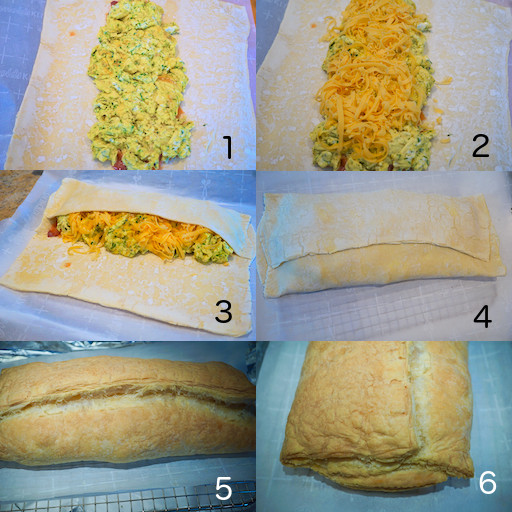
We had this as a light lunch but it also goes well as a hor d'oeuvres. The only problem was that the bottom crust did not quite puff up. Based on past experience with puff pastry we were afraid this would happen so we took some extra measures such as putting it on parchment paper and cooking it on a metal wire grate that elevated it above the baking sheet so the bottom could get more heat (see #5, composite picture below). The cut section shows nice layers of salmon and egg but, as can be seen, the bottom is not flaky. To remidy this my wife turned it upside down and toasted it in the toaster oven on high heat for several minutes. That did the trick the bottom puffed up nicely.


In making this we divided our labour. I made the eggs and my wife prepared the rest of the ingredients and assembled it.

Ingredients: (our modification).
1 frozen puff pastry sheet, thawed
4 eggs*
1/4 cup cream (original recipe calls for milk)
1/8 tsp salt
1 tsp butter
2 oz cream cheese (I used cream cheese with chives)
1/2 tsp chives, chopped (Original recipe calls for green onion)
2 tsp fresh dill, chopped
Smoked salmon, enough to cover center 1/3 of the puff pastry
1/2 cup Double Gloucester cheese (original recipe calls for Mozzarella, we did not have it).

*The original recipe called for 8 eggs. Although we used one sheet of puff pastry as indicated in the original recipe, we thought "8" eggs would be too much and reduced it to 4 eggs reducing the other ingredients accordingly. As you can see below 4 eggs are more than enough for one sheet of pastry (#3 and #4).


Directions:
The recipe said to preheat oven to 350F (we think 400F, is more appropriate. It is also the temperature called for in the instructions on the puff pastry box. At 350F the pastry was a bit too pale (#5 and 6) and the bottom did not cook completely).

Beat the eggs, add chives and dill, cream, and salt. Add small pieces of the cream cheese. In the non-stick frying pan, melt butter and add the egg mixture. Make loose scrambled egg/omelet.

Roll out the sheet of thawed puff pastry to 12 x15inches. On the center 1/3 place the smoked salmon leaving 1/2 inch on both ends, layer the eggs (#1) and the cheese (#2). Fold both sides (#3 and 4), brush with water  (or as the original recipe suggests egg water) to seal the ends. Bake 25 minutes (#5 and 6).

Although we did not taste much of dill or chives, this is a very nice breakfast or snack with wine. After my wife re-toasted the bottom in the toaster oven, the eggs were encased in nicely puffed pastry. Initially the smoked salmon was quite assertive but still quite good.  The whole dish got even better with time as the flavors melded together. It reheated nicely in the toaster oven. We will freeze some and see how we can reheat it. We'll have to work out a way to make sure the bottom also gets cooked because we will be making this again.