Wednesday, July 31, 2024

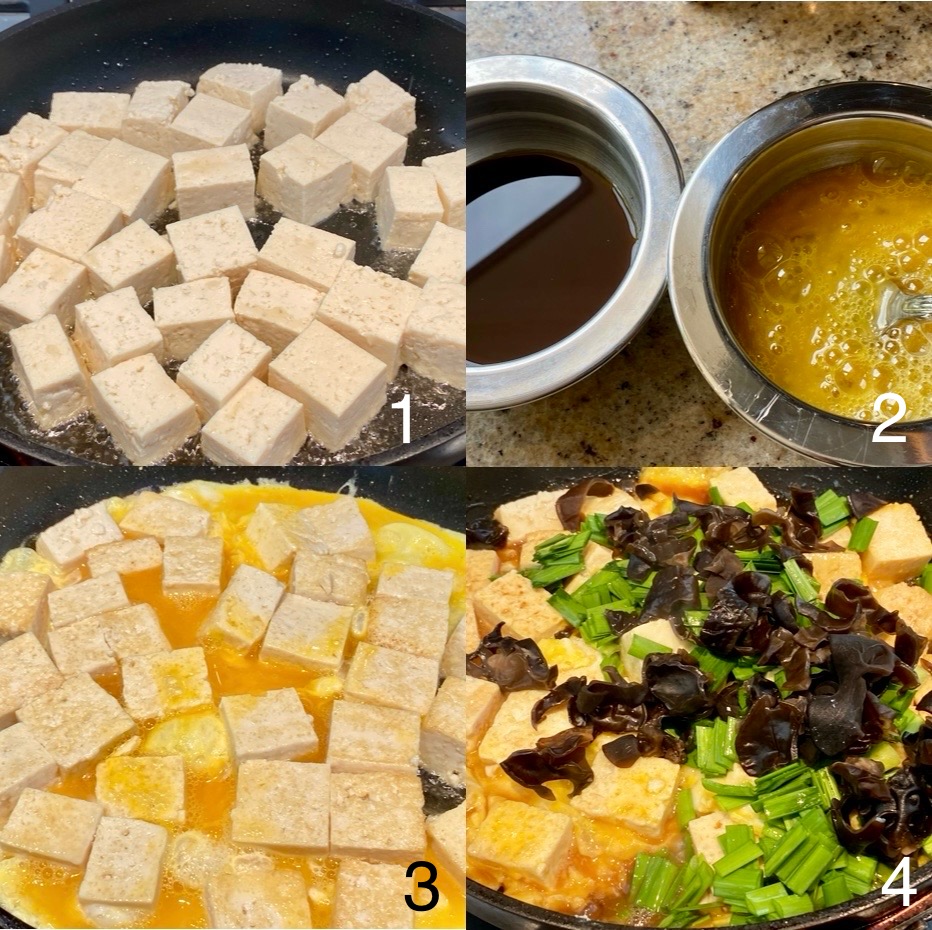
Tofu, Egg and Garlic Chives Stir Fry 豆腐ニラ玉、木耳入り

This is one of the left-over control dishes. I had a package of “medium firm” tofu 豆腐 which just reached “BUB” (Best Used By) date, the last of garlic chive ニラand wood ear mushroom 木耳. So, I made this dish for lunch one day. I sort of got an idea from some of the recipes I saw on the Web and YouTube. Based on my memory and CCK (Common Culinary Knowledge) I  winged it. The seasonings could be improved but overall this was a quite good satisfying dish and fairly healthy and nearly vegetarian (I am not sure if oyster sauce really contains oysters or their derivatives). Depending on how much seasoning you add, this could be a side dish for rice but I seasoned it lightly and we had it as a main dish for lunch.


Ingredients:
One package of tofu (I used medium firm but firm would be good), drained and cut into cubes (#1 in the composite picture).
Two eggs, beaten and seasoned with a pinch of salt (#2)
Wood ear mushroom (optional, this was leftover, I blanched, washed it previously and cut into small trips, the amount is arbitrary) (#4)
Garlic chive, washed and cut into short segments, the amount arbitrary (#4)
2 tbs vegetable oil or peanut oil and a splash of dark sesame oil

Seasonings (#2): (premix, #2)
2 tbs oyster sauce
2 tbs soy sauce
2 tbs Shaoxing wine (or dry sherry or mirin, which makes it sweeter, or sake)

1 tsp Ponzu sauce


Directions:
Add the oil to the non-stick frying pan on medium high flame and cook turning once or twice until the surface is lightly browned (2-3 minutes) (#1 in the composite picture)
Reduce the flame to medium and pour in the egg mixture (#3) cook until the edges are set and gently turn and coat the tofu cubes
Add the seasonings and cook for 30 seconds mixing gently
Add the garlic chive and wood ear mushroom (#4)
Mix and toss to combine for 30 seconds to 1 minute
Splash the ponzu sauce and a small amount of sesame oil and mix to finish

I felt a bit self righteous finishing up the tofu, garlic chive and wood ear mushrooms by making this dish and nothing wasted. But better yet it was pretty good. The tofu went extremely well with the egg coating. The tofu and egg had similar texture but each brought a slightly different taste which was interesting in the same bite. The wood ear mushroom brought its own element to the dish in the form of a slight crunchiness that offset the tofu/egg texture. The garlic chive contributed a distinctly but mild garlic taste. Not a bad left-over control dish which can bear repeating. 

Sunday, July 28, 2024

Cucumber in soy sauce 胡瓜の醤油漬け

I would like to have fresh cucumbers (if available Japanese cucumber but American mini-cucumber is a great substitute). Usually American min-cucumbers come in a pack of 6. If not used within 2-3 days, they go bad (white specks, either bacteria or fungus, develop on the surface).  I make several kinds of cucumber salads and pickles in an attempt to use up the cucumbers.  Currently our favorite pickled cucumber is using leftover pickling liquid after making the daikon pickles. In addition, I also try to preserve fresh cucumbers by placing them in a Ziploc bag and pouring enough Vodka to coat all the surface plus a bit more and then I squeeze out as much air from the bag as I can. With this treatment, the fresh cucumber last about one week or a bit more. I am always looking for other recipes to use cucumbers. I saw this recipe in one of the Ko Kentetsu You Tube episodes. It is easy enough and looks interesting. This is marinated about 3 days. It is still crunchy. Soy sauce and vinegar make the foundation but the addition of ginger and a small slash of dark sesame oil really make it.


Ingredients:
3 American mini-cucumbers or 2 Japanese cucumbers. 
Fine julienne of ginger root

Marinade:
1 tbs sugar
2 tbs soy sauce
2 tbs rice vinegar
Small splash of dark sesame oil

Directions:
Cut the cucumbers length wise in half
Remove the seeds using a small spoon
Cut the cucumber on a bias in bite sized pieces

Add the cucumber, ginger and the marinade to a sealable container. Close the container and refrigerate. 

You can enjoy this immediately or in few days.

We like this. It is very easy to make and slight sweetness combided with the sesame oil and ginger really make this a good side dish or “Hashi-yasume” 箸休め meaning “chopsticks rest” so that the chopsticks take a brief rest after heavy lifting of main dishes.

Wednesday, July 17, 2024

Dassai 45 and Dassai blue comparison 獺祭45とDassai Blue 50 の飲み比べ

“Dassai” 獺祭 is a well known and popular sake in Japan and US. We like it for its very clean, fruity flavors. We used to get  “Dassai 50” daiginjo 獺祭50大吟醸. But the Dassai 50 is not sold any more. It was replaced by “Dassai 45” in 2019 (In Dassai 50, the sake rice is polished to 50% of the original volume, in Dassai 45, it is polished to 45%).  We learned that Dassai (brewed by Asahi Sake Brewery 朝日酒造 in Yamaguchi 山口県) established a sake brewery in Hyde Park, NY some years ago. However, this is the first time we obtained several bottles of  the NY-brewed sake “Dassai Blue 50”.  Interestingly, Dassai Blue is labeled as “Type 50”. I assume that indicates 50% polish like the old Dassai 50. My understanding based on an article I read,  was that they used imported Japanese “Yamada Nishiki” 山田錦 sake rice. But another source of information (again, not their website) indicated the rice is grown in Arkansas. (Further more, I would have to wonder what water source* they are using in the brewing; NY tap water, Hudson river water, or Hyde Park artesian well water???) In any case, one evening we compared Dassai blue and Dassai 45 (picture #1).

*One on-line store website indicates the sauce of the water is a “local well”. But again, this is unofficial information.


The Dassai Blue, when first tasted, has a definitive tingling/prickly sensation on the tip of the tongue. It is like very lightly effervescent. Then comes a very subtly sweet and Dassai signature fruity taste.  As it sits in the glass, the tingling character diminishes indicating indeed this might be the effervescence. The “Dassai Blue” label indicated “keep refrigerated”. I wonder if the label “keep refrigerated” means, “Blue”may be  “Nama” sake 生酒** or not heat-treated and slight fermentation happened in the bottle producing the effervescence. (Again no details are available from the brewery and these are all our conjuncture).

**Another unofficial information indicated “Blue” only had one “hi-ire” 火入れ heat-treatment instead of  usual  two (after pressing and bottling).

The Dassai 45 is a classic Dassai, clean, fruity and smooth in the mouth—no effervescence or tingly sensation.

Which one do we like better? It is hard to say. Dassai Blue’s tingling sensation is not unpleasant (we had similar effervescence in other “non-sparkling” sake). According to the label (picture #2), they are aiming to surpass Dassai brewed in Japan but not just to reproduce it. We can certainly enjoy either Dassai.


To enjoy sake, we need some “otsumami” おつまみ appetizers. For Dassai tasting, I served warm chawam-mushi with ginko nuts, shrimp, shiiitake mushroom and the garnish was our home grown fresh “mitsuba” 三つ葉 which added a nice unique flavor (left in picture #3). The center is eggplant, shiitake and wood ear mushroom brased in oyster sauce and ginger 茄子と椎茸のオイスターソース炒め. The right is garlic chive “ohitashi” ニラのお浸し topped with golded thread omelet.


In the past we tried a few US brewed sake and Dassai Blue in definitely one of the best. Only one which is in the same class is “Sho-Chiku-Bai” daiginjou 松竹梅大吟醸 brewed from California-grown “Yamada Nishiki” sake rice. But these two cannot be compared in the same way. Sho-Chiku-Bai was produced in very limited quantity, is not readily available and has a much higher price point. On the other hand, the Dassai Blue 50 is very reasonably priced and relatively widely available.


Sunday, July 14, 2024

Mitsuba ミツバ

Mitsuba 三つ葉 is a sort of Japanese parsley mainly used as a garnish or topping for certain dishes such as soup, katsu-don カツ丼 and chawan-mushi 茶碗蒸し. “Mitsuba” in Japanese means three leaves since it has three leaves. It has a very distinctive and unique flavor. In the past, I rarely got fresh ones at our Japanese grocery store and I could get dried ones which do not have much flavor. I tried to grow it a few times from the seeds (from Kitazawa seeds) which was not a great success for some reason. This time the mitsuba we planted in a pot on the window sill grew quite nicely (picture #1). 


I added this home-grown fresh mitsuba to the usual chawanmushi I make (picture #2). I mixed the stalks which were cut into small pieces into the egg mixture but I added the leaves just 30 seconds before serving. This time I served chawanmush hot just out of the steamer.


Althouhg mitsuba is not a major component of the any dishes incuding the chawanmushi, I really like the unique flavor.

Thursday, July 11, 2024

Garlic Chive Dumpling ニラ頭饅 or 韮菜万頭

We used to grow garlic chives or “nira” ニラ in our herb garden but it failed in two ways: 1) the garlic chives were very fibrous except when we harvested them very young and 2) they grew like weeds taking over the entire herb garden. The plant had deep roots that were very hard to extract. It was quite a lot of work to get rid of it and we are not completely successful even now. (Digression alert: Some years ago we hired a gardener to do the spring clean up which included the herb garden. When he found out the herb garden contained garlic chives he specified the clean up would include everything EXCEPT the garlic chives.) Although we did make quite a few garlic chive dishes, we gave up growing our own. We have been shying away from even buying garlic chive for a while (besides it is not readily available). Since Weee almost always carries garlic chives, we tried them. They came in quite a large bundle (about 1 lb). We tried it in several dishes and, even though they were fully grown, the garlic chive were not fibrous at all.  We added garlic chives to our stir-fried dishes, soup and as a “ohitashi” ニラのお浸し. We still had some garlic chives left so I started looking for new recipes to use them. I came across a recipe by Koh Kentetsu on YouTube.  I was not familiar with this dish. I am not sure if this is based on a known Chinese dish or invented in Japan but it is apparently very popular. 

A quick internet search indicated that “nira-manju” or “garlic chive dumpling” was “invented” in a Chinese restaurant called “Niramanju Fussa” or “韮菜万頭福生” near the Yokota American military base 横田米軍基地. In any case, I have not tasted or seen the “original”. I made this based on the Koh Kentetsu recipe but I ended up making some changes (in the seasonings, not intentionally. Since I made this dish from memory after I saw the YouTube video). This is in the similar ilk as gyoza 餃子 and shumai  焼売 but maybe even better. We really like the garlic chive flavor and cripsy skin (picture #1). It re-heated nicely in the toaster oven. Since I seasoned the filling adequately, we did not use dipping sauce.


The innovations of his recipe is to use two sheets of store-bought wonton skin to encase the filling and the instructions of how to encase the filling very easily for a home cook. It was cooked exactly like gyoza producing a nice crispy skin on both sides (picture #2) and juicy inside.


Ingredients: (made 10 good-sized dumplings, see picture #2)
1/2 lb ground pork
1/4 lb garlic chive, finely chopped (about 1/5 in)
6-7 medium shrimp, thawed, and minced (optional)
1/2 tsp minced/graded ginger (original recipe used only ginger juice)
1/2 tsp minced/grated garlic (optional,  original recipe does not use this. My wife felt this added too much garlicky flavor)
1 large cap of fresh shiitake mushroom, finely chopped

Seasnings:
1 tsp Shao Xing wine
1 tsp oyster sauce
1 tsp soy sauce
1/2 tsp dark sesame oil

20 Wonton skins

Directions:
Add the meat, shrimp, garlic, ginger and seasonings in a bowl and mix well
Add the mushroom and garlic chives and further mix and cover. Let it stand in the refrigerator for a few hours
Using a medium sized ice cream scoop, make balls of the filling and place them on a rimmed baking sheet.
Place the wonton skin on top of the filling balls (I moistened all the edges to make sure it would stick)
Using all five fingers, press down on the edge and turn several times until the sides of the wonton skin adhere to the filling. Then flip it over (picture #3). (If you just steam this, you are making “garlic chive shumai” ニラシュウマイ).


Place the second set of wonton skin on top (I also moistened the outer edges). Using the same process, turn and totally encase the filling to make sure all sides are attached to the filling and each other
Press gently to make a disk (picture #4)


(I covered the dumplings with a plastic wrap and refrigerated 1-2 hours before cooking but this is not needed. I just wanted to have all the dumpling assembled before cooking them in the evening.)
Using a 12 inch non-stick frying pan, I added the vegetable oil with a splash of sesame oil on medium flame and browned one side (2-3 minutes) and turned it over to brown the other side for another 2-3 minutes (picture #2)
Add a small amount of water (about 1/4 cup). Cover with a tight fitting lid to steam for 2-3 minutes or until the steam stops coming out.
Remove the lid and let the moisture evaporate. Keep browning the bottom and the other side with the addition of a small amount of sesame oil toward the end of cooking.

This is a really nice dish and easier to make compared to gyoza (because you do not have to clip the edges). A good amount of garlic chive adds a nice flavor (my addition of garlic was a bit too much for my wife, I will omit it next time). This is a perfect small dish with drinks.