We spent 3 nights in Kyoto. As usual, we stayed at our favorite hotel Granvia Kyoto グランビア京都 with a north and Kyoto tower view room. This means we went to 3 izakayas during our stay. In the past, we went to izakayas in other areas but this time, we limited ourselves to izakaya near the station including our favorite “Kurakura”.
1. Kurakura 蔵倉
京都市下京区飴屋町244木村ビル
Kimura-bldg
Ameya-machi 244, Shimokyou-ku
Kyoto
For reservation: 075-351-0347, credit card accepted, smoking allowed
Although I posted about this izakaya previously, I did not mention the origin and meaning of the name “Kurakura”. The name “Kurakura” is a double entendre; this izakaya is housed in a renovated “warehouse” or “kura” in Japanese. “Kura” can be written in kanji 漢字 as “倉” or “蔵”. Although both kanji sound the same, “倉” is a grain/food warehouse and “蔵” is where family treasures are kept. So, the name of this izakaya is “蔵倉” covering both kinds of warehouses. But “kurakura くらくら” written in phonetic letters also means “dizzy” or “state of being enchanted”. Appropriate for the state of inebriation.
As you can see in the picture, this place is quite recessed from the narrow alley and the majority of the front appears to be a garage (I am not sure to whom this garage belongs). Then you had to walk narrow passageway on the left to the entrance of this izakaya.
Although we made a reservation, the place was not crowded and remained that way while we were there. Besides not being as crowded as the last few times we visited, the owner/master appeared to have delegated his position to the young chef who appeared to be in charge while the owner hung back out of the way. The young chef was in the center and front of the cooking area and when we asked for a dish, he was the one who repeated the order in a loud commanding voice. Another change was the absence of the owner’s (we presumed) wife/casher/sake sommelier.
We had decent sake and food including sashimi and fried taro “satoimo 里芋 ” but, at this point, nothing else sticks out in our minds. We liked when the old guy was in charge and his wife recommended many wonderful sakes.
Saturday, July 12, 2025
Wednesday, July 9, 2025
Topping of Katsu-Don カツ丼のあたま
A few days ago, I made “tonkatsu トンカツ” or pork cutlets from frozen pork chops we had in the freezer. I made much more than we could finish in one evening meal. To use up the left-over tonkatsu, I made katsu-don or “katsu-don-no-atama カツ丼の頭 which was the katsu-don pork topping without the rice base. (We were not hungry enough to eat the addition of rice). Japanese refer to this dish as katsu-don head. Since I used left-over tonkatsu which was heated up in the toaster oven, I did not simmer the tonkatsu in a broth or add the egg on the top. Instead, I simmered sliced onion in seasoned broth and when the onion was cooked, I added a beaten egg and cooked until most of the egg was cooked but some was still uncooked (I used a pasteurized egg). I added salt broth soaked snap peas スナップ豌豆の塩びたし for color. Then, I placed the sliced tonkatsu on top. Without rice, this was a perfect sized dish for us that evening.
Ingredients:
Tonkatsu (pork cutlet sliced) (Either freshly cooked or left overs heated in the toaster oven.)
1/2 small onion, sliced
Green beans or snap peas (cooked) for garnish
One egg, beaten (I used a pasteurized egg)
Cooking liquid (the amount is somewhat arbitrary, you can make it to your liking, either sweet or salty by adjusting the sugar and soysauce)
1/3 cup Japanese dashi broth (I made it with the usual dashi packs)
1tbs mirin
2 tbs soysauce
1 tbs sugar
Directions:
In a small frying pan, add the onion and the cooking liquid and simmer for a few minutes or until the onion is cooked. Pour in the beaten egg, cover with a lid and cook until the egg is just set (to your liking, runny or more set). Add the greens and slide the entire contents onto a shallow bowl/plate. Add the slices of ton-katsu on top.
The topping of katsu-don is considered perfect as drinking snack. For us if we make “Katsu-don”, we usually divide one serving into two.
Ingredients:
Tonkatsu (pork cutlet sliced) (Either freshly cooked or left overs heated in the toaster oven.)
1/2 small onion, sliced
Green beans or snap peas (cooked) for garnish
One egg, beaten (I used a pasteurized egg)
Cooking liquid (the amount is somewhat arbitrary, you can make it to your liking, either sweet or salty by adjusting the sugar and soysauce)
1/3 cup Japanese dashi broth (I made it with the usual dashi packs)
1tbs mirin
2 tbs soysauce
1 tbs sugar
Directions:
In a small frying pan, add the onion and the cooking liquid and simmer for a few minutes or until the onion is cooked. Pour in the beaten egg, cover with a lid and cook until the egg is just set (to your liking, runny or more set). Add the greens and slide the entire contents onto a shallow bowl/plate. Add the slices of ton-katsu on top.
The topping of katsu-don is considered perfect as drinking snack. For us if we make “Katsu-don”, we usually divide one serving into two.
Sunday, July 6, 2025
Izakaya in Kanazawa 金沢の居酒屋
We have visited Kanazawa 金沢 on a number of our trips to Japan. This time, we stayed in Kanazawa only one night. As a result, we went to only one Izakaya but this was a very special one. We usually stay in the hotels near Kanazawa Station 金沢駅 but this time, we stayed at a hotel near “Oomi market 近江市場”. We visited Oomi market in the afternoon after we arrived and had a late lunch. Not all but some stores were open. We looked into many restaurants/izakaya in the Oomi merket, but many looked like tourist traps.
1. Shukou Yuunagi 酒肴夕凪
I looked into finding an izakaya where we could go in the evening. So many places popped up within easy walking distance of our hotel in Google map search. Using my usual criteria of menu, review, pictures available on line, I chose this place. I quickly called and made the reservation for the evening. Although it was very close to our hotel, I misread the Google map and turned into the first alley way when I should have turned into the second alley. In any case, I called and the person who answered the phone helped us get to the right place.
The place was almost full. It is run by a single owner with a young helper. Initially, we interacted with the young helper. when I asked him to recommend a sake, he consulted with the owner and asked what kind of sake we usual drank so I said we like diaginjo style; a clean and fruity sake. He brought out Kokuryu Daiginjo Fuku 黒龍大吟醸 福 (#1) which was fruity and clean tasting. Since I saw a bottle of Tengumai Junnmai Yamahai-shikomi 天狗舞純米山廃止込 on the shelf, I ordered it. (Despite the fact we usually prefer “Daiginjo Tengumai”, which is actually our “house sake”). We have tasted and posted about Yamahai Tengumai sake. We like this sake served warm at home. This was served at room temperature. This order appeared to draw the attention of the owner. (Initially we had a difficult time engaging the proprietor directly which left us dealing mostly with the young helper. We ordered several special sakes and it turned out the bottles only contained a partial serving which the helper served us anyway. (It is our understanding we were not charged for these partial servings.) Eventually after these various orders, the proprietor realized we liked and knew sake and he warmed up; personally taking care of us suggesting various unique sake varieties.
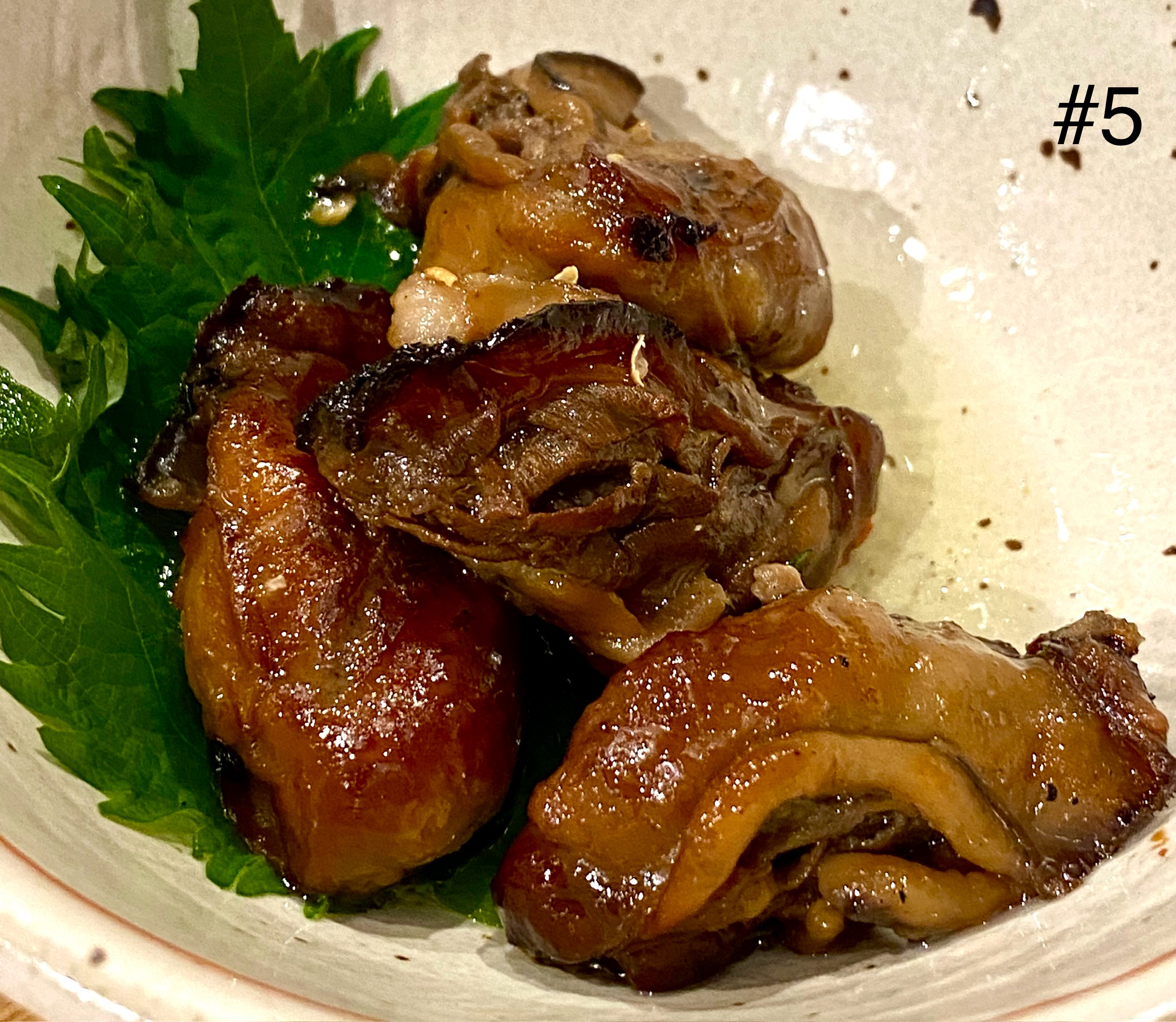
Meanwhile we had couple of nice dishes including sashimi and an extremely good smoked oyster in olive oil (#5). (The taste of this dish was special; unique and very memorable. We have never experienced this combination of flavors and textures before. ) When I asked for other recommended sake, the owner himself brought out the next sake saying “if you could handle Yamahai Tengumai, you might like to try this.” The sake he bought was an aged sake or “koshu 古酒” called “Takesuzume Yamahai Junnmai BY28 竹雀山廃止純米酒 BY28 (#3). “BY” is brewery year. BY28 means it was brewed in “Heisei 28 平成28年” which is 2019 so it had been aged for 6 years. I assume this was cold aged since the color was still light. Although we usually do not prefer “aged sake”, this was quite a sake with almost sherry-like but clean taste which went perfectly with the smoked oyster (#5). He served “Yoshida-kura u Ishikawamon 吉田蔵 u Ishikawamon” (#4) which is made from a rare sake rice from Ishikawa prefecture 石川県 called “Ishikawamon 石川門”. This one was much fresher tasting than the previous aged one. Although I learned later this was supposedly “slightly effervescent”, we did not feel that.
By far, this was one of the best Izakaya experiences with interesting sake and food. The customers appear to be all locals. It would have been difficult for tourists (like us) to find and fully enjoy this place. Next time we vist Kanazawa, we will try this izakaya again.
1. Shukou Yuunagi 酒肴夕凪
I looked into finding an izakaya where we could go in the evening. So many places popped up within easy walking distance of our hotel in Google map search. Using my usual criteria of menu, review, pictures available on line, I chose this place. I quickly called and made the reservation for the evening. Although it was very close to our hotel, I misread the Google map and turned into the first alley way when I should have turned into the second alley. In any case, I called and the person who answered the phone helped us get to the right place.
The place was almost full. It is run by a single owner with a young helper. Initially, we interacted with the young helper. when I asked him to recommend a sake, he consulted with the owner and asked what kind of sake we usual drank so I said we like diaginjo style; a clean and fruity sake. He brought out Kokuryu Daiginjo Fuku 黒龍大吟醸 福 (#1) which was fruity and clean tasting. Since I saw a bottle of Tengumai Junnmai Yamahai-shikomi 天狗舞純米山廃止込 on the shelf, I ordered it. (Despite the fact we usually prefer “Daiginjo Tengumai”, which is actually our “house sake”). We have tasted and posted about Yamahai Tengumai sake. We like this sake served warm at home. This was served at room temperature. This order appeared to draw the attention of the owner. (Initially we had a difficult time engaging the proprietor directly which left us dealing mostly with the young helper. We ordered several special sakes and it turned out the bottles only contained a partial serving which the helper served us anyway. (It is our understanding we were not charged for these partial servings.) Eventually after these various orders, the proprietor realized we liked and knew sake and he warmed up; personally taking care of us suggesting various unique sake varieties.
Meanwhile we had couple of nice dishes including sashimi and an extremely good smoked oyster in olive oil (#5). (The taste of this dish was special; unique and very memorable. We have never experienced this combination of flavors and textures before. ) When I asked for other recommended sake, the owner himself brought out the next sake saying “if you could handle Yamahai Tengumai, you might like to try this.” The sake he bought was an aged sake or “koshu 古酒” called “Takesuzume Yamahai Junnmai BY28 竹雀山廃止純米酒 BY28 (#3). “BY” is brewery year. BY28 means it was brewed in “Heisei 28 平成28年” which is 2019 so it had been aged for 6 years. I assume this was cold aged since the color was still light. Although we usually do not prefer “aged sake”, this was quite a sake with almost sherry-like but clean taste which went perfectly with the smoked oyster (#5). He served “Yoshida-kura u Ishikawamon 吉田蔵 u Ishikawamon” (#4) which is made from a rare sake rice from Ishikawa prefecture 石川県 called “Ishikawamon 石川門”. This one was much fresher tasting than the previous aged one. Although I learned later this was supposedly “slightly effervescent”, we did not feel that.
By far, this was one of the best Izakaya experiences with interesting sake and food. The customers appear to be all locals. It would have been difficult for tourists (like us) to find and fully enjoy this place. Next time we vist Kanazawa, we will try this izakaya again.
Thursday, July 3, 2025
Matcha Almond Pancake (again) 抹茶アーモンドパンケーキ
Having just come back from Japan, when we saw this recipe for matcha green tea pancakes on the Washington Post web site the word matcha caught our attention and we decided it was a “must-make” for breakfast recipe. But as I was writing this up, I happened to search our blog and found out we had already made these and posted this exact recipe 2 years ago. It turns out this was just another one of the green pancakes collection we had previously presented. Apparently, WP posted the exact same recipe used 2 years ago again and we did not realize it. In any case, this was a pretty good pancake. We definitely tasted matcha green tea flavor. As before my wife made the batter and I cooked the pancakes using 4 small non-stick frying pans (picture #2).
Ingredients: (we doubled the recipe this time making 7 pancakes, picture #3, two were already served)
1cup whole-wheat pastry flour or all-purpose flour
1 cup almond flour
4 teaspoons baking powder
1/2 teaspoon salt
2 tablespoon matcha
2 cup buttermilk
2 large egg
2 tablespoon neutral oil
4 teaspoons vanilla extract
Butter and Maple syrup, for serving
Directions:
In a medium bowl, thoroughly whisk together the pastry flour, almond flour, baking powder and salt until combined. Sift the matcha into the mixture and whisk again to thoroughly combine.
In another medium bowl, whisk together the milk, egg, oil and vanilla until combined. Add the milk mixture to the flour mixture and stir just to combine. Do not overmix; it’s okay if there are some small lumps. Let the batter hydrate for 5 to 10 minutes.
Heat a large nonstick skillet or griddle over medium-high heat until hot. (To test, drop a dime-size amount of batter into the skillet and if it starts to bubble and brown right away, the pan is ready.)
Ladle the batter into the skillet. Cook until bubbles form on the top and the underside is nicely browned, about 2 minutes (#2), then flip and cook until browned on the other side, and cooked through, 2 minutes more (#3). Adjust the heat as necessary to prevent the pancakes from browning too fast before they’re cooked through. Serve with maple syrup.
Ingredients: (we doubled the recipe this time making 7 pancakes, picture #3, two were already served)
1cup whole-wheat pastry flour or all-purpose flour
1 cup almond flour
4 teaspoons baking powder
1/2 teaspoon salt
2 tablespoon matcha
2 cup buttermilk
2 large egg
2 tablespoon neutral oil
4 teaspoons vanilla extract
Butter and Maple syrup, for serving
Directions:
In a medium bowl, thoroughly whisk together the pastry flour, almond flour, baking powder and salt until combined. Sift the matcha into the mixture and whisk again to thoroughly combine.
In another medium bowl, whisk together the milk, egg, oil and vanilla until combined. Add the milk mixture to the flour mixture and stir just to combine. Do not overmix; it’s okay if there are some small lumps. Let the batter hydrate for 5 to 10 minutes.
Heat a large nonstick skillet or griddle over medium-high heat until hot. (To test, drop a dime-size amount of batter into the skillet and if it starts to bubble and brown right away, the pan is ready.)
Ladle the batter into the skillet. Cook until bubbles form on the top and the underside is nicely browned, about 2 minutes (#2), then flip and cook until browned on the other side, and cooked through, 2 minutes more (#3). Adjust the heat as necessary to prevent the pancakes from browning too fast before they’re cooked through. Serve with maple syrup.
Monday, June 30, 2025
Tokyo Kyobashi Areas Izakayas (part 4) 東京の居酒屋 東京駅八重洲京橋付近 パート4
7. Wasabi Tokyo Station Yaesu Branch 和菜美東京駅八重洲店
東京都中央区八重洲1-7-17 八重洲ロータリービルB1
Yaesu Rotary Bldg. B1
Yaesu 1-7-17, Chuo-ku
Tokyo
For reservation: 03-4405-1480, Credit card accepted, smoking allowed
This is another large chain izakaya. Later we learned that the holding company is called NBM which also runs several other chains. I called for a reservation one day ahead. This is a bit like ”The restaurant with many orders/conditions 注文の多い料理屋” by Kenji Miyazawa 宮沢賢治. When I called, a man answered. I asked a table for two, date and time. He said “A table is available” and “Are you taking a course menu?”. I said “No”. He sounded disappointed and said, “You have a table for 2 hours and minimum orders of one drink and two dishes per customer are required”. I said “okay” and thus we got a table for two for two hours.
The place was located in the basement floor of a building just across from Yaesu-guchi 八重洲口 of Tokyo station. Going down the steps triggered a chime and a man appeared. He ushered us to a small table. Although this place advertised “all private rooms”, this was a table with an opaque fabric partition on one side through which we can sort of see the next table/room. The other side was a Japanese style sliding door which was very close to the table. We got to the table by opening the sliding door. The guy repeated the conditions with which we could have our table for 2 hours. We ordered sake and several dishes (see below) immediately fulfilling their strict conditions we agreed on.
As we were waiting for our orders to come, a large group of people came into the room/table across the aisle. The same server was taking care of this party. In a very loud voice (shout), he started outlining the precise conditions and rules for the “all-you-can-drink” deal. This was indeed “the restaurant with many conditions”.
Shortly, our orders started arriving. The assorted sashimi (#1) was decent but again the “Tai” perch was on the chewy side. One interesting item was fried fava beans (#2). Boiled or grilled (in pods) fava beans are common but fried was new to us. They were very good. We also ordered “crab cream croquets カニクリームコロッケ” which were excellent. Finally we had a dish of “branded” chicken thigh (a special brand of chicken unique to the regional area) with french fries”. The french fries were clearly previously frozen and the chicken did not taste any different from any other chicken we have eaten but over all it was good.
We ordered more sake and some more dishes. Despite our initial misgivings, we had a good time here. Later we learned they have a store even in Sapporo (the last destination of our Japan trip). But we learned this only after we got back from Japan.
8. Fukube ふくべ*
東京都中央区八重洲1−4−5
Yaesu 1-4-5, Chuo-Ku, Tokyo
For reservation 03-3271-6065, credit card not accepted, smoking allowed
Without realizing it, we stumbled into a genuine Izakaya of Showa 昭和** era. This izakaya was first opened 75 years ago with a period of closure due to the world war II and reopened 60 years ago. I made the obligatory reservation the same day. The first floor was small with only a L-shaped counter. One wall in front of the counter had tall shelves with many large bottles of sake on display. Although the counter was all crowded with “salary” men, we sat at the very end of the counter (thanks to the reservation). The stools were very closely placed (cozy). There is a second floor which appears to be for larger parties but some people who came in after us were sent upstairs.
There was a stack of two sake barrels in front of us and the sake recommendation was “Kiku-masamune Taruzake 菊正宗樽酒”. We ordered it. The guy behind the counter removed the wooden bung from the front of the large sake cask and poured sake into a large copper funnel with an “ochoushi お銚子” sake serving bottle underneath. A “Ichigo-masu*** 一合升” was located in the bottom the funnel. Then, the sake in the “masu” Japanese wooden measuring cup was poured into the ochoshi and served. They had only “ichigo” size ochoshi sake serving bottles. (so if you order 2-go, you get two ochoshi bottles). The taruzake had a cidarly flavor as expected. Not our favorite but in this atmosphere, this was really enjoyable. They served other sakes either at room temperature or warmed. We had a few more sakes. The food menu was very small and simple. We got grilled tarako cod roe, tuna sashimi and others. The dishes were not fancy but perfect for this place. The salary men around us were enjoying themselves and some were getting quite drunk. This was quite a genuine izakaya experience.
*”Fukube 瓢” is a traditional Japanese vessel made of hollowed out “hyou-tan gourd 瓢箪” used to store and carry liquid especially sake.
**Reign of Showa emperor 1926-1989. I am firmly from this period since I was born and grew up in the showa period.
*** “Masu 升” is a traditional square wooden measuring cup. “Ichigo 1合” is about 180ml.
For reservation: 03-4405-1480, Credit card accepted, smoking allowed
This is another large chain izakaya. Later we learned that the holding company is called NBM which also runs several other chains. I called for a reservation one day ahead. This is a bit like ”The restaurant with many orders/conditions 注文の多い料理屋” by Kenji Miyazawa 宮沢賢治. When I called, a man answered. I asked a table for two, date and time. He said “A table is available” and “Are you taking a course menu?”. I said “No”. He sounded disappointed and said, “You have a table for 2 hours and minimum orders of one drink and two dishes per customer are required”. I said “okay” and thus we got a table for two for two hours.
The place was located in the basement floor of a building just across from Yaesu-guchi 八重洲口 of Tokyo station. Going down the steps triggered a chime and a man appeared. He ushered us to a small table. Although this place advertised “all private rooms”, this was a table with an opaque fabric partition on one side through which we can sort of see the next table/room. The other side was a Japanese style sliding door which was very close to the table. We got to the table by opening the sliding door. The guy repeated the conditions with which we could have our table for 2 hours. We ordered sake and several dishes (see below) immediately fulfilling their strict conditions we agreed on.
As we were waiting for our orders to come, a large group of people came into the room/table across the aisle. The same server was taking care of this party. In a very loud voice (shout), he started outlining the precise conditions and rules for the “all-you-can-drink” deal. This was indeed “the restaurant with many conditions”.
Shortly, our orders started arriving. The assorted sashimi (#1) was decent but again the “Tai” perch was on the chewy side. One interesting item was fried fava beans (#2). Boiled or grilled (in pods) fava beans are common but fried was new to us. They were very good. We also ordered “crab cream croquets カニクリームコロッケ” which were excellent. Finally we had a dish of “branded” chicken thigh (a special brand of chicken unique to the regional area) with french fries”. The french fries were clearly previously frozen and the chicken did not taste any different from any other chicken we have eaten but over all it was good.
We ordered more sake and some more dishes. Despite our initial misgivings, we had a good time here. Later we learned they have a store even in Sapporo (the last destination of our Japan trip). But we learned this only after we got back from Japan.
8. Fukube ふくべ*
東京都中央区八重洲1−4−5
Yaesu 1-4-5, Chuo-Ku, Tokyo
For reservation 03-3271-6065, credit card not accepted, smoking allowed
Without realizing it, we stumbled into a genuine Izakaya of Showa 昭和** era. This izakaya was first opened 75 years ago with a period of closure due to the world war II and reopened 60 years ago. I made the obligatory reservation the same day. The first floor was small with only a L-shaped counter. One wall in front of the counter had tall shelves with many large bottles of sake on display. Although the counter was all crowded with “salary” men, we sat at the very end of the counter (thanks to the reservation). The stools were very closely placed (cozy). There is a second floor which appears to be for larger parties but some people who came in after us were sent upstairs.
There was a stack of two sake barrels in front of us and the sake recommendation was “Kiku-masamune Taruzake 菊正宗樽酒”. We ordered it. The guy behind the counter removed the wooden bung from the front of the large sake cask and poured sake into a large copper funnel with an “ochoushi お銚子” sake serving bottle underneath. A “Ichigo-masu*** 一合升” was located in the bottom the funnel. Then, the sake in the “masu” Japanese wooden measuring cup was poured into the ochoshi and served. They had only “ichigo” size ochoshi sake serving bottles. (so if you order 2-go, you get two ochoshi bottles). The taruzake had a cidarly flavor as expected. Not our favorite but in this atmosphere, this was really enjoyable. They served other sakes either at room temperature or warmed. We had a few more sakes. The food menu was very small and simple. We got grilled tarako cod roe, tuna sashimi and others. The dishes were not fancy but perfect for this place. The salary men around us were enjoying themselves and some were getting quite drunk. This was quite a genuine izakaya experience.
*”Fukube 瓢” is a traditional Japanese vessel made of hollowed out “hyou-tan gourd 瓢箪” used to store and carry liquid especially sake.
**Reign of Showa emperor 1926-1989. I am firmly from this period since I was born and grew up in the showa period.
*** “Masu 升” is a traditional square wooden measuring cup. “Ichigo 1合” is about 180ml.
Subscribe to:
Comments (Atom)