Monday, May 31, 2010
Japanese style steak, 2 kinds 和風ステーキ、二種類
Judging from the numbers of my posts, we do not eat beef that often. Unlike our "youngish" food blogger colleague who buys two (Japanese) servings of steak to reconstruct one serving for him, we have the opposite problem. One serving of steak we get here is way too big for us. One of the ways to deal with this "problem" is to serve the steak Japanese style or "wafu" 和風, in which the steak is served thinly sliced or served in small cubes (the famous "dice" steak along with "Lumb Chap" and "Spare Lib").
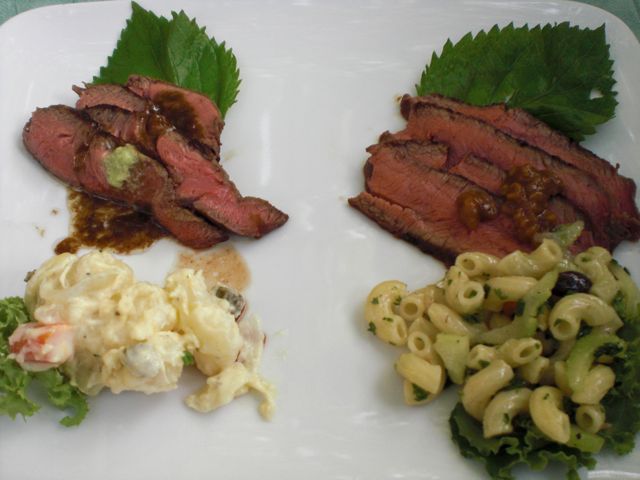
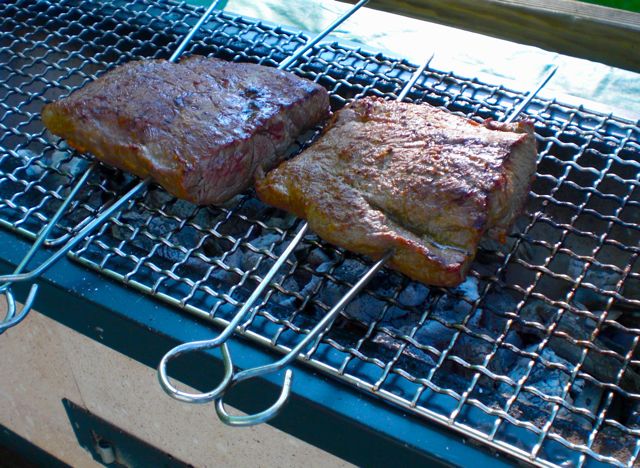
I used a somewhat unusual cut here, called Flat Iron Steak. My understanding is that this comes from upper portion of the shoulder and includes two muscle groups with a sinew in between. But this particular one came vacuum packed and only contained one kind of muscle which is easier to handle. As the name implies, it is a rather flat rectangular piece of meat. I decided to use two different Japanese marinades and cranked up our Japanese Konro grill. Both marinades are very simple; the first is wasabi soy sauce ("real" wasabi, about 1 tbs, I smeared over the meat and added enough soy sauce to coat in a Ziploc bag, the second is "moromi" miso which I again smeared over the meat and placed it in a Ziploc bag. Both were marinated about 1 hour. I removed the marinades (reserving the wasabi soy sauce) but did not wash the meat so that some marinade remained on the surface. Over the charcoal fire, I grilled them to medium rare (2-3 minutes on each sides). I put them on a plate and loosely covered with aluminum foil and let it rest for 5-7 minutes while I made a sauce. I browned the butter (1 tsp) and then added the remaining wasabi-soy sauce marinade into a small frying pan. I then added the meat juice accumulated on the plate on which the steak was resting). After heating up (1-2 minutes), I added 1 small pat of butter to finish. I sliced both steaks into thin slices across the grain of the meat. One (left) served with wasabi and the sauce I just made and the other I just add more moromi miso.
(left, wasabi-soy sauce and right, moromi-miso marinated)
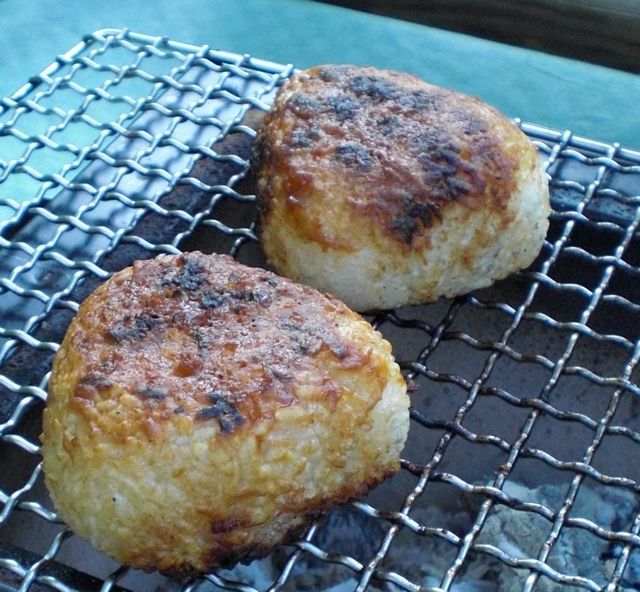
Both are good but we liked the wasabi-soy sauce steak slightly better. We had this with our potato salad and macaroni salad which also have Japanese touches--subjects for posting another time. We also made our usual grilled rice balls, this time with a "yuzu" citrus miso (Yuzu juice from a bottle, miso, mirn and some sugar). My wife said she felt virtuous because despite how very good it was she restrained herself from overeating by not going back for seconds. We had this with an excellent (surprisingly) Bordeaux blend from South Africa, "Vilafonte" 2004. This wine really went well with this dish, highly recommended if you could get one (not too expensive to boot).
Saturday, May 29, 2010
Cabbage braised in butter キャベツのバター焼き
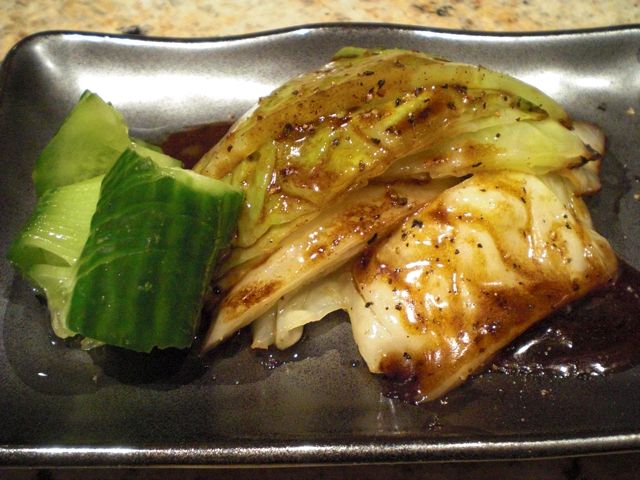
I cut 1/3 of a small head of cabbage (avoiding the core) which is then cut into three portions. I melt butter (1 tbs) in a frying pan and put in the cabbage chunks with cut side down on a medium low flame. I add salt and freshly ground black pepper to taste. I put a tightly fitting lid so that the cabbage is pan fried and steamed at the same time. Since we like cabbage to be more cooked than the original recipe will produce, I add 2-3 tbs of sake after 10 minutes or before the bottom of pan scorches and then put back the lid and continue to cook it on a slightly higher flame for another 5-6 minutes or until liquid is almost all gone. Remove the cabbage to the serving plate. Depending on how much liquid is left in the pan, I add a bit more sake to deglaze the brown bits on the bottom of the pan. I add 1 -2 tsp of soy sauce, and finish it with few pats of cold butter (less than 1 tbs). Pour the sauce over the cabbage and add freshly cracked black pepper.
This is surprisingly good. Salt and pepper flavors go well with cabbage and browned butter and soy sauce is also a winning combination. This dish will go well with any drink.
Thursday, May 27, 2010
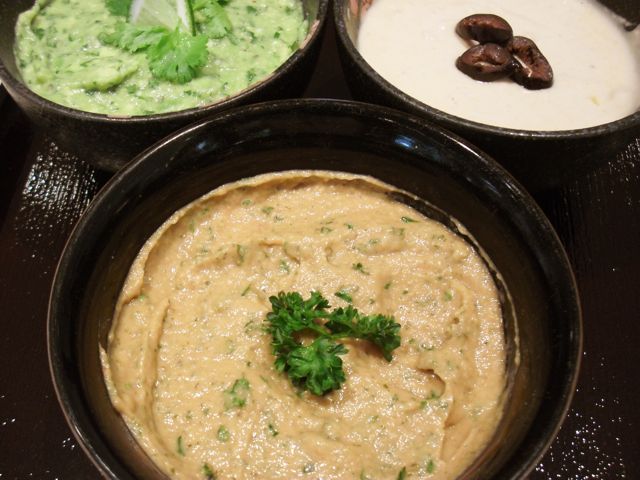
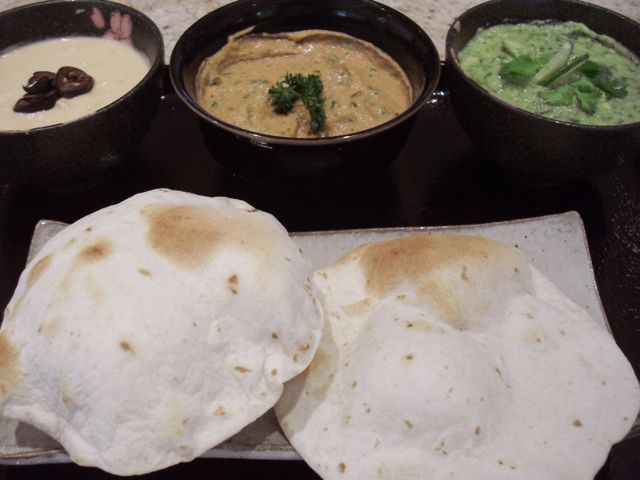
Baba Ghanoushu, Gazpacho flavored or "Baba Gazpa-nouchu" ガスパッチョ味のババガヌーシュ
Sometimes when you are trying a new recipe, things don't go right. I have less of a problem with this because I usually don't follow recipes that closely as long as I know what should be the end result. Compared to my rather free wheeling approach, my wife tends to follow recipes more precisely (which anyone in their right mind should do). She read this rather healthy sounding recipe for baked eggplant, zucchini and tomato. It was a bit complicated. The eggplant, was not the Japanese variety and needed to be peeled, sliced, salted to remove the bitterness and prebaked with olive oil. Then, the eggplant slices, zucchini, and slices of tomatoes (she used canned whole plum tomatoes) were layered in a baking dish topped with seasoned bread crumbs (panko, thyme, oregano) and repeat the layers. We thought putting the bread crumbs in the middle of the layers did not make sense but that was what the recipe called for. The resulting dish was certainly edible (good flavor) but everything was mushy and the wet bread crumbs in the middle layer were not good. My wife was extremely disappointed and ready to throw it out. But, I said, "Wait, since everything is mushy why not mush it all up and make it into a dip like babaghanoush" which is supposed to be mushy. Only difference between this dish and "Baba Ghaoushu" are the zuchini, tomato and bread crumbs (come to think of it, that is quite a difference. The only common link is the eggplant).
But that did not deter me. I just put this mixture of the baked zucchini, eggplant, tomato, and bread crumbs in the mixing cup of an immersion blender, added some lemon juice, tahini (I used Japanese white sesame paste), crushed garlic and blended it. After tasting it, I added a small amount of good extra virgin olive oil, salt, and black pepper. Finally I added finely chopped parsley for color and fresh taste. It turned out to be pretty good (and was great as a spread on sandwiches). It is sort of "Baba ghanoushu" but because of the tomato, olive oil, and bread which acted as thickener, it has the flavor profile of Gazpacho. It is a very wonderful new-age fusion dip which I henceforth named "Baba Gazpa-noushu". I also made guacamole and hummus to complete a trio of ethnically confused dips.
Tuesday, May 25, 2010
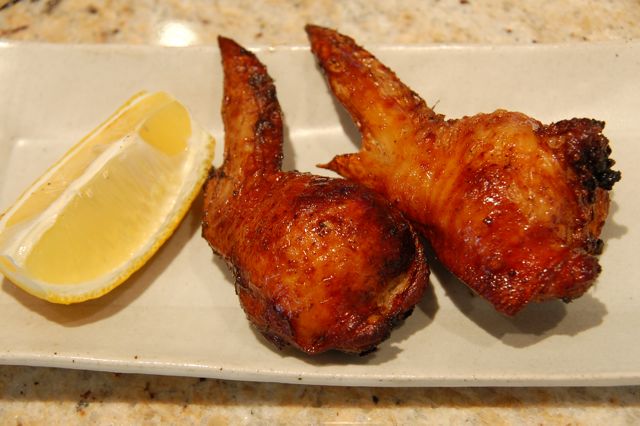
Chicken wing "Teba" Gyoza 手羽餃子
This dish must have been invented after I left Japan. It is a wonderful dish except for being rather fatty or, if I borrow the expression from the Japanese food critic who appears on Iron Chef America, "too oily". We first had this in a small Yakitori place (now defunct) run by a middle-aged husband and wife team, on a narrow alley way near the downtown "Yon-chome" 4丁目 intersection in Sapporo 札幌 some time ago while we were visiting Japan. Essentially this dish is a Japanese sausage with the skin of chicken wings as the casing. After removing the bones from the chicken wing, stuff the wing part with the pork gyoza mixture (leaving the wing tip as a handle so that you can hold it while you eat). Somehow, this dish reminds me of a "Turducken". The original recipe is to deep fry this to make it really deadly. This time, I followed the original way of cooking but I promise I will work on making this less deadly by either baking it in a high temp oven or grilling it. If I am successful you will see it in my future postings.
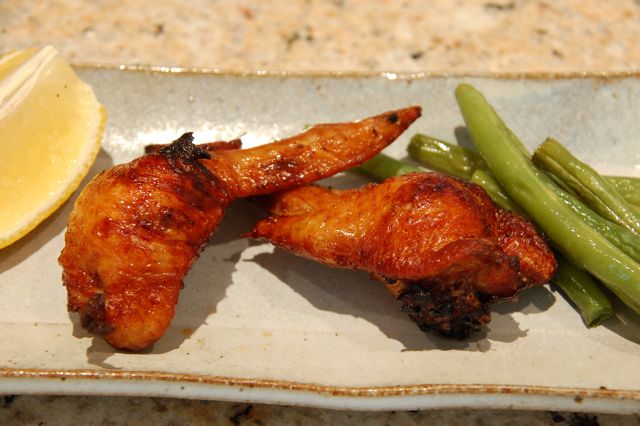
My wife made baked green beans (just coat them with olive oil, salt and black pepper and spread in one layer in the cookie sheet and bake them for 30 minutes at 350F), which is the best way to cook green beans. They become very sweet and better than boiling or steaming. So, I added the green beans as a side after I took the first picture.
Chicken wings: I remove the drummetts (use for another dish) but leave the wing tips. Using a small knife, separate the meat around the two bones (equivalent to the "ulna" and "radius", if you would like to know) and pull the skin and meat down to expose the joint. I grab the ends of the bones and rotate and wiggle until both come off the joint. Please take care not to cut or break the skin. Now you have created the pocket.
Gyoza stuffing: This is the usual pork stuffing for gyoza. I made much more than I intend to use for this dish so that I could make regular gyoza later. We happened to grow garlic chives in our herb garden, so I added that as well. As usual, I used the trimming from a pork tenderloin and, by using a chef's knife, chopped up finely into ground pork (probably 1 cup). I added chopped garlic chives (probably 3 tbs), blanched and finely chopped cabbage (4 tbs), finely chopped scallion (2 tbs), crushed garlic (1 fat clove), grated ginger (1 tsp), salt (1/2 tsp), black pepper (1/2 tsp), mirin (2 tbs), soy sauce (1 tbs), sesame oil (2-3 tbs) and knead by hand until it become nicely elastic and bound together.
Assembly and frying: Stuff the wing pocket with the gyoza mixture and close it by inserting a tooth pick through the skin at the opening. I shallow fry as usual rather than deep dry. At about 160F (I actually did not measure but used the stick-bamboo-chopsticks-in-oil method as usual) for 5-7 minutes turning several times. I took them out of the oil. I then cranked up the flame and, briefly, re-fried to make the skin crispy. I cut into the fattest one to make sure the pork is thoroughly cooked (which it was).
This dish is very good, although the skin was "oily" and could have been crispier. Since it is a type of sausage with a Japanese twist, it will go well with a cold beer but we had this with a red wine, Brookdale Cab Sauv from Napa, to counteract the effect of the fat.
Sunday, May 23, 2010
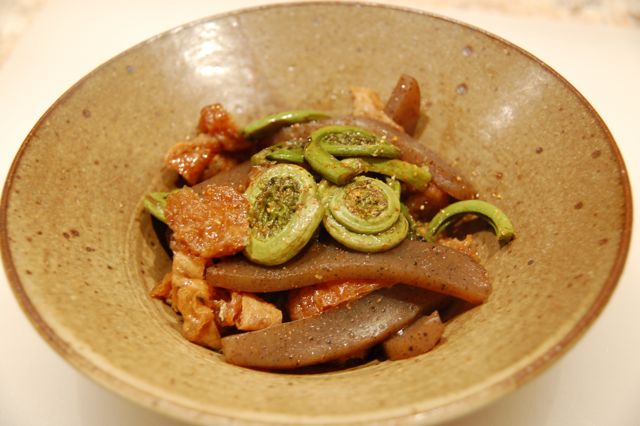
Braised Fiddlehead fern with Konnyaku and aburaage ぜんまい、コンニャク、油揚の炒め物
Japanese like to eat seasonal "Sansai" 山菜 or mountain vegetables. These are wild vegetables collected from the mountains. One of them is furled fern leaves called "Zenmai" ぜんまい (which means a spring such as those used in wind-up toys--for it's obvious resemblance) or "Warabi" 蕨 (Both are ferns but with some subtle difference). As a kid, I was not crazy about this vegetable but as you get older (as I am), you remember and get nostalgic about the food you tasted as a kid. In North America, Fiddle head fern (which is very similar to the Japanese Zenmai) is harvested (very seasonal) from the wild and eaten especially in Eastern Canada and New England. When I saw fresh Fiddle head fern in our neighborhood gourmet supermarket, I decided to make a small dish in the Izakaya food category. In its raw form, fiddle head ferns contain some toxins and need to be prepared properly before being consumed.
I wash the Fiddle head ferns well in several changes of cold running water and remove discolored ends of the stems. I boil the fern in a large amount of salted water for 5 minutes (The water browns in the first boil). I drain them in a colander, then wash in cold water. Repeat this process twice more (total of 15 minutes cooking or boiling time and three changes of water). This process is called "nikobosu" 煮こぼす (boil and drain) in the Japanese cooking parlance. After the last boiling and draining, place them in a sealed container with an ample amount of cold water. I leave it in the refrigerator overnight. Once this preparation is done, it is fairly easy to use the Fiddle head fern in a dish. I decided to make a rather rustic Izakaya or home style dish.
I am not sure how much Fiddle head ferns I had but they are just enough for two small servings (probably 15-20 heads). Devils tongue or konnyaku (alternative spelling=Konjac) 蒟蒻 (I used about half) is blanched for a few minutes and sliced into thin strips. Two aburaage 油揚げ (small koage 小揚げ or ianari 稲荷 kind) were also blanched and the water squeezed out, then cut into thin strips. I put peanut oil (1tbs) with a dash of dark sesame oil in a frying pan. When the oil was hot, I added the drained Fiddle head fern, sauteed for 1-2 minutes and added the strips of konnyuaku and aburaage and sauteed another minute or two. I added mirin (1tbs) and soy sauce (1 tbs) and Japanese 7 flavor red pepper powder 七味唐辛子 to taste and braised until the liquid was almost all gone.
I wash the Fiddle head ferns well in several changes of cold running water and remove discolored ends of the stems. I boil the fern in a large amount of salted water for 5 minutes (The water browns in the first boil). I drain them in a colander, then wash in cold water. Repeat this process twice more (total of 15 minutes cooking or boiling time and three changes of water). This process is called "nikobosu" 煮こぼす (boil and drain) in the Japanese cooking parlance. After the last boiling and draining, place them in a sealed container with an ample amount of cold water. I leave it in the refrigerator overnight. Once this preparation is done, it is fairly easy to use the Fiddle head fern in a dish. I decided to make a rather rustic Izakaya or home style dish.
The Fiddle head fern has an interesting texture and flavor. With a combination of konnyaku and aburaage and some spiciness, this is a good rustic dish but given the amount of preparation required, I am not sure if I will make this often (probably once a year).
Subscribe to:
Comments (Atom)