Thursday, February 27, 2025

Burdock Root Kelp Roll ごぼうの昆布巻き

We decided that salmon kelp rolls are not just for new year and started making it regularly.  We ususally get a half filet of a whole salmon which is much more economical per unit weight but you end up with a lot of salmon. The way I usually handle this is; 1. Scale the salmon skin, 2: Remove the belly portion (we have it as an appetizer, lightly salted and dried overnight in the refrigerator), 3. Remove flesh from the skin from the irregular pieces such as the both ends (From them I make salmon cakes), 4. Thinly slice and make Russian marinated salmon and 5. Cut into half inch buttons and make salmon kelp rolls, 6. When the salmon is particularly large, I also could make two small fillets.  This leaves a good amount of salmon skin. I cut the skin in a few inch rectangle and make them flat with a small sheet of parchment paper separating the each pieces and place them in a sealable plastic container stored in the fridge until I cook them

When I make salmon kelp rolls, I try to hydrate just the right amount of “Konbu” kelp and “Kanpyo” goard peel, but, often I have some extras. So, to use up the hydrated kelp and kanpyo, I made burdock root kelp rolls since I had burdock roots at hand.  I served this with slamon kelp roll, green beans with sesame dressing and crispy salmon skin as a starter one evening.


I did not follow any particular recipe. 

For burdock root, I just scrape the skin, cut into the length matching the width of the kelp.  Boil for 10 minutes, roll in the kelp and tie with the kanpyo. Then, I cooked them very similar to the salmon kelp rolls.

This is quite good. I seasoned it less sweet and a bit more salty than the salmon kelp rolls. It has a nice crunch.

Monday, February 24, 2025

Quesadilla with Mini-corn Tortilla and Browned Cheese

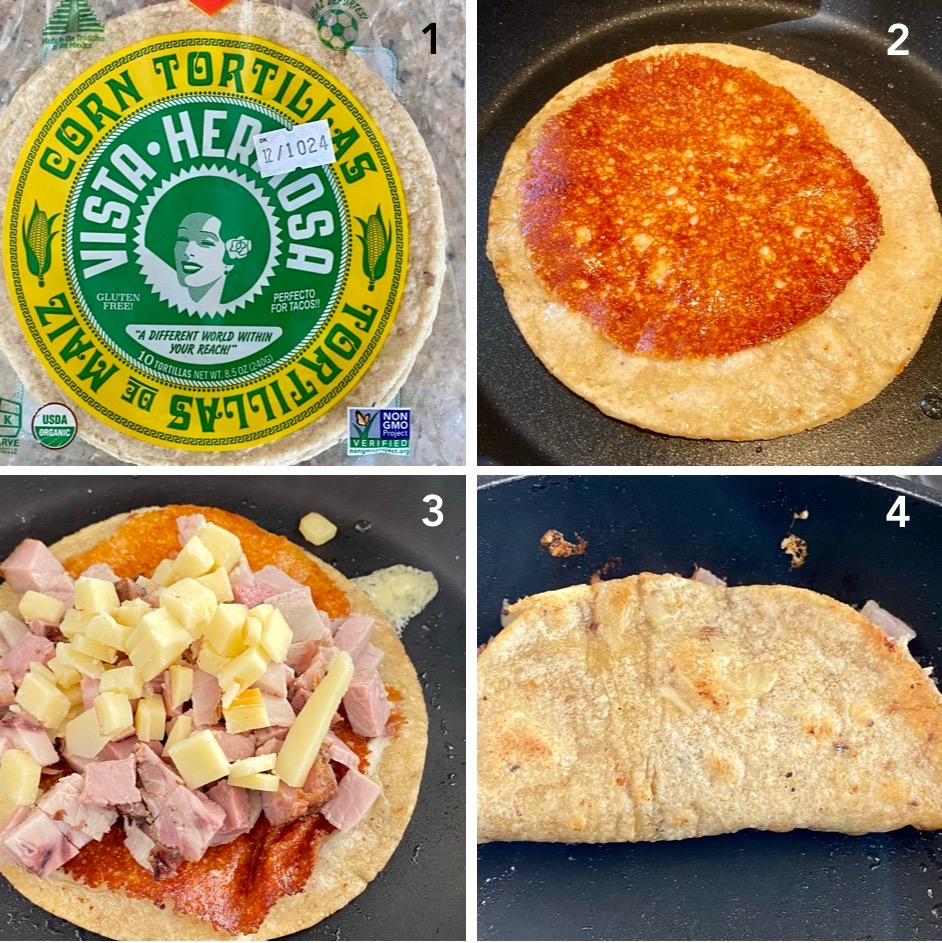
My wife really liked the mini corn tortilla we got from Whole Foods (#1 in the composite picture). Using this tortilla, last time we made something resembling “taco carnitas”.  This time, we made something resembling quesadilla with a bit of a twist.  This was inspired  by a Youtube episode in which melted and browned cheese was transferred to tortillas which were made into quesadilla. Since we made a mochi and mushroom dishes using the melted and brown cheese, it was not too difficult to transfer the browed cheese to the tortillas (#2 in the composite picture) to make our quesadilla. I added more cheese and small dices of roasted/Bbqed pork we had. I served this with guacamole I made a quick salsa (the first picture). This was a bit messy to eat. We ended up using folk and knife. This was very good the tortilla has nice corn flavor. The browned cheese layers made it better.


This is not a recipe but just a note for ourselves to remember.

Ingredients (for two mini-quesadillas)
Two mini corn tortillas (#1 in composite)
Two slices of low-moisture mozzarella cheese
Three slices each of sharp cheddar and smoke gouda cheese, cut int small dice
3-4 slices of roasted pork, cut into small dice
Guacamole
Salsa, sour cream (optional)

Directions:
In a dry no-stick frying pan in low flame, add the slice of the mozzarella cheese.
The cheese will melt and bubble and edges start browning after a few minutes
Place the tortilla on the top of the melting cheese and let it cook for one more minute (the cheese needed to be uniformly browned but it is not easy to judge)
Flip it over and the brown crispy layer of the cheese is attached (#2 in the composite picture)
Place on half of pork and cheeses (#3 in the composite picture)
When the cheeses start melting, fold the tortilla with a small spatula and press  and hold (#4)
After one more minute, carefully flip over and cook other side for one more minute.


Top it with the guac (and sour cream if using)  and the side of  salsa. This was perfect lunch for us.


Friday, February 21, 2025

Assorted Japanese Mini-pans 日本のミニ菓子パン各種

When I was browsing the Weee site, I came across an item called “assorted Japanese mini pan”. This category of Japanese “pan” bread is called “Kahi-pan” 菓子パン or sweet bread. “Kahi” 菓子 is a rather inclusive Japanese word which may mean candies, cake, sweets, or snacks. When this word is applied to bread, it is sweet bread and/or bread with sweet filling. The most classic is “anpan” アンパン in which sweet red bean paste or “an” 餡 is inside a round bun. While I was growing up in Japan, for whatever reason, my parents would not allow my brother and I to have “kashi-pan” in general. So my memories of having these sweet breads are non-existent. This changed when my wife discovered these Japanese sweet breads on one of our trips to Japan.  Thereafter, whenever we were in Japan, she had to have some for breakfast so we would stop at one of the  Japanese bakeries and buy some. She first found “melon-pan” followed by other Japanese sweet and savories. So when I told her an assortment of Japanese sweet bread was available at Weee she asked me to get it. Apparently, this comes from a small bakery in New Jersey called “Parisienne bakery” (#1 in the composite picture). Despite its name, this bakery appears to specialize in Japanese breads and pastries. In any case, the box came with 7 mini-pan.  We split one at a time as a part of our breakfast.


We can easily recognize a mini melon-pan (A). It tasted exactly same as a full sized.


“B” is, I think, “kuri-kinton” 栗きんとん filled. “kuri-kinton” is a classic “Osechi” 御節 new year’s dish made of mashed sweet potato and chestnuts (#6 in the composite). “C” is almond flavored custard cream filled (#5 in the composite). “D” is “an-pan” filled with smooth sweet red bean paste or “koshi-an” 漉餡 (completely smooth without any remnant of red beans). “E” is another “an-pan” filled with sweets red bean paste with some remnant of red beans or “tsubu-an” 粒餡 (#3 in the composite). “F” is a “kri-mu pan” クリームパン and filled with custard cream (#5 in the composite). “G” is, I believe, another classic  called “Chocolate corona or チョコレートコロナ” which is shaped like a whelk shell and filled with chocolate cream. I did not take a picture of the cut surface but the filling was almost solid milk chocolate (probably because we ket this bread in the refrigerator).


As far as I am concerned these Japanese sweet breads are pretty good and enjoyable, but in small doses. My wife, was absolutely delighted with the treat and has asked me get them again when we order groceries from Weee.

Wednesday, February 19, 2025

Ricotta Lemon Cookie リコッタチーズ レモンクッキー

I just made meat balls with Ricotta and parmesan cheeses using ground chicken instead of pork. I used only 2 tbs. from the container of ricotta. I mentioned to my wife that not only was that container open and mostly full but we were getting a back log of other ricotta cheese containers in the fridge, although luckily they hadn’t been opened. (Apparently, for some reason, every week we bought another container from the grocery store). I suggested to my wife that we should push using ricotta cheese for a while. Then, she saw the recipe of Ricotta cookies at King Arthur site. This was just what we needed and decided to make some. The original recipe used a glaze but we both agreed we did not need one. The original recipe also called for something called “ Fiori di Sicilia” which we didn’t have. But the recipe suggested micro-grated lemon zest and vanilla could be substituted for the “fiori di Sicilia” which is what she did. This turned out to be a great and not-too-sweet cookie. It has a soft consistency almost cake like rather than cookie. We had this as a part of morning breads (#1). We really liked it.


Ingredients X1
1 1/4 cups (150g) Unbleached All-Purpose Flour
1/4 cup (41g) Semolina Flour
1 teaspoon baking powder
1/4 teaspoon baking soda
1/2 teaspoon Kosher salt
6 tablespoons (85g) unsalted butter, room temperature
3/4 cup (149g) granulated sugar
1 large egg, at room temperature
1 cup (227g) ricotta cheese, whole milk
1 teaspoon Vanilla Extract
Lemon zest from one lemon (micro-grated) or 1/8 to 1/4 teaspoon Fiori di Sicilia*


Ingredients (X2)
2 1/2 cups (300g) Unbleached All-Purpose Flour 
1/2 cup (82g) Semolina Flour 
2 teaspoon baking powder 
1/2 teaspoon baking soda 
1 teaspoon Kosher salt 
12 tablespoons (170g) unsalted butter, room temperature 
1 1/2 cup (298g) granulated sugar 
2 large eggs, at room temperature 
2 cups (454g) ricotta cheese, whole milk
2  teaspoon Vanilla Extract
2 Lemon zest  (micro-grated) or 1/4 to 1/2 teaspoon Fiori di Sicilia* 


Instructions
To make the dough: Weigh your flours; or measure them by gently spooning them into a cup, then sweeping off any excess.
In a medium bowl, whisk together the flours, baking powder, baking soda, and salt. Set aside.
In a large bowl or the bowl of a stand mixer fitted with the flat beater attachment, combine the butter and sugar. Beat on medium speed until smooth, 1 to 2 minutes. (The mixture will not be lightened in color or fluffy in texture.)
Add the egg and mix until fully combined. Scrape down the sides and bottom of the bowl and beat briefly. Add the ricotta, vanilla, and Fiori di Sicilia. Briefly mix to fully combine.
Add the dry ingredients to the ricotta mixture all at once. Mix slowly until no dry floury streaks remain. Cover the bowl or transfer the dough to an airtight container and chill for at least 2 hours, or up to overnight.
When you’re ready to bake, preheat the oven to 350°F with a rack in the center. Line 2 baking sheets with parchment.
Scoop the chilled dough into generous tablespoon portions.
Place the dough balls onto the prepared baking sheets, spacing them evenly apart (about 12 dough balls per baking sheet)
Bake the ricotta cookies for 15 to 17 minutes, until the edges of the cookies just start to turn light brown.


This was a very nice cookie. It had a soft cake like texture and the lemon flavor really came through nicely  giving it a light slightly sweet flavor. It went very well with our morning coffee. That excess of ricotta cheese won’t be around for long now that we have discovered these cookies.

P.S. Out of curiosity we bought some “fiori di sicilia” flavoring and tried it out in another batch of cookies. While the resulting cookies were very different in flavor from the ones make with just the lemon zest and vanilla, they were still very good. The flavor was much less lemon but had an intriguing somewhat floral after taste. The texture of the cookie was still moist and soft like the previous batch. Next time I may add more of the flavoring to see if I can make it a bit stronger.

Thursday, February 13, 2025

Chocolate Milk Bread チョコレートミルクパン

We regularly get a catalog from the King Arthur Baking. One of them had a recipe for “chocolate milk bread”. Being a fan of Japanese milk bread, my wife decided to make it. Compared to regular milk bread, this is much more difficult to make. A direct quote from my wife: “This is the weirdest bread I’ve ever made.” The dough was especially soft and sticky having the texture of dough you would pour rather than knead. Also the instructions to mix on high speed for 20 minutes were unique. The dough did indeed get stiffer after this treatment but it was still impossible to ”fold” and “shape” as instructed. We ended up using a floured board and a baker’s scraper to form it into a loaf and placed it in a pan. It rose very high after baking but collapsed a bit after it was removed from the pan and cooled. The texture was nicely soft but chocolate flavor was muted. We like it very much but knowing the difficulty of making this, we are not sure it is worth the effort to make it again.

Note: We made a second batch of this bread and using “Common Culinary Knowledge” (CCK) we added enough flour to make a stable workable dough. We also did not knead it 20 minutes but the usual kneading time of 7-10 minutes. We also did not bother reweighing the tangzhong but used it as it came out of the pan. The resulting bread was infinitely better than the first batch and is definitely worth making again (even though no distinctly chocolate flavor comes through). 


Ingredients (X1 one loaf)
Tangzhong
2 tablespoons (11g) black cocoa
2 tablespoons (11g) Dutch- process cocoa
1 1/2 tablespoons (11g) King Arthur Unbleached Bread Flour
1/4 cup plus 1 tablespoon (70g) milk, whole preferred; cold
1/4 cup plus 1 tablespoon (70g) water, cold
1/2 tsp. King Arthur espresso powder (optional). (this brings out the taste of the chocolate

Dough
1 3/4 cups plus 1 tablespoon (219g) King Arthur Unbleached Bread Flour, plus more for dusting or to make the dough stable and useable. 
1/4 cup plus 1 tablespoon (70g) milk, whole preferred; warm (110°F)
3 tablespoons plus 1 teaspoon (41g) granulated sugar
1 1/2 tablespoons (10g) King
Arthur Baker's Special Dry Milk, optional
2 1/2 teaspoons (7g) instant yeast
scant 1 teaspoon (5g) table salt
3 tablespoons (43g) unsalted butter, melted
1 large egg, beaten; divided
Scant 1/2 cup (75g) semisweet chocolate chips

Ingredients (X2) (Why make just one loaf when you can make 2 ?) We made 2 loaves
Tangzhong
4 tablespoons (22g) black cocoa
4 tablespoons (22g) Dutch- process cocoa
3 tablespoons (22g) King Arthur Unbleached Bread Flour
1/2 cup plus 2 tablespoons (140g) milk, whole preferred; cold
1/2 cup plus 2 tablespoon (140g) water, cold
1 tsp. King Arthur espresso powder (optional). (this brings out the taste of the chocolate)

Dough
3 1/2 cups plus 2 tablespoons (438g) King Arthur Unbleached Bread Flour (or however more is needed to make the dough stable and useable.  
1/2 cup plus 2 tablespoons (140g) milk, whole preferred; warm (110°F)
6 tablespoons plus 2 teaspoon (82g) granulated sugar
3 tablespoons (20g) Dry Milk, optional
5 teaspoons (14g) instant yeast
2 teaspoons (10g) table salt
6 tablespoons (86g) unsalted butter, melted
2 large eggs, beaten;
Scant 1 cup (140g) semisweet chocolate chips (we didn’t use this)

Directions:
To make the tangzhong: In a small saucepan, whisk the cocoas, flour, milk, and water until no lumps remain. Over low heat, bring the mixture to a boil, whisking constantly, until the mixture looks glossy and thickened to the consistency of hot fudge sauce, 3 to 6 minutes. Transfer the tangzhong to the bowl of a stand mixer; it will weigh about 145g after cooking (or 284 if doubling the recipe). If your tangzhong is more than 155g, (or 310g when doubling the recipe) return it to the pot and cook it a bit longer. (We did not bother to do this with the second batch and the bread turned out just fine.)

To make the dough: Add the flour, milk, sugar, milk powder, yeast, salt, butter, and egg to the bowl of a stand mixer. Add the cooled tangzhong.

Using the dough hook, mix on medium-low speed adding additional flour as needed until a soft, sticky workable dough forms, scraping down the bowl as necessary. Increase the speed to medium-high and continue mixing until the dough almost clears the sides of the bowl (it will stick to the sides for much of the mixing time) and is smooth and elastic, 15 to 20 minutes total (We did not do this with the second batch we made, 7-10 minutes worked just fine). Every few minutes, scrape down the sides and bottom of the bowl, then continue mixing. Eventually the dough will strengthen enough to mostly pull away from the sides of the bowl; the dough will still be slightly sticky but significantly more manageable than it was before. Transfer the dough to a lightly greased bowl, cover, and let it rise until puffy and doubled in bulk, 1 to 1 1/2 hours.

Lightly grease an 8 1/2" x 4 1/2" loaf pan or 9" x 4" Pullman loaf pan with nonstick spray or vegetable oil.
Use a bowl scraper to gently ease the dough out of the bowl onto a lightly floured work surface. Gently form the dough into two loaves. (At this point the original recipe gave complex instructions on how to fold the dough into various squares, which, given the consistency of the dough was quite impossible. It held together but was more a pouring consistency. (#1) Forming it into loaves was the best we could do.) (#2) Cover and let the loaf rise until it just crests over the rim of the pan, 45 to 90 minutes, depending on the temperature of your kitchen. (#3) (If using a 9" x 4" pan, let the dough rise until it's about 1" below the top of the pan.)


Towards the end of the rising time, preheat the oven to 350 degrees F. Bake the chocolate milk bread for 30 to 35 minutes, until the loaf is fragrant, the top crust is firm, and the internal temperature is at least 190°F. Remove the loaf from the oven and cool briefly in the pan before turning it out onto a rack to cool completely.

The loaf was so soft that when we turned it out it started collapsing on itself (# 4) and we had to cool it on its side. Nonetheless once it cooled it stabilized and the soft texture was very nice. (maybe we should leave it in the pan longer before turning it out). There was almost no flavor of chocolate. We ate it for breakfast lightly toasted with butter. It is good we made this bread because it makes our library of Japanese milk breads (to the extent we know of it) complete. But there are various of the other versions we would choose to make before doing this one again.

P.S. Turns out that over time this bread has gotten better. A nice very subtle chocolate flavor has moved to the fore. The texture has also gotten firmer